Experimental Techniques
Lerne es beim Spielen
Beantworte diese Fragen für Energie, dann angle und erkunde. Kein Konto nötig.
Lektionsnotizen
Apparatus for Measurements
- Time is measured using a stopwatch or stopclock, accurate to 1 or 2 decimal places; units are seconds or minutes.
- Temperature is measured with a thermometer (precision ±0.5 °C) or digital temperature probe (reads to 0.1 °C).
- Mass is measured using a digital balance (reads to 2 decimal places); always tare (zero) before use.
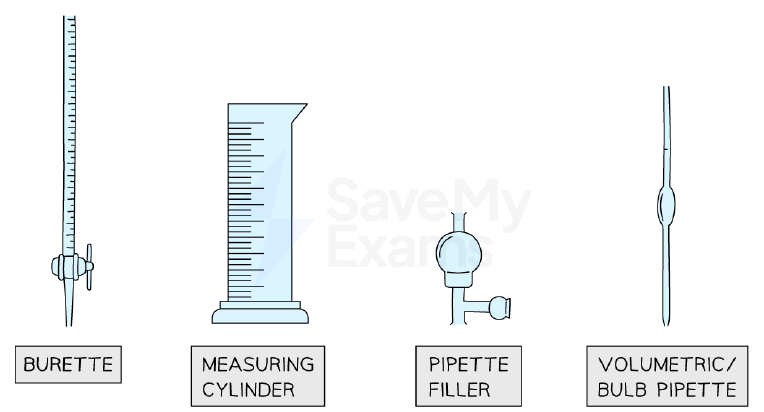
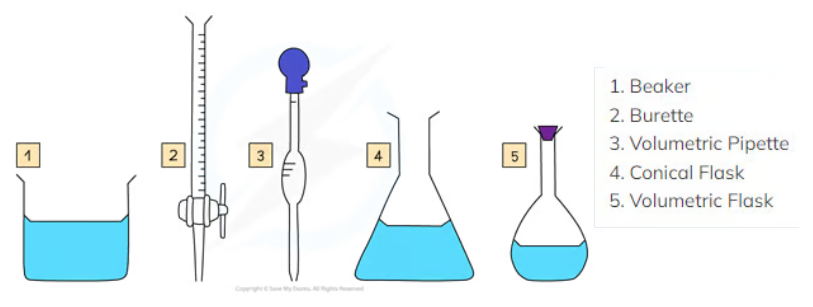
- Volume of liquid is measured with burettes (most accurate for variable volumes, 0–50 cm³), volumetric pipettes (most accurate for fixed volumes, e.g. 25 cm³), or measuring cylinders (for approximate volumes).
- Volume of gas is measured using a gas syringe (more precise) or downward displacement of water (not for soluble gases).
- Read the bottom of the meniscus for accurate liquid volume readings; burette scale reads 0.00 cm³ at the top.
Apparatus for measuring volume
Solutions Terminology
- Solvent: the liquid in which a solute dissolves (e.g., water in seawater).
- Solute: the substance that dissolves (e.g., salt in seawater).
- Solution: the mixture formed when a solute dissolves in a solvent (e.g., seawater).
- Saturated solution: contains the maximum concentration of solute at a given temperature.
- Soluble: a substance that will dissolve (e.g., salt in water).
- Insoluble: a substance that will not dissolve (e.g., sand in water).
- Filtrate: the liquid that passes through a filter (e.g., fresh coffee in a cup).
- Residue: the substance left after filtration, evaporation, or distillation (e.g., coffee grounds).
Acid-Base Titrations: Purpose & Apparatus
- Titrations determine the concentration of an acid or alkali by neutralisation.
- They can also be used to prepare salts.
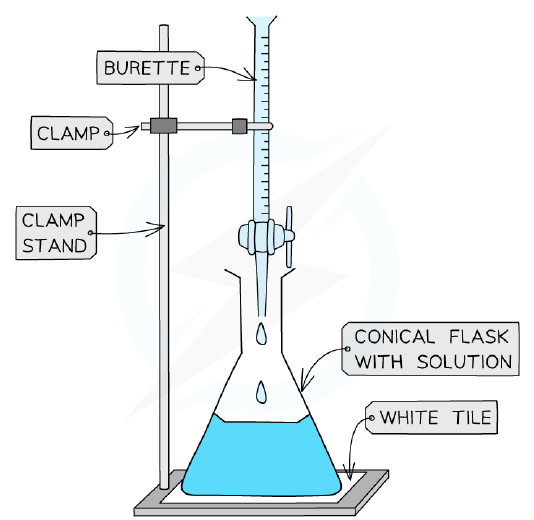
- Key apparatus: 25 cm³ volumetric pipette, pipette filler, 50 cm³ burette, 250 cm³ conical flask, small funnel, white tile, clamp stand.
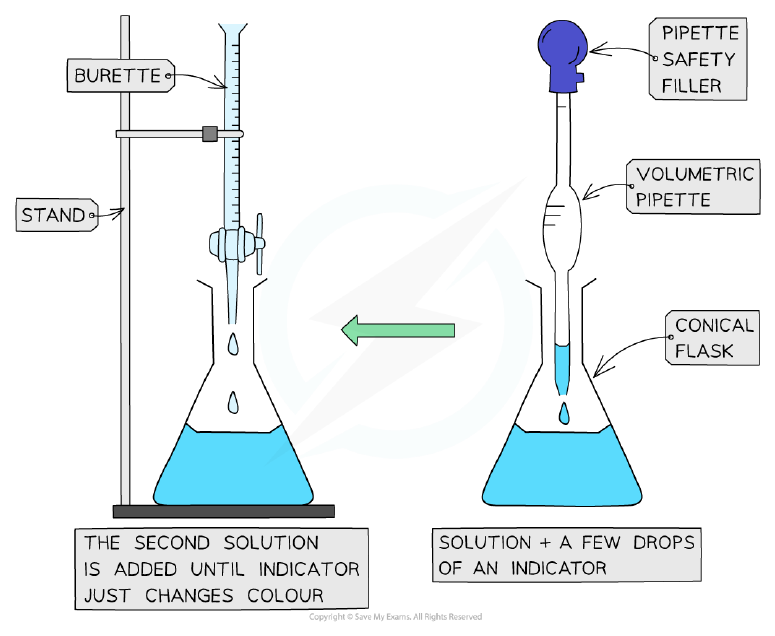
- A suitable indicator (e.g., methyl orange or phenolphthalein) is used to show the endpoint.
Titration apparatus set-up
Titration Method
- 1. Use a pipette to transfer exactly 25 cm³ of alkali into a conical flask.
- 2. Fill the burette with acid using a funnel; run a little through the tap to remove air bubbles.
- 3. Record the initial burette reading to the nearest 0.05 cm³.
- 4. Place the flask on a white tile; add a few drops of indicator.
- 5. Perform a rough titration by adding acid in 1–3 cm³ portions while swirling.
- 6. Near the endpoint, add acid drop by drop until a sharp colour change occurs.
- 7. Record the final burette reading; calculate the titre (volume added).
- 8. Repeat until two concordant results (within 0.1 cm³) are obtained.
Adding indicator and titrating to the endpoint
Common Indicators
- Methyl orange: red in acid, yellow in alkali, orange at neutral.
- Phenolphthalein: colourless in acid, pink in alkali, colourless at neutral.
- Litmus: red in acid, blue in alkali, purple at neutral (not suitable for titrations due to gradual change).
- Thymolphthalein: colourless in acid, blue in alkali.
Common Titration Errors
- Not removing the funnel from the burette – can cause extra liquid to drip in, giving false high readings.
- Not filling the jet space (the part below the tap) – leads to inaccurate volume measurements.
- Reading the burette incorrectly – always read from the bottom of the meniscus; scale is 0.0 cm³ at top.
- Using a wide-range indicator (e.g., litmus) – does not give a sharp colour change at the endpoint.
Advantages & Disadvantages of Apparatus
- Temperature probe: more precise, easy to automate, but can be corroded and expensive.
- Volumetric pipette: accurate fixed volume, but harder to use and only one volume.
- Gas syringe: easy to set up, keeps gas dry, but can stick, limited volume, fragile.
- Microscale experiments: less wasteful, safer, but hard to observe and product loss in purification.
Planning an Experiment
- Choose apparatus suitable for the required accuracy and volume.
- Ensure the method allows for repeat readings and concordant results.
- Consider safety, waste, and time constraints.
- Check that the range of measurements is appropriate for the investigation.
Common apparatus for measuring liquid volume
Folien
Sign up free to view the lesson slides
Step through every slide for this topic — plus flashcards and revision notes — with a free account.
Übungsfragen
Gratis-Vorschau — 8 von 46 Fragen. Registriere dich, um alle zu sehen.
1.Which piece of apparatus is most accurate for measuring a variable volume of liquid between 0 cm³ and 50 cm³?
Easy- ABurette
- BMeasuring cylinder
- CVolumetric pipette
- DBeaker
2.Which term describes the liquid in which a solute dissolves?
Easy- ASolvent
- BSolute
- CSolution
- DFiltrate
3.What is the substance that remains on the filter paper after filtration called?
Easy- AResidue
- BFiltrate
- CSolute
- DSolution
4.Which indicator is suitable for an acid-base titration?
Easy- AMethyl orange
- BLitmus solution
- CUniversal indicator
- DRed litmus paper
5.A student needs to measure exactly 25.0 cm³ of sodium hydroxide for a titration. Which apparatus is most appropriate?
Easy- AVolumetric pipette
- BMeasuring cylinder
- CBurette
- DBeaker
6.Which of the following is a correct step in performing a titration?
Medium- AAdd indicator before measuring the alkali
- BFill the burette with the solution to be added
- CRecord the final burette reading before the endpoint
- DUse a beaker to measure the alkali
7.A student investigates the rate of reaction between marble chips and hydrochloric acid by measuring the volume of carbon dioxide produced. Which equipment is essential?
Medium- AGas syringe, conical flask, bung, delivery tube
- BGas syringe, cotton wool, bung, delivery tube
- CGas syringe, beaker, bung, balance
- DBalloon, conical flask, stopper, balance
8.What is the colour of methyl orange in an alkaline solution?
Easy- AYellow
- BRed
- COrange
- DPink
Unlock all 46 questions & more
Erstelle ein Gratis-Konto, um alle Fragen, Folien, Karteikarten und Lernnotizen zu diesem Thema zu sehen.