Preparation Of Salts
Lerne es beim Spielen
Beantworte diese Fragen für Energie, dann angle und erkunde. Kein Konto nötig.
Lektionsnotizen
What is a Salt?
- A salt is a compound formed when the hydrogen atom in an acid is replaced by a metal or ammonium ion.
- Example: Replacing H in HCl with K gives KCl (potassium chloride).
- The name of a salt has two parts: first part from the metal/metal oxide/carbonate, second part from the acid.
- Hydrochloric acid produces chlorides; sulfuric acid produces sulfates; nitric acid produces nitrates.
Solubility Rules
- All sodium, potassium, and ammonium salts are soluble.
- All nitrates are soluble.
- Most chlorides are soluble except silver chloride and lead(II) chloride.
- Most sulfates are soluble except barium sulfate, calcium sulfate, and lead(II) sulfate.
- Most carbonates are insoluble except those of sodium, potassium, and ammonium.
- Most hydroxides are insoluble except those of sodium, potassium, and ammonium (calcium hydroxide is sparingly soluble).
Solubility of common salts
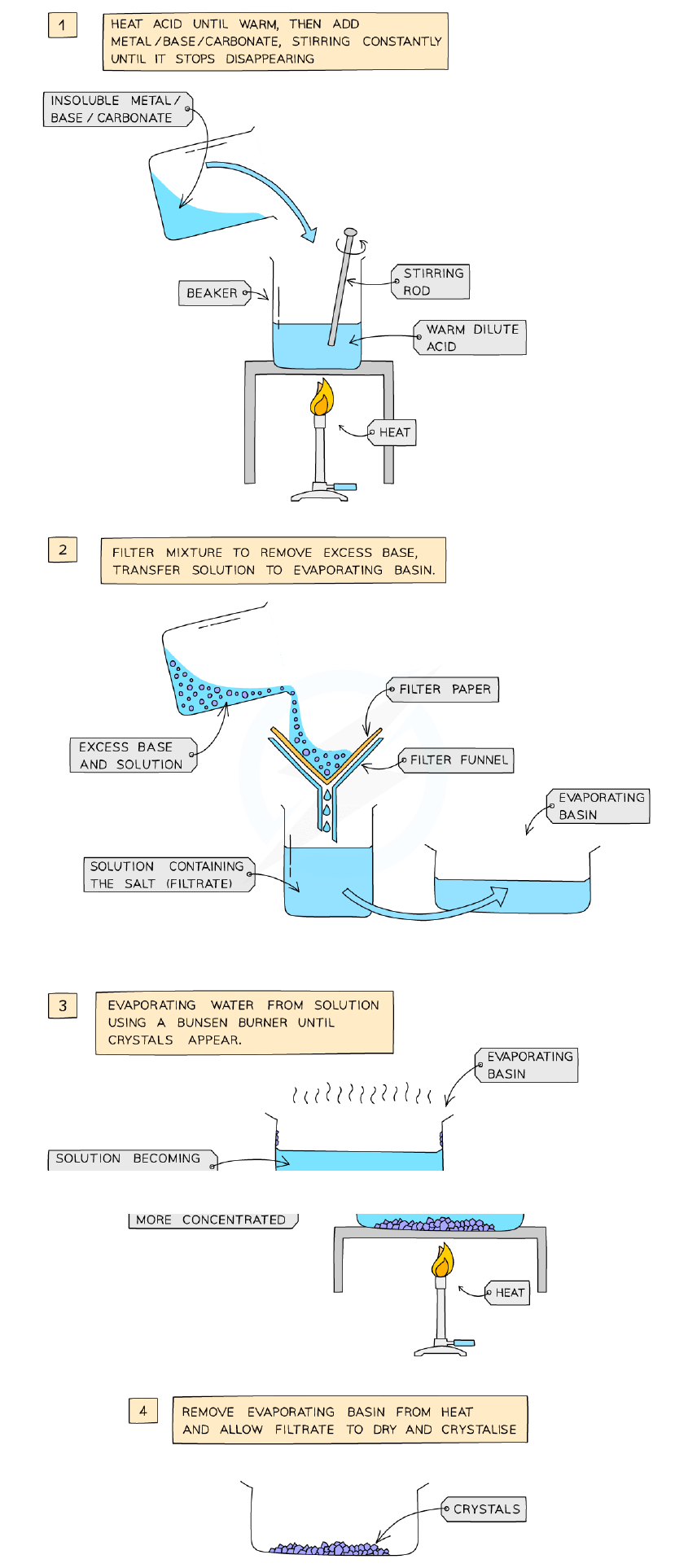
Preparing Soluble Salts – Method A (Excess Solid)
- Use excess solid reactant (metal, insoluble base, or insoluble carbonate) with dilute acid.
- Add solid until no more reacts, indicating excess.
- Filter to remove unreacted solid; the filtrate is the salt solution.
- Evaporate the filtrate gently until saturated (test with cold glass rod – crystals form).
- Crystallise by leaving in a warm place, then decant excess liquid and dry crystals with filter paper.
- Example (metal): Mg + H₂SO₄ → MgSO₄ + H₂.
- Example (insoluble base): CuO + H₂SO₄ → CuSO₄ + H₂O.
- Example (insoluble carbonate): CaCO₃ + 2HCl → CaCl₂ + CO₂ + H₂O.
Preparing a soluble salt by the excess solid method
Preparing Soluble Salts – Method B (Titration)
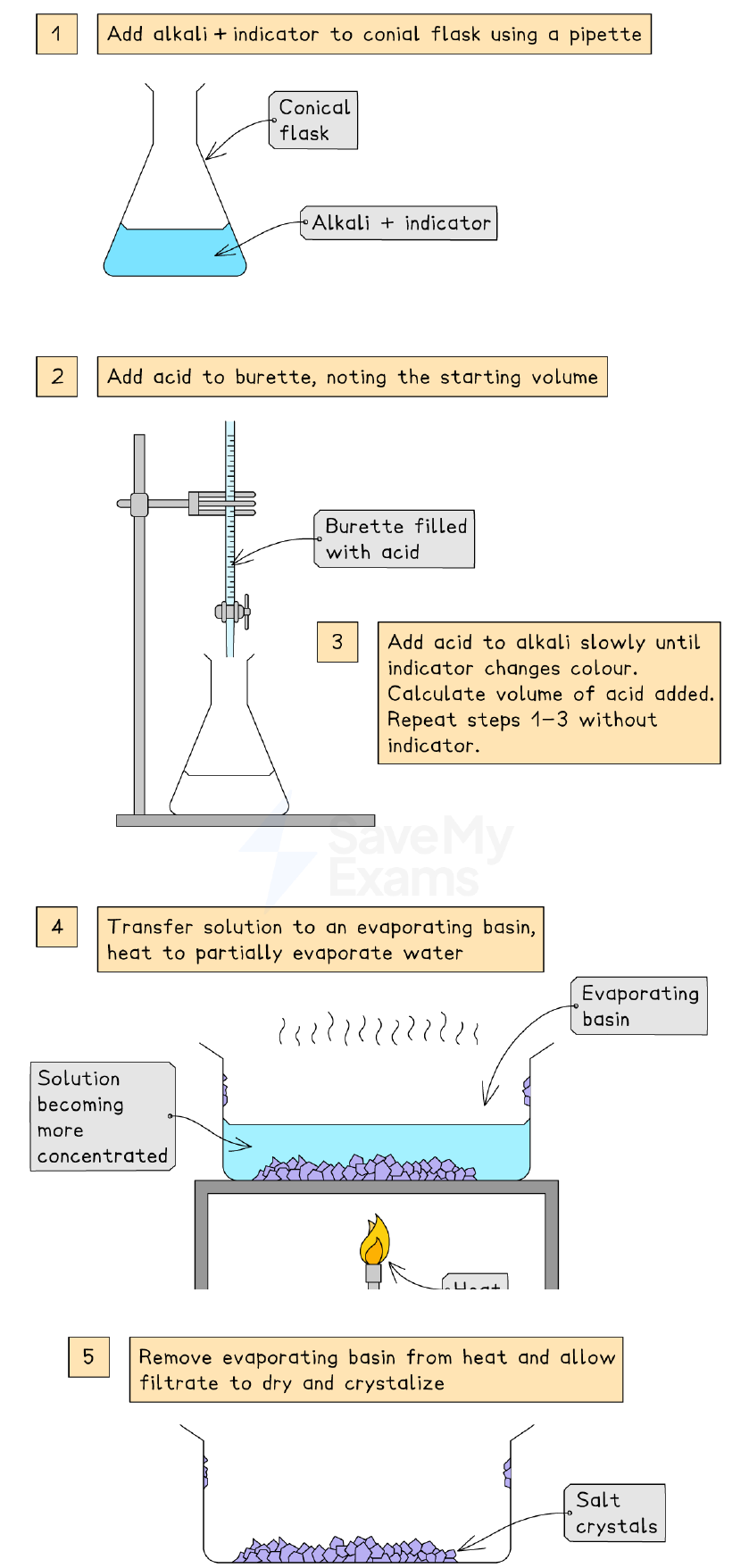
- Use titration when the base is soluble (alkali).
- Pipette a known volume of alkali into a conical flask, add a few drops of indicator (e.g., phenolphthalein).
- Fill a burette with acid, add slowly while swirling until the indicator changes colour (end point).
- Repeat without indicator using the same volumes to obtain a neutral solution.
- Evaporate, crystallise, decant, and dry the crystals as in Method A.
- Example: NaOH + HCl → NaCl + H₂O.
Preparing a soluble salt by titration
Preparing Insoluble Salts (Extended Tier)
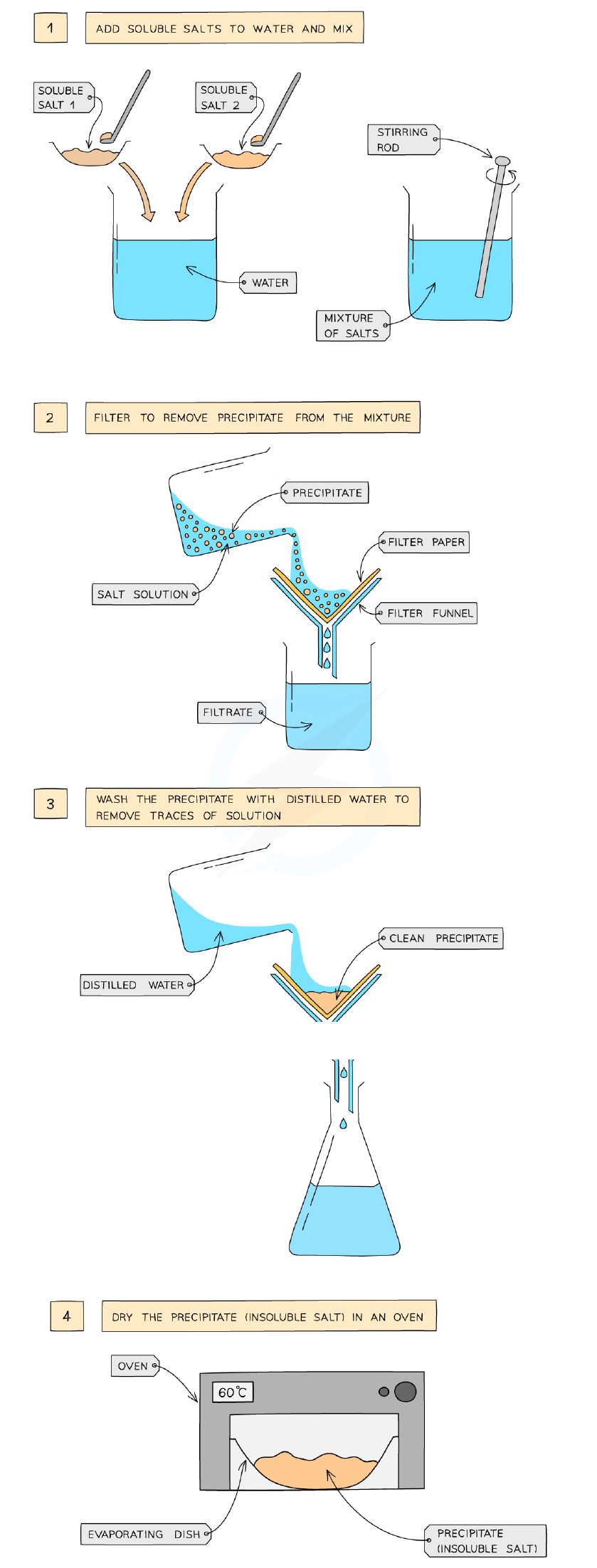
- Insoluble salts are prepared by precipitation.
- Mix aqueous solutions of two soluble salts that react to form the insoluble salt (precipitate).
- Filter to collect the precipitate.
- Wash the precipitate with distilled water to remove soluble impurities.
- Dry the solid (e.g., in a warm oven).
- Example: Pb(NO₃)₂(aq) + K₂SO₄(aq) → PbSO₄(s) + 2KNO₃(aq).
Preparing an insoluble salt by precipitation
Hydrated & Anhydrous Salts
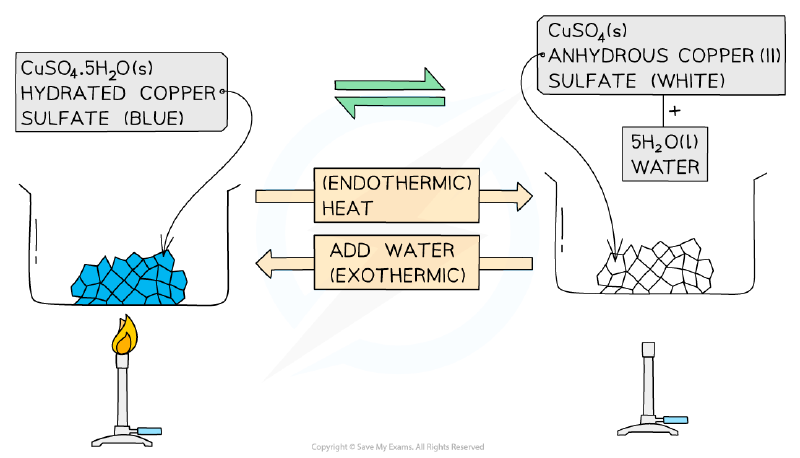
- Hydrated salts contain water of crystallisation within their structure (e.g., CuSO₄·5H₂O, blue).
- Anhydrous salts contain no water (e.g., CuSO₄, white).
- Heating a hydrated salt drives off water of crystallisation, forming the anhydrous salt.
- Adding water to an anhydrous salt rehydrates it (reversible reaction).
- Water of crystallisation is shown in the formula with a dot: e.g., CoCl₂·6H₂O.
Dehydration of hydrated copper(II) sulfate
Folien
Sign up free to view the lesson slides
Step through every slide for this topic — plus flashcards and revision notes — with a free account.
Übungsfragen
Gratis-Vorschau — 8 von 45 Fragen. Registriere dich, um alle zu sehen.
1.When solid sodium chloride is mixed with water, sodium chloride solution forms. What name is given to the process of mixing a solid with water to form a solution?
Easy- ACrystallising
- BDiluting
- CDissolving
- DMelting
2.Which salt is insoluble in water?
Easy- ASodium chloride
- BPotassium nitrate
- CSilver chloride
- DAmmonium sulfate
3.A student reacts excess iron powder with sulfuric acid to prepare iron(II) sulfate. How would the student know when all the sulfuric acid has reacted?
Medium- ANo more gas is produced and the mixture becomes neutral
- BThe solution turns blue
- CThe iron powder dissolves completely
- DA precipitate forms
4.Lead(II) sulfate is prepared by mixing aqueous lead(II) nitrate and aqueous potassium sulfate. What is the state symbol for lead(II) sulfate in the equation?
Easy- A(aq)
- B(s)
- C(l)
- D(g)
5.What is the name of the salt formed when magnesium oxide reacts with sulfuric acid?
Easy- AMagnesium sulfate
- BMagnesium sulfide
- CMagnesium sulfite
- DMagnesium oxide
6.In the preparation of a soluble salt using an excess solid method, what is the purpose of adding the solid in excess?
Medium- ATo increase the rate of reaction
- BTo ensure all the acid reacts
- CTo produce more salt crystals
- DTo make the solution saturated
7.Which method should be used to prepare a soluble salt from a soluble base (alkali) and an acid?
Medium- AExcess metal method
- BExcess insoluble base method
- CTitration method
- DPrecipitation method
8.Hydrated copper(II) sulfate is blue. When heated, it turns white. What is the white substance?
Easy- AAnhydrous copper(II) sulfate
- BHydrated copper(II) sulfate
- CCopper(II) oxide
- DCopper metal
Unlock all 45 questions & more
Erstelle ein Gratis-Konto, um alle Fragen, Folien, Karteikarten und Lernnotizen zu diesem Thema zu sehen.