Redox
Lerne es beim Spielen
Beantworte diese Fragen für Energie, dann angle und erkunde. Kein Konto nötig.
Lektionsnotizen
Oxidation & Reduction (Oxygen Definition)
- Oxidation is the gain of oxygen by an element or compound.
- Reduction is the loss of oxygen from an element or compound.
- A redox reaction is one where oxidation and reduction occur simultaneously.
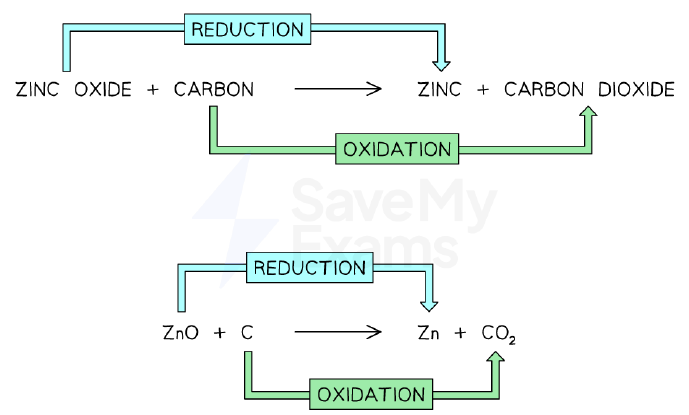
- Example: ZnO + C → Zn + CO – zinc oxide is reduced (loses O), carbon is oxidised (gains O).
Reduction and oxidation shown for zinc oxide + carbon
Oxidation & Reduction (Electron Definition – Extended)
- Oxidation is the loss of electrons; reduction is the gain of electrons (OIL RIG).
- Oxidation increases the oxidation number; reduction decreases it.
- Half-equations show electron transfer: e.g., Ag → Ag⁺ + e⁻ (oxidation); O₂ + 4e⁻ → 2O²⁻ (reduction).
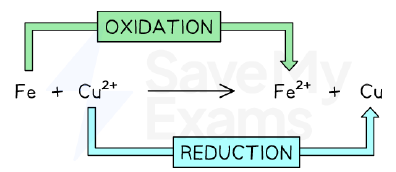
- Example: Fe + Cu²⁺ → Fe²⁺ + Cu – Fe loses electrons (oxidised), Cu²⁺ gains electrons (reduced).
Redox reaction between Fe and Cu2+ shown by electron transfer
Oxidation Numbers & Roman Numerals
- Oxidation number (state) shows the charge an atom would have if electrons were completely transferred.
- Roman numerals in names indicate oxidation number: e.g., iron(II) = Fe²⁺, iron(III) = Fe³⁺.
- Rules: uncombined elements = 0; monatomic ion = its charge; sum in compound = 0; sum in ion = charge.
- Group 1 always +1, Group 2 always +2, F always –1, H usually +1, O usually –2.
Bohr model of iron atom showing electron shells. Iron can lose 2 electrons (Fe²⁺) or 3 electrons (Fe³⁺), corresponding to oxidation numbers +2 and +3.
Identifying Redox Reactions by Colour Changes
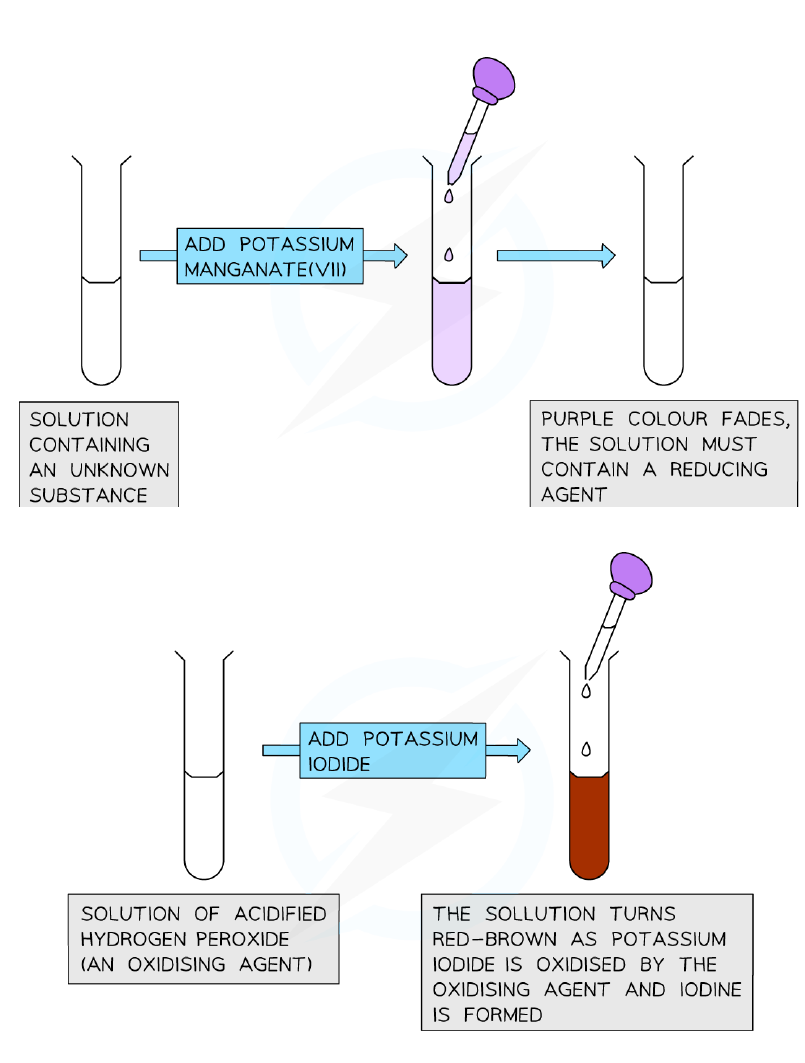
- Potassium manganate(VII) (KMnO₄) is a purple oxidising agent; with a reducing agent it turns colourless.
- Potassium iodide (KI) is a colourless reducing agent; with an oxidising agent it turns red-brown (I₂ formed).
- These colour tests are used to detect oxidising or reducing agents.
Colour-change tests for oxidising and reducing agents
Oxidising & Reducing Agents (Extended)
- An oxidising agent oxidises another substance and is itself reduced (gains electrons).
- A reducing agent reduces another substance and is itself oxidised (loses electrons).
- Common oxidising agents: O₂, Cl₂, KMnO₄, H₂O₂. Common reducing agents: C, H₂, KI.
- Example: CuO + H₂ → Cu + H₂O – CuO is oxidising agent (reduced), H₂ is reducing agent (oxidised).
Displacement Reactions & Redox
- In displacement reactions, the more reactive metal loses electrons (oxidised) and the less reactive metal ion gains electrons (reduced).
- Example: Fe + CuSO₄ → FeSO₄ + Cu – Fe is oxidised, Cu²⁺ is reduced.
- Ionic equation: Fe + Cu²⁺ → Fe²⁺ + Cu.
Half-Equations & Balancing (Extended)
- Half-equations show either oxidation or reduction separately with electrons.
- Oxidation half: atoms/ions lose electrons (e.g., Ni → Ni²⁺ + 2e⁻).
- Reduction half: atoms/ions gain electrons (e.g., Ni³⁺ + e⁻ → Ni²⁺).
- Balance atoms and charge: e.g., O₂ + 4e⁻ → 2O²⁻.
Extraction of Metals & Redox
- Carbon is used to reduce metal oxides (e.g., ZnO + C → Zn + CO).
- The metal oxide is reduced (loses oxygen), carbon is oxidised (gains oxygen).
- Metals below carbon in the reactivity series can be extracted by reduction with carbon.
Folien
Sign up free to view the lesson slides
Step through every slide for this topic — plus flashcards and revision notes — with a free account.
Übungsfragen
Gratis-Vorschau — 8 von 55 Fragen. Registriere dich, um alle zu sehen.
1.In terms of oxygen, what is oxidation?
Easy- AGain of oxygen
- BLoss of oxygen
- CLoss of electrons
- DGain of electrons
2.In terms of oxygen, what is reduction?
Easy- ALoss of oxygen
- BGain of oxygen
- CLoss of electrons
- DGain of electrons
3.What is a redox reaction?
Easy- AA reaction where oxidation and reduction occur simultaneously
- BA reaction where only oxidation occurs
- CA reaction where only reduction occurs
- DA reaction where no electron transfer occurs
4.In the reaction ZnO + C → Zn + CO, which substance is reduced?
Easy- AZinc oxide (ZnO)
- BCarbon (C)
- CZinc (Zn)
- DCarbon monoxide (CO)
5.In terms of electron transfer, oxidation is the:
Easy- ALoss of electrons
- BGain of electrons
- CGain of oxygen
- DLoss of oxygen
6.What is the oxidation number of iron in iron(III) oxide (Fe₂O₃)?
Easy- A+3
- B+2
- C-3
- D0
7.Which change in oxidation number indicates that the species has been reduced?
Easy- ADecrease from +3 to +2
- BIncrease from 0 to +2
- CIncrease from -1 to 0
- DNo change
8.In the reaction Cl₂ + 2KI → 2KCl + I₂, which species is reduced?
Medium- AChlorine (Cl₂)
- BPotassium iodide (KI)
- CIodine (I₂)
- DPotassium chloride (KCl)
Unlock all 55 questions & more
Erstelle ein Gratis-Konto, um alle Fragen, Folien, Karteikarten und Lernnotizen zu diesem Thema zu sehen.