Diffusion Osmosis And Active Transport
Lerne es beim Spielen
Beantworte diese Fragen für Energie, dann angle und erkunde. Kein Konto nötig.
Lektionsnotizen
Diffusion
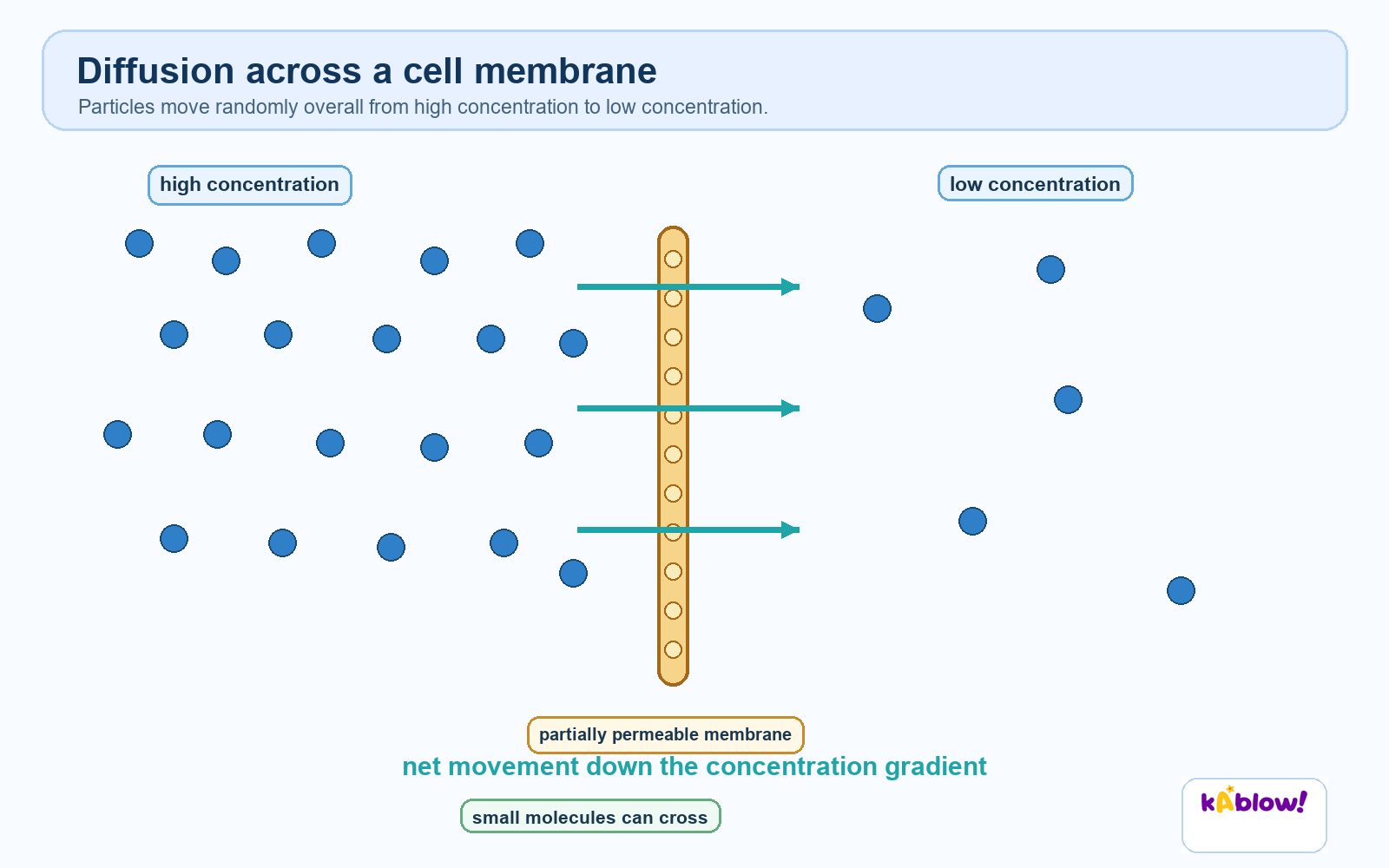
- Diffusion is the net movement of molecules from a region of higher concentration to a region of lower concentration (down a concentration gradient).
- Movement occurs due to the random motion (Brownian motion) of particles; energy comes from their kinetic energy.
- The cell membrane is partially permeable – it allows some molecules to cross easily but restricts others (e.g., based on size).
- Diffusion helps organisms obtain requirements (e.g., oxygen, carbon dioxide) and remove waste products (e.g., carbon dioxide).
- Examples: oxygen diffusing into cells for respiration; carbon dioxide diffusing out of cells; carbon dioxide diffusing into leaf cells for photosynthesis.
Diffusion across the cell membrane
Factors that Influence Diffusion
- Surface area to volume ratio: larger surface area speeds up diffusion; cells like root hair cells and ileum cells have folded surfaces to increase area.
- Distance: shorter distance increases rate; e.g., capillary and alveolus walls are one cell thick.
- Temperature: higher temperature gives particles more kinetic energy, increasing diffusion rate.
- Concentration gradient: steeper gradient increases rate because more collisions occur on the high-concentration side.
Osmosis
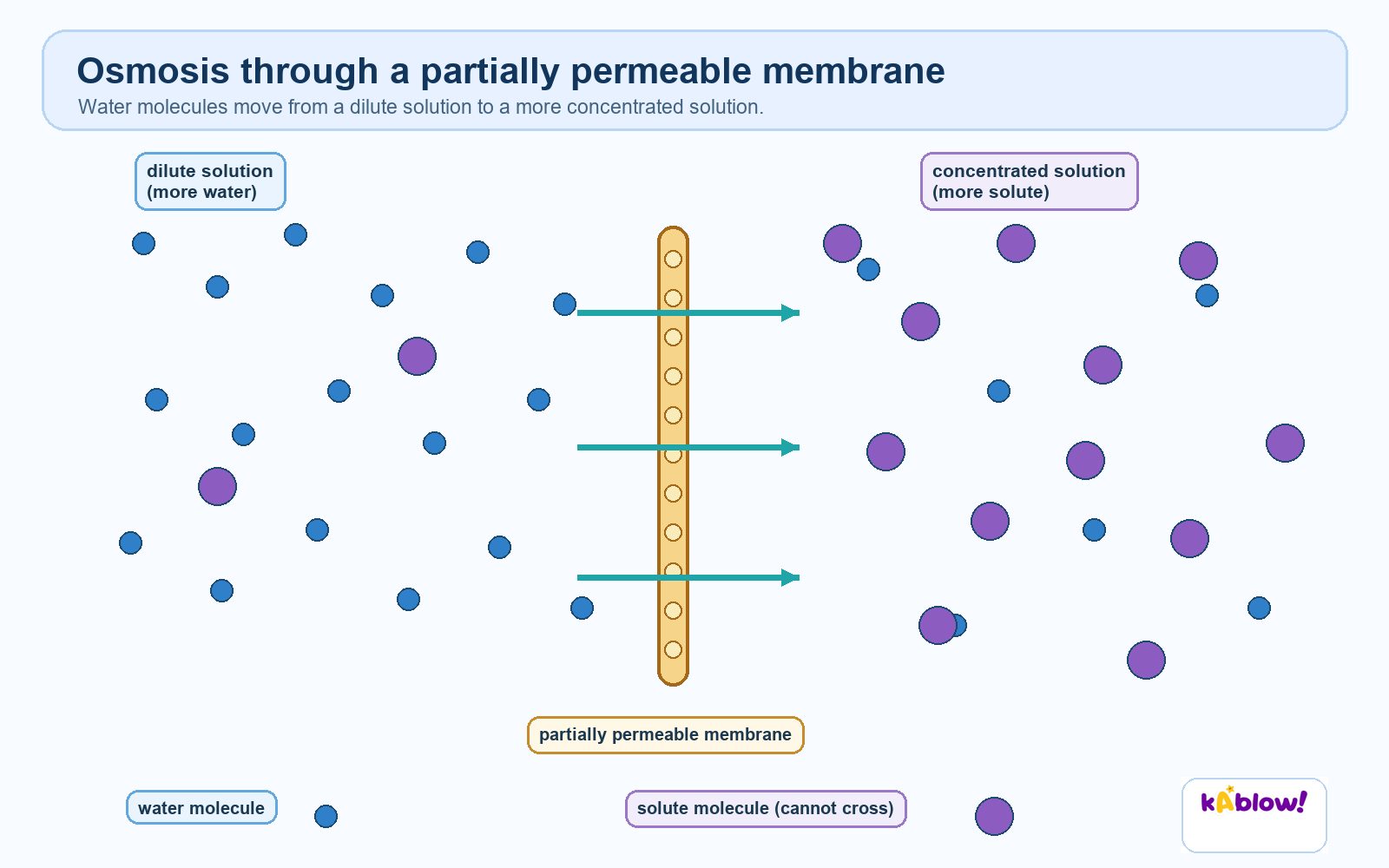
- Osmosis is the diffusion of water molecules from a dilute solution (high water potential) to a concentrated solution (low water potential) across a partially permeable membrane.
- Water moves down its concentration gradient; the membrane allows small water molecules through but not larger solute molecules.
- Water potential describes the tendency of water to move: dilute solutions have high water potential; concentrated solutions have low water potential.
Osmosis and the partially permeable membrane
Osmosis Experiments
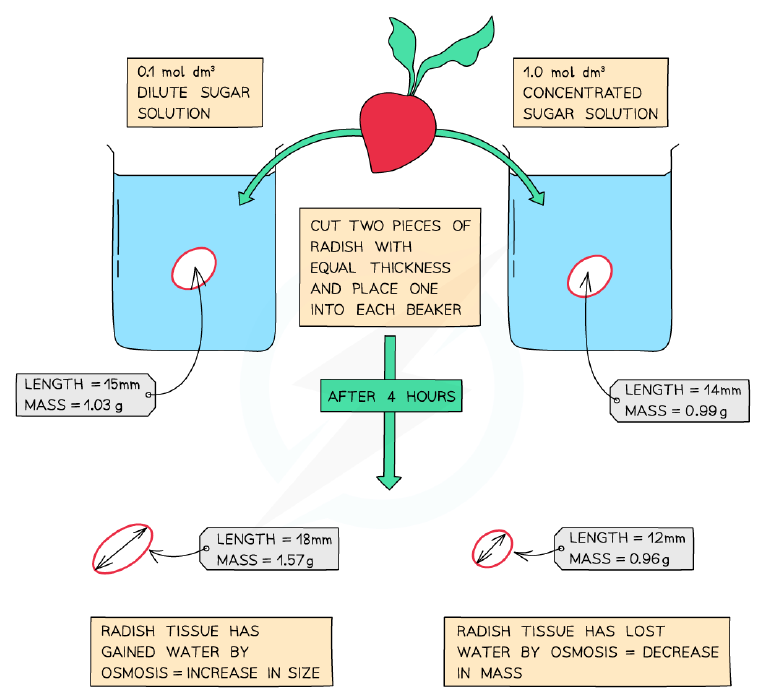
- Common practical: cut cylinders of potato or radish, weigh, place in distilled water or sucrose solutions of increasing concentration, leave 20–30 min, dry and reweigh.
- If mass increases: water moved into tissue by osmosis; external solution is more dilute (higher water potential) than the tissue.
- If mass decreases: water moved out of tissue; external solution is more concentrated (lower water potential) than the tissue.
- If mass unchanged: no net movement; internal and external concentrations are equal.
Osmosis in radish tissue
Osmosis in Animals & Plants
- Plant cell in dilute solution: water enters by osmosis, pushes membrane against cell wall, cell becomes turgid (increased turgor pressure).
- Plant cell in concentrated solution: water leaves, cell becomes flaccid; if severe, plasmolysis occurs (membrane pulls away from cell wall).
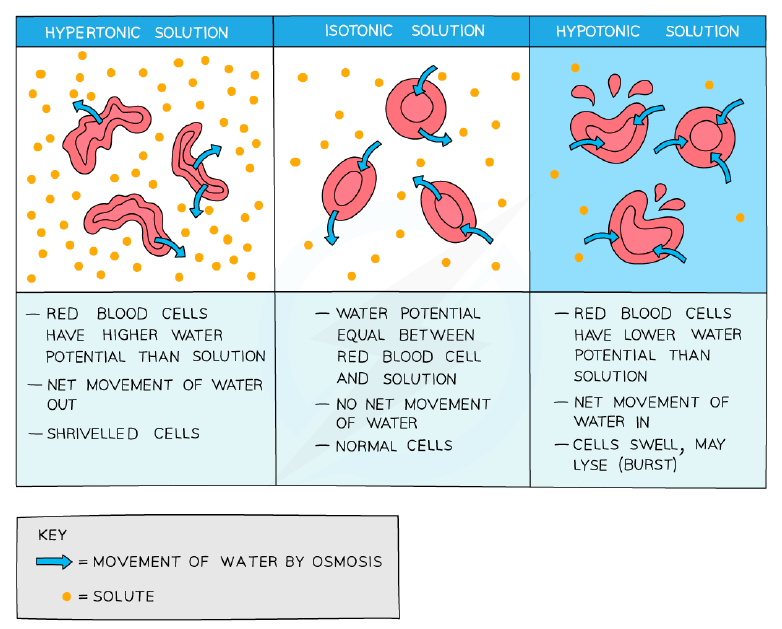
- Animal cell in dilute solution: water enters, cell swells and may burst (no cell wall).
- Animal cell in concentrated solution: water leaves, cell crenates (shrivels).
Effect of osmosis on animal cells
Active Transport
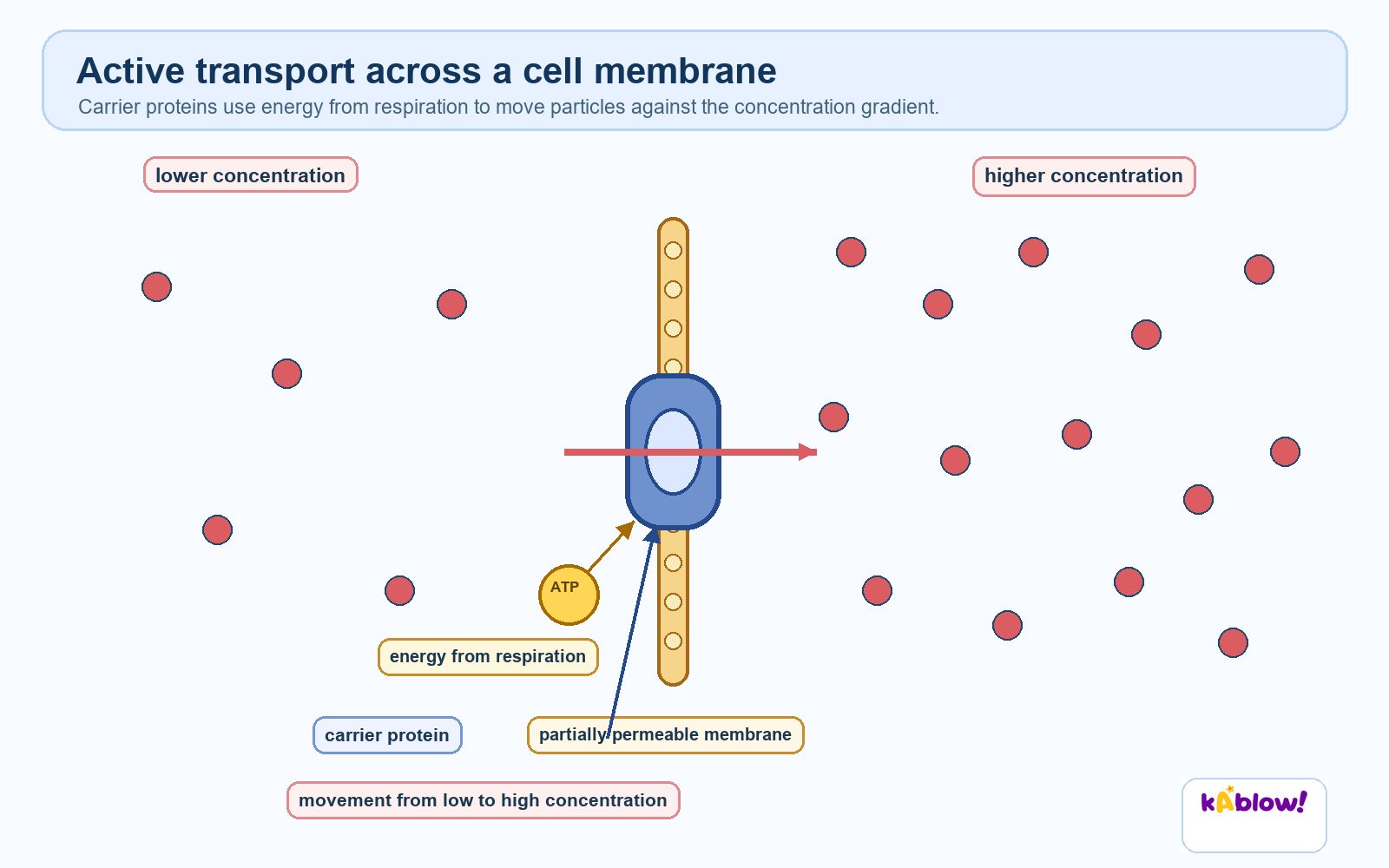
- Active transport is the movement of particles across a cell membrane from a region of lower concentration to a region of higher concentration (against a concentration gradient).
- Requires energy from respiration (ATP).
- Enables cells to take up substances even when they are in low concentration outside.
The process of active transport
Importance of Active Transport
- Uptake of glucose by epithelial cells in the villi of the small intestine and by kidney tubules in the nephron.
- Uptake of ions from soil water by root hair cells in plants.
Folien
Sign up free to view the lesson slides
Step through every slide for this topic — plus flashcards and revision notes — with a free account.
Übungsfragen
Gratis-Vorschau — 8 von 45 Fragen. Registriere dich, um alle zu sehen.
1.Osmosis is:
Easy- AThe active movement of molecules from a region of their lower concentration to a region of their higher concentration.
- BThe movement of water through a partially permeable membrane from a more concentrated to a more dilute solution.
- CParticles from a region of lower concentration to a region of higher concentration using energy from respiration.
- DThe movement of water through a partially permeable membrane from a more dilute to a more concentrated solution.
2.How does a water vapour molecule move out of the air space of a leaf into the atmosphere on a dry day?
Easy- AActive transport
- BDiffusion
- CEvaporation
- DTranspiration
3.What causes the diffusion of carbon dioxide out of a living cell?
Easy- AActive transport
- BRandom movement of molecules
- CRespiration
- DPhotosynthesis
4.Which of the structures below is best adapted for diffusion?
Medium- Aileum
- Bbronchioles
- Catria
- Dcapillary
5.Which of the following statements would be correct for both diffusion and osmosis?
Medium- Adoes not require energy from the cell ✓; molecules must be separated by a partially permeable membrane ✓; molecules move from a dilute to a more concentrated solution ✗
- Bdoes not require energy from the cell ✗; molecules must be separated by a partially permeable membrane ✗; molecules move from a dilute to a more concentrated solution ✓
- Cdoes not require energy from the cell ✓; molecules must be separated by a partially permeable membrane ✗; molecules move from a dilute to a more concentrated solution ✗
- Ddoes not require energy from the cell ✓; molecules must be separated by a partially permeable membrane ✗; molecules move from a dilute to a more concentrated solution ✓
6.A number of red blood cells were immersed in a pure solution of water before being observed under a microscope. There was a dramatic change in their appearance. Which row of the table below correctly describes and explains what happened to the red blood cells?
Hard- Adirection of water movement: in; from higher to lower concentration: ✓; from higher to lower water potential: ✗; effect: cells burst
- Bdirection of water movement: in; from higher to lower concentration: ✗; from higher to lower water potential: ✓; effect: cells burst
- Cdirection of water movement: out; from higher to lower concentration: ✓; from higher to lower water potential: ✗; effect: cells shrink
- Ddirection of water movement: out; from higher to lower concentration: ✓; from higher to lower water potential: ✓; effect: cells shrink
7.A plant absorbs a number of substances into its roots. Which row of the table below correctly shows the substances absorbed by the roots and how these substances are absorbed?
Medium- Aminerals: active transport; oxygen: diffusion; water: osmosis
- Bminerals: active transport; oxygen: not absorbed; water: transpiration
- Cminerals: diffusion; oxygen: diffusion; water: osmosis
- Dminerals: active transport; oxygen: not absorbed; water: osmosis
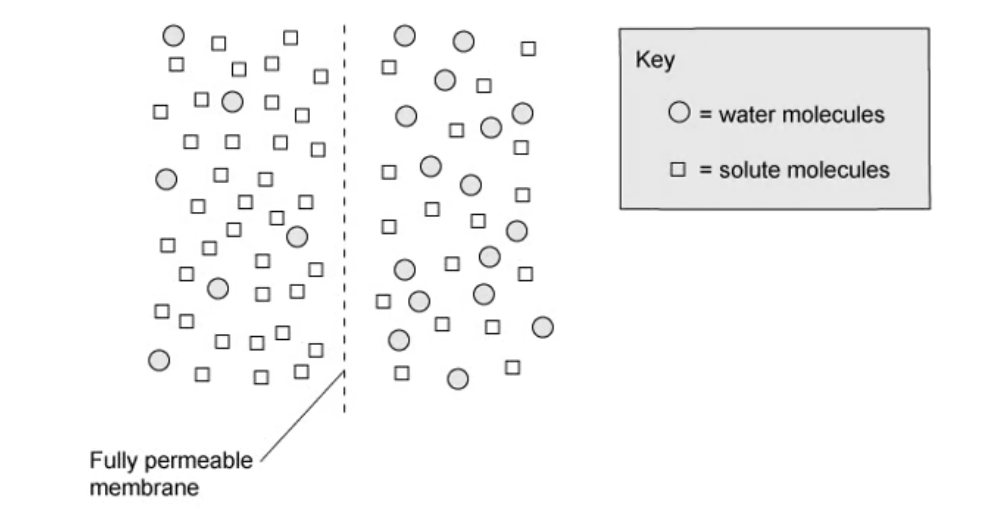
8.Solution W is a dilute sugar solution and solution X is a concentrated sugar solution, separated by a partially permeable membrane. Which of the statements below is true?
Medium- AThere is no net movement of water from W to X
- BThere would be movement of water molecules from W to X
- COsmosis of sugar molecules would occur from the dilute solution (W) to the concentrated solution (X)
- DSolution X is more dilute and therefore has a higher water potential than solution W
Unlock all 45 questions & more
Erstelle ein Gratis-Konto, um alle Fragen, Folien, Karteikarten und Lernnotizen zu diesem Thema zu sehen.