Area And Perimeter
Lerne es beim Spielen
Beantworte diese Fragen für Energie, dann angle und erkunde. Kein Konto nötig.
Lektionsnotizen
Perimeter
- Perimeter is the total distance around the outside of a 2D shape.
- For a circle, perimeter is called circumference.
- Add all side lengths; for regular shapes, multiply side length by number of sides.
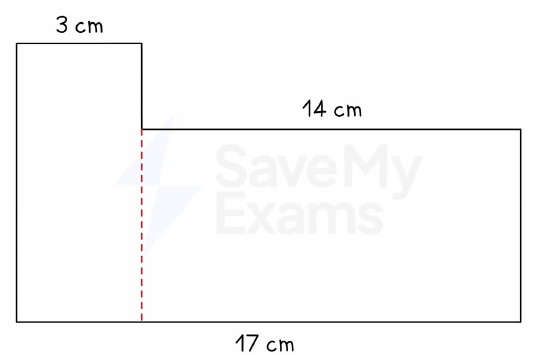
- For compound shapes, split into rectangles, triangles, or parts of circles.
- Use properties (e.g., equal sides, parallel sides) to find missing lengths.
- Units: mm, cm, m, etc.
Perimeter of a Compound Shape
Area on a Grid
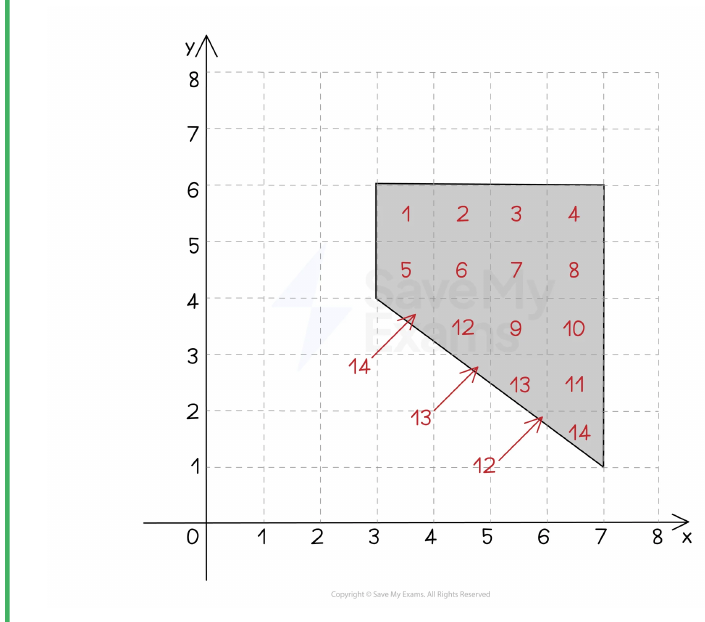
- Count whole squares inside the shape.
- Pair up half squares or parts to make whole squares.
- Multiply the total squares by the area each square represents.
- Example: 14 whole squares on a 1 cm² grid gives area 14 cm².
Area on a Grid
Area Formulas
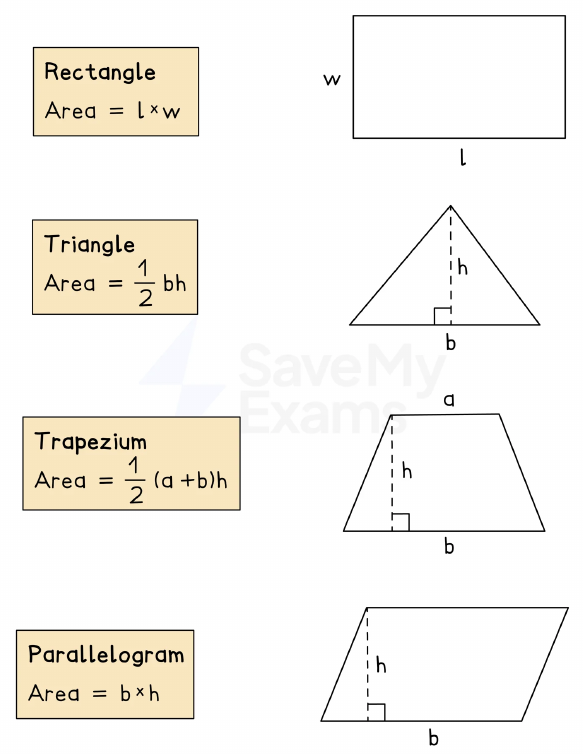
- Rectangle: Area = length × width.
- Triangle: Area = ½ × base × perpendicular height.
- Trapezium: Area = ½ × (sum of parallel sides) × height.
- Parallelogram: Area = base × perpendicular height.
- The triangle formula is given in exams; others should be memorised.
Area Formulas
Adding & Subtracting Areas
- Compound shapes can be split into standard shapes (rectangles, triangles).
- Find area of each part and add them.
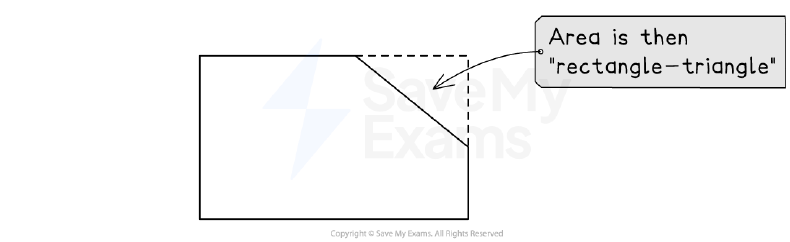
- Alternatively, add an extra shape to form a standard shape, then subtract its area.
- Choose the simplest split to minimise calculations.
Compound Shape by Subtraction
Problem Solving with Areas
- Real-life problems often involve area and cost (e.g., carpet, paint).
- Read carefully: key words like 'area', 'cost per m²' hint at calculations.
- Annotate diagrams with known and missing lengths.
- Compare options (e.g., different companies) to find minimum cost.
- Show working even if final answer is not reached – marks for correct steps.
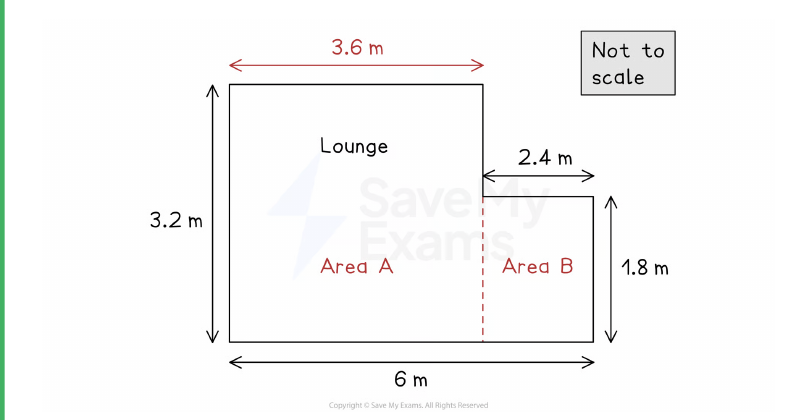
Splitting a Compound Shape for a Real Problem
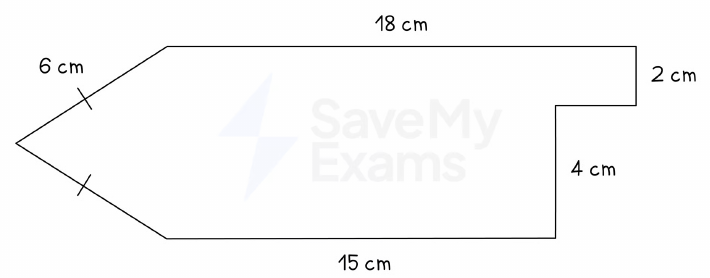
Worked Example: Compound Shape Perimeter
- Split shape into triangle and rectangles.
- Use equal side marks to find missing lengths (e.g., triangle side = 6 cm).
- Horizontal lengths: sum of shorter = longer opposite (e.g., 15 + ? = 18 → ? = 3 cm).
- Add all sides: 6+6+18+2+3+4+15 = 54 cm.
Compound Shape Perimeter
Worked Example: Trapezium Area
- Parallel sides a=30 cm, b=15 cm, height h=20 cm.
- Area = ½ × (30+15) × 20 = 450 cm².
Area of a Trapezium
Worked Example: Parallelogram Area
- Base = 15 cm, perpendicular height = 12 cm.
- Area = 15 × 12 = 180 cm².
Area of a Parallelogram
Worked Example: Triangle Area
- Base = 8 cm, height = 7 cm.
- Area = ½ × 8 × 7 = 28 cm².
Area of a Triangle
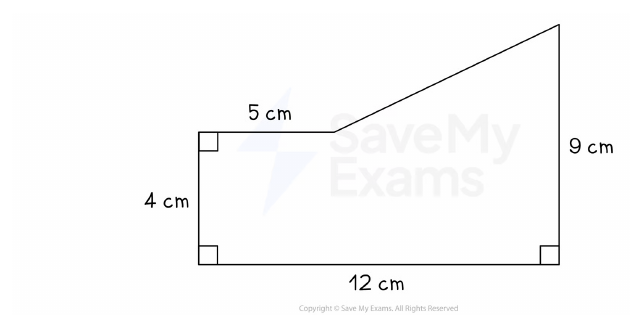
Worked Example: Compound Shape Area (Pentagon)
- Split into rectangle (12×4) and triangle (base 7, height 5).
- Rectangle area = 48 cm², triangle area = ½×7×5 = 17.5 cm².
- Total area = 65.5 cm².
Compound Shape Area (Pentagon)
Folien
Sign up free to view the lesson slides
Step through every slide for this topic — plus flashcards and revision notes — with a free account.
Übungsfragen
Gratis-Vorschau — 8 von 56 Fragen. Registriere dich, um alle zu sehen.
1.What is the perimeter of a square with side length 5 cm?
Easy- A10 cm
- B15 cm
- C20 cm
- D25 cm
2.The area of a square is 64 cm². What is the length of one side?
Easy- A8 cm
- B16 cm
- C32 cm
- D4 cm
3.A rectangle has length 7 cm and width 3 cm. What is its area?
Easy- A10 cm²
- B21 cm²
- C20 cm²
- D24 cm²
4.What is the area of a triangle with base 6 cm and perpendicular height 4 cm?
Easy- A12 cm²
- B24 cm²
- C10 cm²
- D20 cm²
5.The length of a rectangle is 3 cm longer than its width. The perimeter is 26 cm. What is the width?
Medium- A5 cm
- B6 cm
- C7 cm
- D8 cm
6.A parallelogram has base 15 cm and perpendicular height 12 cm. What is its area?
Easy- A180 cm²
- B90 cm²
- C150 cm²
- D30 cm²
7.The area of triangle ABC is 27 cm² and AB = 6 cm. What is the perpendicular height from C to AB?
Medium- A9 cm
- B4.5 cm
- C3 cm
- D12 cm
8.A square has perimeter 12x. What is its area in terms of x?
Medium- A9x²
- B36x²
- C3x²
- D6x²
Unlock all 56 questions, flashcards & more
Erstelle ein Gratis-Konto, um alle Fragen, Folien, Karteikarten und Lernnotizen zu diesem Thema zu sehen.