Geometry Toolkit
Lerne es beim Spielen
Beantworte diese Fragen für Energie, dann angle und erkunde. Kein Konto nötig.
Lektionsnotizen
Rotational Symmetry
- Rotational symmetry is the number of times a shape looks the same when rotated 360° about its centre.
- This number is called the order of rotational symmetry.
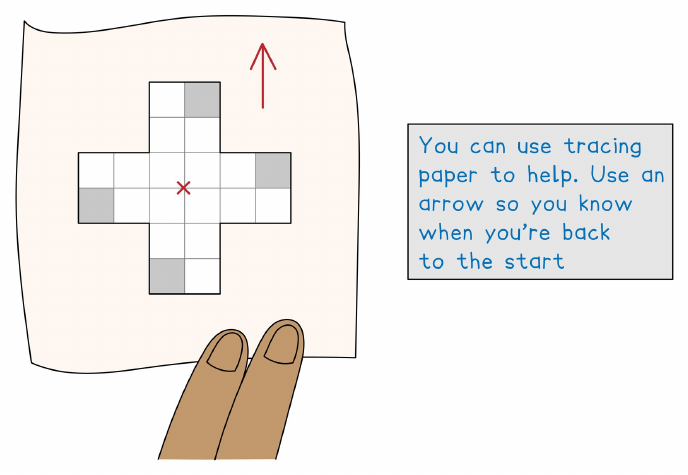
- Use tracing paper with an arrow to track orientation; returning to start counts as 1.
- A shape with order 1 is said to have no rotational symmetry.
- Example: a square has rotational symmetry of order 4.
Finding rotational symmetry with tracing paper
Lines of Symmetry
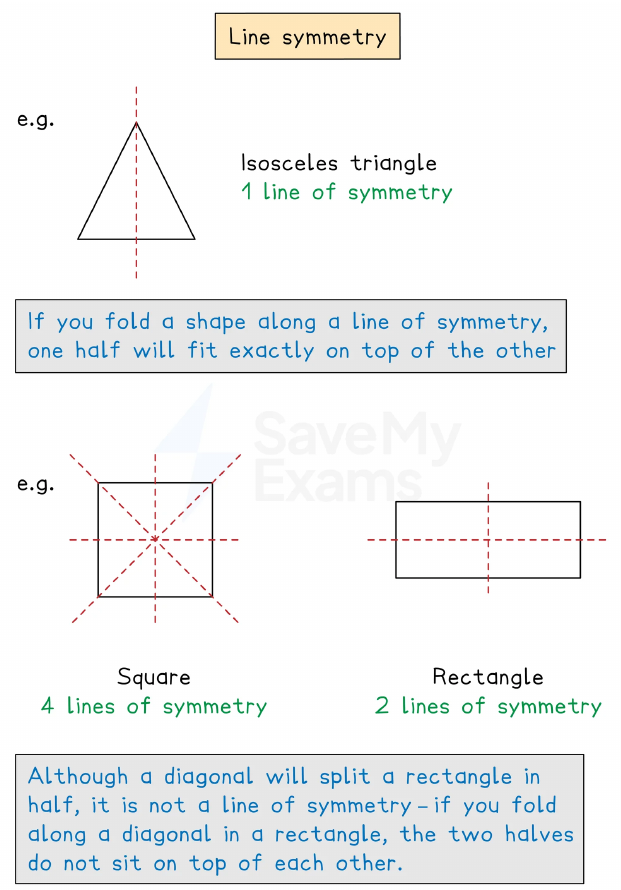
- A line of symmetry divides a shape into two mirror-image halves.
- Folding along a line of symmetry makes the two parts coincide exactly.
- Some shapes have multiple lines (e.g., square has 4, rectangle has 2).
- For diagonal lines, use tracing paper to reflect the shape.
- When completing a shape given a line of symmetry, reflect the given part across the line.
Lines of symmetry
2D Shapes
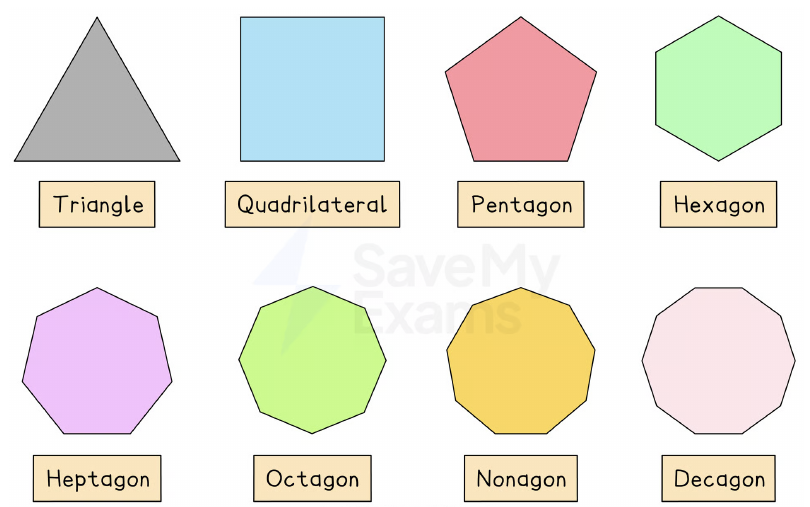
- Polygons are named by number of sides: triangle (3), quadrilateral (4), pentagon (5), hexagon (6), heptagon (7), octagon (8), nonagon (9), decagon (10).
- A regular polygon has all sides equal and all angles equal.
- Triangles: equilateral (3 equal sides), isosceles (2 equal sides), right-angled (90° angle), scalene (no equal sides).
- Quadrilaterals: square (4 equal sides, 4 right angles, 4 lines of symmetry, order 4 rotational symmetry).
- Rectangle: opposite sides equal, 2 lines of symmetry, order 2 rotational symmetry.
- Parallelogram: opposite sides parallel and equal, no lines of symmetry, order 2 rotational symmetry.
- Rhombus: all sides equal, opposite angles equal, 2 lines of symmetry, order 2 rotational symmetry.
- Trapezium: one pair of parallel sides; isosceles trapezium has non-parallel sides equal and 1 line of symmetry.
- Kite: two pairs of equal adjacent sides, 1 line of symmetry, order 1 rotational symmetry.
- Circle terms: circumference (perimeter), diameter (line through centre), radius (centre to edge), arc, sector, chord, segment, tangent.
Named polygons
3D Shapes
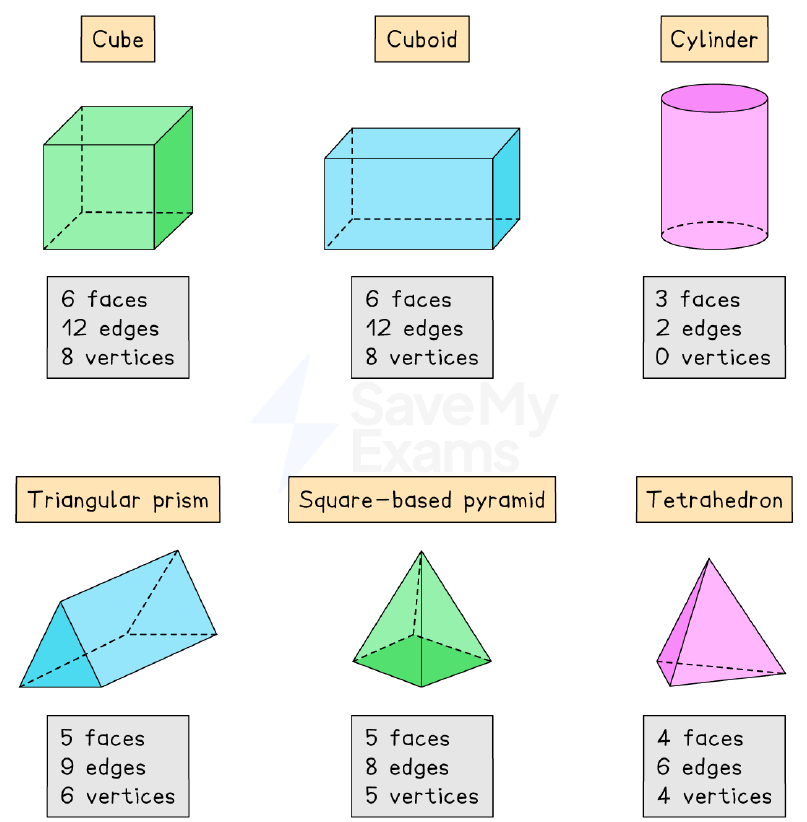
- Common 3D shapes: cube, cuboid, cylinder, prism, pyramid, cone, sphere, tetrahedron.
- A prism has the same cross-section throughout; a cylinder is like a prism with circular cross-section.
- A pyramid has a flat base and sloping sides meeting at a point (apex).
- Faces, vertices, edges: cube (6 faces, 8 vertices, 12 edges); cuboid (6 faces, 8 vertices, 12 edges); tetrahedron (4 faces, 4 vertices, 6 edges).
- A net is a 2D drawing that folds to form a 3D shape; the net of a cube has 6 squares (11 possible arrangements).
- Net of a cylinder: two circles and a rectangle (rectangle length = circumference of circle).
- Net of a pyramid: base plus a triangle attached to each edge of the base.
Properties of common 3D shapes
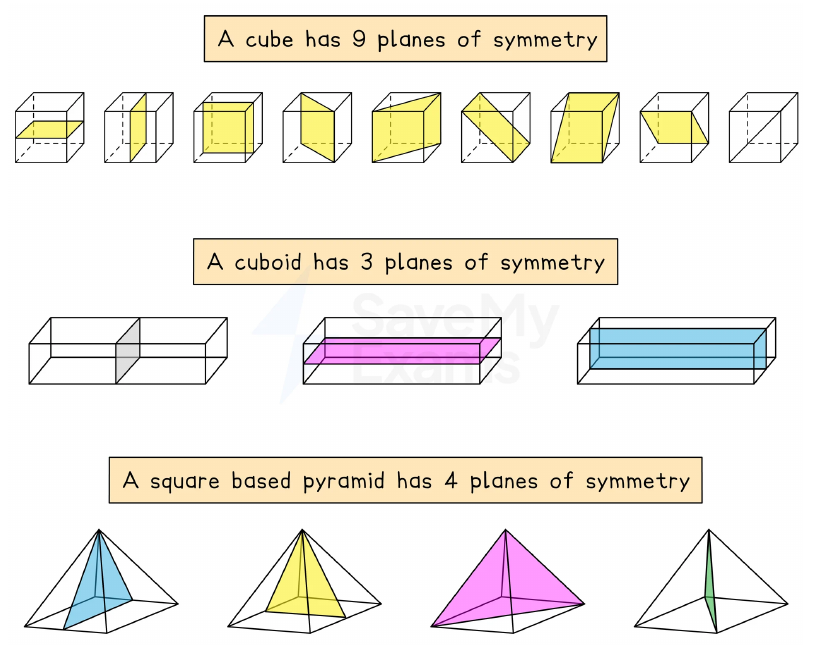
Planes of Symmetry
- A plane of symmetry splits a 3D shape into two congruent mirror-image halves.
- Cubes have 9 planes of symmetry; cuboids have 3 (if all dimensions different).
- Cylinders have an infinite number of planes of symmetry (any plane through the axis).
- For a prism, number of planes = number of lines of symmetry in cross-section + 1.
- For a pyramid with a regular n-sided base, number of planes = n (the lines of symmetry of the base).
Planes of symmetry of common solids
Converting between Units
- Length: 1 cm = 10 mm, 1 m = 100 cm, 1 km = 1000 m.
- Mass: 1 g = 1000 mg, 1 kg = 1000 g, 1 tonne = 1000 kg.
- Capacity: 1 litre = 100 cl = 1000 ml; 1 ml = 1 cm³; 1 litre = 1000 cm³; 1 m³ = 1000 litres.
- To convert, multiply or divide by the conversion factor; check if the number of units increases or decreases.
Squared & Cubic Units
- For area (squared units), square the linear conversion factor: 1 cm² = 100 mm², 1 m² = 10 000 cm², 1 km² = 1 000 000 m².
- 1 hectare = 10 000 m².
- For volume (cubic units), cube the linear conversion factor: 1 cm³ = 1000 mm³, 1 m³ = 1 000 000 cm³, 1 km³ = 1 000 000 000 m³.
- Example: 2.54 m³ = 2.54 × 1 000 000 = 2 540 000 cm³.
Folien
Sign up free to view the lesson slides
Step through every slide for this topic — plus flashcards and revision notes — with a free account.
Übungsfragen
Gratis-Vorschau — 8 von 44 Fragen. Registriere dich, um alle zu sehen.
1.What is the name of a quadrilateral with exactly one pair of parallel sides?
Easy- ATrapezium
- BParallelogram
- CRectangle
- DKite
2.An angle that is greater than 90° but less than 180° is called:
Easy- AObtuse
- BAcute
- CReflex
- DRight
3.How many lines of symmetry does a regular pentagon have?
Easy- A5
- B1
- C10
- D0
4.What is the order of rotational symmetry of a kite?
Easy- A1
- B2
- C4
- D0
5.Convert 1 m³ to cm³.
Easy- A1 000 000 cm³
- B1000 cm³
- C100 cm³
- D10 000 cm³
6.Change 32.4 m³ into cm³.
Medium- A32 400 000 cm³
- B32 400 cm³
- C324 000 cm³
- D3 240 000 cm³
7.Change 457 000 cm² into m².
Medium- A45.7 m²
- B4.57 m²
- C457 m²
- D0.457 m²
8.The diagram shows a pyramid with a square base. The triangular faces are congruent isosceles triangles. How many planes of symmetry does this pyramid have?
Medium- A4
- B1
- C2
- D8
Unlock all 44 questions & more
Erstelle ein Gratis-Konto, um alle Fragen, Folien, Karteikarten und Lernnotizen zu diesem Thema zu sehen.