Prime Factors Hcf And Lcm
Lerne es beim Spielen
Beantworte diese Fragen für Energie, dann angle und erkunde. Kein Konto nötig.
Lektionsnotizen
Prime Factor Decomposition
- Prime factors are prime numbers that multiply to give the original number (e.g., prime factors of 30 are 2, 3, 5).
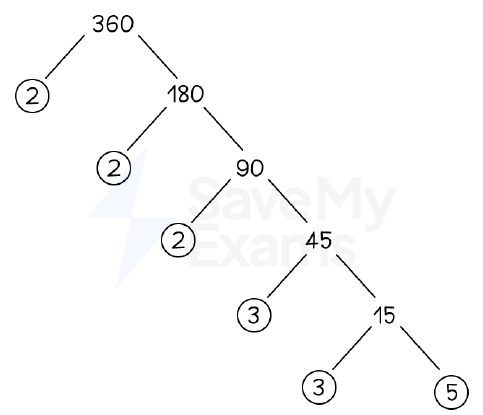
- Use a factor tree: split the number into factor pairs, continue until all branches end in primes, and circle the primes.
- Write the product in ascending order, using index notation for repeated primes (e.g., 360 = 2³ × 3² × 5).
- The decomposition is unique for each number (Fundamental Theorem of Arithmetic).
- Common first primes: 2, 3, 5, 7, 11, 13, 17, 19.
Factor Tree for 360
Identifying Square and Cube Numbers
- A number is a square number if all indices in its prime factor decomposition are even (e.g., 7056 = 2⁴ × 3² × 7²).
- A number is a cube number if all indices are multiples of 3 (e.g., 1728000 = 2⁹ × 3³ × 5³).
- To find the square root of a square number, halve all indices and multiply (e.g., √144 = √(2⁴×3²) = 2²×3 = 12).
- For non-square numbers, rewrite with even indices where possible and simplify (e.g., √1440 = √(2⁴×3²×2×5) = 12√10).
Finding HCF Using Prime Factors
- HCF (Highest Common Factor) is the largest number that divides both numbers exactly.
- Method 1: List all factors of each number and pick the largest common one.
- Method 2 (Venn diagram): Place common prime factors in the centre, multiply them to get HCF.
- Method 3 (powers): For each common prime, take the smallest power appearing in both numbers, then multiply.
- Example: HCF(36,120) = 2² × 3 = 12.
HCF of 36 and 120
Finding LCM Using Prime Factors
- LCM (Lowest Common Multiple) is the smallest number that is a multiple of both numbers.
- Method 1: List multiples of each number until a common one appears.
- Method 2 (Venn diagram): Multiply all prime factors in the diagram (centre and outer regions).
- Method 3 (powers): For every prime that appears, take the highest power from either number, then multiply.
- Example: LCM(36,120) = 2³ × 3² × 5 = 360.
LCM of 36 and 120
Applications: Real-World Problems
- Use LCM to find when events repeat simultaneously (e.g., trams every 9 and 12 min: LCM = 36 min, next at 9:36 am).
- Use HCF to split items into equal groups (e.g., packets of 20 cheese slices and 12 burgers: HCF = 4, but for equal numbers use LCM = 60).
- For problems with 'exactly the same number' of two items, find the LCM of the packet sizes.
- For problems with 'next time together', find the LCM of the time intervals.
Working with Prime Factor Powers (A and B form)
- When numbers are given as products of powers (e.g., A = 2³ × 3² × 5² × 11, B = 2⁴ × 3 × 5⁴ × 13), find HCF by taking minimum power of each common prime.
- Find LCM by taking maximum power of each prime that appears in either number.
- Example: HCF(A,B) = 2³ × 3 × 5² = 8×3×25=600; LCM = 2⁴ × 3² × 5⁴ × 11 × 13.
Finding Smallest Multiplier for a Square/Cube
- To make a number a perfect square, multiply by primes to make all indices even.
- To make a number a perfect cube, multiply by primes to make all indices multiples of 3.
- Example: N = 2³ × 3² × 5⁷, to become a square multiply by 2 × 5 = 10 (so that indices become 4,2,8).
Examiner Tips
- Always show clear working (factor tree or division) – marks awarded for method.
- Write final answer in index form unless told otherwise.
- HCF of two numbers can be one of the numbers (e.g., HCF(4,12)=4).
- LCM of two numbers can be one of the numbers (e.g., LCM(4,12)=12).
Folien
Sign up free to view the lesson slides
Step through every slide for this topic — plus flashcards and revision notes — with a free account.
Übungsfragen
Gratis-Vorschau — 8 von 30 Fragen. Registriere dich, um alle zu sehen.
1.Which of the following is a prime number?
Easy- A15
- B21
- C23
- D27
2.Express 84 as a product of its prime factors.
Easy- A22 × 3 × 7
- B2 × 3 × 7
- C22 × 21
- D23 × 3 × 7
3.Write 525 as a product of its prime factors.
Easy- A3 × 52 × 7
- B3 × 5 × 7
- C52 × 21
- D3 × 5 × 35
4.A tram to Eccles leaves every 9 minutes and a tram to Didsbury leaves every 12 minutes. They both leave Piccadilly at 9 am. At what time will they next leave at the same time?
Easy- A9:36 am
- B9:24 am
- C9:48 am
- D10:00 am
5.Find the highest common factor (HCF) of 90 and 48.
Medium- A6
- B12
- C18
- D24
6.Write 56 as a product of its prime factors.
Medium- A23 × 7
- B2 × 28
- C22 × 14
- D2 × 4 × 7
7.Find the lowest common multiple (LCM) of 56 and 42.
Medium- A168
- B336
- C84
- D252
8.A = 32 × 54 × 7, B = 34 × 53 × 7 × 11. Find the HCF of A and B.
Medium- A32 × 53 × 7
- B34 × 54 × 7 × 11
- C32 × 53
- D34 × 54 × 7
Unlock all 30 questions & more
Erstelle ein Gratis-Konto, um alle Fragen, Folien, Karteikarten und Lernnotizen zu diesem Thema zu sehen.