Breathing
Lerne es beim Spielen
Beantworte diese Fragen für Energie, dann angle und erkunde. Kein Konto nötig.
Lektionsnotizen
The Respiratory System
- Breathing is the mechanical process that moves air in and out of the lungs.
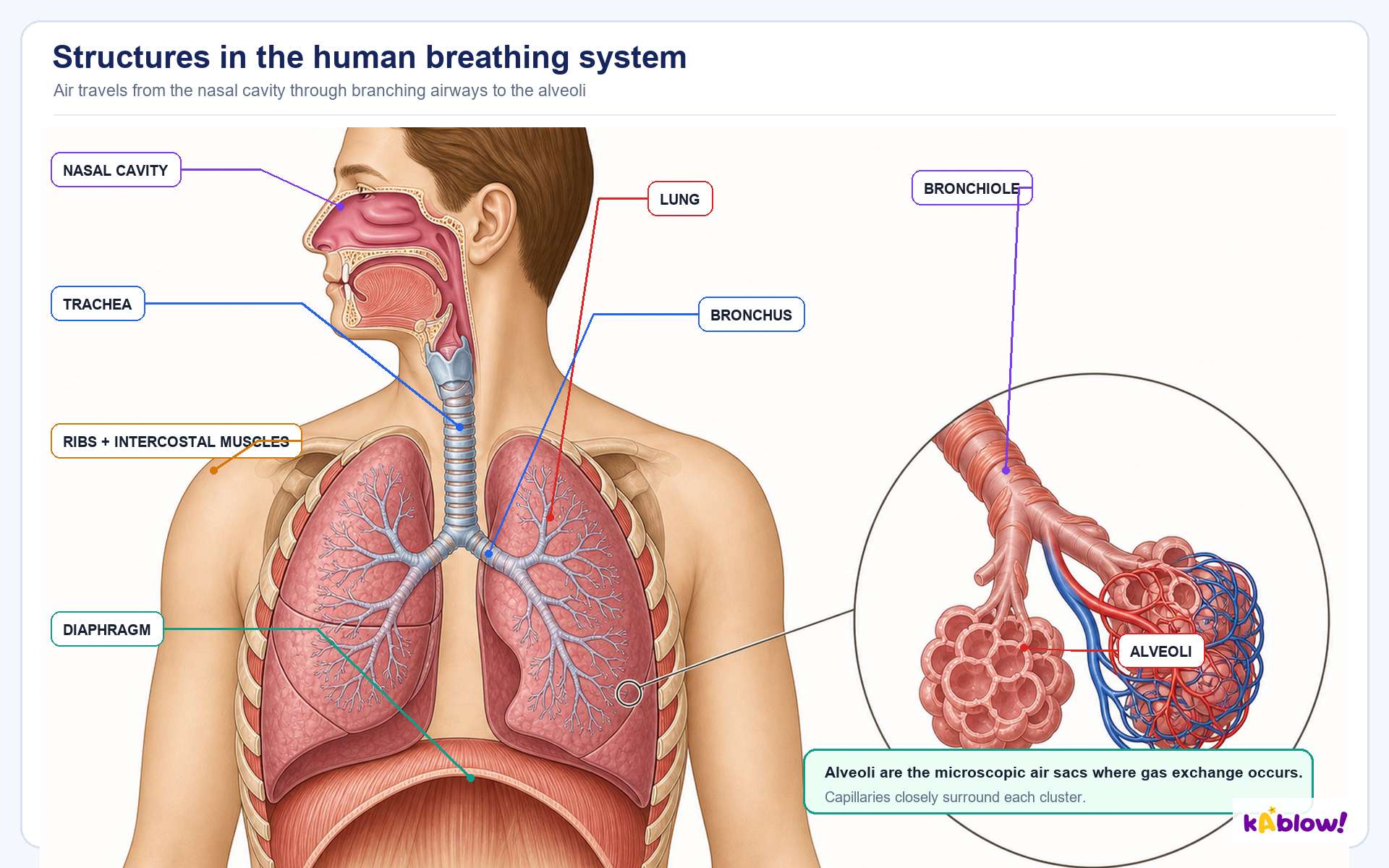
- The respiratory system includes the nose, mouth, trachea, lungs, and diaphragm.
- The nose warms and filters air, trapping dust and particles.
- The trachea (windpipe) connects the throat to the lungs.
- The trachea divides into two bronchi (one per lung), which split into smaller bronchioles.
- Bronchioles lead to tiny air sacs called alveoli, where gas exchange occurs.
- The diaphragm is a large muscle below the lungs that contracts and relaxes to change chest volume.
Air passes from the nasal cavity through the trachea, bronchi and bronchioles to the alveoli; the diaphragm sits below the lungs.
Inhalation (Breathing In)
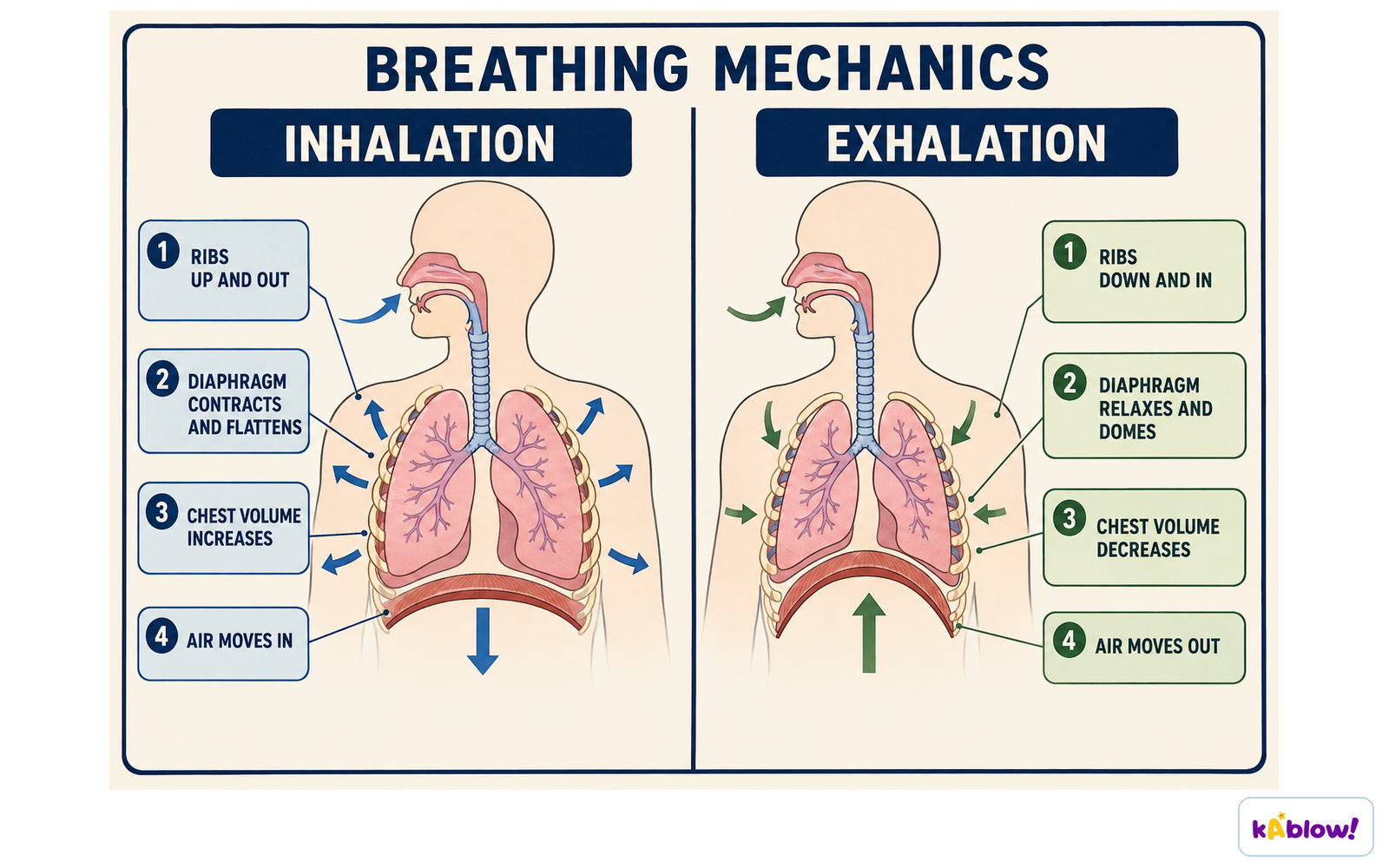
- The diaphragm contracts and moves downward, increasing chest cavity volume.
- Intercostal muscles contract, pulling the ribcage up and out.
- Increased chest volume lowers air pressure inside the lungs relative to outside.
- Air is drawn in through the nose/mouth, down the trachea and bronchi, into the alveoli.
Inhaling increases chest volume as the ribs move up and out and the diaphragm contracts. Exhaling reverses these movements.
Exhalation (Breathing Out)
- The diaphragm relaxes and moves upward, decreasing chest cavity volume.
- Intercostal muscles relax, allowing the ribcage to move down and in.
- Decreased chest volume raises air pressure inside the lungs.
- Higher pressure forces air out of the alveoli, up the bronchi and trachea, and out through the nose/mouth.
Key Points
- The lungs are an organ of the respiratory system.
- Gas exchange occurs in the alveoli.
- Inhalation: diaphragm contracts, chest volume increases, pressure decreases, air flows in.
- Exhalation: diaphragm relaxes, chest volume decreases, pressure increases, air flows out.
- The nose filters air and traps dust and particles.
Folien
Sign up free to view the lesson slides
Step through every slide for this topic — plus flashcards and revision notes — with a free account.
Übungsfragen
Gratis-Vorschau — 8 von 54 Fragen. Registriere dich, um alle zu sehen.
1.Which of the following statements about the diaphragm during inhalation is correct?
Medium- AThe diaphragm relaxes and moves upward.
- BThe diaphragm contracts and moves downward.
- CThe diaphragm relaxes and moves downward.
- DThe diaphragm contracts and moves upward.
2.Which of the following is NOT part of the respiratory system?
Easy- ATrachea
- BLungs
- CDiaphragm
- DOesophagus
3.What is the main function of the nose in the respiratory system?
Easy- ATo warm and filter the air
- BTo exchange gases
- CTo produce mucus
- DTo connect the throat to the lungs
4.The trachea divides into two tubes. What are these tubes called?
Easy- ABronchioles
- BBronchi
- CAlveoli
- DCapillaries
5.During exhalation, what happens to the volume of the chest cavity?
Easy- AIt increases
- BIt decreases
- CIt stays the same
- DIt fluctuates rapidly
6.Which of the following sequences correctly describes the path of air from the trachea to the alveoli?
Medium- ATrachea → bronchioles → bronchi → alveoli
- BTrachea → bronchi → bronchioles → alveoli
- CTrachea → alveoli → bronchi → bronchioles
- DTrachea → bronchioles → alveoli → bronchi
7.Gas exchange occurs in which part of the respiratory system?
Easy- ATrachea
- BBronchi
- CAlveoli
- DDiaphragm
8.What causes air to move into the lungs during inhalation?
Medium- AHigher pressure inside the lungs than outside
- BLower pressure inside the lungs than outside
- CEqual pressure inside and outside the lungs
- DThe diaphragm relaxing
Unlock all 54 questions, flashcards & more
Erstelle ein Gratis-Konto, um alle Fragen, Folien, Karteikarten und Lernnotizen zu diesem Thema zu sehen.