DNA and inheritance
Lerne es beim Spielen
Beantworte diese Fragen für Energie, dann angle und erkunde. Kein Konto nötig.
Lektionsnotizen
Inheritance
- Inheritance is the passing on of traits from one generation to the next.
- Characteristics like eye colour and height are inherited from parents.
- You inherit one chromosome of each pair from your mother and the other from your father.
Chromosomes
- Chromosomes are thread-like structures found in the nucleus of every cell.
- Humans have 46 chromosomes arranged in 23 pairs.
- Each parent contributes one chromosome to each pair.
DNA
- DNA (deoxyribonucleic acid) is the molecule that makes up chromosomes.
- DNA carries genetic instructions that tell cells how to function and determine traits.
- DNA has a double-helix structure, like a twisted ladder.
Genes
- Genes are specific segments of DNA that carry instructions for a specific characteristic.
- For example, one gene determines eye colour, another determines blood type.
- Humans have thousands of genes that work together to determine physical traits and some aspects of personality.
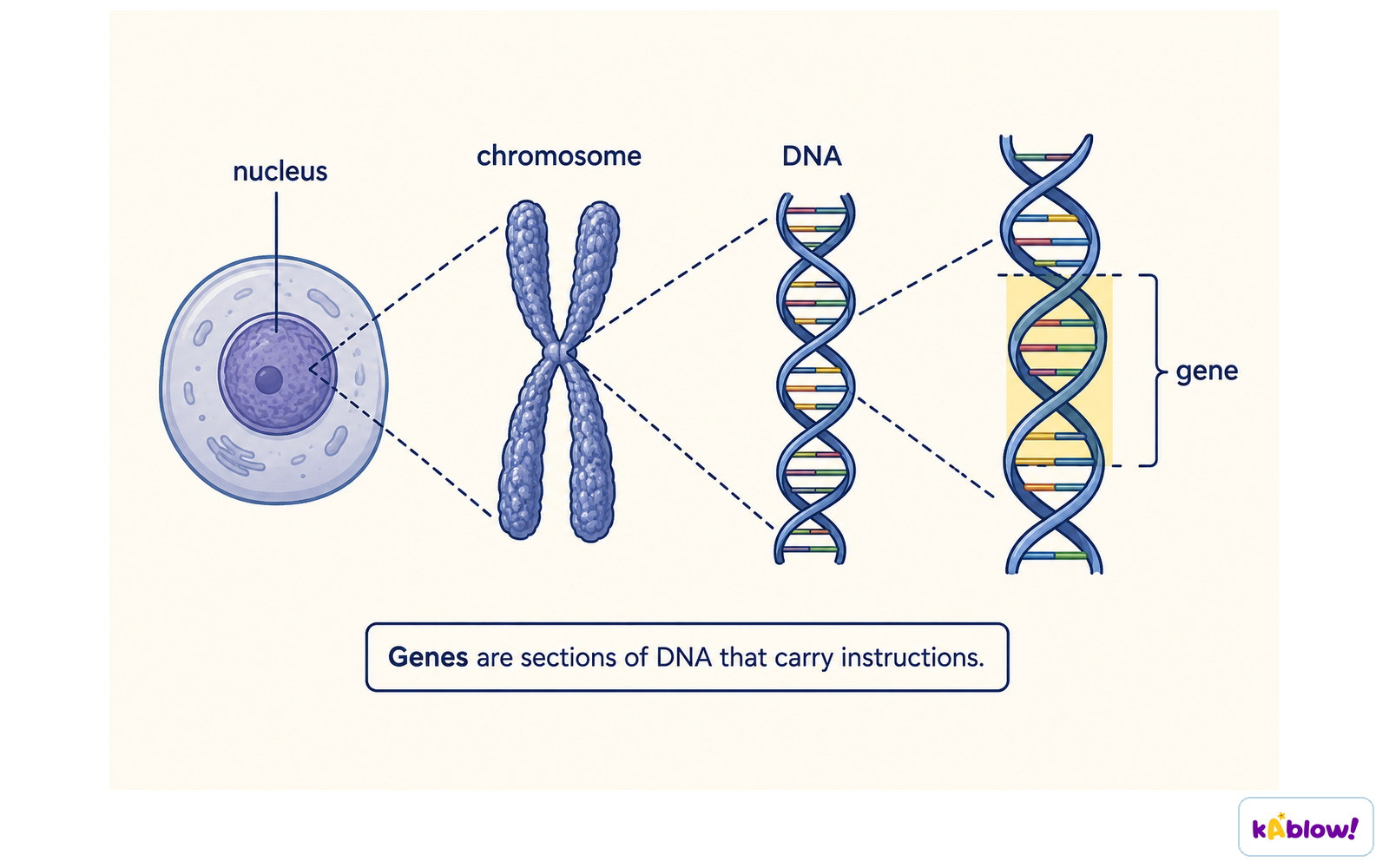
Chromosomes in the nucleus contain DNA. A gene is a section of DNA that carries genetic instructions.
Dominant and Recessive Genes
- Dominant genes: if you inherit the dominant version from one parent, that trait is more likely to show.
- Recessive genes: the trait only appears if you inherit the recessive version from both parents.
Discovery of DNA Structure
- In the 1950s, James Watson and Francis Crick determined the structure of DNA.
- They built on the work of Rosalind Franklin and Maurice Wilkins using X-ray crystallography.
- Raymond Gosling produced Photo 51, which provided crucial clues for the double-helix model.
DNA double helix structure with sugar–phosphate backbones and complementary base pairs (A–T, C–G).
Monohybrid cross showing dominant and recessive inheritance with 3:1 phenotype ratio.
Folien
Sign up free to view the lesson slides
Step through every slide for this topic — plus flashcards and revision notes — with a free account.
Übungsfragen
Gratis-Vorschau — 8 von 56 Fragen. Registriere dich, um alle zu sehen.
1.What does DNA stand for?
Easy- ADeoxyribonucleic acid
- BDeoxyribose nucleic acid
- CRibonucleic acid
- DDeoxyribonucleotide acid
2.How many chromosomes do humans have in each cell?
Easy- A46
- B23
- C92
- D48
3.What is the shape of the DNA molecule?
Easy- ADouble helix
- BSingle helix
- CTriple helix
- DStraight ladder
4.Which of the following correctly describes the relationship between chromosomes, DNA, and genes?
Easy- AChromosomes are made of DNA, and genes are segments of DNA.
- BDNA is made of chromosomes, and genes are segments of chromosomes.
- CGenes are made of chromosomes, and DNA is a type of gene.
- DChromosomes are made of genes, and DNA is a type of chromosome.
5.If a trait is recessive, when will it appear in an individual?
Easy- AOnly if the individual inherits the recessive version from both parents
- BIf the individual inherits the recessive version from at least one parent
- COnly if the individual inherits the dominant version from both parents
- DIt always appears regardless of inheritance
6.Who produced 'Photo 51', which was crucial in determining the structure of DNA?
Easy- ARaymond Gosling
- BRosalind Franklin
- CMaurice Wilkins
- DJames Watson
7.Where are chromosomes found in a cell?
Easy- ANucleus
- BCytoplasm
- CCell membrane
- DMitochondria
8.What is a gene?
Easy- AA segment of DNA that carries instructions for a specific characteristic
- BA type of chromosome
- CThe entire DNA molecule
- DA protein that determines traits
Unlock all 56 questions, flashcards & more
Erstelle ein Gratis-Konto, um alle Fragen, Folien, Karteikarten und Lernnotizen zu diesem Thema zu sehen.