The periodic table
Lerne es beim Spielen
Beantworte diese Fragen für Energie, dann angle und erkunde. Kein Konto nötig.
Lektionsnotizen
History of the Periodic Table
- Early tables arranged elements by atomic weight, but this didn't always match properties.
- In 1869, Dmitri Mendeleev rearranged elements so that similar properties were in the same group.
- Mendeleev left gaps for undiscovered elements and predicted their properties.
- When new elements were found, they matched Mendeleev's predictions.
Modern Periodic Table
- Elements are arranged by increasing atomic number (number of protons).
- Each element has a chemical symbol (e.g., Na for sodium).
- The atomic number is written above the symbol.
Groups and Periods
- Columns are called groups; elements in the same group have similar properties.
- Group 1 elements are alkali metals; they react vigorously with water.
- Rows are called periods.
- Metals are on the left of the bold line; non-metals on the right.
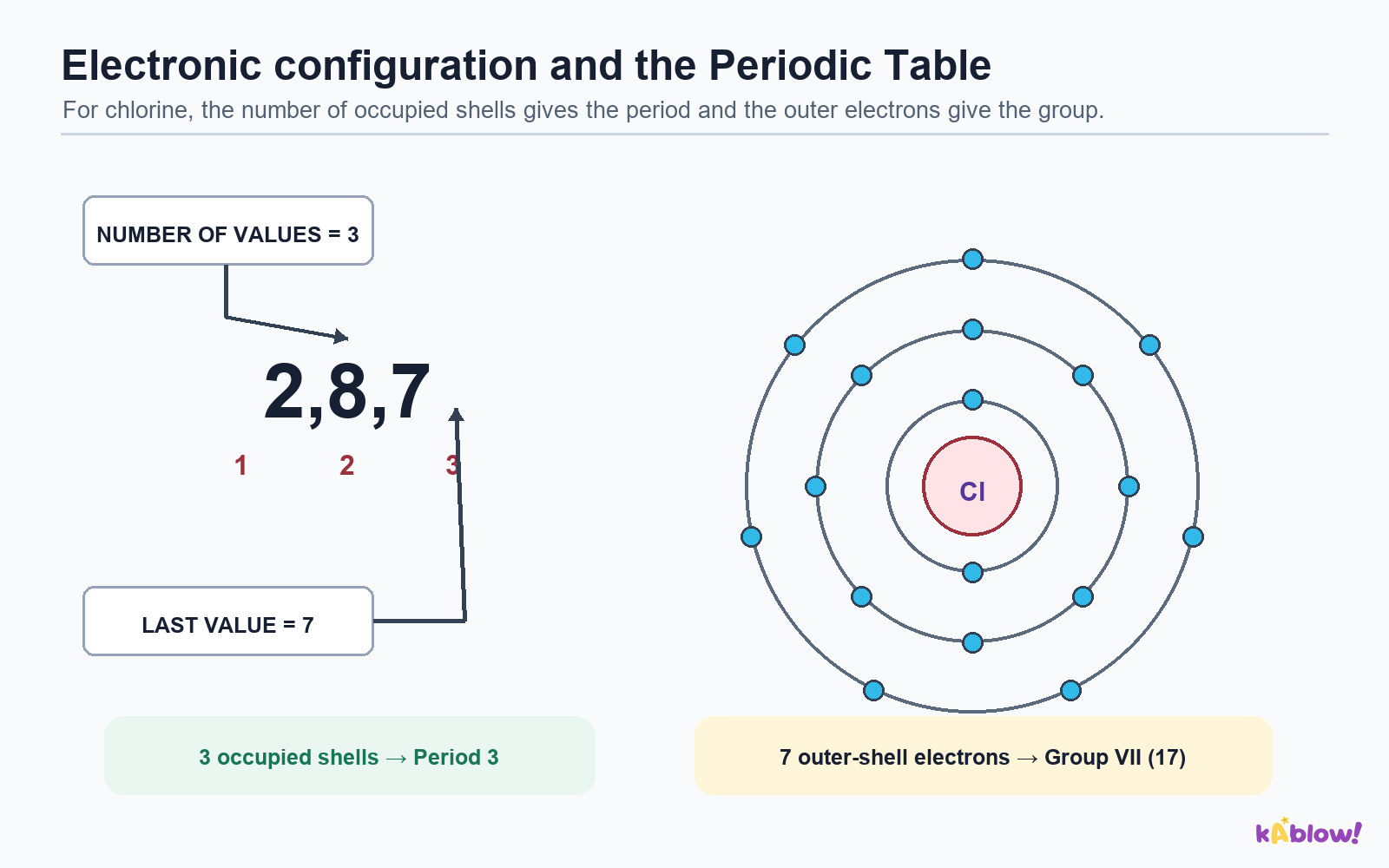
Chlorine's electron configuration (2,8,7): the number of notations gives the period, the last notation gives the group.
Metals and Non-Metals
- Aluminium (Al) is a metal (left of bold line).
- Carbon (C) is a non-metal (right of bold line).
- Metals are good conductors of electricity; non-metals are poor conductors.
Advantages of Grouping
- Similar properties in a group make it easy to predict properties of unknown elements.
- For example, all alkali metals react similarly with water.
Bohr model of sodium atom (atomic number 11) showing electron configuration 2,8,1.
Folien
Sign up free to view the lesson slides
Step through every slide for this topic — plus flashcards and revision notes — with a free account.
Übungsfragen
Gratis-Vorschau — 8 von 56 Fragen. Registriere dich, um alle zu sehen.
1.In the periodic table, elements are arranged in order of increasing:
Easy- Aatomic number
- Batomic weight
- Catomic radius
- Dnumber of neutrons
2.Which of the following statements about the periodic table is true?
Medium- AElements in the same period have similar properties.
- BElements are ordered by atomic mass.
- CColumns are called groups and contain elements with similar properties.
- DMetals are found on the right of the bold line.
3.What is the atomic number of iron (Fe)?
Easy- A26
- B56
- C55
- D30
4.Which of the following elements is a non-metal?
Easy- AAluminium (Al)
- BCarbon (C)
- CIron (Fe)
- DCopper (Cu)
5.Why did Mendeleev leave gaps in his periodic table?
Easy- ATo make the table look balanced
- BFor elements that had not yet been discovered
- CBecause the atomic weights did not match
- DTo separate metals from non-metals
6.Which of the following is a property of alkali metals (Group 1)?
Easy- AThey are unreactive
- BThey react vigorously with water
- CThey are non-metals
- DThey are gases at room temperature
7.Aluminium (Al) is a metal. Which of the following best explains why aluminium is a good conductor of electricity?
Easy- AIt is a non-metal
- BIt is a metal and metals are good conductors
- CIt is in Group 1
- DIt has a low atomic number
8.In the periodic table, what do the rows (periods) indicate?
Easy- ASimilar chemical properties
- BNumber of electron shells
- CAtomic mass increasing
- DNumber of neutrons
Unlock all 56 questions, flashcards & more
Erstelle ein Gratis-Konto, um alle Fragen, Folien, Karteikarten und Lernnotizen zu diesem Thema zu sehen.