Colours in light
Lerne es beim Spielen
Beantworte diese Fragen für Energie, dann angle und erkunde. Kein Konto nötig.
Lektionsnotizen
White Light and the Spectrum
- White light is made up of seven different colours.
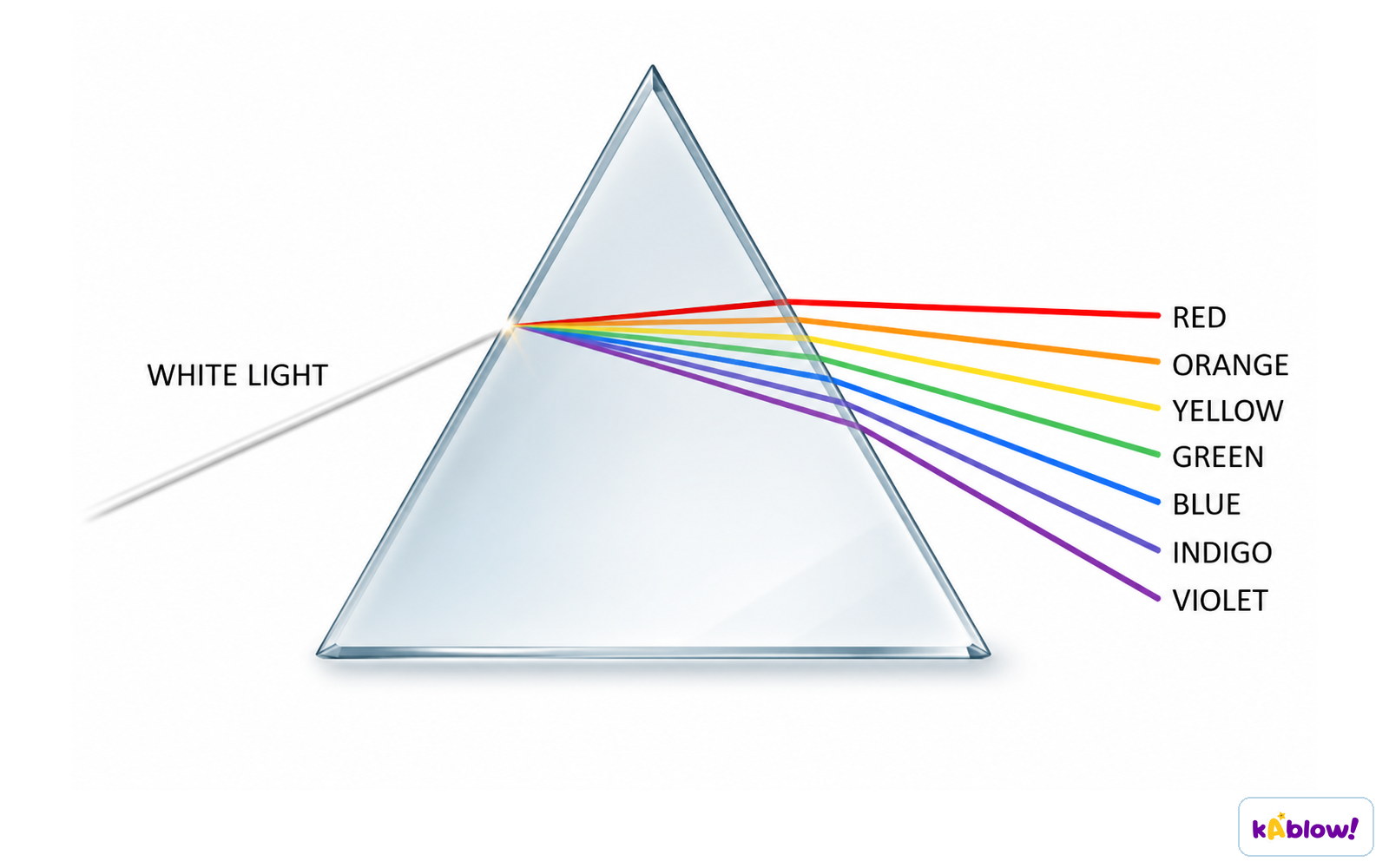
- Passing white light through a prism splits it into a spectrum of colours.
- This splitting is called dispersion and is what causes rainbows.
- The colours in order from longest to shortest wavelength are: red, orange, yellow, green, blue, indigo, violet (ROY G. BIV).
White light is dispersed into the visible spectrum by a glass prism.
Dispersion and Refraction
- Dispersion happens because different colours of light have different refractive indices in a medium.
- Each colour refracts by a different amount when entering a prism.
- Violet refracts most because it experiences the highest refractive index ("violet bends most violently").
- Red refracts least because it experiences the lowest refractive index.
White light is dispersed into the visible spectrum by a glass prism.
Colour Filters
- A colour filter transmits only one colour of light and absorbs all other colours.
- For example, a red filter transmits only red light; a green filter transmits only green light.
Colour of Objects
- An object appears a certain colour because it reflects that colour of light into our eyes.
- A green object reflects only green light and absorbs all other colours.
- A red object reflects only red light.
- A white object reflects all seven colours of the spectrum.
Combining Filters and Object Colour
- If white light passes through a yellow filter, only yellow light is transmitted.
- If that yellow light shines on a blue object, the object appears black because it can only reflect blue light, but no blue light is present.
Refraction of light entering a prism: different colours refract by different amounts (violet most, red least).
Reflection of light from a surface: angle of incidence equals angle of reflection.
Folien
Sign up free to view the lesson slides
Step through every slide for this topic — plus flashcards and revision notes — with a free account.
Übungsfragen
Gratis-Vorschau — 8 von 57 Fragen. Registriere dich, um alle zu sehen.
1.What is the splitting of white light into a spectrum called?
Easy- ADispersion
- BReflection
- CRefraction
- DAbsorption
2.How many colours are in the spectrum of white light?
Easy- A7
- B5
- C6
- D3
3.Which colour of light refracts the most in a prism?
Easy- AViolet
- BRed
- CBlue
- DGreen
4.Which colour of light has the longest wavelength in the visible spectrum?
Easy- ARed
- BViolet
- CBlue
- DGreen
5.A red filter is placed in front of a white light source. What colour light is transmitted?
Easy- ARed
- BWhite
- CBlue
- DNo light
6.Why does a green object appear green?
Medium- AIt reflects green light into our eyes.
- BIt transmits green light.
- CIt absorbs green light.
- DIt emits green light.
7.White light is passed through a yellow filter and then shines onto a blue object. What colour does the object appear?
Medium- ABlack
- BBlue
- CYellow
- DGreen
8.Which of the following statements about dispersion is true?
Medium- ADispersion is caused by different colours refracting by different amounts.
- BDispersion is caused by reflection.
- CAll colours refract by the same amount in a prism.
- DDispersion only occurs in rainbows.
Unlock all 57 questions, flashcards & more
Erstelle ein Gratis-Konto, um alle Fragen, Folien, Karteikarten und Lernnotizen zu diesem Thema zu sehen.