Resistance
Lerne es beim Spielen
Beantworte diese Fragen für Energie, dann angle und erkunde. Kein Konto nötig.
Lektionsnotizen
What is Resistance?
- Resistance is a measure of how hard it is for current to flow through a component.
- Resistance is measured in ohms (Ω).
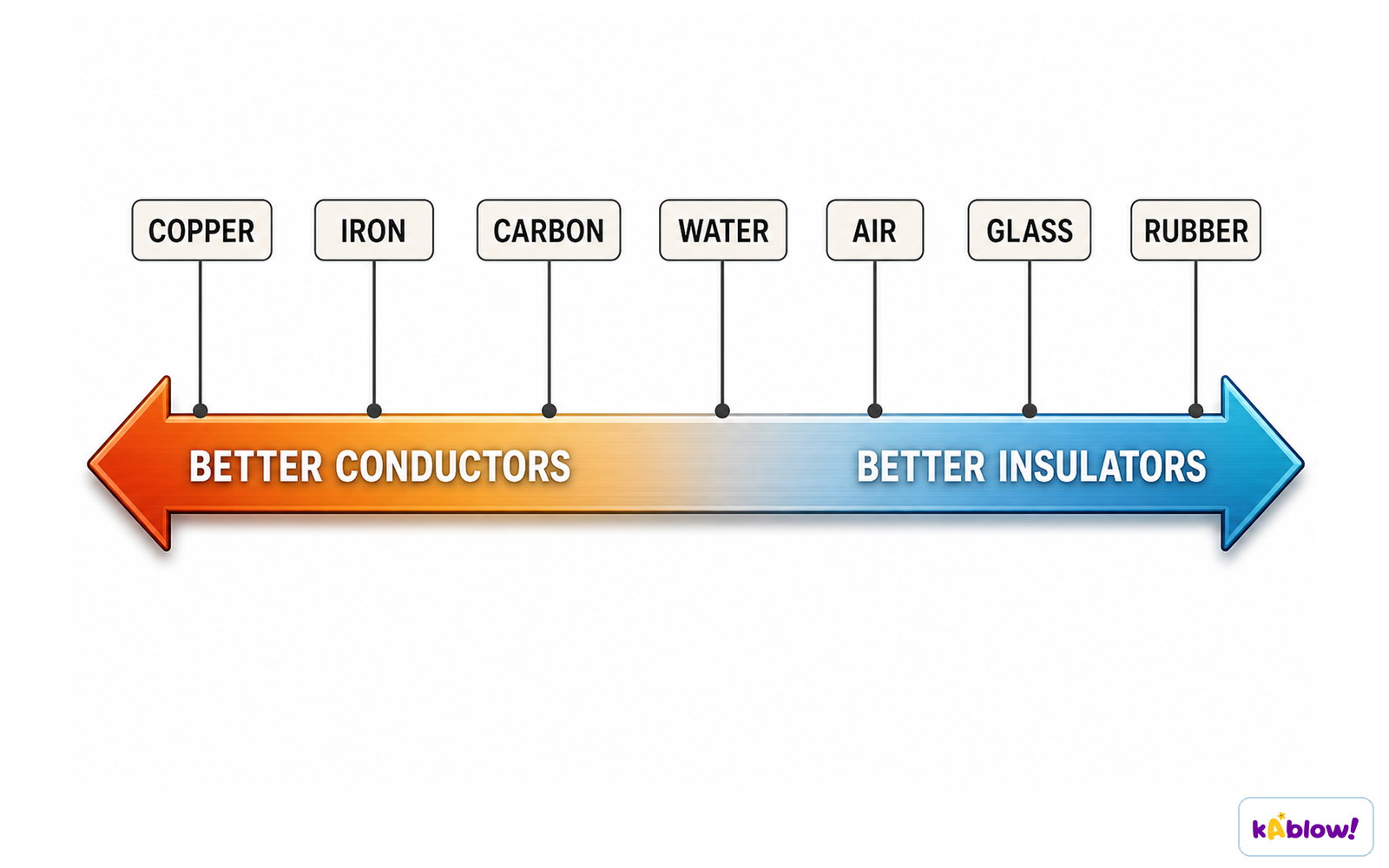
- Conductors (e.g. metals) have low resistance; insulators (e.g. plastic) have high resistance.
Materials form a range from good conductors like copper and iron to good insulators like glass and rubber.
The Resistance Equation
- The equation linking potential difference (V), current (I) and resistance (R) is: V = I × R.
- Rearranged: R = V ÷ I and I = V ÷ R.
- Resistance is the ratio of potential difference to current.
Using the Equation
- To find potential difference: V = I × R (units: V = A × Ω).
- To find resistance: R = V ÷ I (units: Ω = V ÷ A).
- Always write the equation, substitute values, then calculate with units.
Example Calculations
- Example 1: A lamp with R = 20 Ω and I = 0.5 A → V = 0.5 × 20 = 10 V.
- Example 2: A resistor with V = 5 V and I = 2 A → R = 5 ÷ 2 = 2.5 Ω.
Converting Kiloohms
- Resistance can be given in kiloohms (kΩ).
- 1 kΩ = 1000 Ω.
- To convert kΩ to Ω: multiply by 1000.
A series circuit showing a cell, resistor, ammeter and lamp. The ammeter measures current.
Folien
Sign up free to view the lesson slides
Step through every slide for this topic — plus flashcards and revision notes — with a free account.
Übungsfragen
Gratis-Vorschau — 8 von 40 Fragen. Registriere dich, um alle zu sehen.
1.State the equation that links potential difference, current and resistance.
Easy- AV = I × R
- BV = I ÷ R
- CV = R ÷ I
- DV = I + R
2.State the unit of resistance.
Easy- AOhms (Ω)
- BVolts (V)
- CAmps (A)
- DWatts (W)
3.Which of the following best describes the difference between an electrical conductor and an insulator?
Easy- AA conductor has low resistance; an insulator has high resistance.
- BA conductor has high resistance; an insulator has low resistance.
- CA conductor allows current to flow easily; an insulator does not allow current to flow at all.
- DA conductor is made of plastic; an insulator is made of metal.
4.A lamp has a resistance of 15 Ω and a current of 2.0 A flowing through it. Calculate the potential difference across the lamp.
Medium- A30 V
- B7.5 V
- C0.13 V
- D17 V
5.A resistor has a resistance of 500 Ω and a current of 0.10 A flowing through it. Calculate the potential difference across the resistor.
Medium- A50 V
- B5000 V
- C0.0002 V
- D5 V
6.Using the information in the diagram (a series circuit with a cell, switch, lamp, and ammeter), calculate the resistance of the lamp if the voltmeter across the lamp reads 6 V and the ammeter reads 2 A.
Medium- A3 Ω
- B12 Ω
- C0.33 Ω
- D8 Ω
7.A resistor has a resistance of 100 Ω and a current of 0.8 A flowing through it. Calculate the potential difference across the resistor.
Medium- A80 V
- B125 V
- C0.008 V
- D100.8 V
8.A light dependent resistor (LDR) has a potential difference of 6 V across it and a current of 0.02 A flowing through it. Calculate the resistance of the LDR.
Hard- A300 Ω
- B0.12 Ω
- C120 Ω
- D0.0033 Ω
Unlock all 40 questions, flashcards & more
Erstelle ein Gratis-Konto, um alle Fragen, Folien, Karteikarten und Lernnotizen zu diesem Thema zu sehen.