Types of force
Lerne es beim Spielen
Beantworte diese Fragen für Energie, dann angle und erkunde. Kein Konto nötig.
Für Lehrkräfte: sofort einsetzbare Lektionsfolien, Lernnotizen, Diagramme für Types of force (KS3 Science, Physics) — nutze sie in deiner Lektion oder starte das Thema als interaktive Klassenaktivität, die deine Lernenden als Live-Spiel spielen.
Lektionsnotizen
Contact vs Non-Contact Forces
- Contact forces act when two objects are physically touching.
- Non-contact forces act between objects that are not touching.
- Examples of contact forces: air resistance, friction, normal reaction, tension, thrust, upthrust.
- Examples of non-contact forces: gravitational, magnetic, weight.
Contact Forces
- Air resistance is a contact force that opposes motion through air.
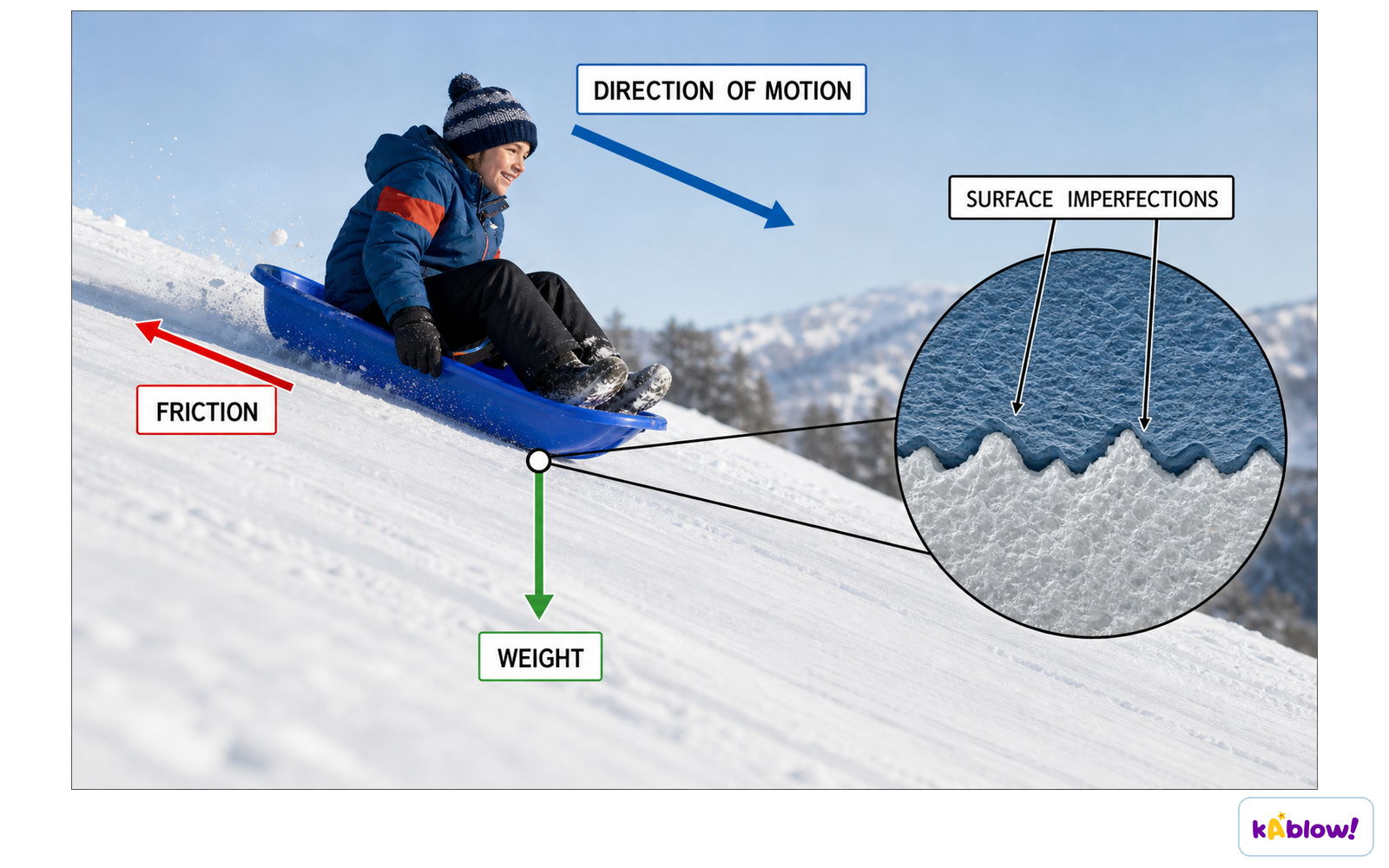
- Friction is a contact force that opposes motion when two surfaces rub together.
- Normal reaction is a contact force acting perpendicular to a surface, opposing weight.
- Tension is a contact force in a rope or cable being pulled.
- Thrust is a contact force produced by an engine or rocket, pushing forwards.
- Upthrust is an upward contact force that allows objects to float in fluids.
Friction happens because imperfections on the two surfaces at the molecular level push against each other.
Non-Contact Forces
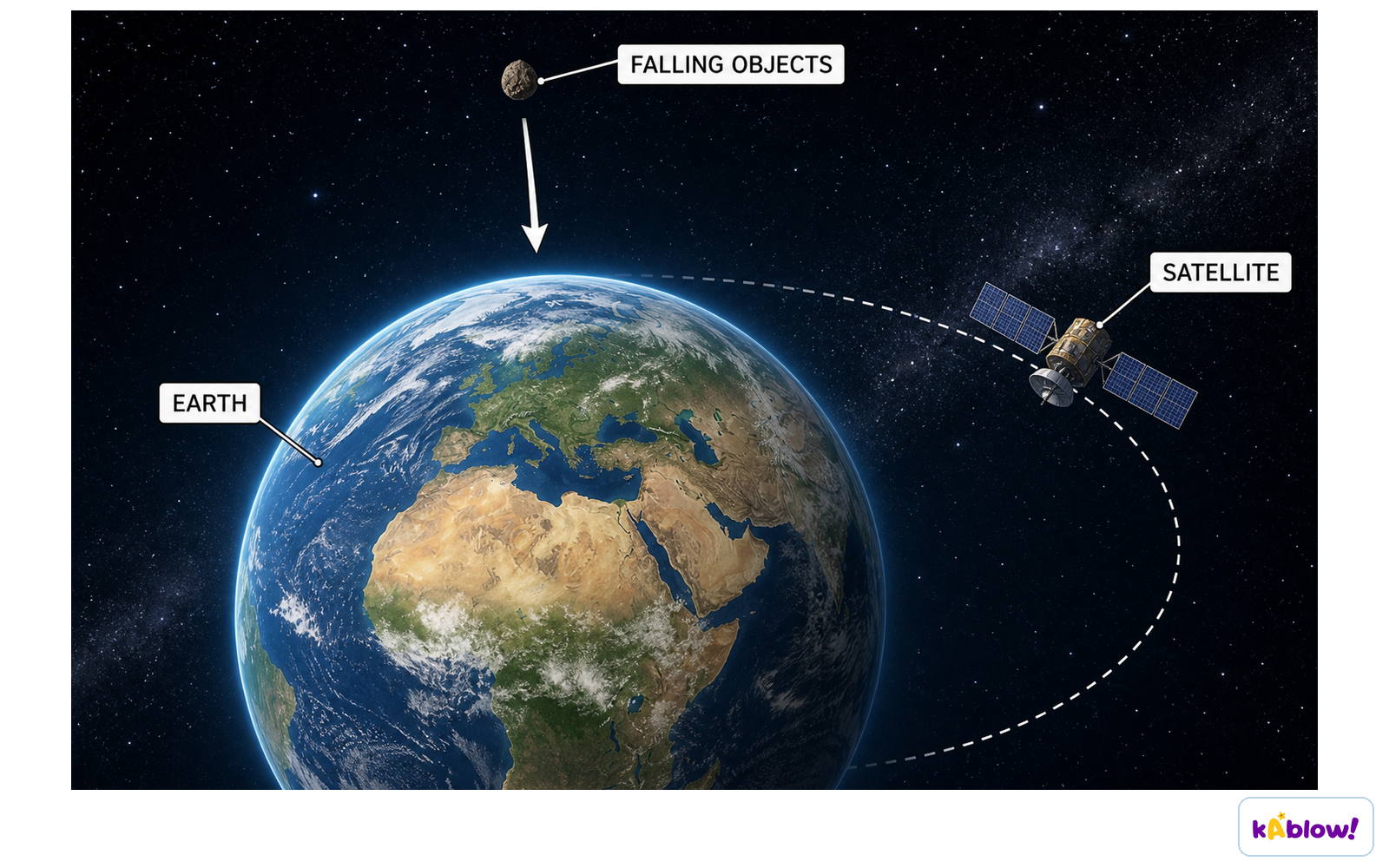
- Gravitational force is an attractive non-contact force between any two masses.
- Magnetic force is a non-contact force from magnetic fields; can attract or repel.
- Weight is a non-contact force due to gravity acting on an object's mass.
Phenomena caused by gravitational attraction and the weight force: falling objects and a satellite held in orbit around Earth.
Balanced and Unbalanced Forces
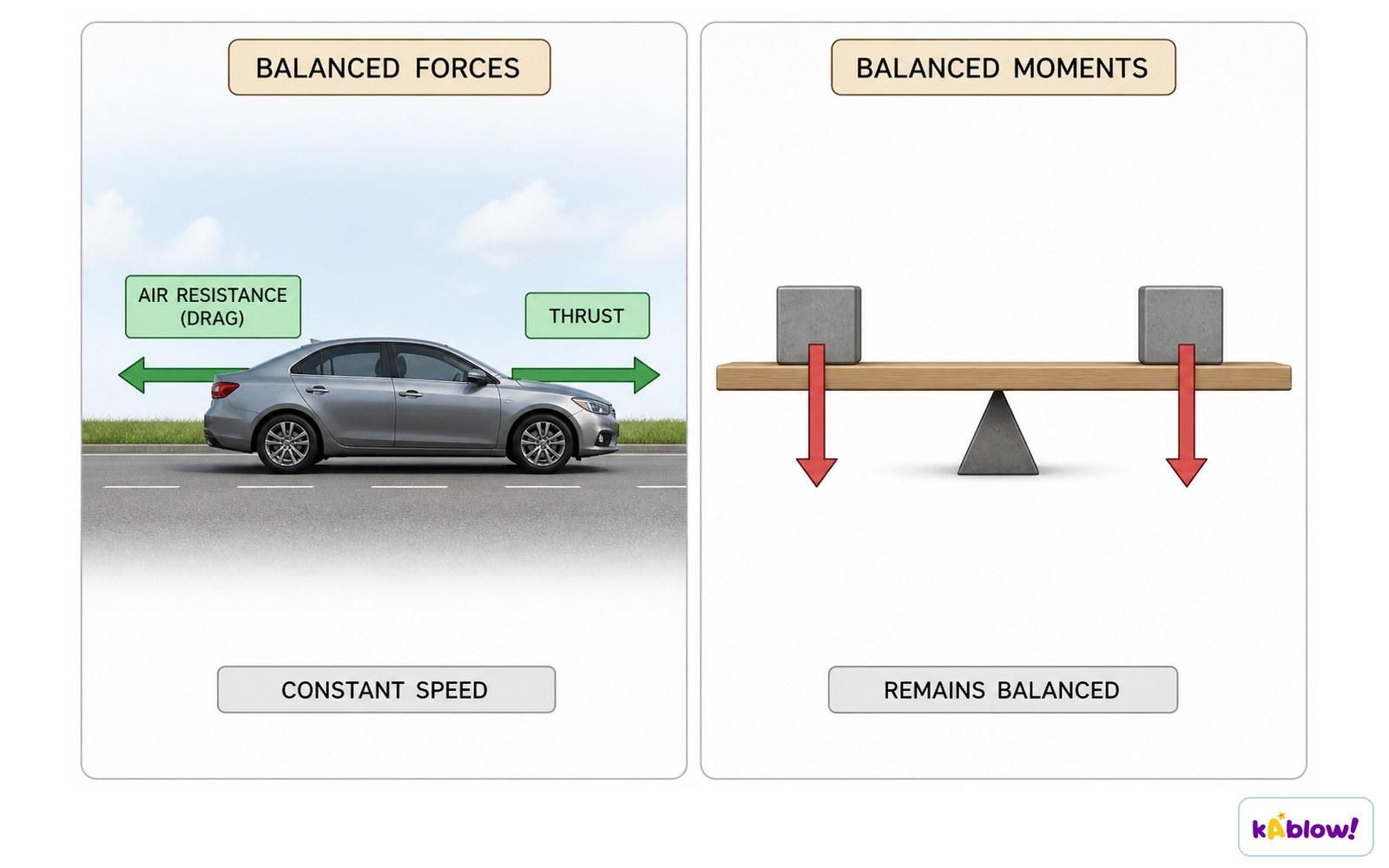
- Balanced forces are equal in size and opposite in direction, resulting in no change in motion.
- If forces are balanced, an object's speed remains constant (or stays at rest).
- If the forward force (thrust) is greater than the backward force (friction + air resistance), the object accelerates.
When the forces and moments on an object are balanced, the object remains in equilibrium.
Particle arrangement in solids, liquids, and gases – relevant to understanding how contact forces (e.g., friction) arise from particle interactions.
Folien
Sign up free to view the lesson slides
Step through every slide for this topic — plus flashcards and revision notes — with a free account.
Übungsfragen
Gratis-Vorschau — 8 von 56 Fragen. Registriere dich, um alle zu sehen.
1.Which of the following is a non-contact force?
Easy- AGravitational force
- BFriction
- CAir resistance
- DTension
2.Which force allows objects to float in a fluid?
Easy- AUpthrust
- BWeight
- CThrust
- DNormal reaction
3.Friction is a type of:
Easy- Acontact force
- Bnon-contact force
- Cmagnetic force
- Dgravitational force
4.Which of the following statements is true?
Easy- AWeight is a non-contact force.
- BWeight is a contact force.
- CWeight is a type of friction.
- DWeight is a magnetic force.
5.Air resistance acts:
Easy- Aagainst the direction of motion
- Bin the direction of motion
- Cperpendicular to the direction of motion
- Donly when an object is stationary
6.Which force is produced by an engine or rocket?
Easy- AThrust
- BTension
- CUpthrust
- DNormal reaction
7.A skydiver falling through the air experiences two main forces. Which are they?
Easy- AWeight and air resistance
- BWeight and upthrust
- CThrust and friction
- DTension and normal reaction
8.If two forces on an object are balanced, what happens to the object's speed?
Easy- AIt remains constant
- BIt increases
- CIt decreases
- DIt becomes zero
Unlock all 56 questions, flashcards & more
Erstelle ein Gratis-Konto, um alle Fragen, Folien, Karteikarten und Lernnotizen zu diesem Thema zu sehen.
Altklausuren
Altklausuren-Übungen für dieses Thema kommen bald.
Bald verfügbar