Earth, sun and moon: phases, eclipses and seasons
Lerne es beim Spielen
Beantworte diese Fragen für Energie, dann angle und erkunde. Kein Konto nötig.
Lektionsnotizen
Moon's Orbit and Rotation
- The Moon orbits Earth once every 27.3 days.
- The Moon rotates on its axis once every 27.3 days (same as its orbital period).
- Because rotation and revolution are synchronized, we always see the same side of the Moon (nearside).
- The Moon's orbit is elliptical, so its distance from Earth varies; average distance is about 385,000 km.
- The Moon moves anti-clockwise around Earth when viewed from above the North Pole.
- The Moon's diameter is just under one-third of Earth's diameter.
Phases of the Moon
- The Moon does not make its own light — we see it because it reflects sunlight from the Sun.
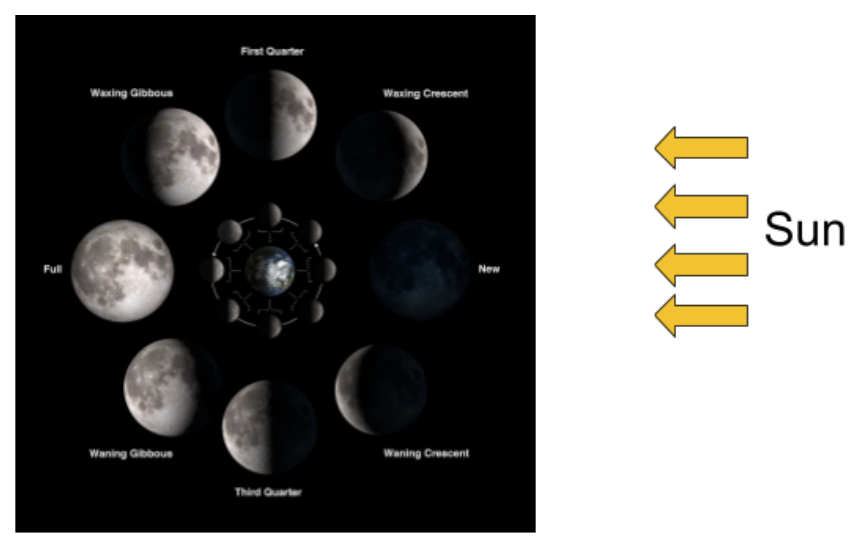
- The Moon is always half lit by the Sun. As the Moon orbits Earth, different portions of that lit half face Earth, which is why its shape appears to change.
- The 8 phases, in order, are: new moon, waxing crescent, first quarter, waxing gibbous, full moon, waning gibbous, third quarter, and waning crescent.
- At new moon, the lit side faces away from Earth. At full moon, the lit side faces directly toward Earth.
- This cycle of phases repeats about every 28 days.
Phases of the Moon
Moon's Surface
- The Moon's surface is covered with regolith (lunar soil), which lacks organic matter.
- Dark areas on the Moon are called maria (seas), which are basaltic plains.
- Bright areas are called highlands, which are higher in elevation.
- The nearside has more maria than the farside.
- The farside was first photographed by the Soviet spacecraft Luna 3 in 1959.
Solar Eclipses
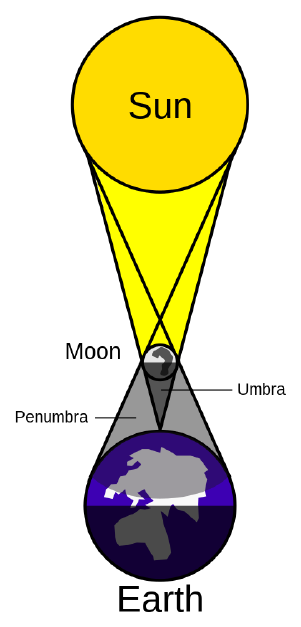
- A solar eclipse occurs when the Moon passes directly between the Sun and Earth, blocking the Sun's light.
- Solar eclipses happen only when the Sun, Moon, and Earth are aligned in the ecliptic plane.
- The Moon's shadow has two parts: the umbra (inner, fully dark) and the penumbra (outer, partially dark).
- A total solar eclipse happens when the Moon completely covers the Sun, visible only from within the umbra.
- A partial solar eclipse occurs when only part of the Sun is blocked, visible from the penumbra.
- Solar eclipses are rare and brief because the Moon's shadow covers a small area and Earth rotates rapidly.
- During totality, the Sun's corona and solar prominences become visible.
Solar eclipse geometry
Lunar Eclipses
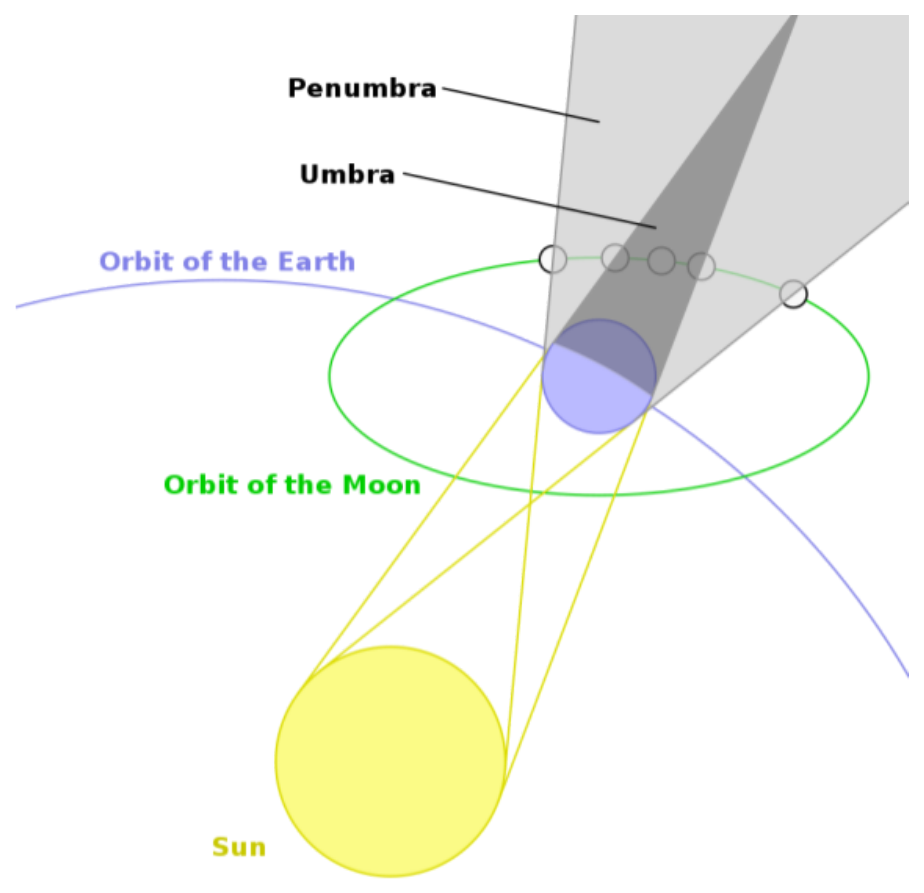
- A lunar eclipse occurs when the Earth passes between the Sun and the Moon, casting its shadow on the Moon.
- Lunar eclipses happen only during a full moon when all three bodies are aligned in the ecliptic plane.
- Earth's shadow also has an umbra and penumbra.
- A total lunar eclipse occurs when the Moon passes completely into Earth's umbra.
- A partial lunar eclipse occurs when only part of the Moon enters the umbra.
- Lunar eclipses can last for hours and are visible from anywhere on Earth's night side.
- Lunar eclipses do not occur monthly because the Moon's orbit is inclined about 5° to Earth's orbit.
Lunar eclipse geometry
Seasons: Cause and Effect
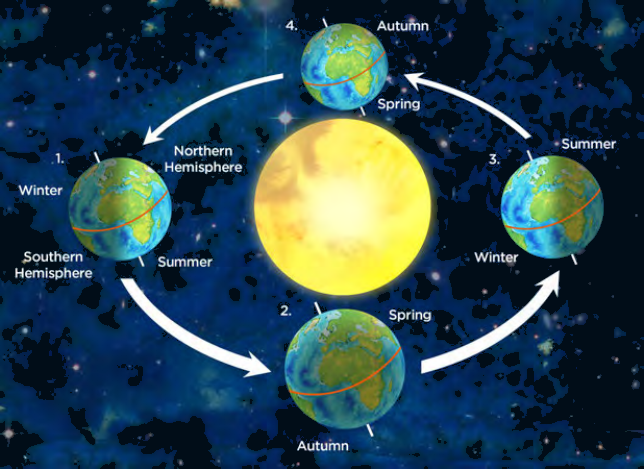
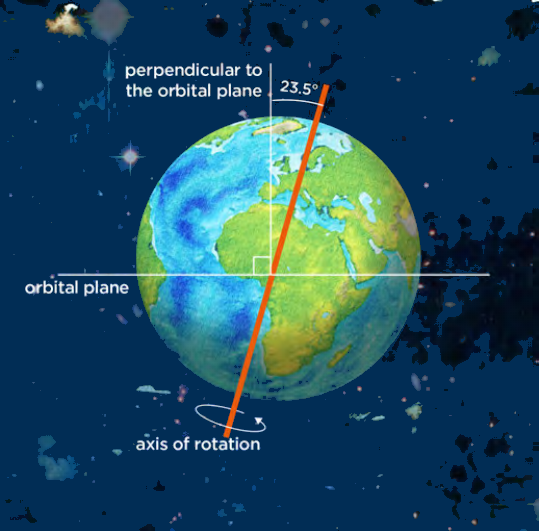
- Seasons are caused by the 23.5-degree tilt of Earth's axis and its revolution around the Sun.
- Earth's axis always points in the same direction, toward Polaris (the North Star).
- When a hemisphere is tilted toward the Sun, it receives more direct sunlight and has longer days, causing summer.
- When a hemisphere is tilted away from the Sun, it receives indirect sunlight and has shorter days, causing winter.
- The distance from the Sun does not cause seasons; in fact, Earth is closest to the Sun during Northern Hemisphere winter.
- Seasons are reversed in the Northern and Southern Hemispheres.
Earth's revolution around the Sun showing the seasons in the Northern and Southern Hemispheres.
Solstices and Equinoxes
- The summer solstice (around June 21) is when the Sun's rays hit the Tropic of Cancer most directly; it's the longest day in the Northern Hemisphere.
- The winter solstice (around December 21) is when the Sun's rays hit the Tropic of Capricorn most directly; it's the shortest day in the Northern Hemisphere.
- At the equinoxes (around March 21 and September 22), the Sun shines directly on the equator, and day and night are nearly equal.
- The vernal equinox occurs in spring, and the autumnal equinox occurs in fall.
- Solstices and equinoxes mark the start of seasons in many calendars.
Earth's axial tilt relative to its orbital plane
Key Vocabulary
- Orbit: The path an object takes around another object.
- Rotation: The spinning of an object on its axis.
- Revolution: The movement of one object around another.
- Axis: An imaginary line through the center of an object around which it rotates.
- Ecliptic: The plane of Earth's orbit around the Sun.
- Umbra: The inner, darkest part of a shadow.
- Penumbra: The outer, lighter part of a shadow.
- Solstice: The time when the Sun reaches its highest or lowest point in the sky at noon.
- Equinox: The time when the Sun crosses the celestial equator, making day and night equal.
Folien
Sign up free to view the lesson slides
Step through every slide for this topic — plus flashcards and revision notes — with a free account.
Übungsfragen
Gratis-Vorschau — 8 von 38 Fragen. Registriere dich, um alle zu sehen.
1.What is the term for the apparent shape of the Moon as seen from Earth?
Easy- ALunar phase
- BLunar eclipse
- CSolar eclipse
- DLunar cycle
2.How long does it take for the Moon to complete one cycle of phases?
Easy- AAbout 29.5 days
- BAbout 365 days
- CAbout 24 hours
- DAbout 7 days
3.During which lunar phase does the Moon appear completely dark from Earth?
Medium- ANew moon
- BFull moon
- CFirst quarter
- DWaning crescent
4.What is the correct order of lunar phases from new moon to full moon?
Medium- ANew moon, waxing crescent, first quarter, waxing gibbous, full moon
- BNew moon, waning crescent, first quarter, waning gibbous, full moon
- CNew moon, first quarter, waxing crescent, waxing gibbous, full moon
- DNew moon, waxing gibbous, first quarter, waxing crescent, full moon
5.If the Moon is at first quarter phase, what is its approximate angular separation from the Sun as seen from Earth?
Hard- A90°
- B0°
- C180°
- D270°
6.What causes the changing phases of the Moon?
Easy- AThe changing position of the Moon in its orbit around Earth, affecting how much of its sunlit side we see
- BEarth's shadow falling on the Moon
- CThe Moon rotating on its axis
- DClouds blocking parts of the Moon
7.Which term describes the Moon when its illuminated portion is increasing from new to full?
Medium- AWaxing
- BWaning
- CGibbous
- DCrescent
8.In the Northern Hemisphere, during which season does the full moon appear highest in the sky?
Hard- AWinter
- BSummer
- CSpring
- DAutumn
Unlock all 38 questions, flashcards & more
Erstelle ein Gratis-Konto, um alle Fragen, Folien, Karteikarten und Lernnotizen zu diesem Thema zu sehen.