Cell division
Apréndelo jugando
Responde estas preguntas para ganar energía, luego pesca y explora. Sin cuenta.
Apuntes de la lección
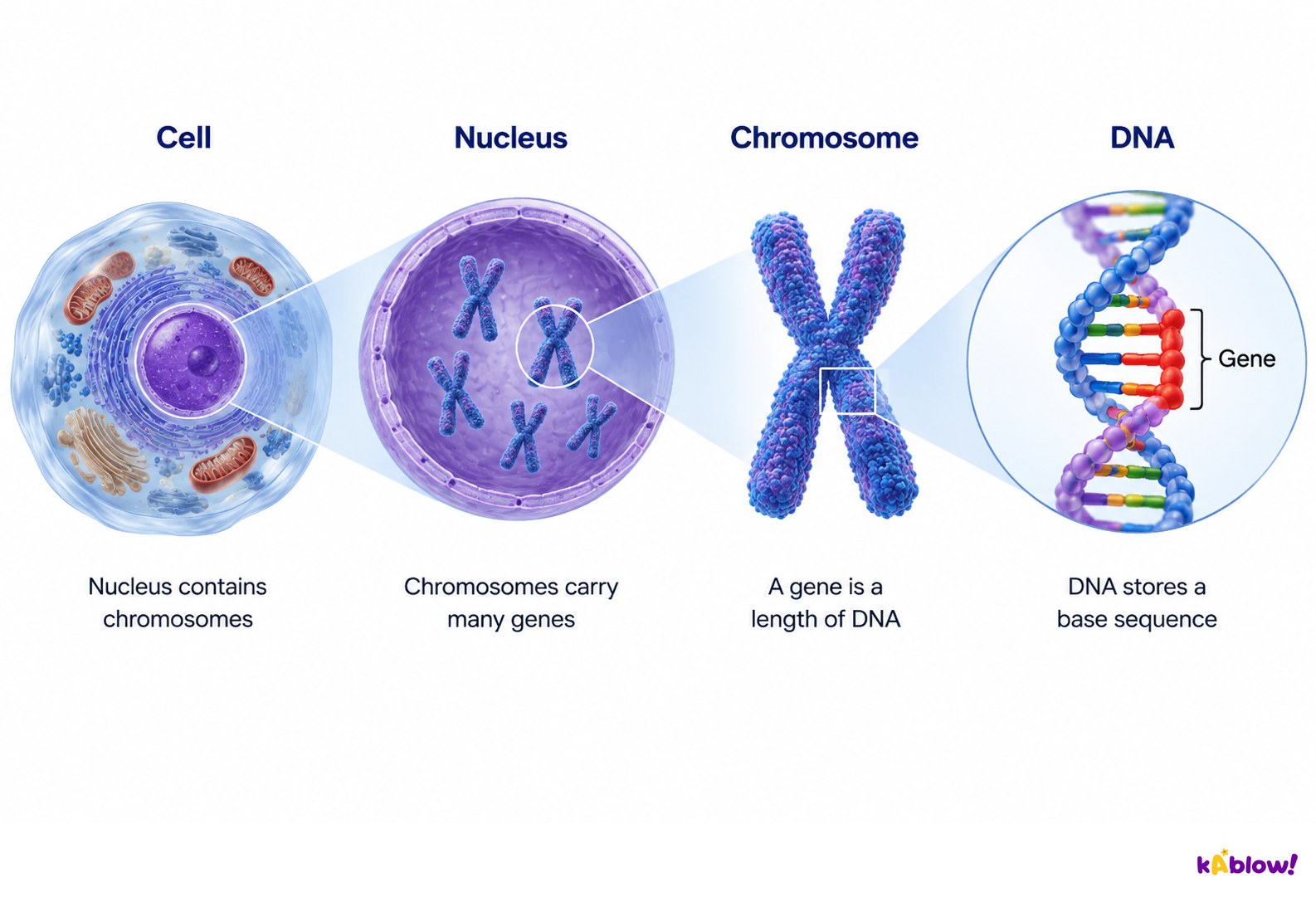
Chromosomes
- The nucleus of a eukaryotic cell contains thread-like structures called chromosomes.
- Chromosomes are made from long, coiled strands of DNA; each chromosome contains one DNA molecule.
- A chromosome carries many genes, and different versions of the same gene are called alleles.
- In body cells of diploid organisms, chromosomes are found in pairs — one inherited from the mother, one from the father.
- Different species have different numbers of chromosomes: humans have 46 chromosomes (23 pairs); horses have 64 (32 pairs).
- Red blood cells are an exception — they lose their nucleus, so they have no chromosomes.
- Before a cell divides, its DNA is doubled, giving the characteristic 'X' shape seen in micrographs.
Zooming from cell to gene: chromosomes in the nucleus, made of DNA wrapped around proteins.
The Cell Cycle
- The cell cycle is the series of stages in the life of a cell, made up of three overall parts.
- Interphase (growth phase): just before mitosis, the DNA copies itself exactly and the number of sub-cellular structures such as ribosomes and mitochondria increases.
- Mitosis: the nucleus divides — chromosomes line up along the centre of the cell and cell fibres pull them apart.
- Cytokinesis: the cytoplasm and cell membrane divide, producing two daughter cells, each with a copy of every chromosome.
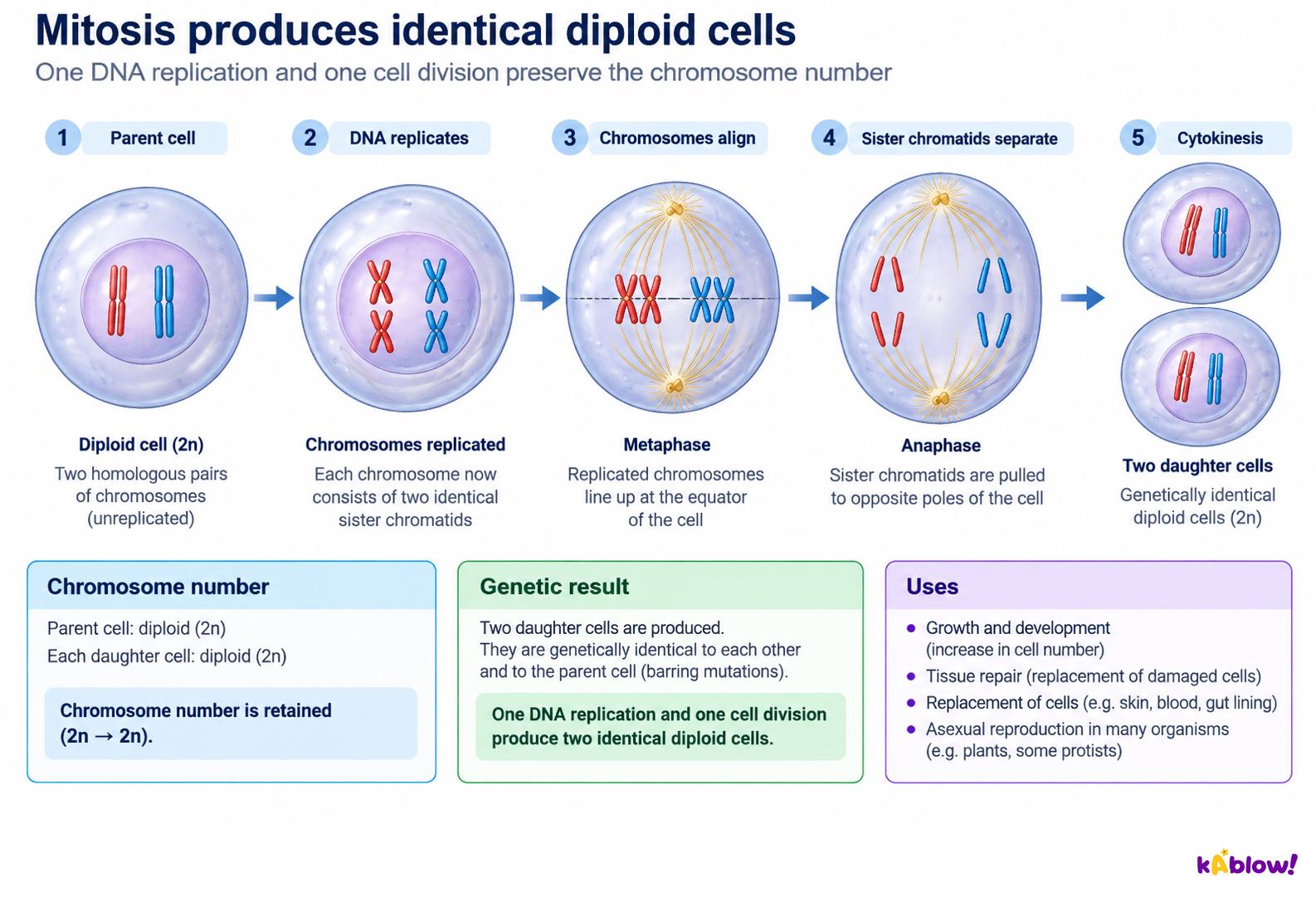
- During interphase, two copies of each chromosome are produced; these copies are called chromatids and initially remain attached to each other.
Mitosis
- Mitosis is a nuclear division that produces two genetically identical diploid daughter cells.
- In humans, the diploid number is 23 pairs of chromosomes (46 in total).
- All body cells (not gametes) are produced by mitosis of the zygote.
- Mitosis is needed for growth (producing new cells), repair (replacing damaged or dead cells) and asexual reproduction (producing offspring genetically identical to the parent).
- During mitosis, chromosomes line up along the equator of the cell, the chromatids are separated and pulled to opposite ends, and a new nucleus forms around each group of chromosomes.
- After mitosis, cytokinesis divides the cytoplasm and cell membrane, forming two genetically identical daughter cells.
- If you start with one cell and it divides n times, you end up with 2ⁿ cells (e.g. 7 divisions give 2⁷ = 128 cells).
Mitosis
Uncontrolled Cell Division and Cancer
- Cells divide by mitosis to produce more cells — essential for growth and to repair damaged cells.
- For example, cells of the intestines constantly divide to replace those shed as food moves through the digestive system.
- The cell cycle is regulated by many different genes so that cells divide only when needed and stop when required.
- Cancer is caused by mutations in DNA that lead to uncontrolled cell growth and division, forming a tumour (a mass of cells).
- Benign tumours are growths of abnormal cells contained in one area, usually within a membrane; they do not invade other parts of the body and are not cancerous.
- Malignant tumours are cancerous — their cells invade neighbouring tissues and spread via the blood and lymphatic system to form secondary tumours.
- Malignant tumours are dangerous because they disrupt the functioning of the organ they originate in and the organs they spread to.
Stem Cells
- A stem cell is an undifferentiated cell capable of dividing to produce many more cells of the same type.
- Stem cells can give rise to other cell types through the process of differentiation.
- Embryonic stem cells are found in the very early embryo and can differentiate into any type of body cell.
- Adult stem cells are partially specialised and can only differentiate into a few cell types (mainly blood cells); they are used to replace damaged cells and for growth.
- Adult stem cells are found in bone marrow, skin, and some other organs such as the liver and brain.
- Umbilical cord blood contains stem cells that can differentiate into blood cells, muscle and nerve tissue.
- In plants, stem cells are found in the meristem tissue at the tips of roots and shoots; they can differentiate into any type of plant cell throughout the plant's life.
Stem Cells in Medicine
- Adult stem cells can be cultured in the lab and made to differentiate into specialised cells (mainly blood cells) but into fewer types than embryonic stem cells.
- Stem cells are already used to treat some diseases such as leukaemia, and have potential to treat diabetes and paralysis in the future.
- Embryonic stem cells can be stimulated to differentiate into most types of specialised cell, so they are potentially very effective for treating diseases or repairing damaged organs.
- Therapeutic cloning produces an embryo with the same genes as the patient, so stem cells from it are not rejected by the patient's body.
- Benefits of stem cell therapy include treating a wide variety of diseases, reducing the risk of organ rejection, and avoiding the wait for an organ donation.
- Risks include transfer of viral infection from cultured cells, accumulation of mutations that could lead to cancer, and low numbers of stem cell donors.
- Ethical issues include whether it is right to use unused IVF embryos, create and destroy embryos through therapeutic cloning, and whether an embryo should be treated as a person.
Plant Stem Cells and Cloning
- Plant stem cells can be obtained easily and without ethical objection from meristems.
- They can be used to produce clones of plants quickly and economically — clones can be produced in weeks at relatively low cost.
- Rare species at risk of extinction can be cloned to protect them and maintain biodiversity.
- The plants produced are clones, so although numbers increase, genetic diversity within the clones is low.
- Crop plants with special features such as disease or pest resistance can be cloned to produce large numbers of identical plants for farmers.
- This reduces the need to use chemicals such as pesticides, which has environmental benefits.
Growth and Cell Differentiation
- Growth is a permanent increase in size or mass.
- Both plants and animals grow via cell division (mitosis) and cell differentiation.
- Plants also grow through cell elongation, where hormones such as auxin cause cells to grow longer in response to stimuli like sunlight.
- As a multicellular organism develops, its cells differentiate to form specialised cells with structural adaptations for specific functions.
- Almost all cells in a multicellular organism contain the same genetic information, but each cell has a different set of active genes.
- In animals, most cells differentiate early in development and lose the ability to differentiate further; cell division is mainly for repair and replacement in mature animals.
- In plants, many types of cell retain the ability to fully differentiate throughout the life of the plant.
Diapositivas
Sign up free to view the lesson slides
Step through every slide for this topic — plus flashcards and revision notes — with a free account.
Preguntas de práctica
Vista previa gratis — 8 de 63 preguntas. Regístrate para verlas todas.
1.Which of the following statements indicates that a cell is preparing to divide?
Easy- AThe nucleus has visible pores
- BThe nucleus is visible and 'X' shaped
- CThe chromosomes are visible and 'X' shaped
- DThere is a haploid number of chromosomes
2.A diploid nucleus from the body cell of a dog contains 78 chromosomes. How many chromosomes would be found in the nucleus of a dog's gamete?
Medium- A156
- B78
- C39
- D23
3.Which of the following statements about stem cells is not true?
Medium- AMeristem cells can differentiate into any type of plant cell throughout the life of the plant
- BAdult stem cells are partially specialised
- CUmbilical cord stem cells can develop into any of the different cell types in the human body
- DEmbryonic stem cells could be used to cure type 1 diabetes
4.Which of the following is a true statement about mitosis?
Medium- AMitosis produces genetically identical cells
- BA cell divides twice in the process of mitosis
- CDaughter cells from mitosis are haploid
- DDNA is replicated after mitosis
5.A cell is observed under a microscope as it prepares for mitosis. Which of the following observations indicates that the cell is preparing to divide?
Medium- AThe nucleus has visible pores
- BThe nucleus is visible and 'X' shaped
- CThe chromosomes are visible and 'X' shaped
- DThere is a haploid number of chromosomes
6.Which of the following statements about mitosis are true? (select all that apply)
Medium- AMitosis produces genetically identical cells
- BA cell divides twice in the process of mitosis
- CDaughter cells from mitosis are haploid
- DDNA is replicated before a cell can divide
- EMitosis is important for growth and repair
7.In mitosis, the chromosome number is halved in the daughter cells.
EasyTrue or false?
8.DNA replication occurs during interphase, before mitosis begins.
EasyTrue or false?
Unlock all 63 questions, flashcards & more
Crea una cuenta gratis para ver todas las preguntas, las diapositivas, las tarjetas y los apuntes de repaso de este tema.