Identification of ions by chemical and spectroscopic means
Apréndelo jugando
Responde estas preguntas para ganar energía, luego pesca y explora. Sin cuenta.
Apuntes de la lección
Flame Tests
- Metal ions produce a characteristic colour when heated strongly in a flame, so flame tests identify metal cations.
- Clean the wire by dipping it in dilute acid and holding it in a blue Bunsen flame until no colour is seen; this prevents contamination.
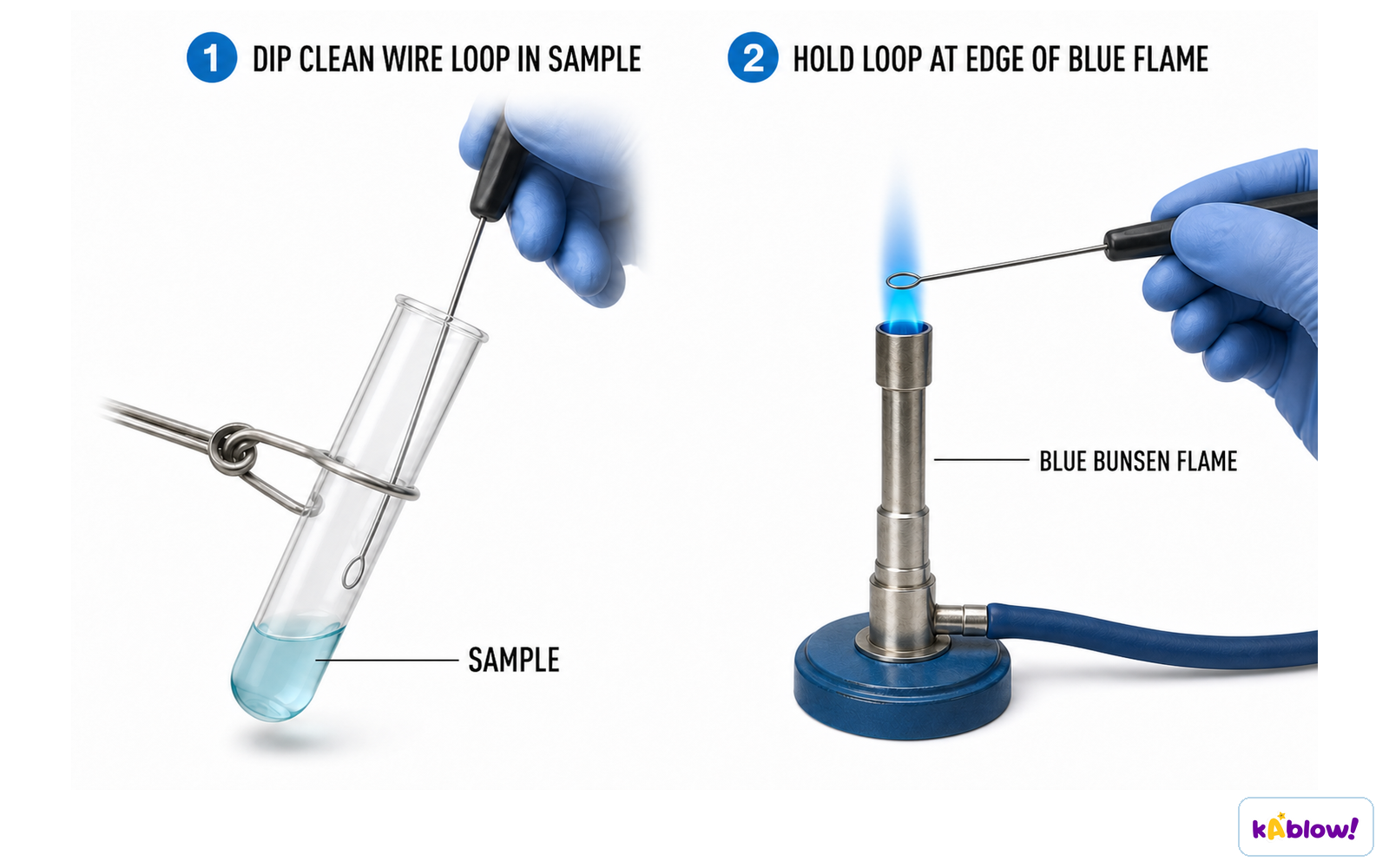
- Dip the clean wire into the sample, then place it in the edge of the blue flame and note the colour.
- Flame colours: lithium crimson, sodium yellow, potassium lilac, calcium orange-red, copper green.
- If a mixture of ions is present, colours can mask each other, making identification unreliable.
- Use a blue flame because the sample must be heated strongly; avoid overheating the wire until it glows red.
Diagram showing the technique for carrying out a flame test
Metal Hydroxides
- Adding sodium hydroxide solution to metal cations forms coloured precipitates of metal hydroxides.
- Add a few drops of NaOH first, then add excess, because some precipitates dissolve in excess NaOH.
- Copper(II) gives a blue precipitate; iron(II) gives a green precipitate; iron(III) gives a brown precipitate.
- Calcium, magnesium and aluminium ions form white precipitates with NaOH.
- Aluminium hydroxide dissolves in excess NaOH to give a colourless solution, but calcium and magnesium hydroxides do not dissolve.
- A flame test can distinguish between calcium and magnesium ions.
Testing for Ammonium Ions
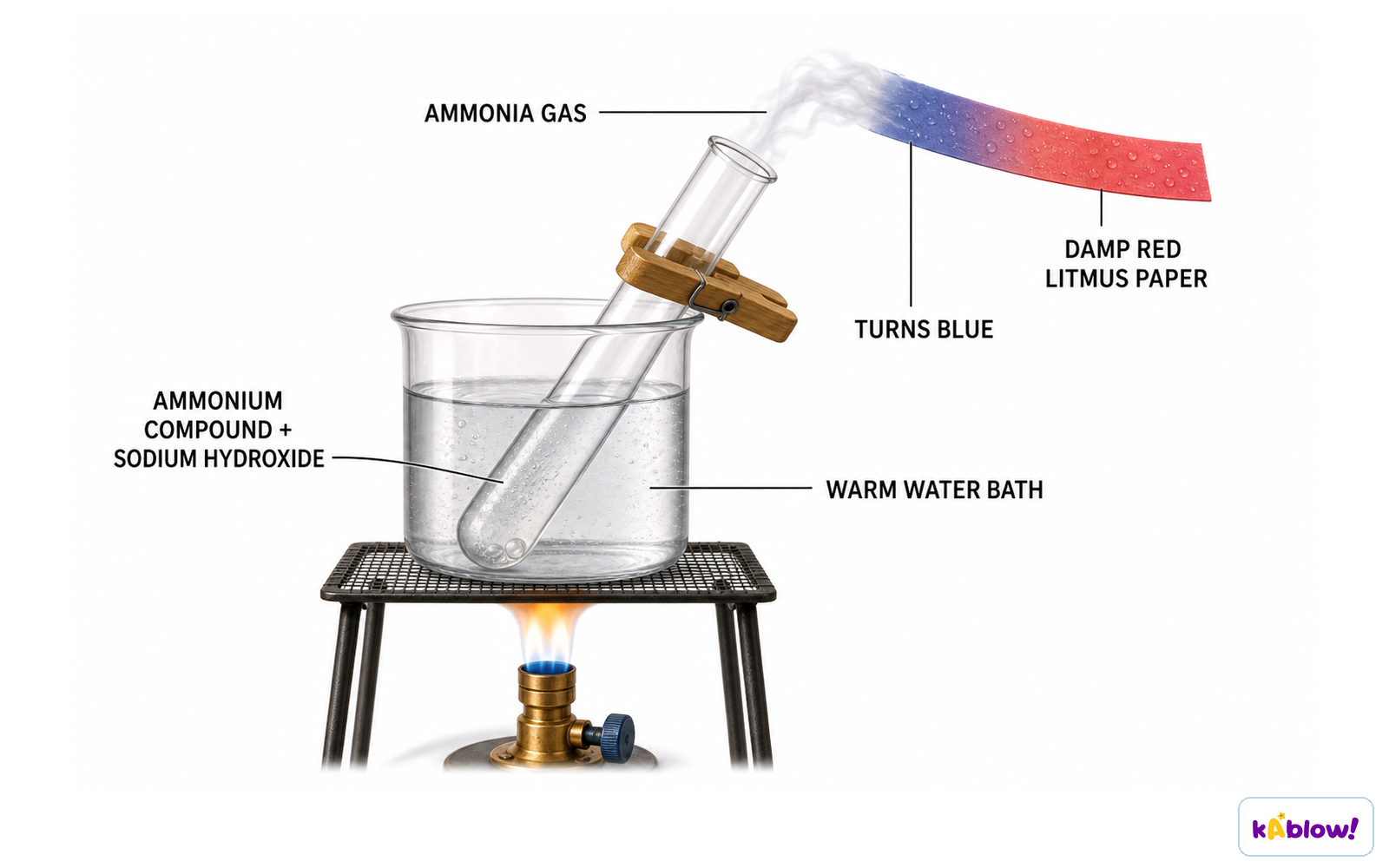
- Test for ammonium ions (NH₄⁺) by adding sodium hydroxide solution and gently heating.
- If ammonium ions are present, ammonia gas is produced.
- Ammonia gas turns damp red litmus paper blue; hold the paper near the mouth of the test tube without touching the sides.
- Ammonia also reacts with hydrogen chloride gas to form a white smoke of ammonium chloride.
- The ionic equation is: NH₄⁺(aq) + OH⁻(aq) → NH₃(g) + H₂O(l).
- Ammonium (NH₄⁺) is the aqueous cation; ammonia (NH₃) is the gas.
Testing for ammonium ions
Test for Carbonates
- Carbonates contain the carbonate ion, CO₃²⁻.
- Add dilute acid to the sample; if a carbonate is present, effervescence occurs and carbon dioxide gas is released.
- Bubble the gas through limewater; carbon dioxide turns limewater cloudy/milky due to formation of insoluble calcium carbonate.
- Equation: CO₃²⁻(aq) + 2H⁺(aq) → CO₂(g) + H₂O(l).
- Equation: CO₂(g) + Ca(OH)₂(aq) → CaCO₃(s) + H₂O(l).
- Connect the test tube to the limewater quickly so no carbon dioxide escapes.
Test for Halides
- Halide ions are the negative ions formed by Group 7 elements: Cl⁻, Br⁻, I⁻.
- Acidify the sample with dilute nitric acid, then add silver nitrate solution.
- A silver halide precipitate forms: silver chloride white, silver bromide cream, silver iodide yellow.
- Ionic equation: Ag⁺(aq) + X⁻(aq) → AgX(s).
- Use nitric acid, not hydrochloric acid, because HCl contains chloride ions that would interfere.
- Example: KCl(aq) + AgNO₃(aq) → KNO₃(aq) + AgCl(s).
Test for Sulfates
- Acidify the sample with dilute hydrochloric acid, then add barium chloride solution.
- A white precipitate of barium sulfate is a positive result for sulfate ions.
- Ionic equation: Ba²⁺(aq) + SO₄²⁻(aq) → BaSO₄(s).
- The test can also be carried out using barium nitrate solution.
- HCl is added first to remove any carbonates, which would also produce a precipitate and interfere.
- State symbols for the reaction are aq, aq, s.
Core Practical: Identifying Ions
- The aim is to use chemical tests to identify the ions in unknown single ionic compounds.
- Common tests include flame tests and tests for sulfate, carbonate and halide ions.
- Tests can be carried out in any order; you may not need to do all tests on one sample.
- Use only small amounts of sample and reagent; dissolve solid samples in distilled water if needed.
- Record observations carefully in a results table and repeat any tests that give unclear results.
- Identify the salt from the cation and anion present, balancing charges in the formula.
- Example: a positive test for Fe²⁺ and sulfate ions means the salt is FeSO₄.
- Hazards: limewater, dilute nitric acid and sodium hydroxide are harmful; ammonia gas is toxic if inhaled.
Instrumental Methods of Analysis
- Instrumental methods include X-ray, infra-red and mass spectroscopy, gas chromatography and flame photometry.
- They are more accurate, faster and easier to use, and more sensitive than traditional chemical tests.
- They can be automated and can perform multiple simultaneous sampling and testing.
- Modern instruments can work with very small sample sizes.
- Advantages should be described in terms of sensitivity, speed and accuracy.
Flame Emission Spectroscopy
- Flame emission spectroscopy is an instrumental method used to analyse metal ions in solution.
- The sample is put into a flame and the light emitted is passed through a spectroscope.
- The output is a line spectrum; different elements produce lines in different parts of the spectrum.
- The spectrum identifies the metal ions present and can measure their concentrations.
- The intensity of light is proportional to the number of ions vaporised, so a calibration curve can determine concentration.
- It works for mixtures of ions, unlike a flame test which can only analyse one ion at a time.
- Unknown samples are identified by comparing their spectrum to reference spectra.
Diapositivas
Sign up free to view the lesson slides
Step through every slide for this topic — plus flashcards and revision notes — with a free account.
Preguntas de práctica
Vista previa gratis — 8 de 62 preguntas. Regístrate para verlas todas.
1.What colour flame is produced by potassium ions in a flame test?
Easy- AYellow
- BLilac
- CCrimson
- DOrange-red
2.A student adds sodium hydroxide solution to a solution containing iron(II) ions. What is observed?
Easy- AA blue precipitate
- BA green precipitate
- CA brown precipitate
- DA white precipitate that dissolves in excess
3.Which reagent is used to test for sulfate ions in solution?
Easy- ASilver nitrate
- BBarium chloride
- CSodium hydroxide
- DLimewater
4.What is the correct test for ammonium ions?
Easy- AAdd sodium hydroxide and warm gently; test the gas with damp red litmus
- BAdd silver nitrate; look for a white precipitate
- CAdd barium chloride; look for a white precipitate
- DAdd dilute acid; test the gas with limewater
5.Which instrumental method is used to analyse metal ions in solution by measuring the intensity and wavelength of light emitted?
Medium- AGas chromatography
- BFlame emission spectroscopy
- CMass spectrometry
- DInfra-red spectroscopy
6.Which statements about testing for halide ions are correct? (select all that apply)
Medium- ADilute nitric acid is added before silver nitrate solution
- BSilver chloride forms a white precipitate
- CSilver bromide forms a yellow precipitate
- DSilver iodide forms a yellow precipitate
- EDilute hydrochloric acid is used to acidify the solution
7.Sodium ions produce a yellow flame in a flame test.
EasyTrue or false?
8.Instrumental methods are less accurate than traditional chemical tests.
EasyTrue or false?
Unlock all 62 questions, flashcards & more
Crea una cuenta gratis para ver todas las preguntas, las diapositivas, las tarjetas y los apuntes de repaso de este tema.