Energy changes in a system, and the ways energy is stored before and after such changes
Apréndelo jugando
Responde estas preguntas para ganar energía, luego pesca y explora. Sin cuenta.
Apuntes de la lección
Energy Stores
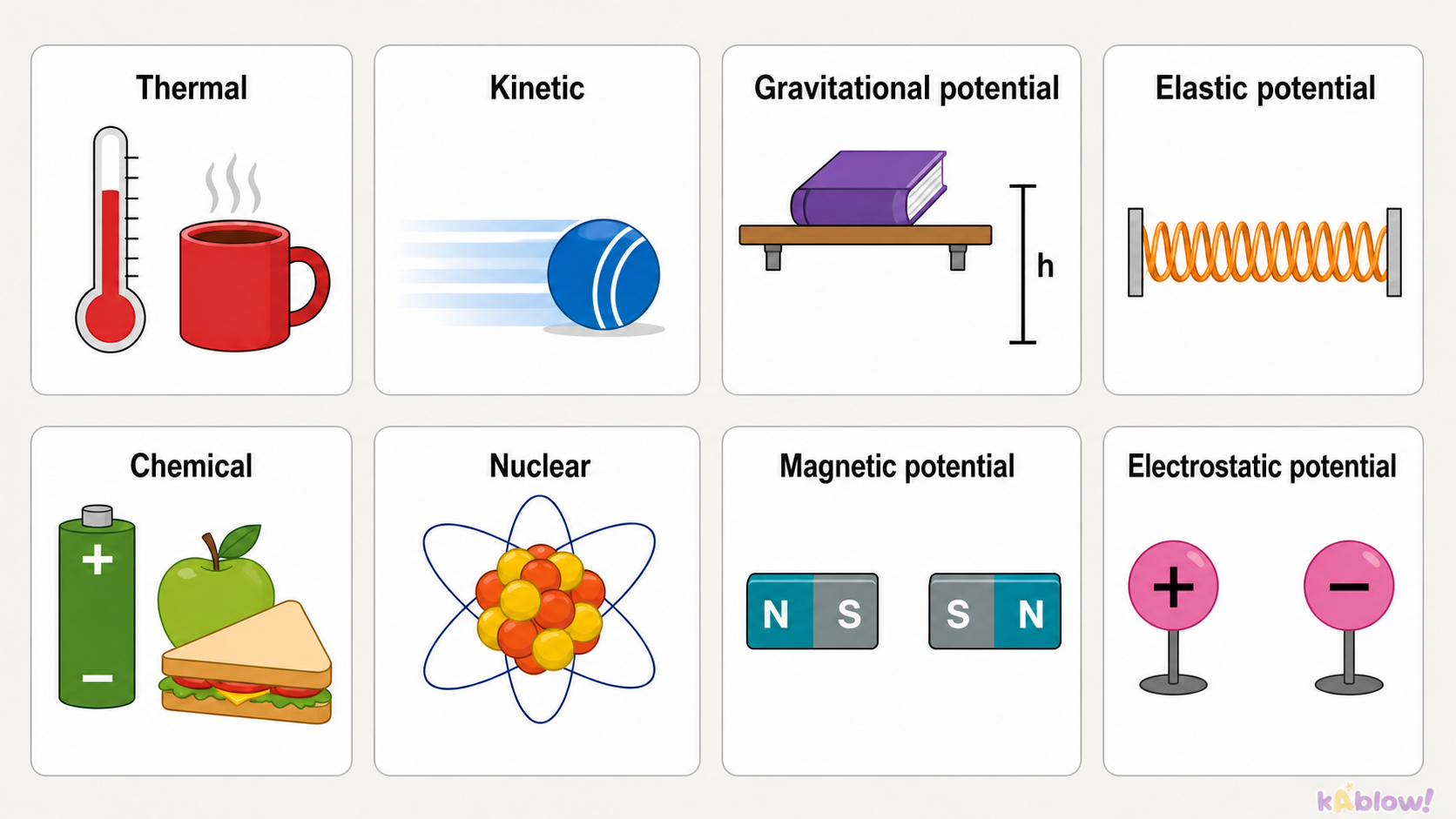
- Energy is stored in objects in different energy stores.
- Kinetic store: moving objects have energy in their kinetic store.
- Gravitational potential store: objects gain energy here when lifted through a gravitational field.
- Elastic potential store: stretched, squashed or bent objects have energy here.
- Thermal store: all objects have energy here; the hotter the object, the more energy it has.
- Other stores include chemical, nuclear, magnetic and electrostatic.
Eight energy stores, each shown with one everyday example.
Energy Transfer Pathways
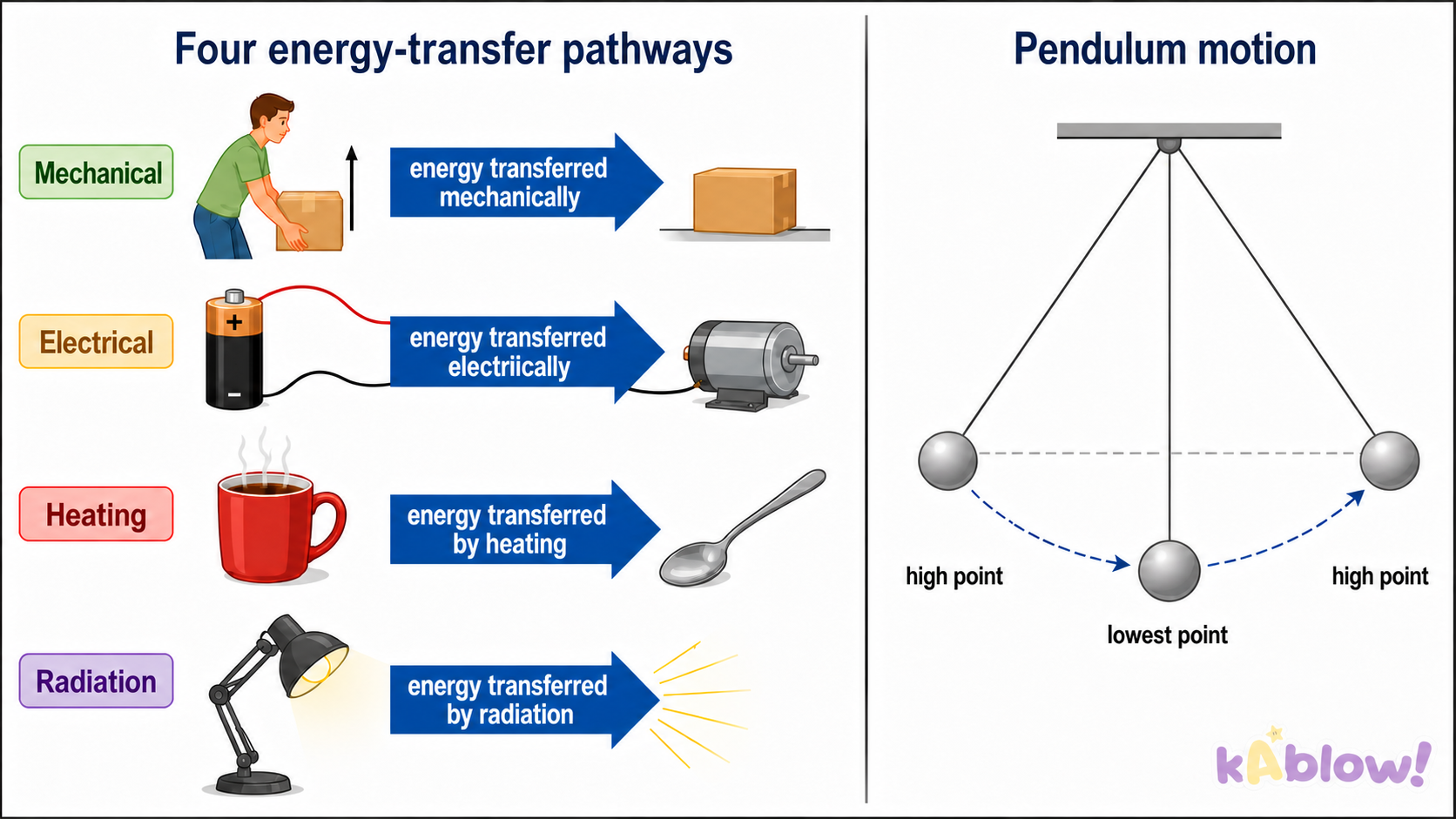
- Energy is transferred between stores by different energy transfer pathways.
- The four pathways are mechanical working, electrical working, heating and radiation.
- Mechanical working: a force acts on an object (e.g. pulling, pushing, stretching, squashing).
- Electrical working: a charge moves through a potential difference (e.g. current).
- Heating: energy is transferred from a hotter object to a colder one (e.g. conduction).
- Radiation: energy is transferred by electromagnetic waves (e.g. visible light).
Energy-transfer pathways and pendulum motion
Systems and Conservation of Energy
- A system is an object or a group of objects.
- When there is a change in a system, energy is transferred.
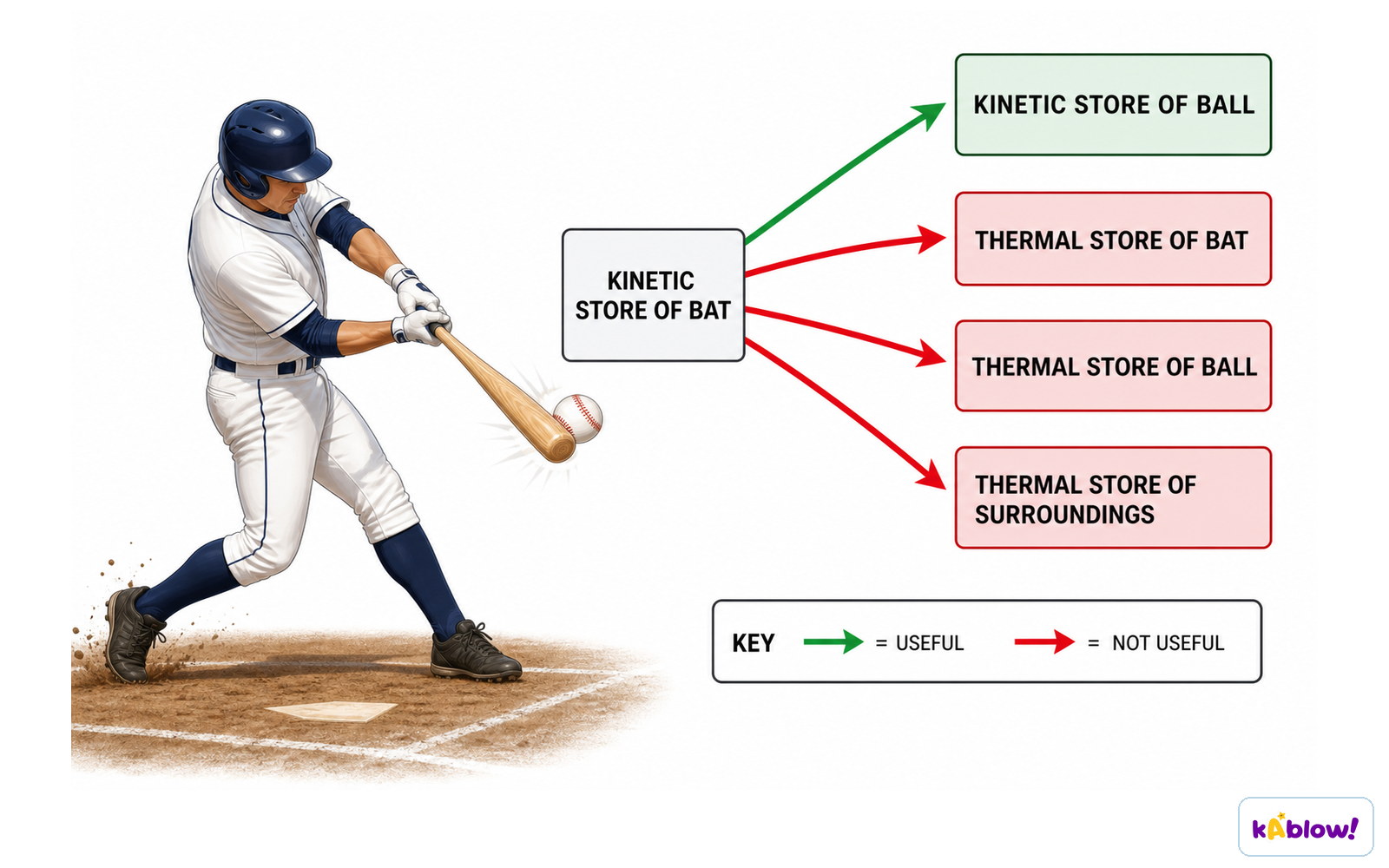
- The principle of conservation of energy states that energy cannot be created or destroyed, only transferred from one store to another.
- In a closed system, the total amount of energy remains constant.
- Total energy in = useful energy out + wasted energy.
- Energy is never 'lost'; it can be dissipated (spread out) to the surroundings, often by heating and radiation.
Conservation of energy: a bat hitting a ball
Energy Transfer Diagrams
- Energy flow diagrams show the stores and the transfer pathways taking place within a system.
- Sankey diagrams represent energy transfers using arrows whose widths are proportional to the amount of energy transferred.
- The flat left-hand end of the arrow represents the energy transferred into the system.
- The straight arrow pointing right represents the useful energy output.
- Arrows that bend away represent the wasted energy.
- A more efficient device has less wasted energy, shown by a smaller arrow bending away.
Changes in Energy
- Energy can be transferred by heating, by mechanical work done by forces, or by electrical work done when a current flows.
- Heating increases the energy in the kinetic store of the particles, which increases the thermal store of the object; this can raise temperature or cause a change of state.
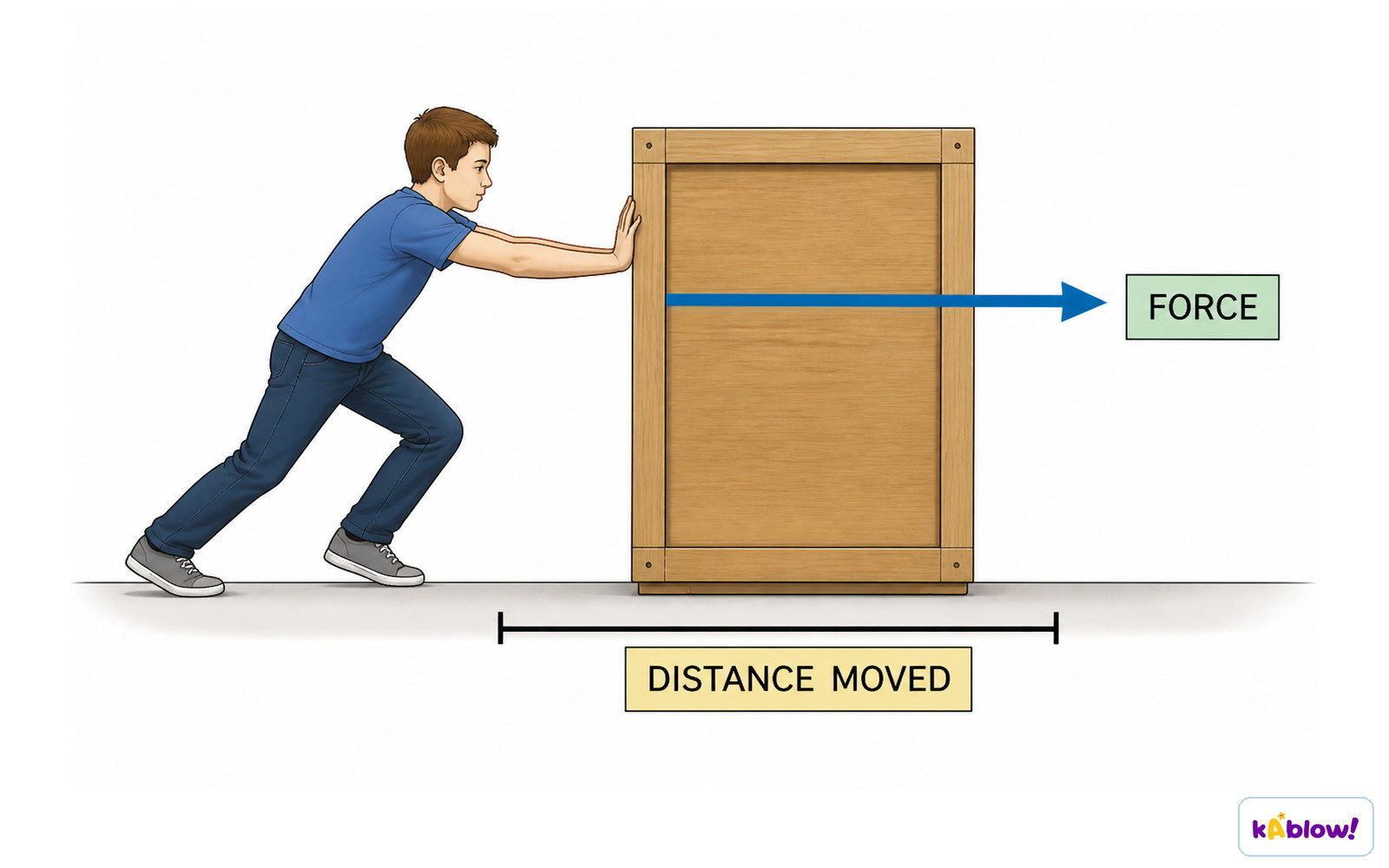
- Mechanical work is done when a force acts over a distance, e.g. pushing a box across the floor.
- When a current flows, energy is transferred electrically from the power supply to the components in the circuit.
- Changes in speed are related to kinetic energy; changes in height are related to gravitational potential energy; changes in shape are related to elastic potential energy.
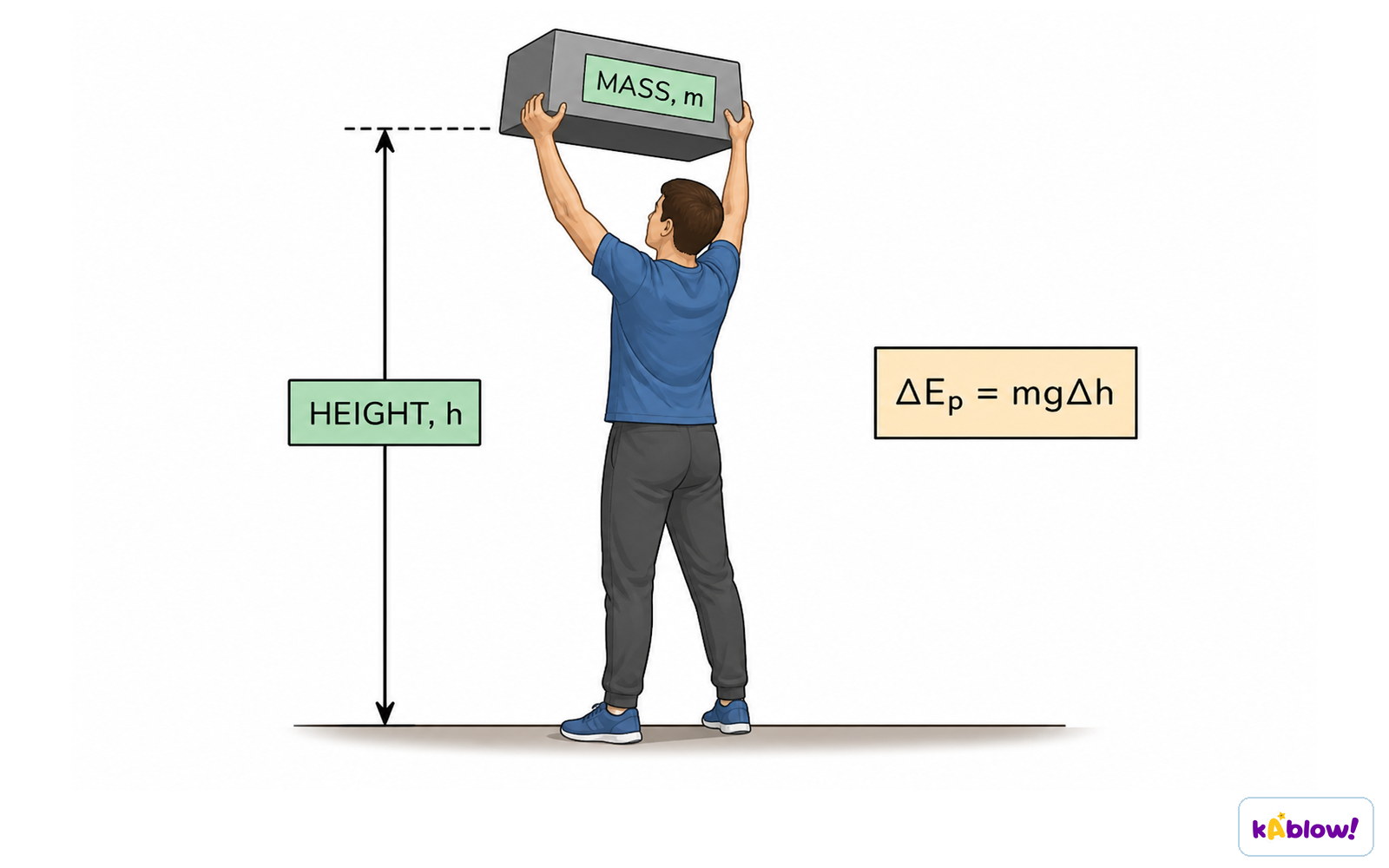
Energy is transferred to an object's gravitational store as it is lifted through a height: ΔEp = mgΔh.
Work Done and Energy
- Work is done when an object is moved over a distance by a force applied in the direction of its displacement.
- If a force is applied but there is no movement, no work is done.
- Work done = energy transferred.
- The equation is E = F × d, where E is work done or energy transferred in joules (J), F is force in newtons (N), and d is distance in metres (m).
- Example: a car's brakes apply a force of 500 N to stop the car over 23 m; work done = 500 × 23 = 11 500 J.
Work is done when a force moves an object over a distance: W = Fd
Gravitational Potential Energy and Kinetic Energy
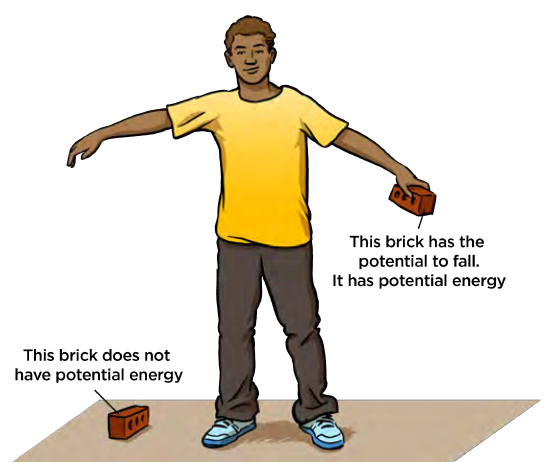
- Gravitational potential energy is the energy an object has due to its height in a gravitational field.
- The change in gravitational potential energy is calculated using ΔGPE = m × g × Δh, where m is mass in kg, g is gravitational field strength in N/kg, and Δh is change in vertical height in m.
- Kinetic energy is the energy an object has as a result of its mass and speed.
- Kinetic energy is calculated using KE = ½ × m × v², where m is mass in kg and v is speed in m/s.
- In a perfect energy transfer (no wasted energy), ΔGPE = KE; this is useful for finding speed or height when resistance is ignored.
A boy holding a brick out at arm's length has given it potential energy; the brick on the ground has none.
Dissipation of Energy
- Wasted energy transfers are inevitable; there is no such thing as a perfect energy transfer.
- Most wasted energy transfers result in heating of the objects and the surroundings.
- Energy that is spread out to the thermal store of the surroundings is said to be dissipated.
- Work done against air resistance, friction, and resistance in wires all result in heating.
- Once energy is in the thermal store of the surroundings, it cannot be gathered for any specific use, so it is called wasted energy.
- Friction is a major cause of wasted energy in machines; it can be reduced by lubrication.
Reducing Unwanted Energy Transfers
- Unwanted energy transfers include keeping a house warm, keeping a hot drink hot or cold, and friction of mechanical parts.
- Insulation reduces energy transfers by conduction.
- The effectiveness of an insulator depends on its thermal conductivity (lower is better), its density (lower is better), and its thickness (thicker is better).
- In a denser material, particles are closer together so they transfer energy more easily.
- Loft insulation is often made from fibreglass; the air trapped between the fibres makes it a good insulator.
- Cavity wall insulation fills the gap between external walls with foam, lowering conduction of heat through the walls.
Power and Efficiency
- Power is the rate of energy transfer, or the rate of work done.
- Power is calculated using P = E / t, where P is power in watts (W), E is energy transferred or work done in joules (J), and t is time in seconds (s).
- 1 watt = 1 joule per second (1 W = 1 J/s); 1 kilowatt (kW) = 1000 W.
- Efficiency is the ratio of useful energy output to total energy output.
- Efficiency = useful energy transferred by the device / total energy supplied to the device, or useful power output / total power input.
- Efficiency can be a decimal (0 to 1) or a percentage (0 to 100%); it has no units.
- A system with high efficiency transfers most of its energy usefully; a system with low efficiency wastes most of it.
Diapositivas
Sign up free to view the lesson slides
Step through every slide for this topic — plus flashcards and revision notes — with a free account.
Preguntas de práctica
Vista previa gratis — 8 de 64 preguntas. Regístrate para verlas todas.
1.Which energy store is associated with the position of an object in a gravitational field?
Easy- AGravitational potential store
- BKinetic store
- CThermal store
- DElastic potential store
2.Energy can be created and destroyed.
EasyTrue or false?
3.A ball is thrown upwards. Which energy transfer takes place as the ball rises?
Medium- AKinetic store → gravitational potential store
- BGravitational potential store → kinetic store
- CKinetic store → thermal store
- DGravitational potential store → elastic potential store
4.A car of mass 1200 kg is travelling at 15 m/s. Calculate its kinetic energy.
Medium- A135 000 J
- B270 000 J
- C18 000 J
- D9 000 J
5.Which of the following are energy transfer pathways? (Select all that apply)
Medium- AMechanical working
- BElectrical working
- CHeating by radiation
- DKinetic store
- EGravitational potential store
6.Put the energy transfers in order for a ball being dropped from a height and bouncing back up (ignoring air resistance).
Medium- Gravitational potential store at the top
- Kinetic store as it falls
- Elastic potential store as it deforms on impact
- Kinetic store as it bounces back up
- Gravitational potential store at the top of the bounce
7.Match each energy store with its correct description.
Medium- Kinetic store
- Gravitational potential store
- Elastic potential store
- Thermal store
- Energy of a moving object
- Energy due to height in a gravitational field
- Energy of a stretched or squashed object
- Energy related to the temperature of an object
8.Which of the following statements about energy stores are correct? (Select all that apply)
Medium- AA moving object has energy in its kinetic store
- BA stretched spring has energy in its elastic potential store
- CA hot object has more energy in its thermal store than a cold object
- DEnergy can be created when a force acts
- EMagnetic materials interacting have energy in a magnetic store
Unlock all 64 questions, flashcards & more
Crea una cuenta gratis para ver todas las preguntas, las diapositivas, las tarjetas y los apuntes de repaso de este tema.