Nuclear fission and fusion
Apréndelo jugando
Responde estas preguntas para ganar energía, luego pesca y explora. Sin cuenta.
Apuntes de la lección
Nuclear Fission
- Nuclear fission is the splitting of a large, unstable nucleus into two smaller nuclei.
- Isotopes of uranium and plutonium undergo fission and are used as fuels in nuclear power stations.
- During fission, a neutron collides with an unstable nucleus, which splits into two smaller daughter nuclei and releases two or three neutrons.
- Gamma rays are also emitted during fission.
- The products of fission move away very quickly, so energy is transferred from the nuclear potential energy store to the kinetic energy store of the products.
Nuclear fission
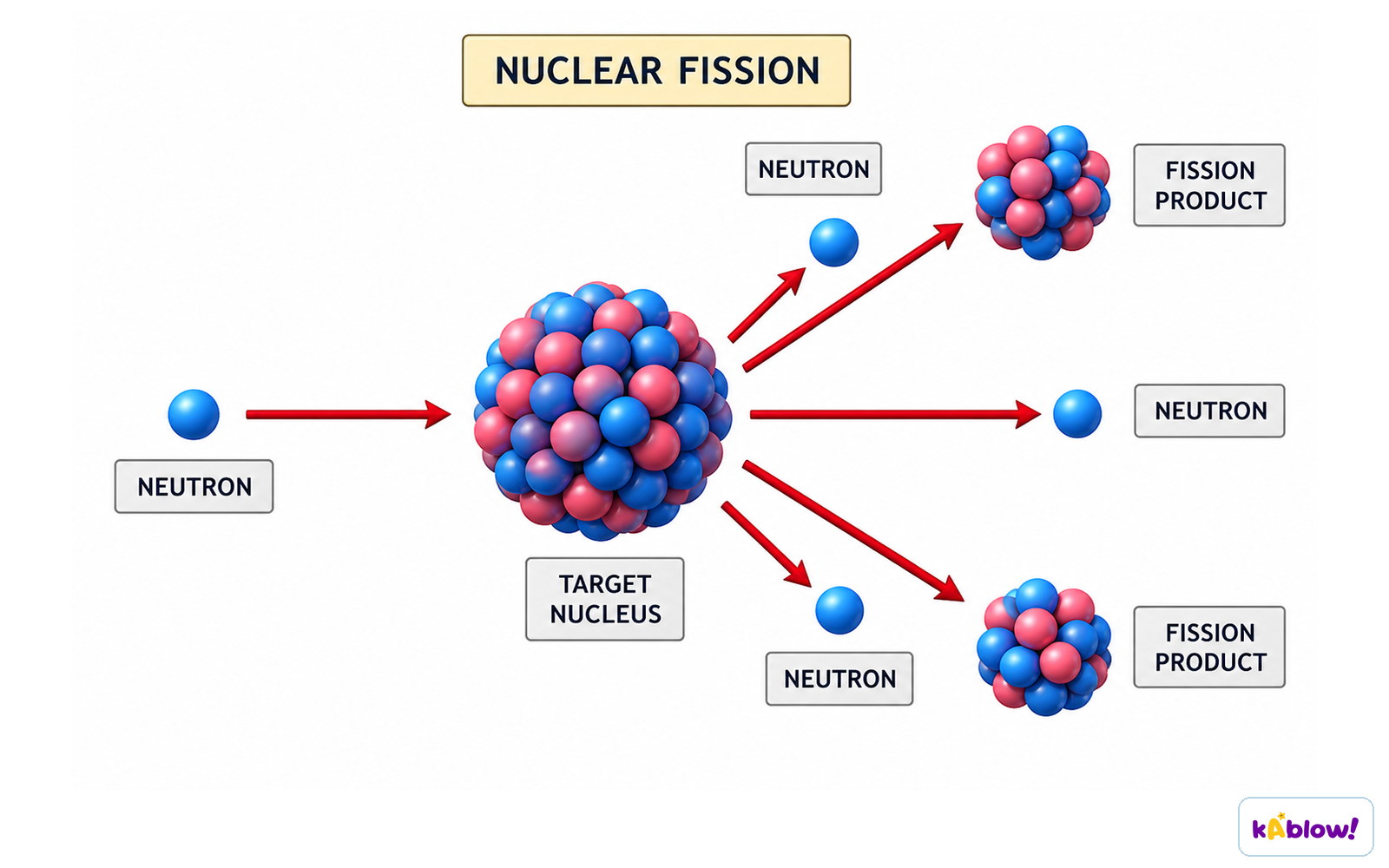
Spontaneous and Induced Fission
- Spontaneous fission is when a nucleus undergoes fission without additional energy being put in; this is rare.
- Usually, for fission to occur, the unstable nucleus must first absorb a neutron — this is induced fission.
- Uranium-235 has a very long half-life of 700 million years, so it would release energy very slowly on its own — unsuitable for a power station.
- In induced fission, a neutron is absorbed by uranium-235 to make uranium-236, which is very unstable and splits almost immediately.
Chain Reactions
- Only one extra neutron is needed to induce a uranium-235 nucleus to split by fission.
- Each fission produces two or three neutrons which move away at high speed.
- Each of these new neutrons can start another fission reaction, which again creates further excess neutrons — this is a chain reaction.
- In a controlled chain reaction, the number of free neutrons is kept constant so the reactor produces energy at the correct rate.
- In an uncontrolled chain reaction, the number of neutrons increases quickly, so the number of reactions does too — this releases a huge amount of energy in a short time, as in a nuclear weapon.
Nuclear Fission Diagrams
- Fission diagrams show a neutron fired into a target nucleus, causing it to split.
- To show a chain reaction, draw the released neutrons hitting other uranium-235 nuclei.
- The daughter nuclei do not need to be shown in a chain reaction diagram — only the neutrons and uranium-235 nuclei.
- Each fission reaction requires one neutron but releases two or more, so the number of neutrons increases with each reaction.
- In these diagrams, time generally moves to the right; clarity of information is more important than artistic quality.
Nuclear fission of uranium-235
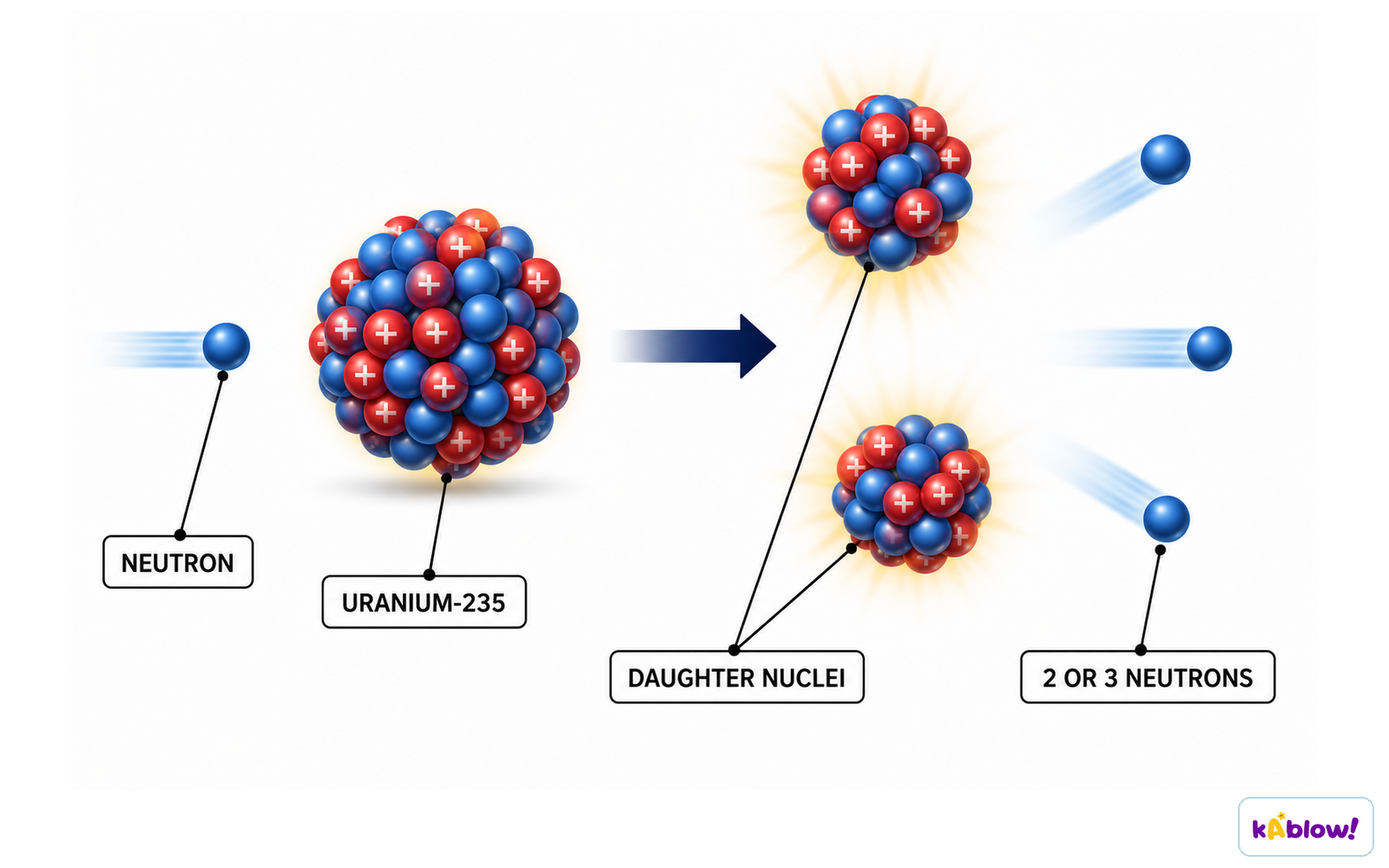
Nuclear Reactors
- In a nuclear reactor, a chain reaction is maintained and controlled to produce a supply of energy to generate electricity.
- Two factors must be controlled: the number of free neutrons and the energy of the free neutrons.
- Control rods absorb neutrons without becoming dangerously unstable themselves.
- The number of neutrons absorbed is controlled by varying the depth of the control rods in the fuel rods: lowering them decreases the rate of fission, raising them increases it.
- In an emergency, control rods can be lowered all the way so no reaction can take place.
- The moderator slows down neutrons so they can react efficiently with the uranium fuel.
Energy & Waste
- Nuclear fission produces a large quantity of heat which is carried away from the reactor by a coolant (usually pressurised water).
- The coolant heats a separate water source, turning it into steam; a separate source reduces the risk of contamination.
- The steam drives turbines which turn generators, producing electricity.
- The reactor provides thermal energy from fission chain reactions; the boiler uses thermal energy to boil water to create steam; the turbine transfers thermal energy into kinetic energy; the generator transfers kinetic energy into electrical energy; the condenser cools the steam back into water.
- The biggest problem with nuclear power is the waste — the unusable fission products from uranium-235 or spent fuel rods.
- The daughter nuclei are highly radioactive — more radioactive than the original fuel — and remain radioactive for thousands of years.
- Spent fuel rods are also extremely hot and must be handled and stored carefully.
- Nuclear waste is stored underground until it is no longer harmful.
Advantages & Disadvantages of Nuclear Power
- Nuclear power can scare people if they do not understand it.
- It is dangerous if not handled properly, and it is invisible, which can be difficult for some people to comprehend.
- With increased education on nuclear energy, society can use this knowledge to inform their own decisions and opinions.
Nuclear Fusion
- Nuclear fusion is when two light nuclei join to form a heavier nucleus.
- This process requires extremely high temperatures to maintain, which is why it has proven very hard to reproduce on Earth.
- Nuclear fusion takes place in the centres of stars, including the Sun.
- In most stars, hydrogen nuclei fuse into helium nuclei and release a large amount of energy.
- The energy produced during fusion comes from a very small amount of the particle's mass being converted into energy.
- Albert Einstein described the mass-energy equivalence with the equation E = mc², where E is energy in joules, m is mass converted into energy in kilograms, and c is the speed of light in metres per second.
- The energy from 1 kg of hydrogen that undergoes fusion is equivalent to the energy from burning about 10 million kilograms of coal.
Nuclear fusion of hydrogen
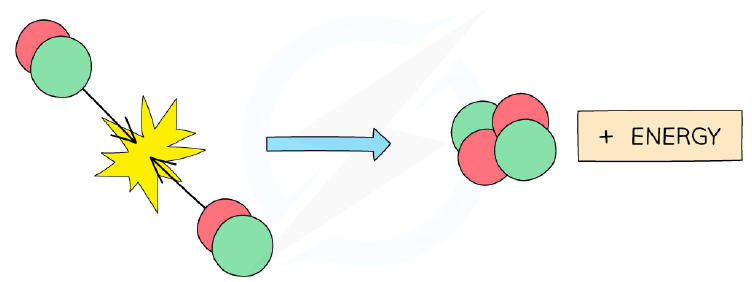
Fusion vs Fission
- Fission is the process in which large nuclei are split into two smaller nuclei, releasing energy; this is used in nuclear power stations, where it is well controlled.
- Fusion is the opposite: taking smaller nuclei and bringing them together to form a bigger nucleus.
- Fission provides less energy per kg of fuel than fusion.
- The products of fission are radioactive and hence very dangerous.
- Fusion provides more energy per kg of fuel than fission.
- The products of fusion are not radioactive and are therefore much safer than the products of fission reactions.
The Conditions for Fusion
- Since protons have a positive charge, they repel each other.
- To overcome this repulsion, the protons must have very high kinetic energy, travelling towards each other at very high speeds.
- The fusion of two protons is only possible through high temperature and pressure.
- The gas has to be heated to millions of degrees Celsius — a temperature usually only reached at the centre of a star.
- In regular conditions on Earth, the possibility of collisions between nuclei which result in fusion is very low.
- High densities (and hence pressures) are needed to increase the number of collisions and hence fusions.
- The conditions for fusion are: very high temperature of fuel; very high kinetic energy/speed of nuclei to overcome repulsion; very high density/pressure to increase the possibility of suitable collisions.
- The main reasons fusion is not currently used as a source of power on Earth are the difficulties in achieving and maintaining high temperatures and high pressures.
- Creating the temperatures needed for fusion requires a great deal of energy, so physicists are still a long way from producing more energy from fusion than the energy needed to start it.
Hydrogen fusion in a star
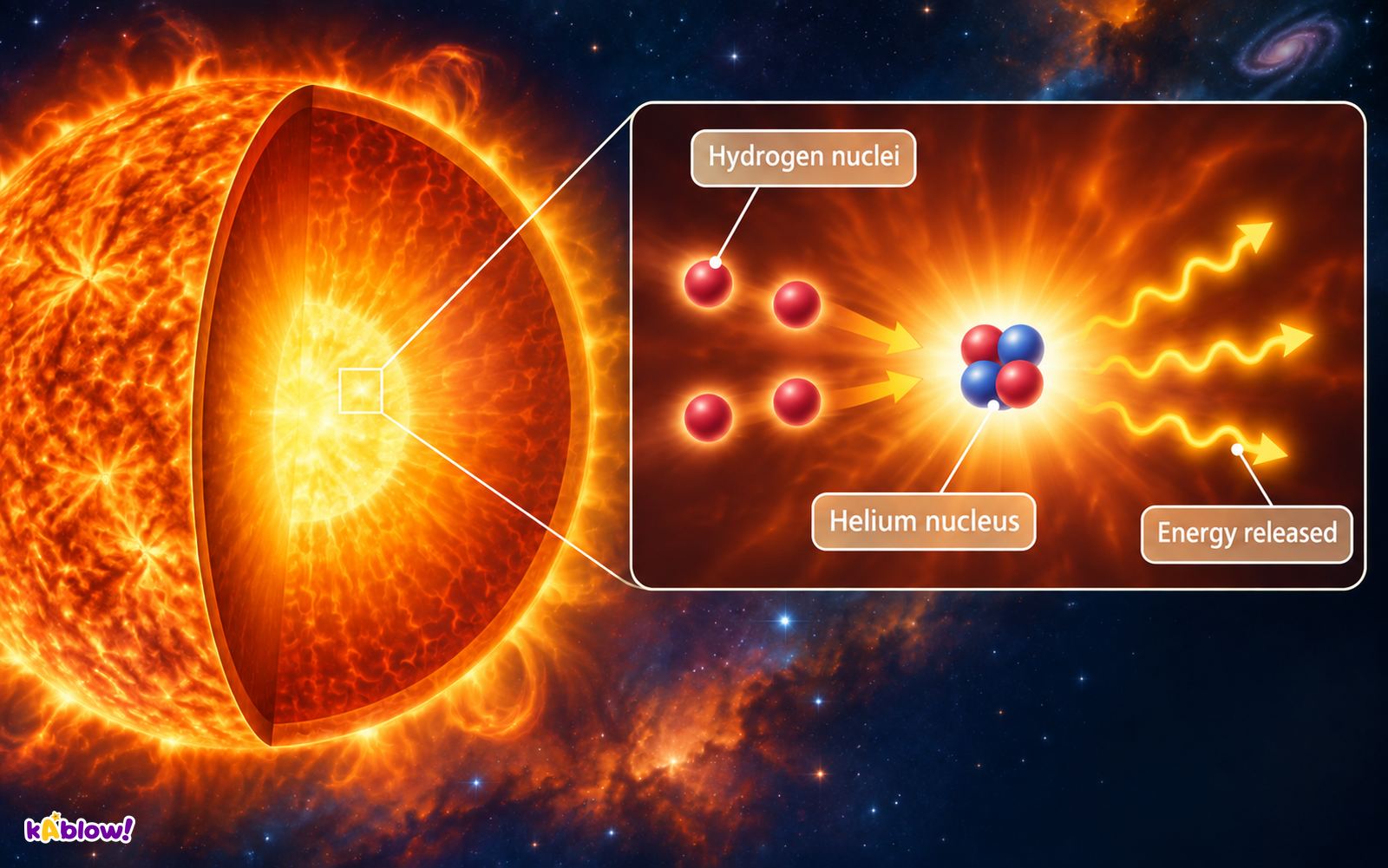
Diapositivas
Sign up free to view the lesson slides
Step through every slide for this topic — plus flashcards and revision notes — with a free account.
Preguntas de práctica
Vista previa gratis — 8 de 60 preguntas. Regístrate para verlas todas.
1.Nuclear fission is defined as:
Easy- Athe splitting of a large, unstable nucleus into two smaller nuclei
- Bthe joining of two light nuclei to form a heavier nucleus
- Cthe emission of an electron from the nucleus
- Dthe cooling of a star's core
2.The element which undergoes fission in a nuclear reactor is:
Easy- Ahydrogen-1
- Bhelium-4
- Curanium-235
- Dradium-226
3.The particle released during fission which can initiate a chain reaction is:
Easy- Aa nucleon
- Ba neutron
- Can α particle
- Da β particle
4.Nuclear fusion is defined as:
Easy- Athe creation of a larger nucleus from smaller nuclei
- Bthe emission of an electron from the nucleus
- Cthe cooling of the Sun
- Da natural process which occurs in the core of the Earth
5.An element that might undergo fusion is:
Easy- Apolonium-210
- Bamericium-241
- Curanium-235
- Dhydrogen-1
6.Which of the following are the correct conditions for nuclear fusion to occur?
Easy- Alow temperature, low pressure
- Blow temperature, high pressure
- Chigh temperature, low pressure
- Dhigh temperature, high pressure
7.How many daughter nuclei are produced from the fission of one nucleus of uranium-235?
Easy- Atwo
- Bthree
- Cfour
- Dsix
8.In a nuclear reactor, the moderator is used to:
Medium- Aabsorb neutrons so the chain reaction slows down
- Bslow down neutrons so they can react efficiently with the fuel
- Cspeed up neutrons so they can escape the core
- Dcool the steam back into water after the turbine
Unlock all 60 questions, flashcards & more
Crea una cuenta gratis para ver todas las preguntas, las diapositivas, las tarjetas y los apuntes de repaso de este tema.