Particle model and pressure
Apréndelo jugando
Responde estas preguntas para ganar energía, luego pesca y explora. Sin cuenta.
Apuntes de la lección
Kinetic Theory and Gas Pressure
- Gas molecules are in constant random motion at high speeds.
- Random motion means molecules travel in no specific path and change direction when they collide with the container walls or other molecules.
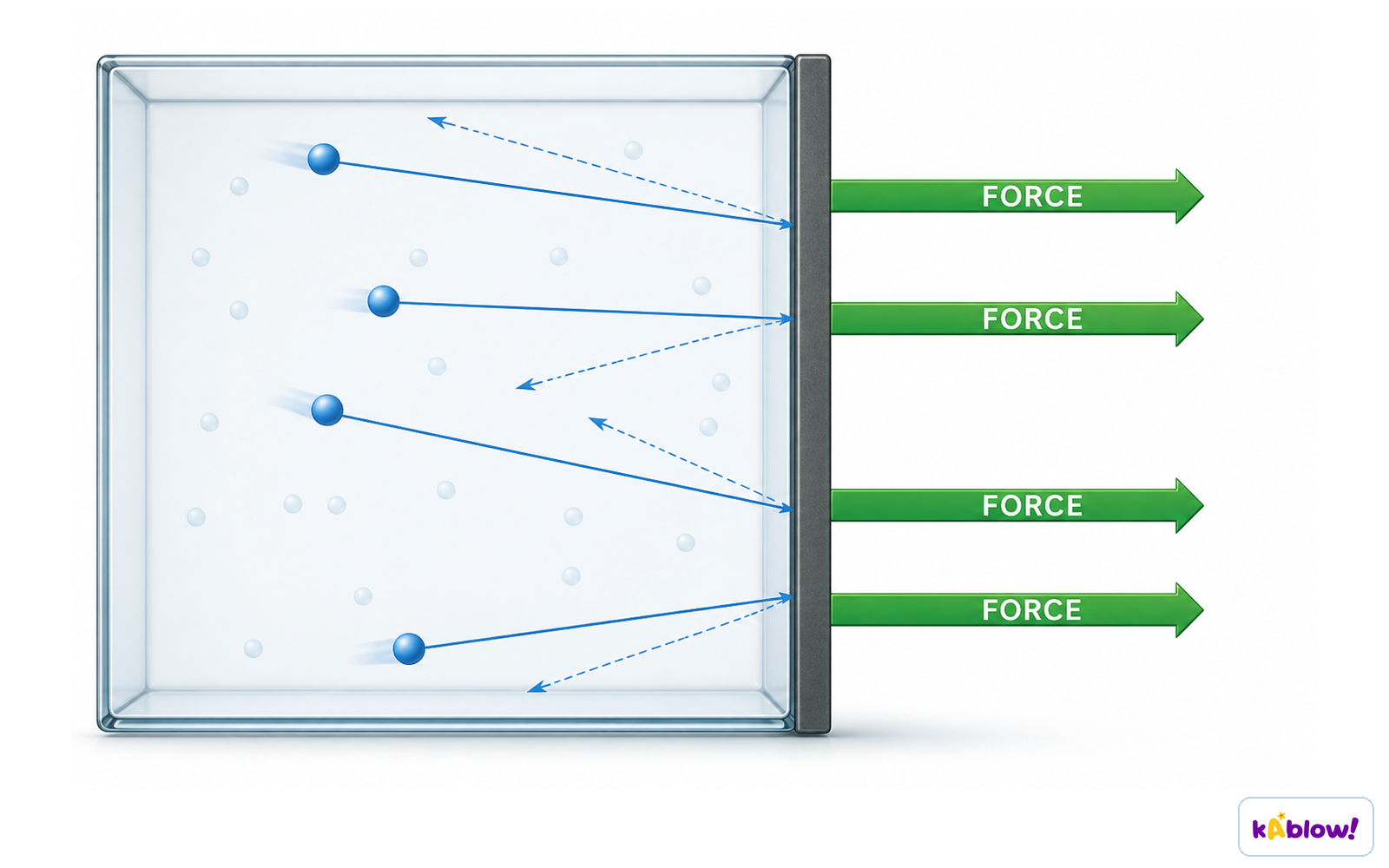
- Gas pressure is the force exerted per unit area on the container walls, caused by molecules colliding with them.
- The collisions produce a net force at right angles to the surface.
- A gas at higher pressure has more frequent collisions and therefore a greater force per unit area.
- The random motion of tiny particles in a fluid is called Brownian motion.
Gas particles colliding with a container wall
Temperature and Kinetic Energy
- The temperature of a gas is related to the average kinetic energy of its molecules.
- The hotter the gas, the higher the average kinetic energy and the faster the molecules move.
- The cooler the gas, the lower the average kinetic energy and the slower the molecules move.
- As temperature increases, molecules collide with the walls more frequently and with more force, increasing pressure.
- At constant volume, an increase in temperature increases the pressure of a gas, and vice versa.
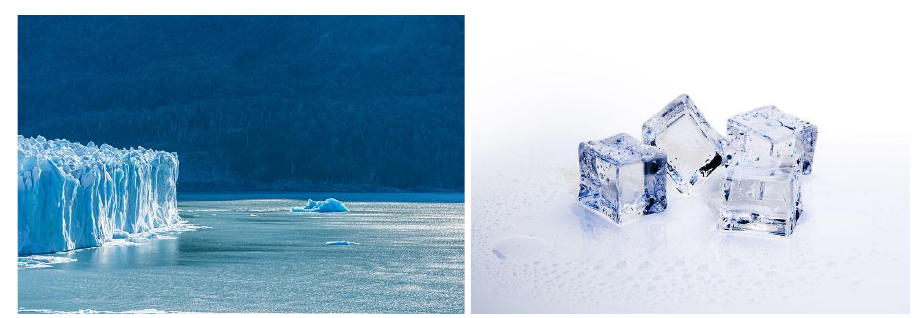
A large iceberg has more total kinetic (thermal) energy than a few small ice cubes of the same substance and temperature, because it is made of far more particles.
Absolute Zero and the Kelvin Scale
- Absolute zero is the temperature at which particles have zero kinetic energy and exert no pressure.
- Absolute zero is equal to −273 °C or 0 K.
- It is not possible to have a temperature lower than 0 K; a Kelvin temperature is never negative.
- The Kelvin scale starts at absolute zero, and a change of 1 K equals a change of 1 °C.
- Convert Celsius to Kelvin: T(K) = θ(°C) + 273.
- Convert Kelvin to Celsius: θ(°C) = T(K) − 273.
Pressure and Volume (Boyle's Law)
- For a fixed mass of gas at constant temperature, pressure × volume = constant: pV = constant.
- Pressure and volume are inversely proportional.
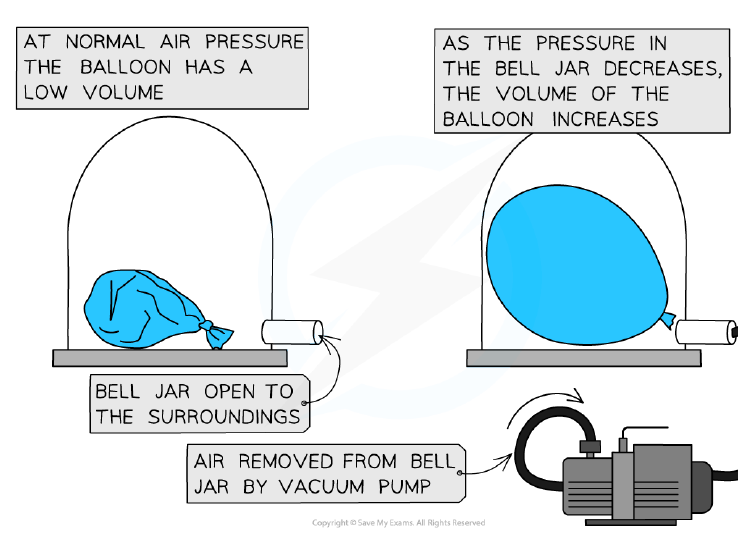
- When volume decreases (compression), pressure increases.
- When volume increases (expansion), pressure decreases.
- The equation can be written for before and after a change: P₁V₁ = P₂V₂.
- Key assumptions: temperature and mass (number of particles) remain constant.
- Pressure is measured in pascals (Pa) and volume in metres cubed (m³).
Illustration of Boyle's Law showing a balloon expanding as pressure decreases in a bell jar.
Explaining Pressure Changes with the Particle Model
- When a gas is compressed, the same number of particles occupy a smaller volume.
- The density of the gas increases, so particles collide with the walls more frequently.
- Each collision exerts the same force, but more frequent collisions give a greater force per unit area (pressure).
- When a gas expands, particles collide with the walls less frequently, so pressure decreases.
- The pressure produces a net force at right angles to the container walls.
Doing Work on a Gas
- Work is the transfer of energy by a force.
- Doing work on a gas increases its internal energy and can increase its temperature.
- Compressing a gas with a piston does work on it, decreasing its volume.
- The molecules move faster and have higher kinetic energy, so temperature rises.
- If a gas expands, it does work and loses energy, so its temperature falls.
- Example: a bicycle pump gets warm when compressed because work is done on the gas.
- Example: releasing pressurised carbon dioxide causes it to expand, do work, and cool, forming dry ice.
Common Misconceptions to Avoid
- Gas pressure is caused by collisions with the container walls, not by particles repelling each other.
- Use kelvin for proportionality with pressure or volume, not degrees Celsius.
- Particles do not lose energy when they collide with the walls.
- Absolute zero is the point of minimum internal energy, not just 'very cold'.
- Do not reverse the pressure–volume relationship: compression increases pressure.
Diapositivas
Sign up free to view the lesson slides
Step through every slide for this topic — plus flashcards and revision notes — with a free account.
Preguntas de práctica
Vista previa gratis — 8 de 64 preguntas. Regístrate para verlas todas.
1.Which statement best describes the motion of the molecules in a gas?
Easy- AThey are in constant random motion at high speeds
- BThey are stationary and held in fixed positions
- CThey vibrate about fixed positions but do not move around
- DThey move in straight lines only, never changing direction
2.The temperature of a gas is related to the average kinetic energy of its molecules.
EasyTrue or false?
3.A sealed container holds a fixed mass of gas at constant volume. What happens to the pressure of the gas when its temperature is increased?
Easy- AThe pressure increases because the molecules collide with the walls more often
- BThe pressure decreases because the molecules collide with the walls less often
- CThe pressure stays the same because the volume is constant
- DThe pressure increases because the molecules repel each other
4.What is absolute zero?
Easy- AThe temperature at which the molecules in a substance have zero kinetic energy
- BThe temperature at which water freezes
- CThe lowest temperature ever recorded on Earth
- DThe temperature at which a gas turns into a liquid
5.A fixed mass of gas is held at constant temperature. Its volume is decreased. What happens to its pressure, and why?
Medium- AThe pressure increases because the molecules collide with the walls more frequently
- BThe pressure decreases because the molecules collide with the walls less frequently
- CThe pressure increases because the molecules push each other apart
- DThe pressure decreases because the molecules lose energy on collision with the walls
6.Which of the following statements about gas pressure are correct? (select all that apply)
Medium- APressure is the force exerted per unit area
- BGas pressure is caused by molecules colliding with the walls of the container
- CGas pressure is caused by molecules repelling each other
- DThe force from the gas acts at right angles to the container walls
- EMolecules lose all their kinetic energy when they collide with the walls
7.A gas is compressed at a constant temperature. What happens to the density of the gas and why?
Medium- AThe density increases because the same number of molecules occupies a smaller volume
- BThe density decreases because the molecules get smaller
- CThe density stays the same because the number of molecules is unchanged
- DThe density increases because new molecules are created
8.Match each term about gases to its correct definition.
Medium- Pressure
- Absolute zero
- Brownian motion
- Boyle's Law
- The force exerted per unit area
- The temperature at which molecules have zero kinetic energy
- The random motion of tiny particles in a fluid
- pV = constant for a fixed mass of gas at constant temperature
Unlock all 64 questions, flashcards & more
Crea una cuenta gratis para ver todas las preguntas, las diapositivas, las tarjetas y los apuntes de repaso de este tema.