Reproduction in flowering plants
Apréndelo jugando
Responde estas preguntas para ganar energía, luego pesca y explora. Sin cuenta.
Para educadores: diapositivas de la lección, apuntes de repaso listos para usar sobre Reproduction in flowering plants (MYP Biology, Year 2) — úsalos en tu lección, o presenta el tema como una actividad interactiva de clase que tus aprendices juegan como un juego en vivo.
Apuntes de la lección
Big idea: how flowering plants make new plants
- Big idea (key concept): Change. A flower changes as a plant reproduces. Pollen is carried to a flower, the ovule becomes a seed, the ovary becomes a fruit, and the seed grows into a new plant.
- Related concept: Interaction. Plants cannot move, so they depend on interactions with wind, insects and other animals to carry their pollen and seeds, and on water, oxygen and warmth to start growing.
- Global context: Globalization and sustainability. Many of the world's food crops need insects to pollinate them. If pollinators such as bees decline, food supplies around the world are at risk, so protecting them matters everywhere.
- Flowering plants reproduce sexually. A male sex cell (inside a pollen grain) joins with a female sex cell (inside an ovule) to make a seed. The new plant is different from both parents.
- The whole life cycle is: flower, pollination, fertilisation, seed and fruit, dispersal, germination, new plant.
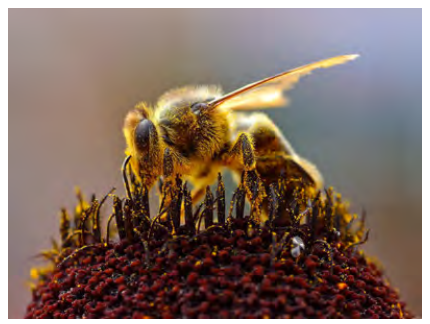
A bee covered in pollen on a flower
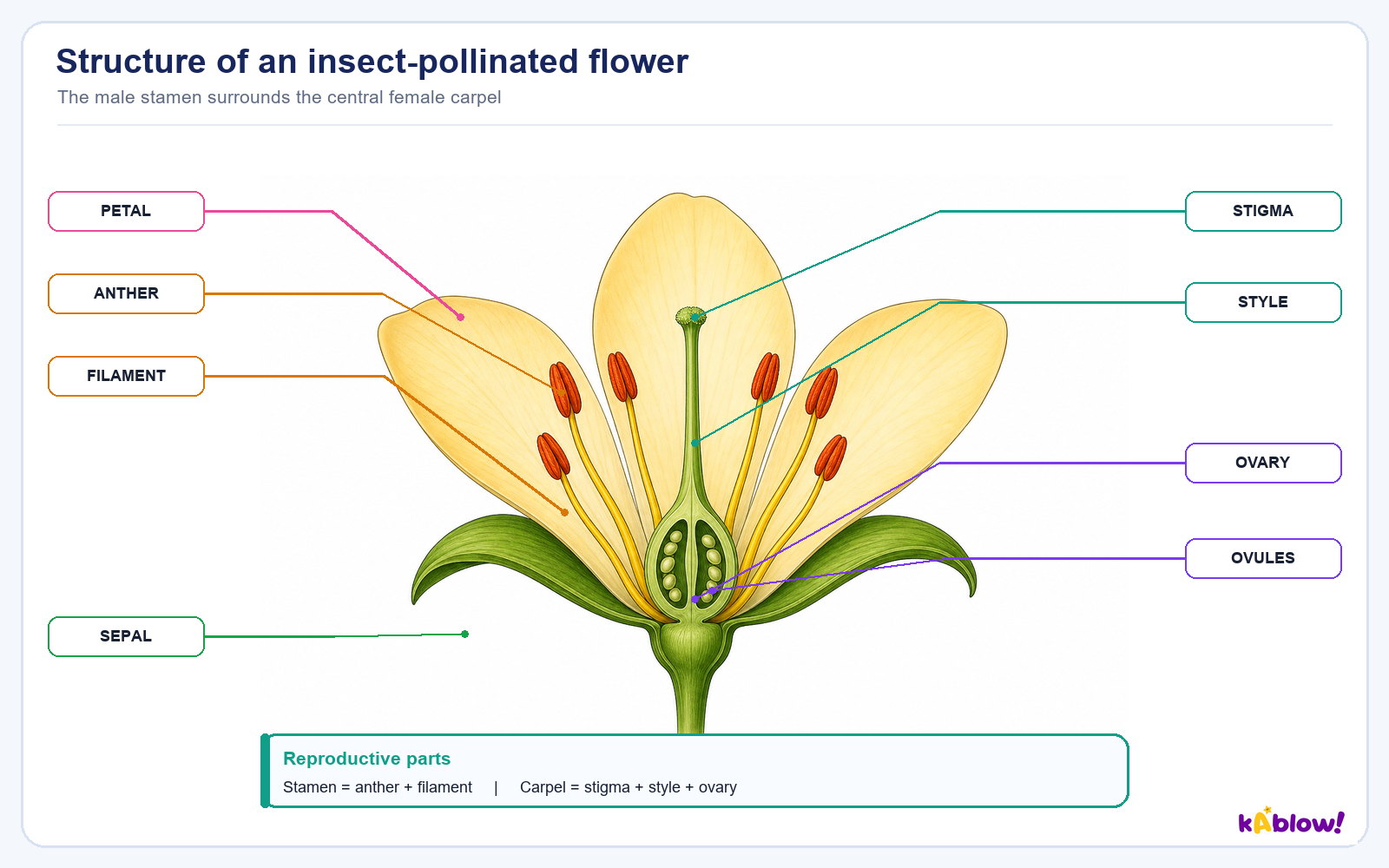
The parts of a flower
- The flower is the reproductive organ of a flowering plant.
- Sepals are small green leaf-like parts that protect the flower while it is still a bud.
- Petals are often large, bright and scented in insect-pollinated flowers, to attract insects.
- The stamen is the male part. The anther makes pollen grains, which contain the male sex cells, and the filament holds the anther up.
- The carpel is the female part. The stigma is the sticky top that catches pollen, the style is the stalk that holds it up, and the ovary at the base contains the ovules. Each ovule holds a female sex cell, the ovum (egg cell).
- Many flowers have both stamens and carpels, but some have only one kind.
The parts of an insect-pollinated flower
Pollination: getting pollen to a stigma
- Pollination is the transfer of pollen from an anther to a stigma. It is not the same as fertilisation.
- In self-pollination the pollen lands on a stigma of the same plant. In cross-pollination it lands on a flower of a different plant of the same species. Cross-pollination mixes genes, so the offspring show more variation.
- Insect-pollinated flowers have bright, scented petals, make sugary nectar as a reward, and have sticky or spiky pollen that clings to an insect's body. The stigma is inside the flower where the insect brushes against it.
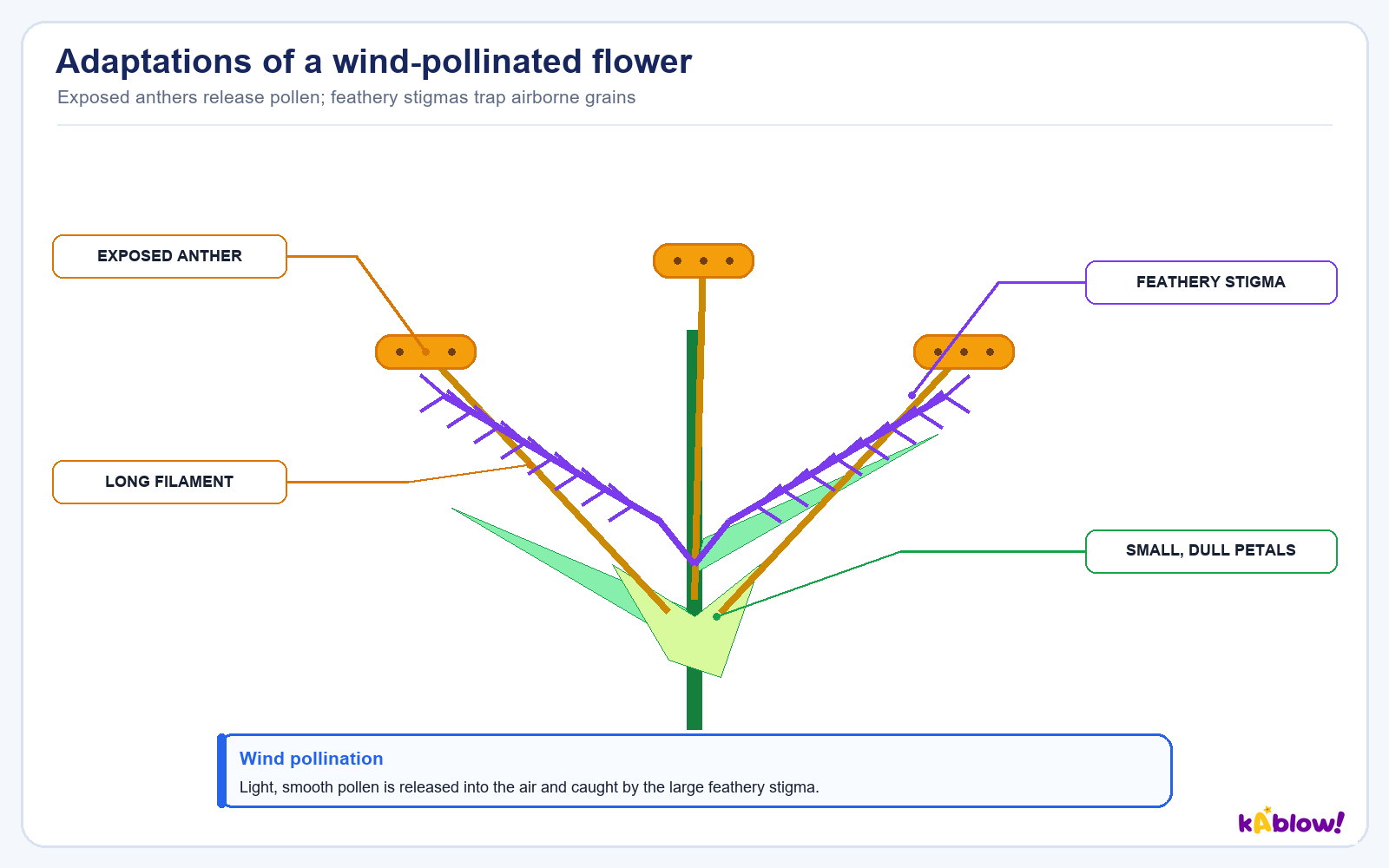
- Wind-pollinated flowers have small, dull petals and no nectar or scent. Their anthers hang outside the flower and their large, feathery stigmas catch pollen from the air. They make huge amounts of light, smooth pollen, because most of it never reaches a stigma.
- Grasses and maize are wind-pollinated. Most garden flowers are pollinated by insects such as bees, hoverflies and butterflies.
How a wind-pollinated flower is built
Fertilisation, seeds and fruits
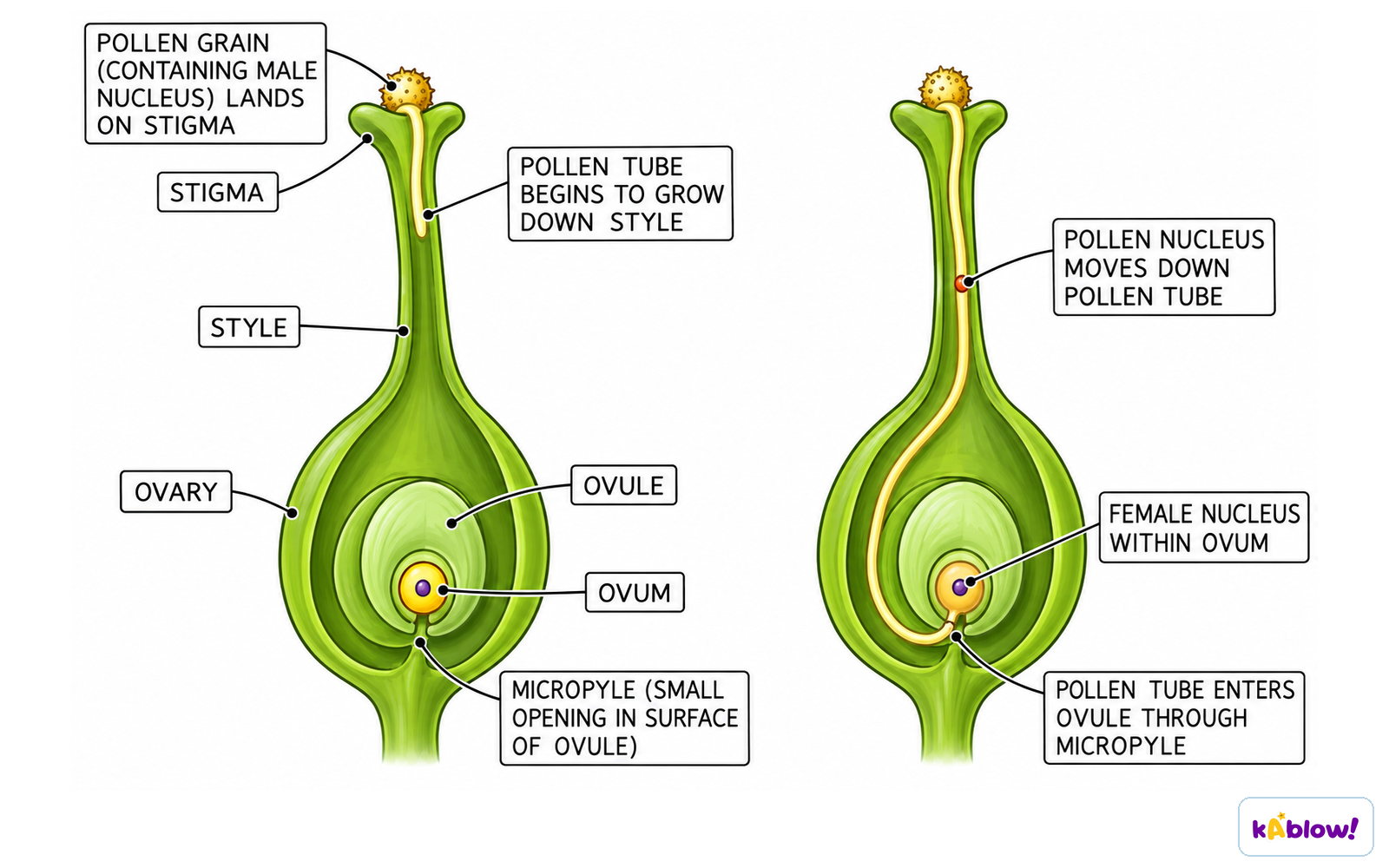
- When a pollen grain lands on a stigma of the right species, it grows a pollen tube down the style towards the ovary.
- The tube enters an ovule through a tiny gap called the micropyle. The male nucleus travels down the tube.
- Fertilisation happens when the male nucleus fuses with the female nucleus inside the ovum. The fertilised cell is a zygote. It divides to make an embryo.
- After fertilisation, each ovule develops into a seed. The ovary develops into a fruit, which protects the seeds and often helps spread them. The petals and stamens wither and fall away.
- A seed has three main parts: a tiny embryo (a new plant), a food store, and a tough seed coat that protects it.
A pollen tube growing to the ovule
Seed dispersal: moving away from the parent
- Seed dispersal is the spreading of seeds away from the parent plant.
- It helps because seedlings that grow far from the parent do not compete with it, or with each other, for light, water and minerals. It also lets the species reach new places.
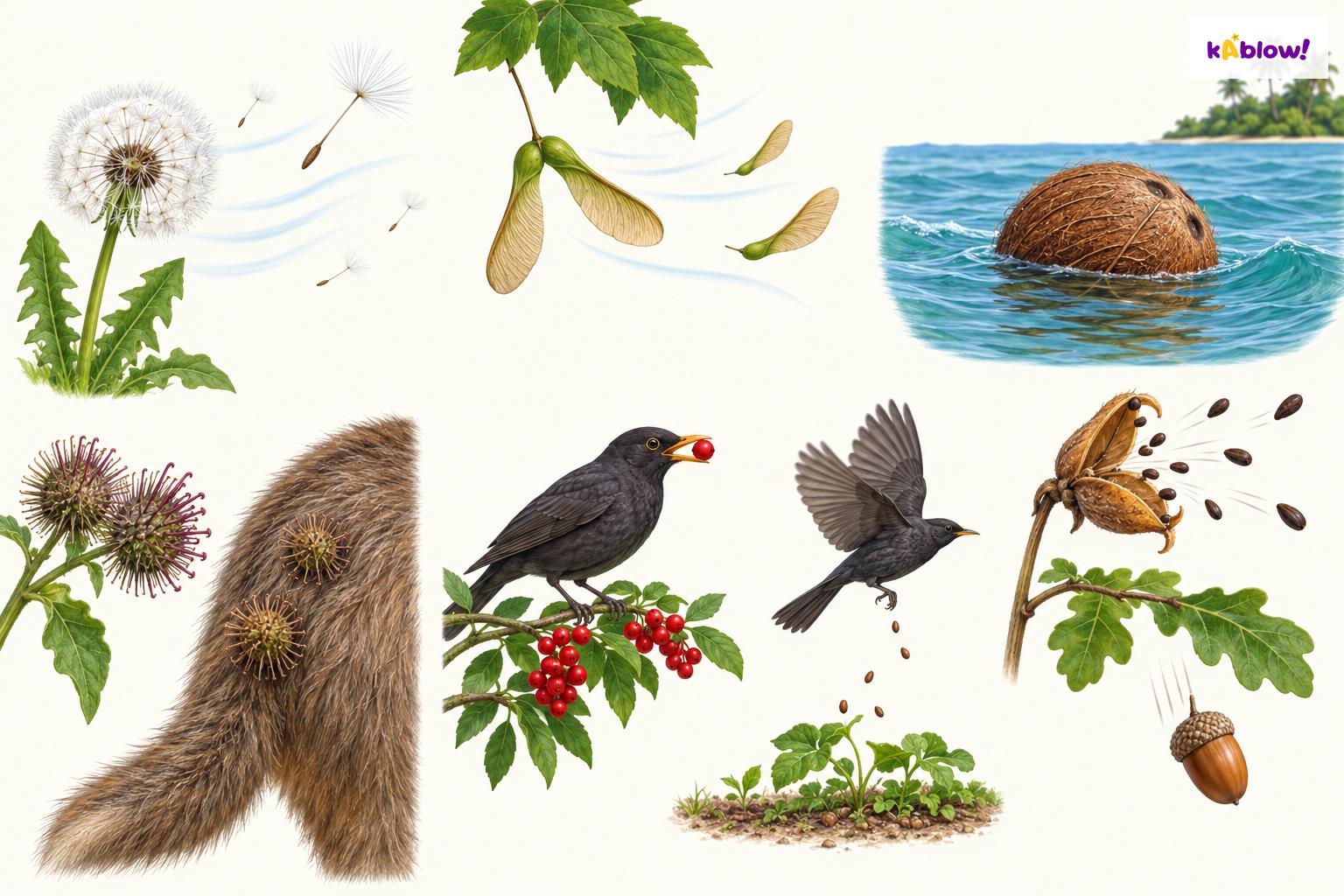
- Wind: light seeds with fluffy parachutes (dandelion) or wings (sycamore and maple) are carried a long way.
- Animals: fruits with hooks or spines (burdock) stick to fur. Juicy fruits are eaten, and the seeds pass through the animal and are dropped in its droppings, often far away.
- Explosive: pods such as peas and gorse dry out, split and fling their seeds out.
- Water: light, waterproof fruits such as coconuts float across seas. Heavy fruits such as acorns simply fall to the ground.
Ways seeds are dispersed
Think like a scientist: what do seeds need to germinate?
- Germination is when a seed starts to grow into a seedling.
- Seeds need water (to swell and to let chemical reactions start), oxygen (for respiration, which releases energy for growth) and a suitable temperature (enzymes work best when it is warm enough, but not too hot). Most seeds do not need light or soil to germinate.
- The first root emerges, then the shoot. Until its leaves open and start photosynthesis, the seedling lives on the food store inside the seed.
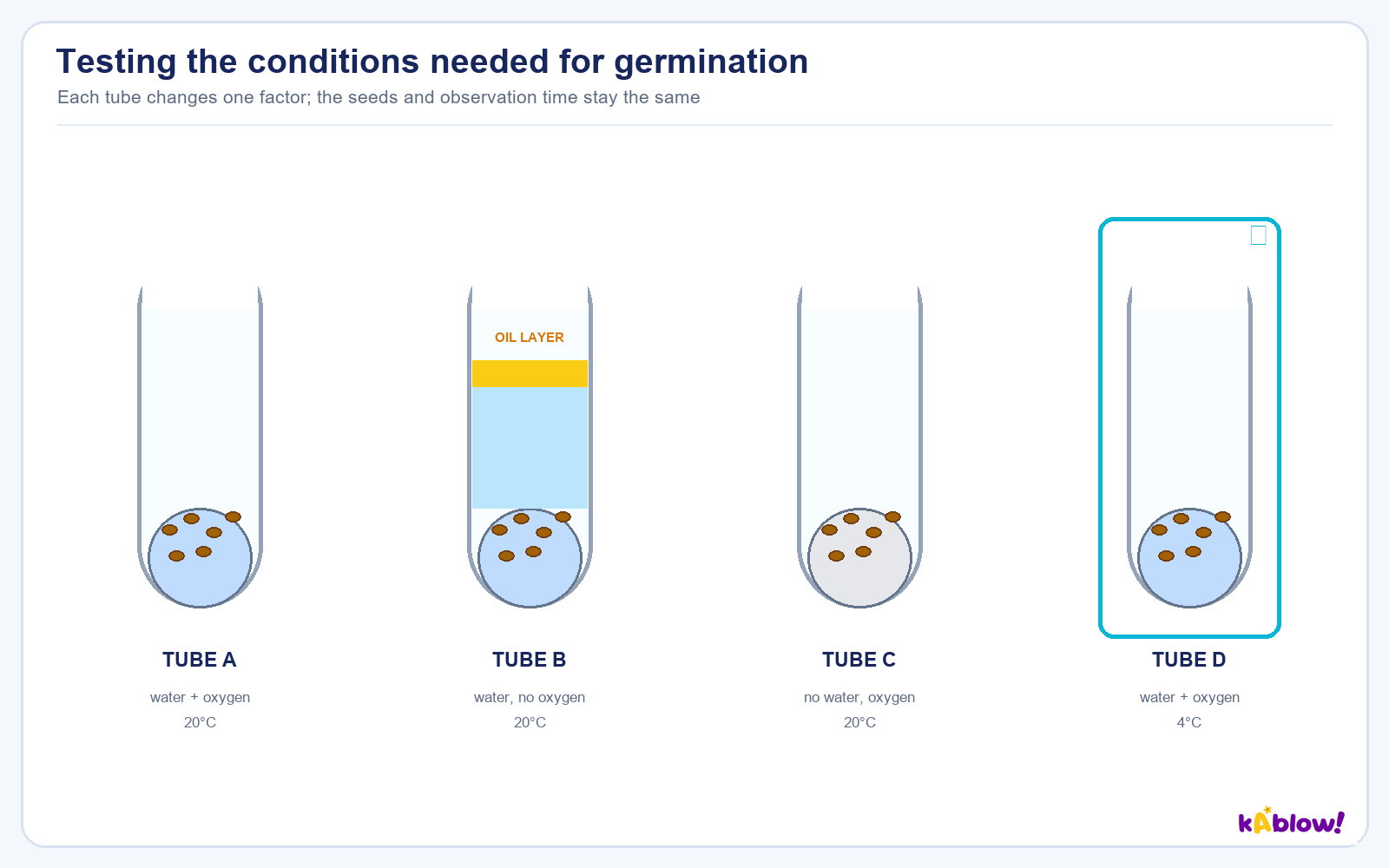
- To test one factor, change only that factor. In the set-up shown, the tube with no water, the tube with boiled water and oil (no oxygen) and the tube in the cold each differ from the first tube in one way only.
- The independent variable is the one you change and the dependent variable is the one you measure, such as the number of seeds that germinate. Repeating the test with more seeds makes the results more reliable.
- Inquiry task: plan an investigation into whether temperature affects how many cress seeds germinate. Choose at least four temperatures, say what you will measure and when, name three variables you will control, and explain how you will decide which temperature is best and how reliable your result is.
Testing what seeds need to germinate
Diapositivas
Sign up free to view the lesson slides
Step through every slide for this topic — plus flashcards and revision notes — with a free account.
Preguntas de práctica
Vista previa gratis — 8 de 52 preguntas. Regístrate para verlas todas.
1.Which part of a flower makes pollen?
Easy- AThe stigma
- BThe ovary
- CThe anther
- DThe sepal
2.Which part of a flower catches pollen?
Easy- AThe stigma
- BThe anther
- CThe filament
- DThe petal
3.Where are the ovules found in a flower?
Easy- AOn the anther
- BOn the sepals
- CInside the filament
- DInside the ovary
4.Which part of a flower is the male part?
Easy- AThe carpel
- BThe stamen
- CThe ovary
- DThe style
5.What is the main job of the sepals?
Easy- ATo make the pollen grains
- BTo protect the flower bud
- CTo catch the pollen grains
- DTo attract the insects
6.What is pollination?
Easy- AThe joining of a male and a female nucleus
- BThe spreading of seeds away from a plant
- CThe growth of a seed into a seedling
- DThe transfer of pollen from an anther to a stigma
7.Why do insect-pollinated flowers have brightly coloured petals?
Easy- ATo attract insects
- BTo protect the seeds
- CTo make pollen
- DTo catch the wind
8.Insects can carry pollen from one flower to another.
EasyTrue or false?
Unlock all 52 questions, flashcards & more
Crea una cuenta gratis para ver todas las preguntas, las diapositivas, las tarjetas y los apuntes de repaso de este tema.
Exámenes anteriores
La práctica con exámenes anteriores de este tema llegará pronto.
Próximamente