Covalent molecules and their properties
Apréndelo jugando
Responde estas preguntas para ganar energía, luego pesca y explora. Sin cuenta.
Apuntes de la lección
Big idea: covalent molecules and their properties
- Key concept: Systems. Atoms share electron pairs in covalent bonds. Melting a simple molecular substance overcomes intermolecular attractions, not the covalent bonds within each molecule.
- Related concepts: Models and evidence. Use a scientific explanation to make predictions, then test it against observations.
- Global context: Scientific and technical innovation. Molecular properties help select solvents and fuels.
Covalent Bonds
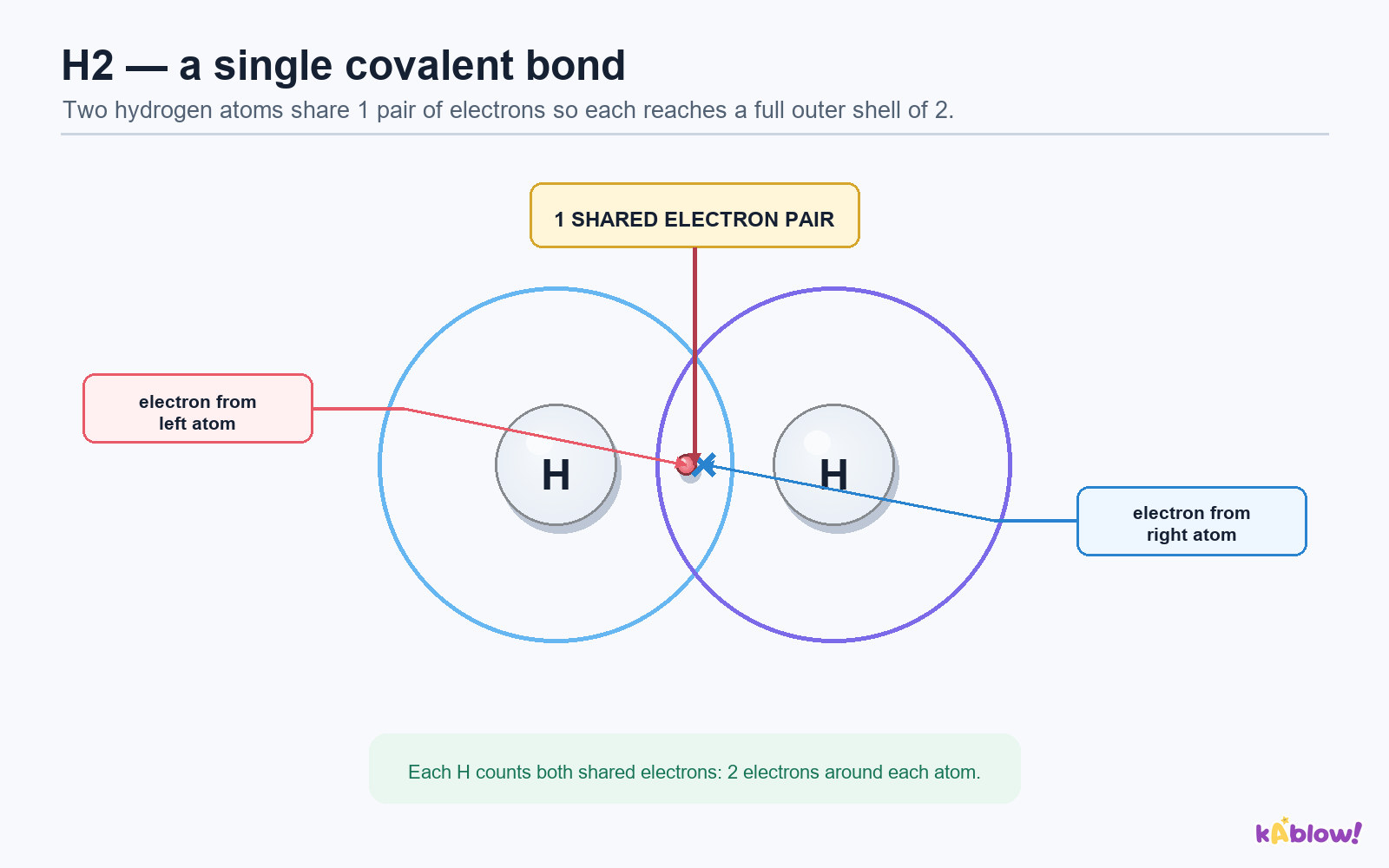
- A covalent bond is formed when pairs of electrons are shared between atoms.
- Only non-metal elements participate in covalent bonding.
- Each atom gains a full outer shell of electrons (noble gas configuration).
- Covalently bonded substances may consist of small molecules or giant molecules.
- Dot-and-cross diagrams show the electronic configuration: dots for one atom's electrons, crosses for the other's.
- Electron shells overlap and shared electrons are shown in the overlap region.
A single covalent bond in hydrogen
Single Covalent Bonds
- A single covalent bond involves one shared pair of electrons.
- Examples: H₂ (H–H), Cl₂ (Cl–Cl), H₂O, CH₄, NH₃, HCl.
- In H₂O, oxygen shares one electron with each hydrogen atom, forming two single bonds.
- In CH₄, carbon shares one electron with each of four hydrogen atoms.
- In NH₃, nitrogen shares one electron with each of three hydrogen atoms.
- In HCl, hydrogen and chlorine share one pair of electrons.
Double and Triple Covalent Bonds
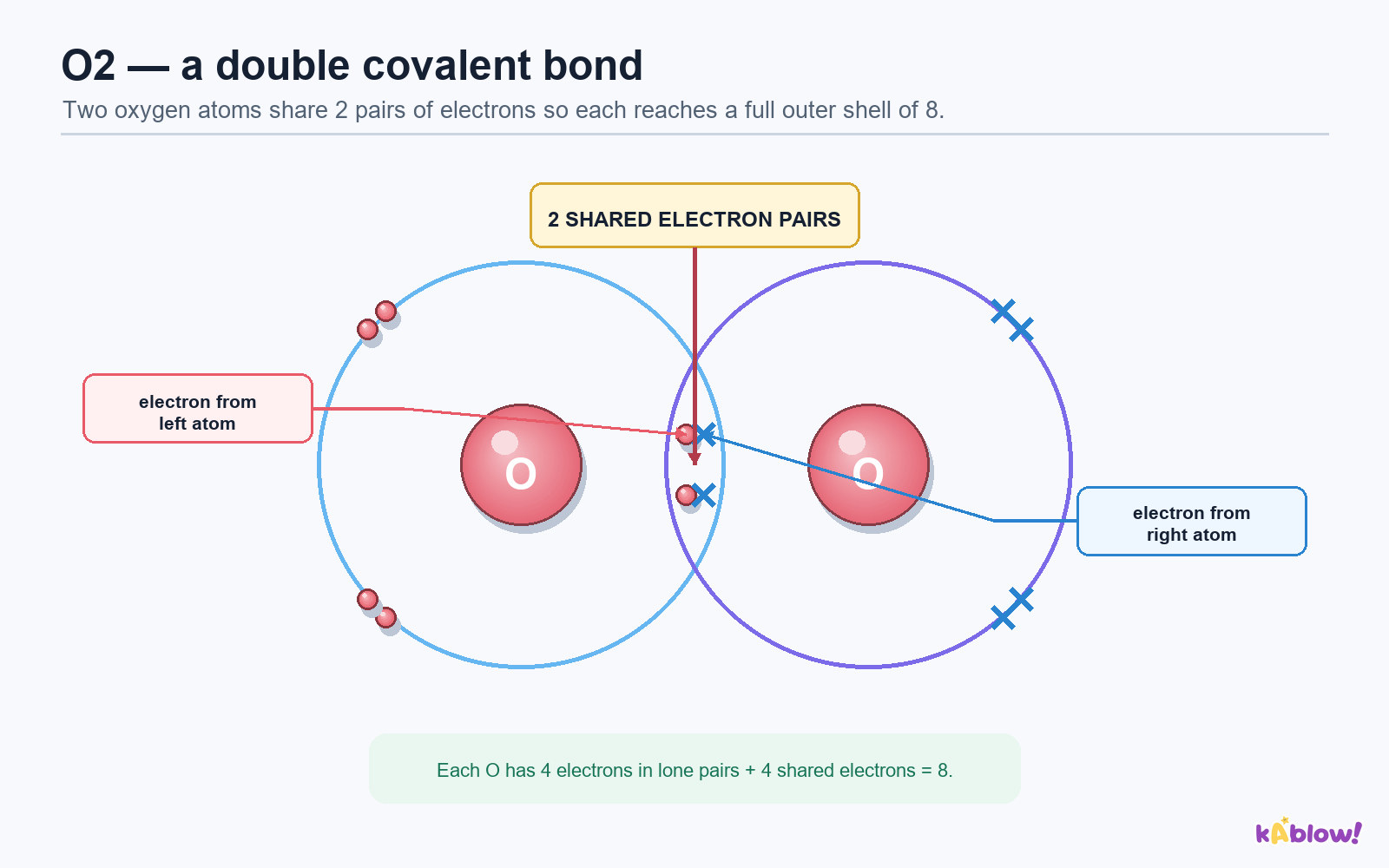
- Some atoms share two pairs of electrons to form a double bond.
- Some atoms share three pairs of electrons to form a triple bond.
- O₂ has a double bond (O=O) – each oxygen shares two electrons.
- N₂ has a triple bond (N≡N) – each nitrogen shares three electrons.
- Ethene (C₂H₄) has a double bond between the two carbon atoms.
- Carbon dioxide (CO₂) has two double bonds (O=C=O).
A double covalent bond in oxygen
Properties of Simple Molecular Compounds
- Simple molecular compounds have low melting and boiling points.
- They are usually liquids or gases at room temperature.
- As molecule size increases, melting and boiling points increase.
- They have poor electrical conductivity – do not conduct in solid or liquid state.
- They are insulators (e.g., plastic coating on wires).
Explaining Properties
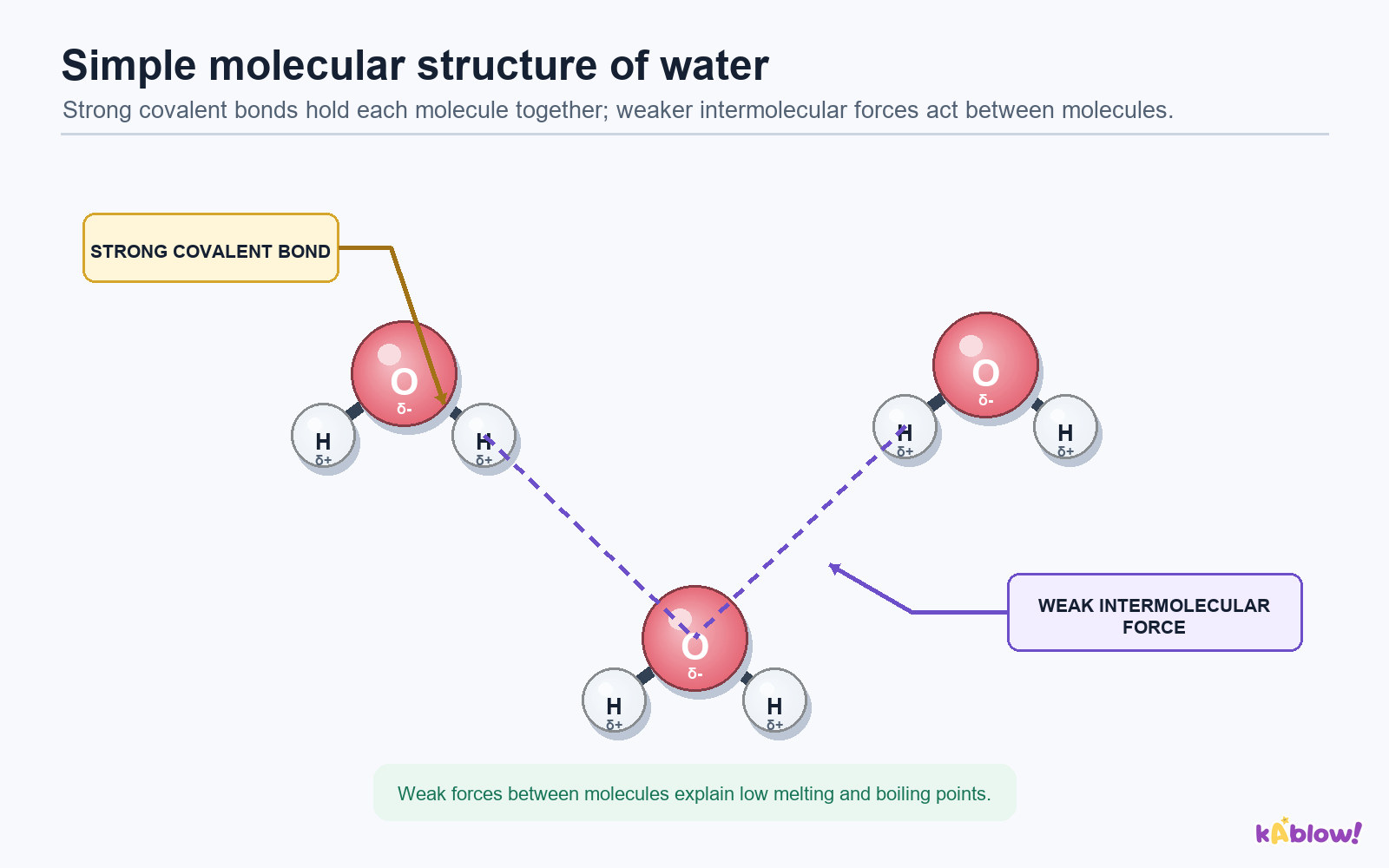
- Atoms within molecules are held by strong covalent bonds.
- Between molecules there are weak intermolecular forces.
- Low melting/boiling points are due to weak intermolecular forces requiring little energy to overcome.
- Intermolecular forces are about one tenth as strong as covalent bonds.
- Larger molecules have more electrons, increasing intermolecular forces and raising melting/boiling points.
- Poor conductivity because there are no free ions or electrons to carry charge.
Bonds within and between water molecules
Distinguishing Covalent from Ionic
- Covalent compounds contain only non-metals.
- Ionic compounds contain metal and non-metal.
- In dot-and-cross diagrams, covalent compounds show overlapping shells with shared electrons.
- Ionic compounds show separate ions with square brackets and charges.
- Covalent compounds have low melting points; ionic compounds have high melting points.
Think like a scientist
- Use teacher-provided melting-point and conductivity data to compare several simple molecular substances.
- Comparison: the molecular substance being compared. Outcome: melting point and electrical conductivity.
- Control: compare measurements made under the same pressure. Explain why this makes the comparison fairer.
- Evidence: Use a consistent method, repeated observations where appropriate and a table with labelled quantities and units. Keep unexpected results and investigate their cause.
- Safety: Practical activities need teacher supervision and an appropriate risk assessment. Use the provided data or simulation where the investigation specifies it.
- Inquiry task: State a testable question, predict the outcome using the science, then explain how your observations would support or challenge the prediction.
Evaluate the science
- Molecular properties help select solvents and fuels.
- A material's melting point alone does not establish its bonding type; several lines of evidence are needed.
- Evaluation task: Link your conclusion to evidence, identify a limitation and suggest a specific improvement. Distinguish a measured result from an explanation of its cause.
Diapositivas
Sign up free to view the lesson slides
Step through every slide for this topic — plus flashcards and revision notes — with a free account.
Preguntas de práctica
Vista previa gratis — 8 de 52 preguntas. Regístrate para verlas todas.
1.What type of bonding is found in methane?
Easy- ACovalent
- BIonic
- CMetallic
- DHydrogen bonding
2.Which of the following substances has a simple molecular structure?
Easy- ACarbon dioxide
- BCalcium carbonate
- CCopper
- DMagnesium oxide
3.A covalent bond is formed when two atoms:
Easy- AShare a pair of electrons
- BTransfer electrons
- CShare protons
- DAttract via opposite charges
4.When a simple molecular substance melts, what is broken?
Easy- AIntermolecular forces
- BCovalent bonds
- CIonic bonds
- DMetallic bonds
5.Which of the following statements explains why ammonia does not conduct electricity?
Easy- AIt does not contain any free ions or free electrons
- BIts ions are in a fixed position
- CIt has delocalised electrons
- DIt contains free electrons
6.The boiling point of nitrogen is very low even though the bond between atoms in a nitrogen molecule is very strong. Why?
Medium- AOnly weak intermolecular forces need to be overcome
- BThe covalent bonds are broken during boiling
- CNitrogen molecules are very small
- DNitrogen is a gas at room temperature
7.Which of the following elements can form covalent bonds?
Easy- ACarbon
- BSodium
- CCalcium
- DIron
8.Which of the following molecules contains a double bond?
Easy- AOxygen (O2)
- BHydrogen (H2)
- CChlorine (Cl2)
- DMethane (CH4)
Unlock all 52 questions, flashcards & more
Crea una cuenta gratis para ver todas las preguntas, las diapositivas, las tarjetas y los apuntes de repaso de este tema.