Forces and their effects
Apréndelo jugando
Responde estas preguntas para ganar energía, luego pesca y explora. Sin cuenta.
Apuntes de la lección
Big idea: forces change things
- Big idea. Key concept: Relationships. The size and direction of the forces on an object decide how it moves.
- Related concept: Interaction. A force is always an interaction between two objects: one pushes or pulls on the other.
- Global context: Scientific and technical innovation. Engineers use forces to design cars, bridges, springs and spacecraft.
- A force is a push or a pull. Forces are measured in newtons (N) using a newtonmeter.
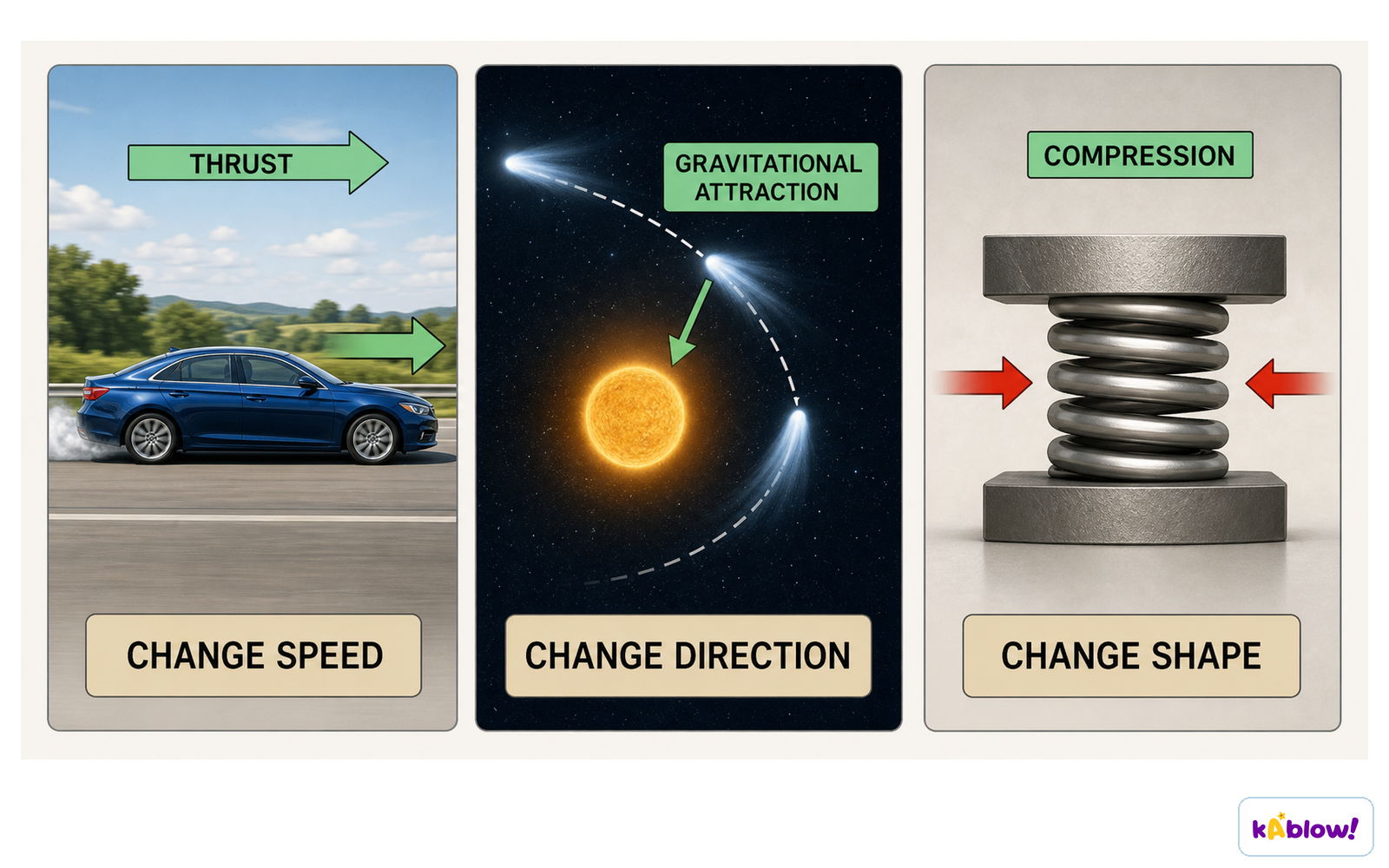
- A force can make an object speed up, slow down, change direction or change shape. A car's thrust changes its speed, the Sun's gravity bends the path of a comet, and squeezing a spring changes its shape.
- A force cannot change how much matter an object contains, so it cannot change an object's mass.
Three effects of a force
Contact and non-contact forces, and force arrows
- A contact force only acts when two objects touch. Examples are friction, air resistance, tension in a rope and the normal contact force (the push of a surface on an object resting on it).
- A non-contact force acts across a gap. Examples are gravity, magnetic force and the electrostatic force between charged objects.
- We draw a force as an arrow. The arrow points in the direction of the force, and a longer arrow means a bigger force.
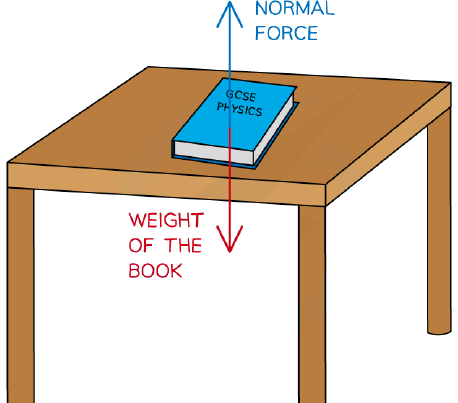
- A free-body diagram shows one object on its own with arrows for every force acting on it. A book on a table has its weight pulling down and the normal contact force from the table pushing up.
- These two arrows for the book are the same length. The upward force and the downward force are equal, so the book stays still.
Forces on a book resting on a table
Balanced and unbalanced forces
- When several forces act on an object we can add them up. The resultant force is the single force that has the same effect as all of them together.
- Forces in opposite directions are subtracted. Forces in the same direction are added. For example, 400 N to the right and 150 N to the left give a resultant of 250 N to the right.
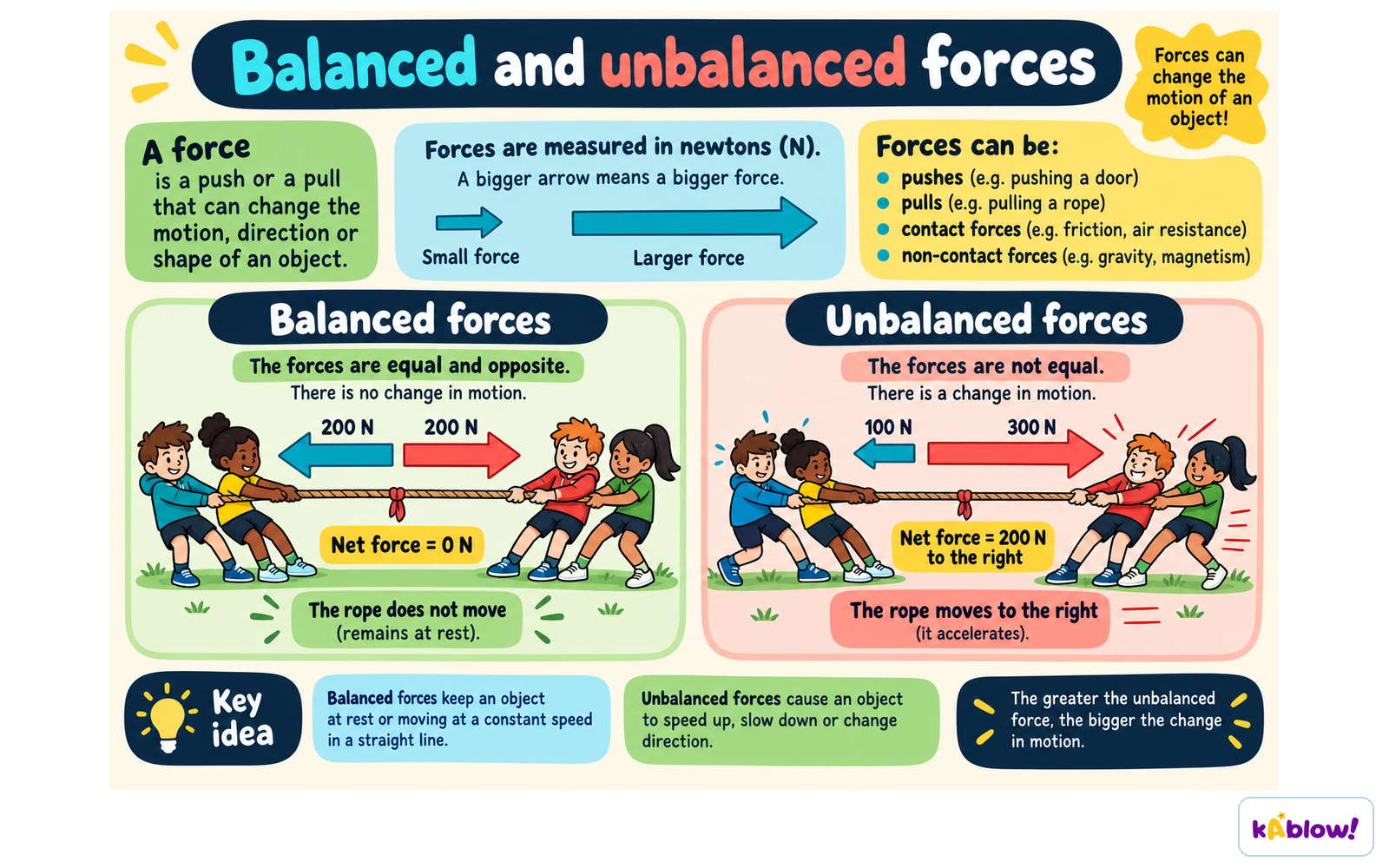
- If the forces are balanced, the resultant force is 0 N. A stationary object stays at rest, and a moving object keeps moving at the same speed in a straight line.
- If the forces are unbalanced, there is a resultant force. The object speeds up, slows down or changes direction. The bigger the resultant force, the bigger the change.
- A car moving at a steady speed has balanced forces: the thrust forwards equals the friction and air resistance backwards. An object does not need a resultant force to keep moving.
Balanced and unbalanced forces in a tug of war
Gravity, mass and weight
- Gravity is a non-contact force that pulls objects with mass towards each other. Near the Earth it pulls everything towards the centre of the Earth.
- Mass is the amount of matter in an object. It is measured in kilograms (kg) and does not change when you move to a different place.
- Weight is the force of gravity on an object. It is measured in newtons (N), so it is a force and it has a direction (downwards).
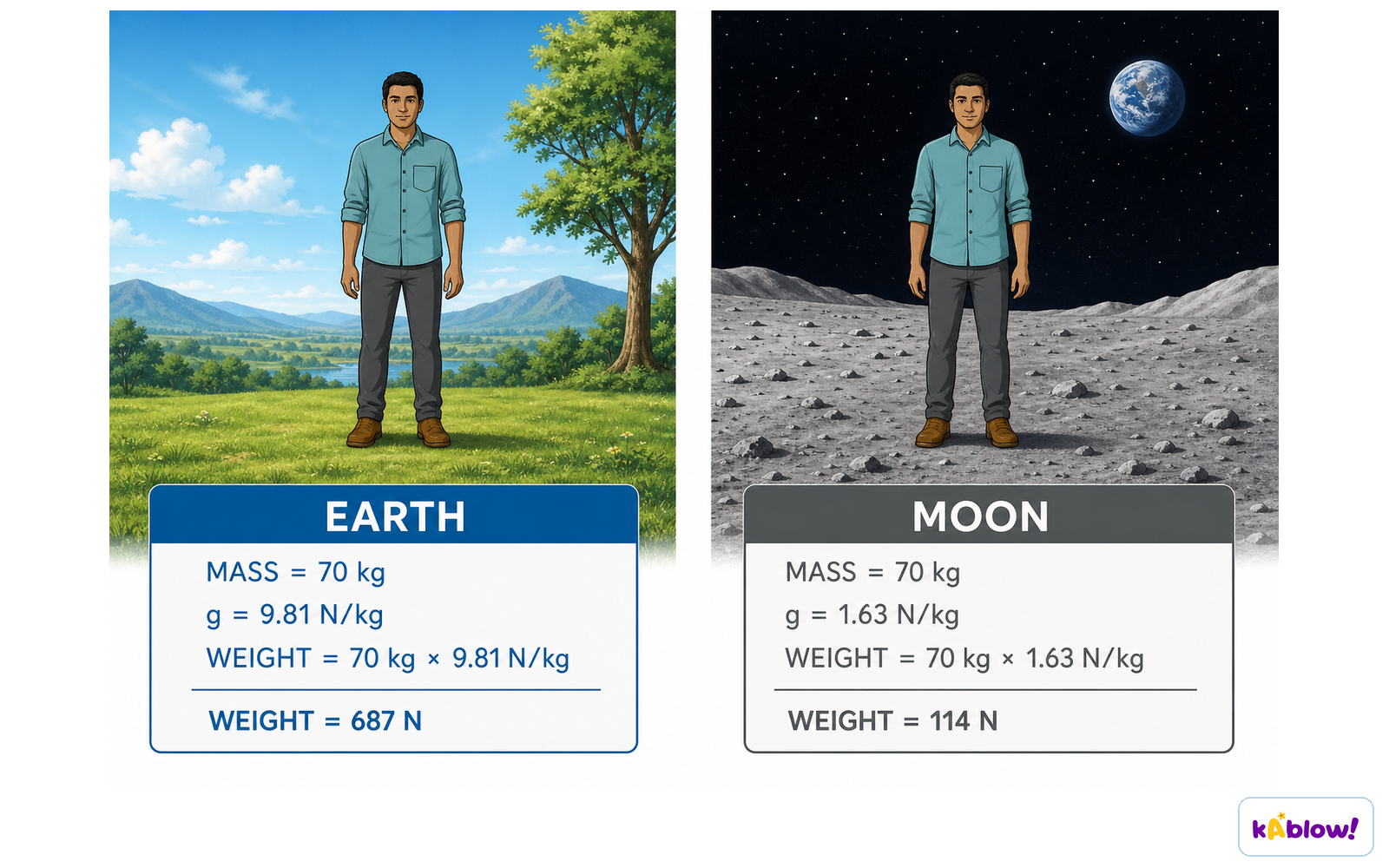
- Weight = mass × gravitational field strength, or W = m × g. On Earth g is about 10 N/kg (9.81 N/kg more exactly). On the Moon g is about 1.6 N/kg.
- A 3 kg bag has a weight of 3 kg × 10 N/kg = 30 N on Earth. Its mass is still 3 kg on the Moon, but its weight is only 3 × 1.6 = 4.8 N.
- This is why astronauts can bounce along on the Moon: their mass is the same, but their weight is about six times smaller.
Same mass, different weight on the Moon
Friction and air resistance
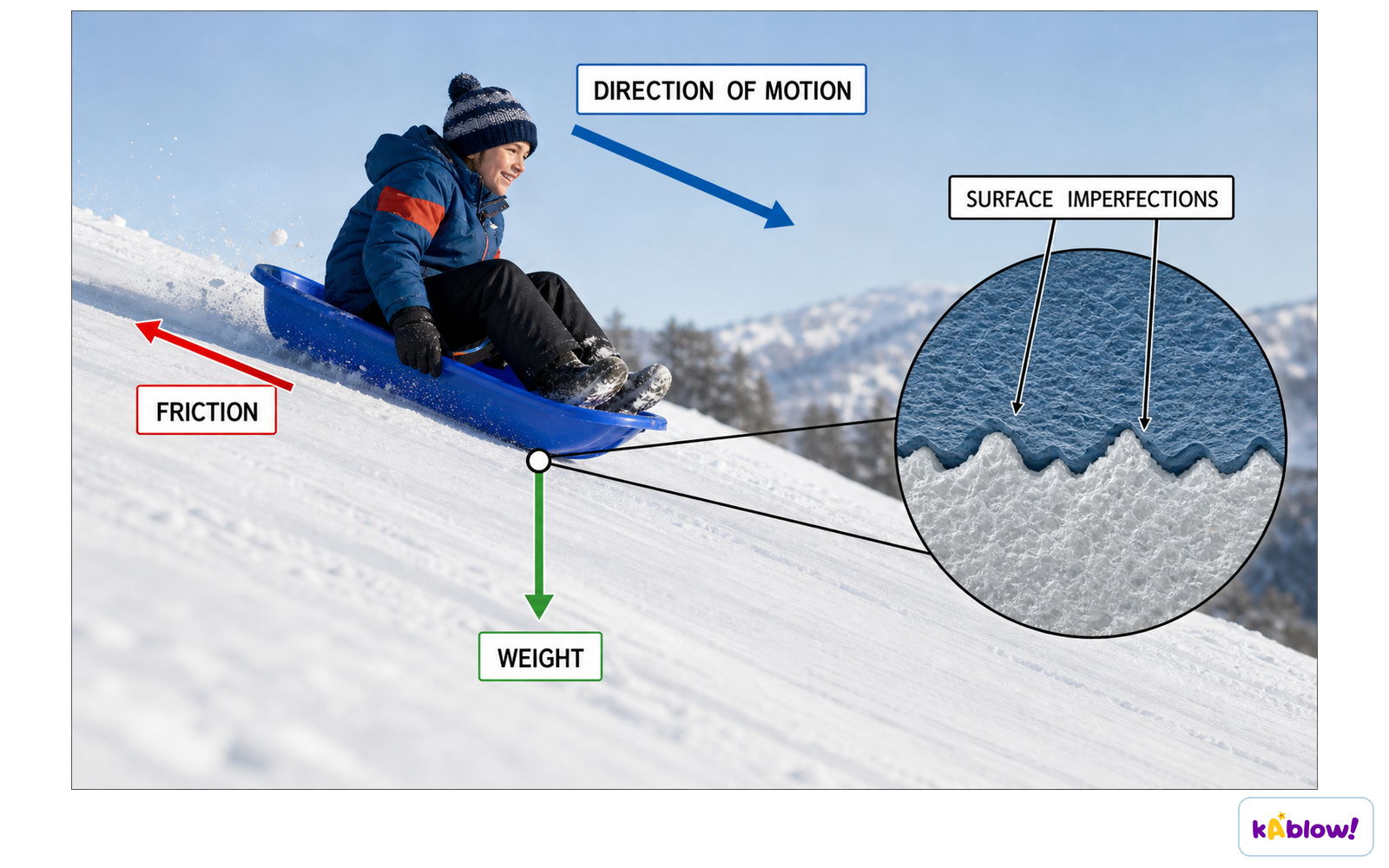
- Friction is a contact force between two surfaces that are rubbing or trying to slide past each other. It acts in the direction opposite to the motion.
- Friction happens because even smooth-looking surfaces have tiny bumps that catch on each other. Rougher surfaces give more friction.
- Air resistance (drag) is friction from the air or any fluid. It acts against the motion, and it gets bigger as speed increases and as the object's front area gets bigger.
- Friction can be useful (brakes, shoe grips) and a nuisance (it wastes energy as heat and wears parts out). A lubricant such as oil reduces friction between moving parts.
- Streamlined shapes, such as a racing cyclist crouching low, reduce air resistance.
- A skydiver speeds up at first because weight is bigger than air resistance. As speed rises, air resistance grows until it equals weight. The forces are then balanced and she falls at a steady speed.
Friction acts against the motion of a sledge
Think like a scientist: springs and Hooke's law
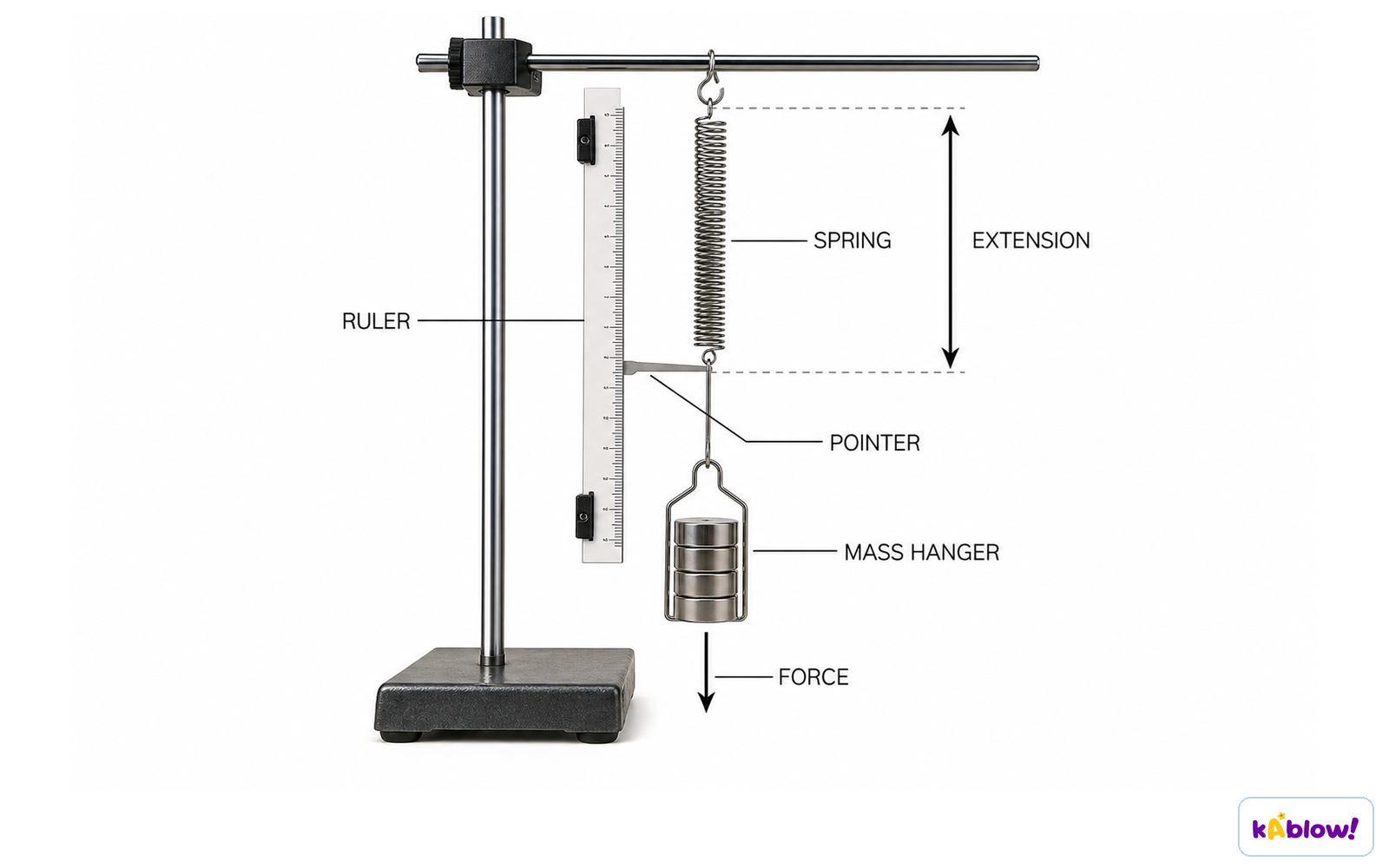
- A spring stretches when a force pulls on it. The extension is the stretched length minus the original length.
- In a safe school investigation, hang a spring from a clamp stand, add masses to a hanger one at a time and measure the length each time with a ruler. Keep feet clear of falling masses and wear eye protection.
- The independent variable is the force (the load on the spring). The dependent variable is the extension. Control variables include the same spring and the same ruler.
- If the line on a force-extension graph is straight through the origin, extension is directly proportional to force. This is Hooke's law. It stops working at the limit of proportionality.
- Example: a spring stretches 4 cm when pulled by 2 N. If it obeys Hooke's law, 4 N gives 8 cm and 5 N gives 10 cm.
- Inquiry task: plan a fair test to find out whether two different springs stretch by the same amount for the same load. List your variables, say how you will make the measurements reliable and say how you will decide which spring is stiffer.
Equipment for stretching a spring
Diapositivas
Sign up free to view the lesson slides
Step through every slide for this topic — plus flashcards and revision notes — with a free account.
Preguntas de práctica
Vista previa gratis — 8 de 53 preguntas. Regístrate para verlas todas.
1.Which unit is used to measure force?
Easy- AKilogram (kg)
- BNewton (N)
- CMetre (m)
- DSecond (s)
2.Which of these is a contact force?
Easy- AGravity
- BMagnetic force
- CFriction
- DStatic electric force
3.Which of these is a non-contact force?
Easy- AGravity
- BFriction
- CAir resistance
- DTension in a rope
4.Which of these can a force NOT do to an object?
Easy- AMake it speed up
- BChange its direction
- CChange its shape
- DChange its mass
5.A newtonmeter is used to measure which quantity?
Easy- ATime
- BTemperature
- CForce
- DVolume
6.In a force diagram, what does a longer arrow mean?
Easy- AA heavier object
- BA force that acts for longer
- CA force that is moving faster
- DA larger force
7.A book rests on a table. Which force from the table pushes up on the book?
Easy- ANormal contact force
- BFriction
- CWeight
- DAir resistance
8.A car travels along a straight, level road at a steady speed. The engine's thrust is 1500 N. What is the total of friction and air resistance acting on the car?
Medium- A0 N
- B1500 N forwards
- C3000 N backwards
- D1500 N backwards
Unlock all 53 questions, flashcards & more
Crea una cuenta gratis para ver todas las preguntas, las diapositivas, las tarjetas y los apuntes de repaso de este tema.