Light and reflection
Apréndelo jugando
Responde estas preguntas para ganar energía, luego pesca y explora. Sin cuenta.
Apuntes de la lección
Big idea: how light lets us see
- Big idea. Key concept: Systems. A light source, the objects it shines on and our eyes work together as one system that lets us see.
- Related concept: Models. We draw light as straight lines called rays. A ray is a model: it is not a real thread, but it helps us predict where light goes.
- Global context: Scientific and technical innovation. Mirrors, periscopes, cameras and telescopes all work by controlling light.
- A luminous object gives out its own light, for example the Sun, a lamp or a candle flame. A non-luminous object, such as the Moon, a book or you, only reflects light from a luminous source.
- We see an object when light from it enters our eyes. Our eyes do not send out beams. Light enters through the pupil, the lens focuses it onto the retina, and the retina sends signals to the brain.
- Never look straight at the Sun or into a laser beam. Bright light can damage the retina for good.
Light travels in straight lines
- Light travels in straight lines through a material such as air that is the same all the way through. A torch beam in a dusty room shows this.
- Light travels extremely fast: about 300 000 km every second. Sunlight takes about 8 minutes to reach Earth. Light is far faster than sound, which is why you see lightning before you hear thunder.
- A transparent material (clear glass, air) lets light pass straight through. A translucent material (frosted glass, tracing paper) lets some light through but scatters it. An opaque material (wood, metal, card) lets no light through.
- A shadow forms when an opaque object blocks light. Because light travels in straight lines, the shadow has the same shape as the object.
- Move the object closer to the light source and the shadow gets bigger. Move it closer to the screen and the shadow gets smaller and sharper.
Reflection and the law of reflection
- Reflection is when light bounces off a surface. A flat, shiny surface such as a mirror reflects light in a very regular way.
- The incident ray is the ray that arrives at the mirror. The reflected ray is the ray that bounces off.
- The normal is a dashed line drawn at 90° to the mirror at the point where the ray hits it.
- The angle of incidence (i) is the angle between the incident ray and the normal. The angle of reflection (r) is the angle between the reflected ray and the normal. Always measure from the normal, never from the mirror surface.
- Law of reflection: angle of incidence = angle of reflection. If i = 40°, then r = 40°, and the angle between the two rays is 80°.
- A ray that travels along the normal (i = 0°) is reflected straight back along itself.
- In a school investigation you use a ray box (a low-voltage lamp that makes a thin beam), a plane mirror and a protractor. Never use the Sun or a laser pointer.
Investigating the law of reflection
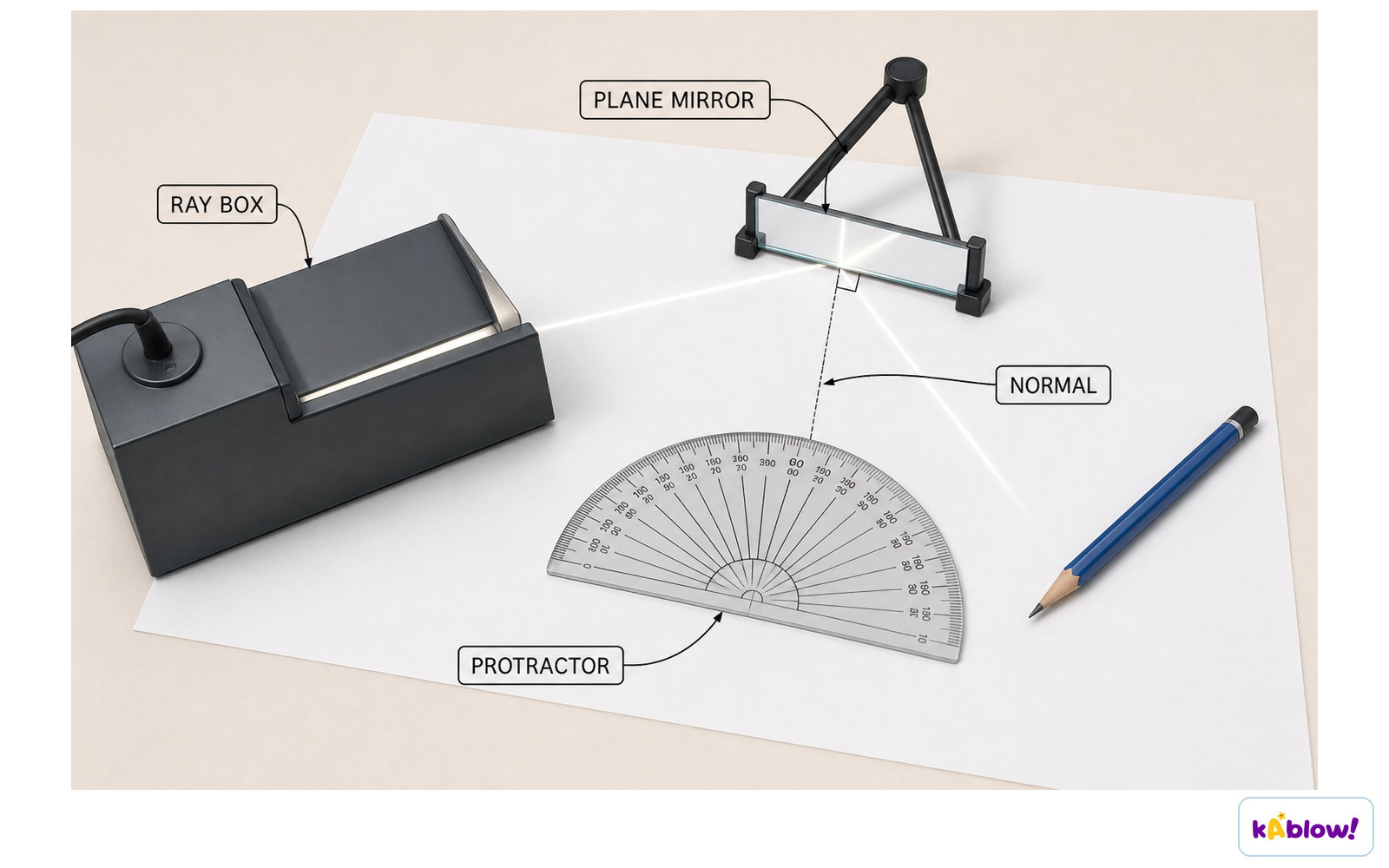
Images in plane mirrors
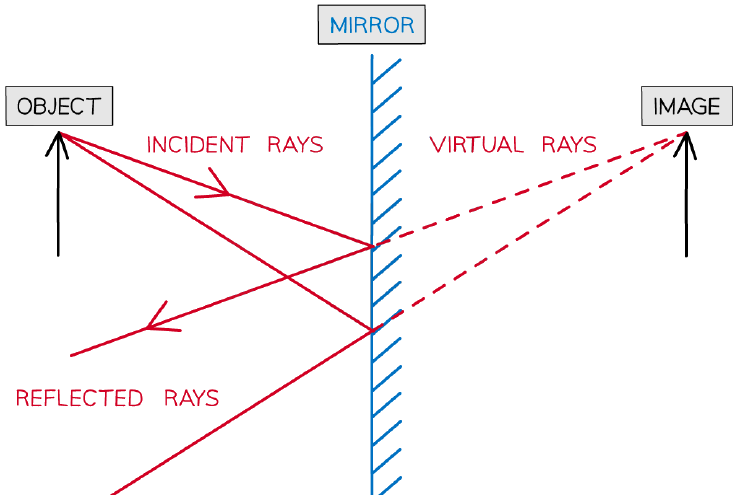
- A plane mirror is a flat mirror. When you look into it you see an image that seems to be behind the mirror.
- The image is the same size as the object and the same distance behind the mirror as the object is in front of it.
- The image is laterally reversed: left and right are swapped. That is why the word AMBULANCE is written back to front on the front of the vehicle, so drivers can read it in their mirrors.
- The image is virtual. Light only seems to come from it, because your brain assumes light travels in straight lines. No light is really behind the mirror, so the image cannot be caught on a screen.
- A smooth surface such as a mirror or calm water gives regular reflection: parallel rays stay parallel, so you see a clear image.
- A rough surface such as paper or a wall gives diffuse reflection. Each ray still obeys the law of reflection, but the tiny bumps point the normal in different directions, so the light scatters and there is no clear image. Scattering is why you can see a wall from any part of a room.
How a plane mirror forms an image
Colour and white light
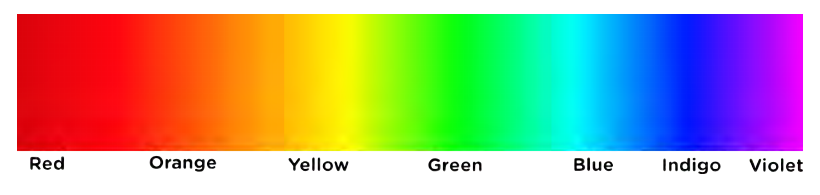
- White light is a mixture of colours. A glass prism splits it into a spectrum: red, orange, yellow, green, blue, indigo and violet. Splitting light into colours is called dispersion. A rainbow forms when raindrops disperse sunlight.
- Red, green and blue light mixed together make white light.
- The colour of an object depends on which colours it reflects. A red apple reflects mostly red light and absorbs the others. White paper reflects all colours. Black cloth absorbs nearly all of them.
- A colour filter lets through (transmits) its own colour and absorbs the rest. A red filter in white light gives red light. A blue light shone at a red filter is absorbed, so almost no light comes out.
- In red light a blue shirt looks very dark, because the shirt reflects blue but there is no blue light to reflect.
The visible spectrum from red to violet
Think like a scientist: testing the law of reflection
- Question: is the angle of reflection always equal to the angle of incidence?
- The independent variable is the angle of incidence (for example 20°, 30°, 40°, 50° and 60°). The dependent variable is the angle of reflection, measured with a protractor.
- Control variables include the same mirror, the same ray box, the same point on the mirror and always measuring from the normal.
- In one class experiment the angles of reflection were 21°, 29°, 40°, 52° and 59°. They are close to the angles of incidence but not identical. The differences are measurement error: it is hard to read a protractor and to mark the middle of a thick beam.
- To improve the investigation: use a narrow beam, draw the normal carefully, measure each angle more than once and take a mean.
- Inquiry task: plan an investigation to find out whether the distance of an object from a plane mirror changes the distance of its image behind the mirror. List your variables, say how you will measure the distances and describe how you will make your results reliable.
Diapositivas
Sign up free to view the lesson slides
Step through every slide for this topic — plus flashcards and revision notes — with a free account.
Preguntas de práctica
Vista previa gratis — 8 de 55 preguntas. Regístrate para verlas todas.
1.Which of these objects is luminous?
Easy- AThe Moon
- BA mirror
- CA white wall
- DA candle flame
2.Why can you see a book on a desk?
Easy- AYour eyes send out light that bounces off the book
- BThe book gives out its own light all the time
- CLight reflects off the book and enters your eyes
- DThe book absorbs all the light that hits it
3.Which material is opaque?
Easy- AClear glass
- BThick card
- CTracing paper
- DClean water
4.Why does an opaque object make a shadow?
Easy- AIt blocks light, which travels in straight lines
- BIt bends light round to the back of the object
- CIt makes new darkness that spreads out
- DIt reflects all of the light back to the source
5.A card is held between a small lamp and a wall, and casts a shadow. What happens to the shadow if the card is moved closer to the lamp?
Medium- AThe shadow gets smaller
- BThe shadow stays the same size
- CThe shadow disappears
- DThe shadow gets bigger
6.What is the normal in a ray diagram?
Easy- AThe ray that arrives at the mirror
- BThe ray that leaves the mirror
- CA line at 90° to the mirror where the ray hits
- DThe surface of the mirror itself
7.The angle of incidence is the angle between the incident ray and which line?
Easy- AThe normal
- BThe mirror surface
- CThe reflected ray
- DThe edge of the paper
8.A ray of light hits a plane mirror with an angle of incidence of 25°. What is the angle of reflection?
Easy- A65°
- B25°
- C50°
- D90°
Unlock all 55 questions, flashcards & more
Crea una cuenta gratis para ver todas las preguntas, las diapositivas, las tarjetas y los apuntes de repaso de este tema.