Climate Change
Apréndelo jugando
Responde estas preguntas para ganar energía, luego pesca y explora. Sin cuenta.
Apuntes de la lección
The Greenhouse Effect and Anthropogenic Causes
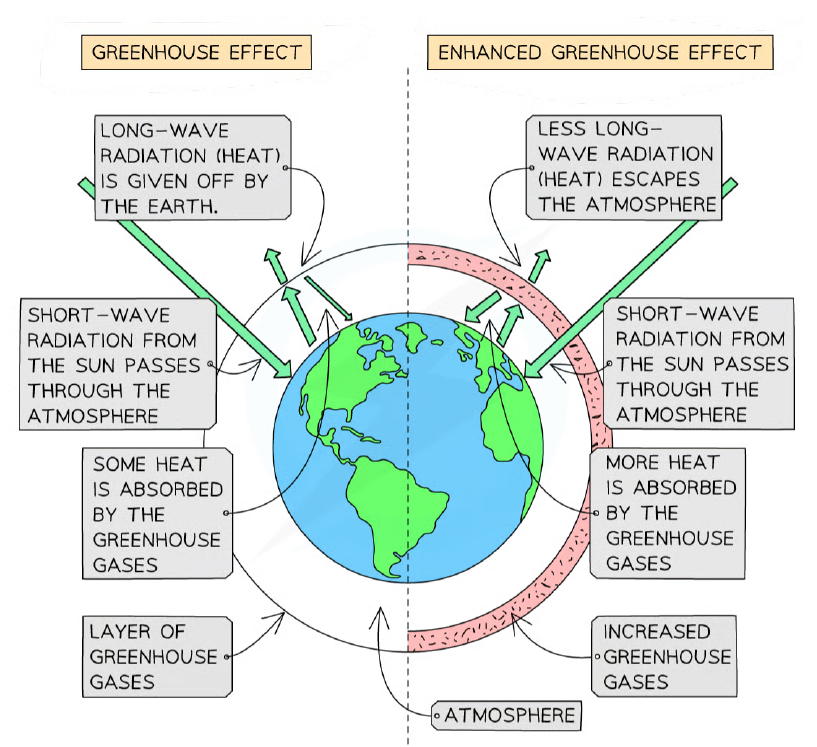
- Greenhouse gases absorb radiation re-emitted from Earth's surface, trapping it in the atmosphere and keeping the planet warm enough for life.
- The greenhouse effect is a naturally occurring process; without it, Earth would experience extreme temperature fluctuations like those on Mars (20°C to −153°C).
- Human activities have increased atmospheric concentrations of carbon dioxide and methane, leading to anthropogenic climate change.
- Global warming refers to the rise in global temperatures mainly due to increasing greenhouse gas concentrations; climate change refers to long-term changes in precipitation, temperature, and wind patterns.
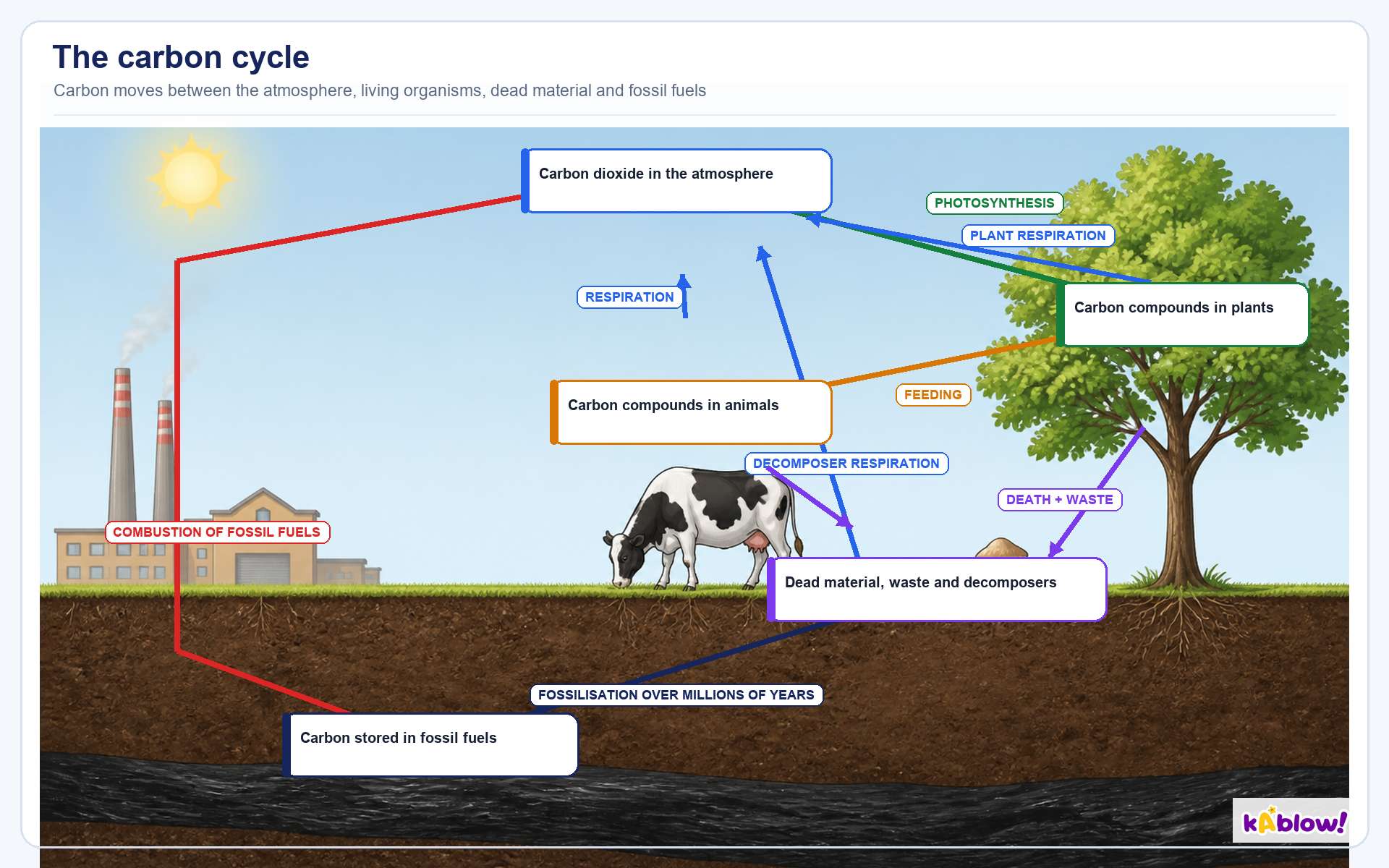
- Since the industrial revolution (late 1700s), atmospheric carbon dioxide levels have risen to their highest in Earth's history due to fossil fuel combustion.
- A clear positive correlation exists between rising carbon dioxide levels and increasing global temperatures, providing evidence for human impact, though correlation alone does not prove causation.
- Carbon sinks such as trees, soils, peat bogs, and oceans store carbon; their destruction by deforestation, soil degradation, peat harvesting, and ocean warming releases carbon dioxide.
The greenhouse effect
Human Activities and Methane Production
- Methane (CH₄) is a simple hydrocarbon and the main component of natural gas; its levels have risen significantly in the last 150 years due to human activities.
- Methane is released from the guts of ruminant mammals such as cattle; intensive farming has greatly increased this contribution.
- Landfill sites release methane when organic matter decomposes anaerobically.
- Extraction of fossil fuels from underground releases methane.
- Anaerobic bacteria in waterlogged rice paddy fields release methane.
- Warming of the poles leads to release of methane from natural stores such as permafrost (ground that remains frozen all year round).
Positive Feedback Cycles in Global Warming
- Positive feedback amplifies changes away from equilibrium, driving systems towards a tipping point where the state suddenly shifts to a new equilibrium.
- Loss of reflective snow and ice: as polar ice caps melt, Earth's albedo decreases, causing more solar energy to be absorbed by dark surfaces (rock, soil, ocean), increasing warming.
- Accelerating decomposition: higher temperatures increase the rate of enzyme-controlled decomposition by bacteria and fungi, releasing more carbon dioxide, especially from peat bogs and permafrost.
- Release of methane: melting permafrost leads to increased activity of methanogenic microorganisms (archaea) that produce methane.
- Increasing drought and forest fires: droughts make vegetation dry and flammable; combustion releases carbon dioxide and reduces photosynthesis, further increasing warming.
Impact of Climate Change: Boreal Forests and Polar Habitats
- Boreal forests (taiga) are an important carbon sink due to their size but are at risk of switching from a carbon sink to a carbon source—a tipping point.
- Reduced snow leads to less meltwater, causing drought, reduced photosynthesis, forest browning, tree death, and increased fire risk.
- Legacy carbon combustion releases carbon locked up for many years in living trees, dead needles, and soil, potentially making the switch from sink to source irreversible.
- Polar habitat change: less sea ice and earlier break-up cause problems for breeding animals such as emperor penguins (not enough time to raise young) and walruses (mothers must leave young unprotected for longer when hunting).
Impact of Climate Change: Ocean Currents and Range Shifts
- Ocean currents redistribute heat and nutrients; warm currents like the Gulf Stream moderate temperatures in coastal areas (e.g., Europe warmer than Canada at similar latitude).
- Upwelling brings cold, nutrient-rich water to the surface, supporting abundant marine life and fisheries.
- Changes in ocean currents, such as El Niño events, can cause shifts in atmospheric circulation, leading to droughts, floods, and extreme weather.
- El Niño involves warming of the central Pacific, preventing nutrient upwelling off Central and South America, reducing primary production and disrupting marine food chains.
- Species must migrate or face extinction when conditions exceed their range of tolerance; shifts may be poleward (towards poles) or upslope (to higher altitude).
- Evidence from Papua New Guinea shows montane bird species have moved upslope by an average of more than 100 m over 50 years.
- North American tree species have shown range contraction and northward spread due to temperature limits on survival.
Impact of Climate Change: Coral Reefs and Ocean Acidification
- Coral reefs are built by coral polyps that live symbiotically with algae; the algae provide carbon compounds via photosynthesis, and the polyps provide shelter.
- Around 25% of the world's ocean fish species depend on coral reefs for survival.
- Corals are highly sensitive to water temperature and pH; death of polyps leads to ecosystem collapse and reduced biodiversity.
- Ocean acidification: increased atmospheric CO₂ dissolves in oceans, forming carbonic acid (H₂CO₃), which dissociates to release hydrogen ions (H⁺), lowering pH.
- The reaction H⁺ + CO₃²⁻ → HCO₃⁻ reduces the availability of carbonate ions needed for building calcium carbonate exoskeletons, weakening or dissolving them.
- Rising ocean temperatures cause coral polyps to expel their algae symbionts, leading to coral bleaching and eventually death if prolonged.
- Note: ocean acidification shares the same cause as global warming (increased CO₂) but is not a direct result of global warming.
Carbon Sequestration
- Carbon sequestration is the process of capturing and storing carbon dioxide from the atmosphere.
- Natural carbon sequestration can be increased by forest regeneration (reforestation), afforestation (creating new forests), and peat bog restoration.
- If trees grow to maturity, they store huge amounts of carbon in their biomass; Costa Rica now plants seven times more trees than it cuts down.
- Peat bogs form when plant matter cannot fully decompose due to waterlogged, acidic conditions; they are essential carbon sinks.
- Draining peat bogs for fuel or land increases decay organism activity, releasing carbon; filling in drainage ditches and regulating peat harvesting allows recovery.
- There is active scientific debate over whether planting fast-growing non-native trees or rewilding with native species is the best approach for carbon sequestration.
The carbon cycle
Climate Change: Phenology
- Phenology is the study of the timing of biological events such as migration, egg laying, flowering, and hibernation.
- For deciduous trees, bud setting, bud bursting, and flowering must be timed correctly for reproductive success, e.g., to coincide with pollinators or suitable weather.
- Birds must migrate at the right time; too early means unsuitable conditions or lack of resources, too late means nesting sites taken or no mates available.
- Climate change can disrupt phenological events, causing trophic mismatches where species are left without needed resources, disrupting food chains.
- Reindeer rely on day length for migration, but their food source, Arctic mouse-ear chickweed, has peak productivity determined by temperature; mismatch affects breeding success.
- Great tits depend on caterpillars for feeding young; global warming causes caterpillar biomass to peak about 2 weeks earlier and egg hatching about 1 week earlier, creating a temporal mismatch.
- Spruce bark beetles can complete one or two life cycles per year depending on temperature; warming increases the likelihood of two cycles, increasing tree damage and death.
Climate Change: Evolution
- Natural selection is driven by selection pressures—environmental features that limit survival chances (e.g., predators, lack of food).
- Climate change introduces new selection pressures, driving evolution by natural selection.
- Tawny owls show polymorphism: grey and brown morphs. A Finnish study showed an increase in brown owls from ~30% to ~50%.
- In snowy environments, pale grey owls are less visible and more successful; with milder winters and less snow, brown owls have increased success.
- Brown owls are more likely to survive, reproduce, and pass on alleles for brown feathers, demonstrating evolution in response to climate change.
Diapositivas
Sign up free to view the lesson slides
Step through every slide for this topic — plus flashcards and revision notes — with a free account.
Preguntas de práctica
Vista previa gratis — 8 de 63 preguntas. Regístrate para verlas todas.
1.Which human activity directly releases methane into the atmosphere?
Easy- AIntensive livestock farming of ruminant mammals
- BDeforestation for agriculture
- COcean acidification
- DAerobic respiration of decay organisms
2.Which statements about the effect of climate change on boreal forests are correct? I. A change from net carbon loss to net carbon accumulation. II. An increase in drought. III. A decrease in legacy carbon combustion.
Medium- AI and II only
- BII only
- CI, II and III
- DII and III only
3.Which of the statements about phenology are correct? I. The timing of biological events is not a significant factor in determining the success of a species. II. The timing of reindeer migration and of the growth of Arctic mouse-ear chickweed are both determined by temperature. III. Temperature is the only factor that affects the timing of biological events. IV. Climate change affects the synchrony of biological events.
Medium- AI, II and III
- BII and IV only
- CI and IV only
- DII, III and IV
4.A climate change sceptic claims that global warming is a natural phenomenon. Which of the following provides the strongest opposition to this claim?
Medium- AThe idea that many factors contribute towards global climate
- BData produced by companies involved in global fossil fuel supply shows decreasing greenhouse gas production
- CScientific research which links the combustion of fossil fuels with global warming
- DPublished data which shows that rates of global warming have not been consistent over the last 50 years
5.Which of the following are impacts of global warming? I. Increased UV radiation reaching Earth due to depletion of ozone gas in the atmosphere II. Ocean acidification III. An increase in the number of extreme weather events
Medium- AI and II only
- BII and III only
- CIII only
- DI, II, and III
6.The pH of a water body in Australia was measured over a 10-year period and showed a downward trend, meaning less alkaline conditions. Which of the statements suggests why scientists may have cause for concern? I. Decreased rates of photosynthesis may occur at low pH II. Decreasing pH increases calcium carbonate solubility III. Some species of algae thrive in extreme pH levels
Hard- AI and II only
- BII and III only
- CNone of the above
- DII only
7.Which of the following best defines the term 'carbon sequestration'?
Medium- AThe release of carbon dioxide from fossil fuel combustion
- BThe process of capturing and storing carbon dioxide from the atmosphere
- CThe conversion of carbon dioxide into methane by microorganisms
- DThe absorption of carbon dioxide by the oceans, leading to acidification
8.Which of the following statements about the greenhouse effect is correct?
Medium- AIt is a naturally occurring process that keeps Earth warm enough for life.
- BIt is caused solely by human activities since the industrial revolution.
- CIt results from the absorption of shortwave radiation by greenhouse gases.
- DIt leads to a decrease in global temperatures.
Unlock all 63 questions & more
Crea una cuenta gratis para ver todas las preguntas, las diapositivas, las tarjetas y los apuntes de repaso de este tema.