Enzymes & Metabolism
Apréndelo jugando
Responde estas preguntas para ganar energía, luego pesca y explora. Sin cuenta.
Apuntes de la lección
Metabolism and Enzymes
- Metabolism is all the chemical reactions that take place within cells and organisms; the molecules involved are metabolites.
- Metabolic reactions are classified as anabolic (building large molecules from smaller ones) or catabolic (breaking down large molecules into smaller ones).
- Anabolic reactions are endergonic (require energy input), often involve condensation reactions, and store energy; examples include photosynthesis, protein synthesis, and glycogen formation.
- Catabolic reactions are exergonic (release energy), often involve hydrolysis reactions, and provide energy for cellular processes; examples include respiration, deamination, and digestion.
- Enzymes are globular proteins that act as biological catalysts, speeding up reactions by lowering activation energy without being used up or permanently changed.
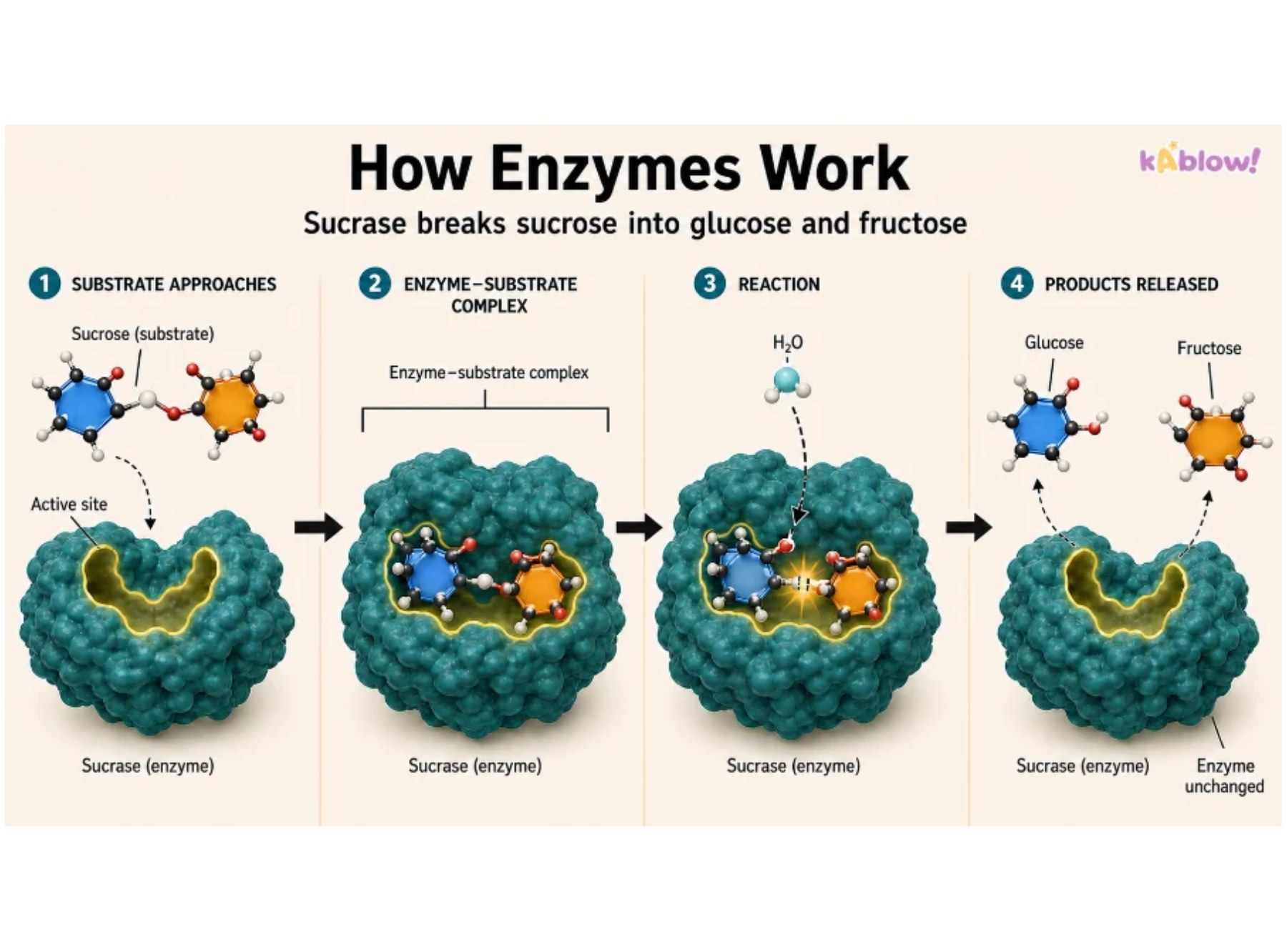
- Enzymes are specific to their substrates due to the complementary shape and chemical properties of the active site and substrate.
Enzyme Action and Specificity
- The active site is the region of an enzyme where the substrate binds; it is made of only a few amino acids but its shape is determined by the enzyme's complex 3D structure.
- For a reaction to occur, substrate molecules must collide with the active site at the correct orientation and speed, forming a temporary enzyme-substrate complex.
- The lock-and-key model proposed that the active site is precisely complementary to the substrate, like a key fitting a lock.
- The induced-fit hypothesis is the current model: the enzyme and active site (and sometimes the substrate) change shape slightly (conformational changes) as the substrate binds, achieving an ideal binding arrangement.
- Enzymes lower the activation energy needed for a reaction, so the reaction proceeds at a faster rate; the overall energy released is unchanged.
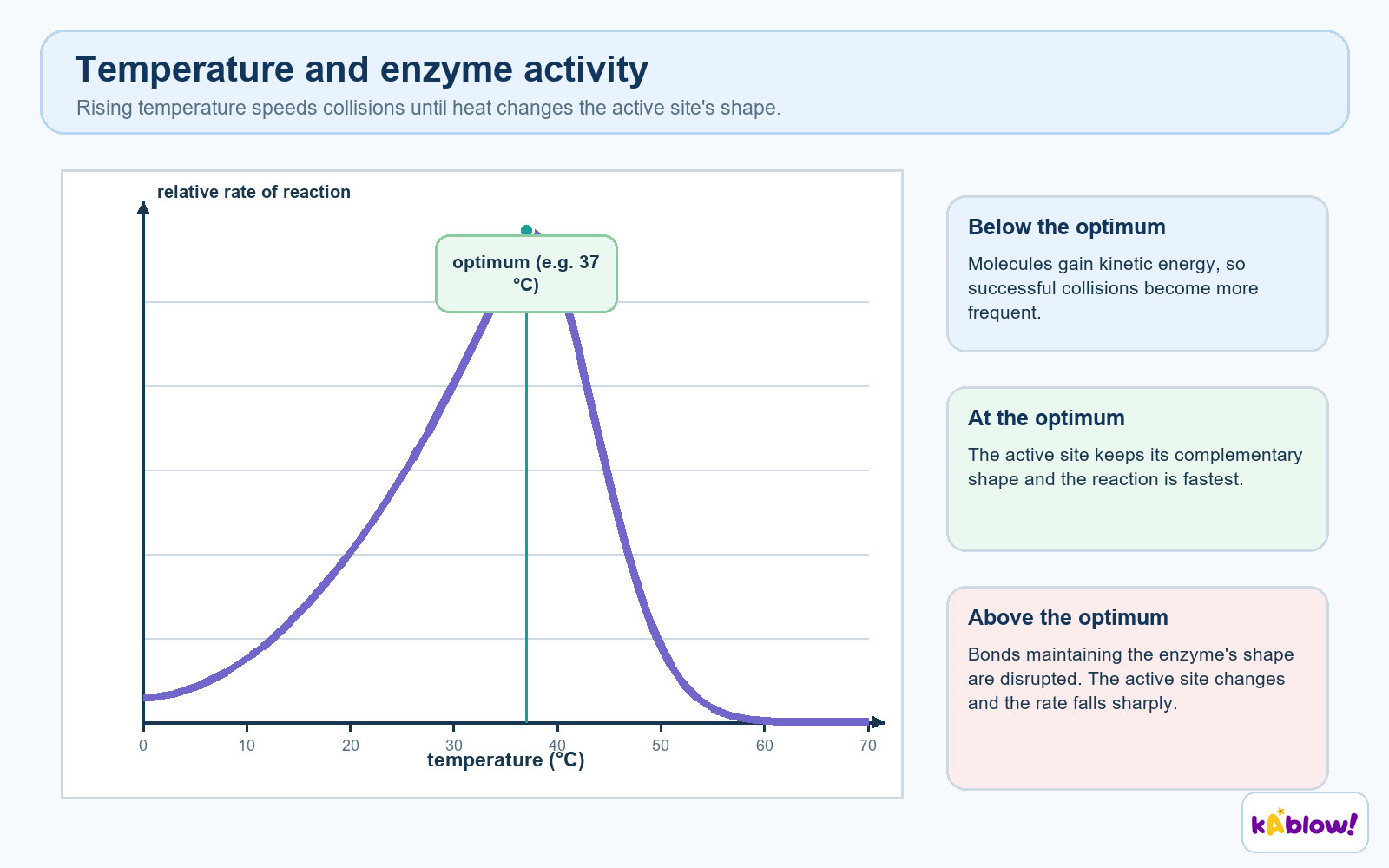
- Denaturation occurs when high temperatures or extreme pH break bonds (e.g., hydrogen bonds) holding the enzyme's 3D shape, permanently changing the active site so the substrate can no longer bind.
The lock and key model
Factors Affecting Enzyme Activity
- Temperature: lower temperatures slow reactions because molecules have less kinetic energy and fewer successful collisions; higher temperatures increase collisions until the optimum temperature, above which the enzyme denatures and the rate drops sharply.
- pH: each enzyme has an optimum pH; extremes of pH alter hydrogen bonding and cause irreversible denaturation. For example, pepsin works best at pH 2, while some bacterial enzymes work at pH 9–10.
- Substrate concentration: as substrate concentration increases, the rate increases until all active sites are saturated; beyond this point, adding more substrate has no effect unless enzyme concentration is increased.
- Enzyme concentration: with substrate concentration constant, increasing enzyme concentration increases the rate until substrate becomes limiting.
- The rate of reaction can be measured as the rate of product formation or substrate disappearance over time.
- The rate can also be calculated as 1 ÷ time taken (s⁻¹) when quantitative data on amount is not available.
Effect of temperature on enzyme activity
Investigating Enzyme Activity: Skills
- Catalase breaks down toxic hydrogen peroxide into water and oxygen; the volume of oxygen produced over time measures the rate of reaction.
- When investigating temperature, the conical flask is held in a water bath with the water level higher than the H₂O₂ level to ensure even heating; swirling maintains an even temperature.
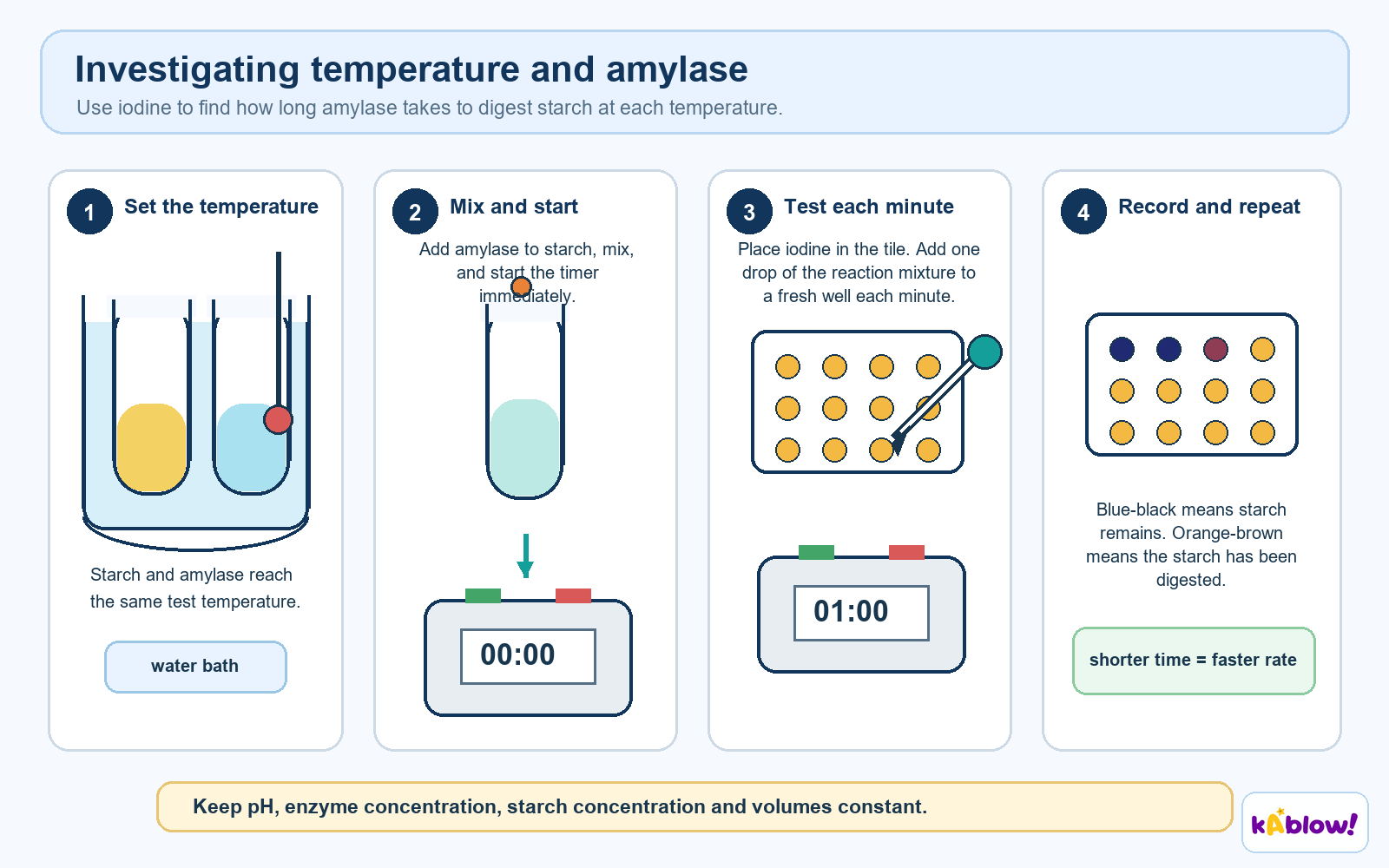
- Amylase hydrolyses starch into maltose and glucose; its activity can be followed by testing samples with iodine in potassium iodide solution (blue-black with starch, yellow-brown without).
- Colorimetry measures light absorbance or transmission; as starch is broken down, absorbance decreases (or transmission increases), allowing the rate to be measured.
- A calibration graph of starch concentration against absorbance or transmission is plotted using serial dilutions of a stock starch solution.
- When drawing graphs, the initial rate is found by drawing a tangent at the origin and calculating its gradient (change in volume ÷ change in time).
Investigating enzyme activity
Metabolic Pathways
- A metabolic pathway is a series of interlinked reactions, each stage catalysed by a separate enzyme.
- Linear (chain) pathways have a distinct beginning and end; glycolysis is an example.
- Cyclical pathways involve the end product starting the next cycle; examples include the Calvin cycle and the Krebs cycle.
- Enzymes can be intracellular (function inside the cell, e.g., glycolysis and Krebs cycle enzymes) or extracellular (secreted to function outside the cell, e.g., digestive enzymes).
- End-product inhibition occurs when the end product of a pathway acts as a non-competitive inhibitor of an earlier enzyme, binding to an allosteric site and changing the active site shape.
- End-product inhibition prevents build-up of intermediates and regulates the pathway; it is a reversible feedback loop.
- Example: isoleucine inhibits threonine deaminase, the enzyme catalysing the first step of its own synthesis from threonine.
Enzyme Inhibition
- Competitive inhibitors have a similar shape to the substrate and bind to the active site, blocking the substrate; their effect can be overcome by increasing substrate concentration.
- Non-competitive inhibitors bind to an allosteric site, causing conformational changes that alter the active site; increasing substrate concentration cannot overcome this inhibition.
- Statins are competitive inhibitors that block the enzyme synthesising cholesterol, lowering LDL levels and reducing risk of coronary heart disease.
- Mechanism-based inhibition is irreversible: a substrate analogue forms covalent bonds with the active site, producing a stable inhibitor-enzyme complex.
- Penicillin is an example: it inhibits DD-transpeptidase, preventing cross-link formation in bacterial cell walls; the weakened wall bursts by osmosis (death by lysis).
- Penicillin is only effective against growing bacteria because autolysins (which create holes for wall expansion) are only active during growth.
- Bacteria can develop resistance to penicillin through DNA mutations altering the active site of DD-transpeptidase; these mutations can be shared via plasmids during conjugation.
Diapositivas
Sign up free to view the lesson slides
Step through every slide for this topic — plus flashcards and revision notes — with a free account.
Preguntas de práctica
Vista previa gratis — 8 de 63 preguntas. Regístrate para verlas todas.
1.Which of the options below refers to the features of catabolism?
Easy- AExergonic, condensation reaction, an example is polypeptide synthesis
- BEndergonic, hydrolysis reaction, an example is respiration
- CEndergonic, condensation reaction, an example is photosynthesis
- DExergonic, hydrolysis reaction, an example is deamination
2.Which of the following statements apply to enzymes? (select all that apply)
Easy- AThey speed up the rate of chemical reactions in the body
- BThey are fibrous proteins
- CThe active site is where the substrate binds
- DThe shape of the active site is complementary to the shape of the substrate molecule
3.The following diagram shows the three stages involved in enzyme catalysis. Which of the following provides the most accurate description of the events occurring at each stage?
Easy- AThe substrate collides with the enzyme; New bonds are forming within the substrate molecule; Chemical substances are released from the enzyme
- BThe substrate collides with the active site of the enzyme; The substrate is bound to the active site of the enzyme; The products are released from the active site
- CThe substrate binds to the enzyme; New chemical substances are formed while attached to the enzyme; These substances are released from the enzyme
- DThe substrate collides with the active site of the enzyme; The substrate changes into different chemical substances; The products are released from the active site
4.An enzyme catalysed reaction is heated to a temperature of 65 °C. Which of the following best explains the effect this temperature increase would have on the enzymes?
Medium- AThe enzyme and substrate molecules will gain kinetic energy and collide more frequently
- BThe bonds in the enzyme will vibrate more and break, which will cause a permanent change in the shape of the active site
- CThe bonds in the enzyme will vibrate more and break, causing a temporary change in the shape of the active site
- DThe active site of the enzyme will permanently change shape due to the increased speed of collisions between the substrate molecule and the active site
5.Lactase is an enzyme that is often immobilised and used in the food industry to produce lactose-free milk. Which of the following would not be an advantage of using lactase?
Medium- AIncreases the sweetness of many dairy products, such as yoghurt and milk shakes
- BIt may increase the rate of crystallisation of frozen dairy products, such as ice cream
- CIt may increase the fermentation rate of products such as yoghurt and cheese
- DLactase is able to function closer to its optimum conditions in a controlled factory environment
6.Students investigated the effect of pH on catalase activity. Each experiment was repeated at a different pH value (pH = 2, 4, 7, 9, 11) and was set up as follows: Five potato cubes of similar dimensions were used as a source of catalase; this was added to 50 cm³ of hydrogen peroxide; the volume of oxygen released from this reaction was collected in a measuring cylinder; this was used to calculate the initial rate of the reaction in dm³ min⁻¹. Which of the rows in the following table correctly identifies the variables in this experiment?
Medium- AIndependent variable: pH; Dependent variable: Initial reaction rate; Control variable: Volume of oxygen released
- BIndependent variable: Initial reaction rate; Dependent variable: pH; Control variable: Volume of hydrogen peroxide
- CIndependent variable: pH; Dependent variable: Initial reaction rate; Control variable: Volume of hydrogen peroxide
- DIndependent variable: Volume of oxygen released; Dependent variable: pH; Control variable: Initial reaction rate
7.Which of the following statements is not true about enzymes in metabolic pathways?
Easy- AAll metabolic reactions are catalysed by an enzyme.
- BAll proteins are enzymes.
- CAll enzymes are proteins.
- DAll enzymes reduce activation energy of metabolic reactions in living organisms.
8.The following statements are about enzymes: 1. The speed that they function at can be reduced by competitive inhibitors. 2. Their primary structure is translated from mRNA. 3. They can be embedded in the plasma membrane of a cell. 4. They all have quaternary structures. Which of these statements are correct for all enzymes? (select all that apply)
Medium- A1 and 3 only
- B1, 2 and 3 only
- C2, 3 and 4 only
- DAll of them are correct
Unlock all 63 questions & more
Crea una cuenta gratis para ver todas las preguntas, las diapositivas, las tarjetas y los apuntes de repaso de este tema.