Mutations & Gene Editing
Apréndelo jugando
Responde estas preguntas para ganar energía, luego pesca y explora. Sin cuenta.
Apuntes de la lección
Gene Mutations: Types and Causes
- A gene mutation is a change in the sequence of base pairs in a DNA molecule; this may result in a new allele.
- Mutations occur randomly and all the time; they are more likely during DNA replication (S phase of interphase) due to copying errors.
- Substitution mutations swap one nucleotide base for another; they only affect the triplet where the mutation occurs and have no knock-on effect.
- Insertion mutations add an extra nucleotide, creating a new triplet and causing a frameshift that changes all subsequent triplets.
- Deletion mutations remove a nucleotide, also causing a frameshift that alters the reading frame and changes the amino acid sequence downstream.
- Mutagenic agents are environmental factors that increase mutation rate: high-energy radiation (UV light), ionising radiation (X-rays, gamma rays, α particles), and chemicals (benzo[a]pyrene, nitrosamines in tobacco smoke, mustard gas).
- Internal mutagens include enzymes that break down DNA or produce mutagenic substrates; errors during DNA replication and repair can also cause mutations if not detected by DNA polymerase proofreading.
The sickle cell mutation
Consequences of Gene Mutations
- Silent mutations do not alter the amino acid sequence because the genetic code is degenerate (multiple codons code for the same amino acid).
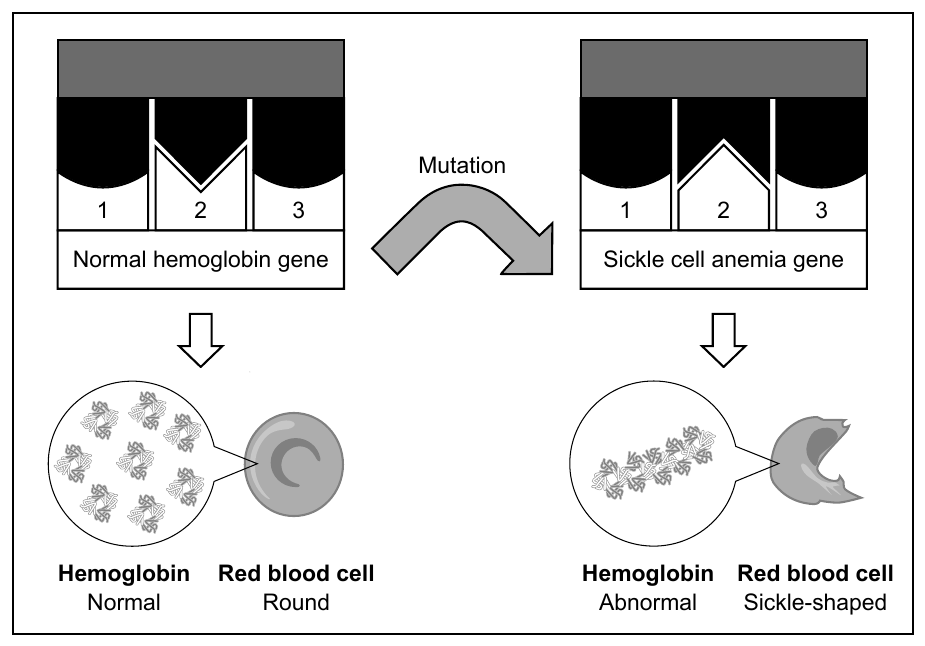
- Missense mutations change a single amino acid in the polypeptide chain; sickle cell anaemia is caused by a single substitution mutation changing one amino acid.
- Nonsense mutations create a premature stop codon, causing an incomplete polypeptide; cystic fibrosis can be caused by a nonsense mutation.
- Insertions and deletions are point mutations that often cause frameshift mutations, completely changing the amino acid sequence after the mutation site and usually making the polypeptide non-functional.
- Frameshift mutations are generally more harmful than substitutions because they affect how the entire mRNA sequence is read by ribosomes in codons (groups of three nucleotides).
- Single nucleotide polymorphisms (SNPs) are substitutions that occur normally throughout DNA, about once every 300 nucleotides, and can act as biological markers for disease-associated genes.
Mutations in Germ and Somatic Cells
- Germ cells produce gametes via meiosis; mutations in these cells can be passed to offspring and future generations.
- A mutation in a sperm cell can affect the zygote and all cells developed from it; a female with an inherited mutation can pass it on through her germ cells.
- Somatic cell mutations are not inherited; they are associated with cancers and are eliminated when the cell dies.
- Cancers arise from uncontrolled mitosis when mutations occur in genes that control cell division; a mutated gene that causes cancer is called an oncogene.
- Most mutations do not lead to cancer because they result in early cell death or the cell being destroyed by the immune system.
Mutations and Genetic Variation
- Variation refers to differences between organisms of the same species, such as coat colour in mammals or flower colour in plants.
- Variation results from small differences in DNA base sequences, arising from mutation, meiosis, and random fertilisation during sexual reproduction.
- Mutation is the original source of genetic variation and generates new alleles that can influence evolution.
- Mutations in sex organ cells lead to changes in gamete alleles passed to the next generation; a new allele may be advantageous, disadvantageous, or neutral.
- Advantageous alleles are more likely to be passed on because they increase survival and reproduction; disadvantageous mutations are more likely to die out.
- Mutations are essential for evolution by natural selection in the long term; in asexually reproducing species, mutation is the only source of variation.
Gene Editing Techniques
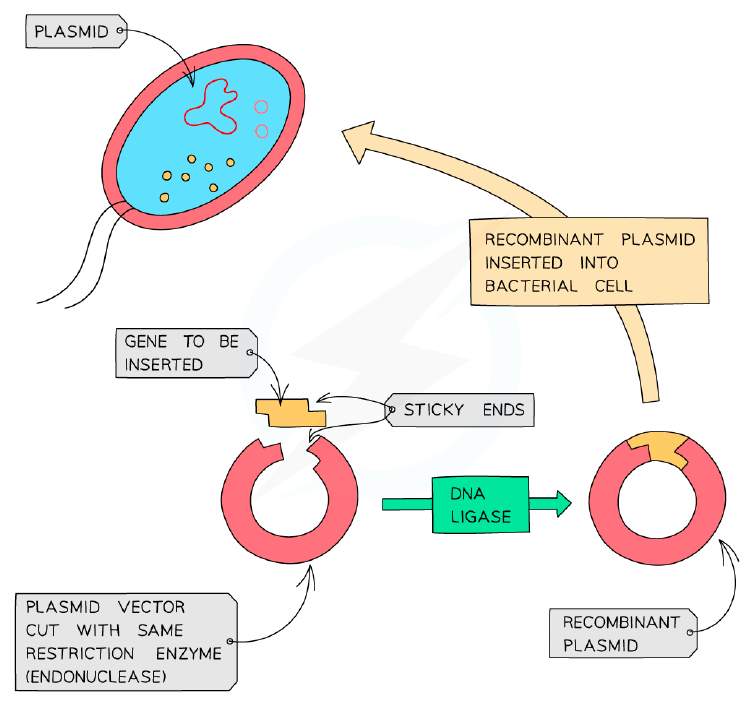
- Gene editing allows genetic engineers to alter DNA by inserting, deleting, or replacing DNA at specific sites in the genome known to cause disease.
- It differs from genetic engineering because it modifies existing DNA rather than inserting DNA from another organism.
- Older techniques included modifying viruses to insert DNA (sometimes causing unforeseen consequences) and spraying liposomes containing normal genes into noses (only a short-term solution).
- CRISPR (Clustered Regularly Interspaced Short Palindromic Repeats) is the most commonly used modern technique; it uses a guide RNA attached to the Cas9 enzyme to cut DNA at a specific point.
- After cutting, scientists can insert, delete, or replace faulty DNA with normal DNA.
- Gene editing is involved in gene therapies (e.g., for cystic fibrosis and sickle cell anaemia), which treat genetic disease by altering the person's genotype.
Inserting a gene into a plasmid
Investigating Gene Function and Gene Knockout
- The genome is the entire set of genetic material of an organism; the Human Genome Project (completed 2003) determined the DNA sequence of the entire human genome.
- Gene knockout is a technique that removes a gene from the genome or makes it unusable to study the gene's function.
- The organism with a knocked-out gene is called a knockout organism; common examples are laboratory mice.
- Knockout organisms are used to study conditions such as obesity, diabetes, cancer likelihood, addiction, and cardiovascular disease.
- A genetic library of knockout organisms exists, such as for the fungal species×Saccharomyces cerevisiae×, to understand drug mechanisms and target biological processes.
Ethical Issues in Gene Editing
- Genetic engineering raises ethical issues around consent for genetic data, insurance companies requiring genetic test results, and legal control over data use, especially human genomes.
- Ethics committees must approve all experiments and gain advice from world-leading experts; decisions tend to be made on a worldwide scale.
- Countries have laws to protect participants in genetic technology research, and international committees make recommendations to governments and scientists.
- The International Commission on the Clinical Use of Human Germline Genome Editing and the World Health Organisation (WHO) play key roles in creating guidance and best practices.
- The challenge is to ensure all policymakers and countries work together to coordinate regulations, applied to all gene editing processes including CRISPR.
Conserved Sequences
- A conserved sequence is a section of DNA or RNA that shows minimal mutations over time and tends to be identical or similar across a species or group of species.
- Highly conserved sequences show little to no mutations over long evolutionary periods; examples include sequences for DNA replication, transcription, translation, and cellular respiration proteins.
- Specific examples include sequences for DNA helicases, tRNA, ribosomes, and respiratory proteins cytochrome c and ferredoxin.
- One hypothesis is that functional requirements maintain conserved sequences: genes essential for survival cannot tolerate mutations, so natural selection eliminates them.
- Another hypothesis is that some DNA sequences have slower mutation rates because DNA repair and proofreading are more active in coding regions and highly functional genes.
- Error correction is less active in non-coding DNA, so higher mutation rates are found there; lower mutation rates may reflect more frequent correction rather than fewer mutations.
Diapositivas
Sign up free to view the lesson slides
Step through every slide for this topic — plus flashcards and revision notes — with a free account.
Preguntas de práctica
Vista previa gratis — 8 de 62 preguntas. Regístrate para verlas todas.
1.What is a gene mutation?
Easy- AA change in the sequence of base pairs in a DNA molecule
- BA change in the number of chromosomes in a cell
- CA change in the structure of a protein
- DA change in the sequence of amino acids in a polypeptide
2.Which type of mutation involves a nucleotide base being randomly swapped for a different base?
Easy- ASubstitution
- BInsertion
- CDeletion
- DFrameshift
3.Which of the following are examples of mutagenic agents? (select all that apply)
Medium- AUV light
- BX-rays
- CBenzo[a]pyrene
- DDNA polymerase
- EMustard gas
4.Mutations in somatic cells can be inherited by offspring.
EasyTrue or false?
5.Which type of mutation creates a premature stop codon?
Medium- ANonsense mutation
- BMissense mutation
- CSilent mutation
- DFrameshift mutation
6.Which of the following are possible effects of a substitution mutation? (select all that apply)
Medium- ASilent mutation
- BMissense mutation
- CNonsense mutation
- DFrameshift mutation
- EDeletion of a nucleotide
7.Match each type of mutation with its description.
Medium- Silent mutation
- Missense mutation
- Nonsense mutation
- Frameshift mutation
- Does not alter the amino acid sequence
- Alters a single amino acid in the polypeptide chain
- Creates a premature stop codon
- Changes the reading frame of the sequence
8.Place the following steps of the CRISPR gene editing process in the correct order.
Medium- Cas9 enzyme cuts the DNA at the target site
- Guide RNA binds to the target DNA sequence
- The faulty DNA is repaired or replaced
- The Cas9-guide RNA complex forms
Unlock all 62 questions & more
Crea una cuenta gratis para ver todas las preguntas, las diapositivas, las tarjetas y los apuntes de repaso de este tema.