Water
Apréndelo jugando
Responde estas preguntas para ganar energía, luego pesca y explora. Sin cuenta.
Apuntes de la lección
Water as the Medium for Life
- The first cells are believed to have evolved in a watery environment, likely in deep oceans near hydrothermal vents.
- Water in its liquid state allows dissolved molecules to move and collide, enabling chemical reactions.
- Most life processes occur in water; it is the medium in which all metabolic reactions take place in cells.
- Between 70% and 95% of the mass of a cell is water.
- Water covers 71% of Earth's surface and is a major habitat for organisms.
- Scientists searching for extraterrestrial life look for evidence of water as an indicator of possible life.
Hydrogen Bonds and the Polarity of Water
- A water molecule consists of one oxygen atom covalently bonded to two hydrogen atoms.
- Electrons are shared unevenly: oxygen attracts electrons more strongly, creating a weak negative region (δ-) on oxygen and weak positive regions (δ+) on hydrogen.
- This separation of charge makes water a dipole and a polar molecule.
- Hydrogen bonds form between the δ- oxygen of one water molecule and the δ+ hydrogen of another.
- Hydrogen bonds are weak individually and constantly break and reform, but collectively they form a strong structure.
- Hydrogen bonding explains many of water's biologically important properties.
Roles of Hydrogen Bonding in Biological Molecules
- Hydrogen bonds are involved in dissolving solutes in water.
- They provide cohesion and adhesion of water molecules, enabling water to move up tall trees.
- They are responsible for base-pairing between the two strands of DNA.
- They help form secondary and tertiary structure in proteins.
- Hydrogen bonds between strands of cellulose and collagen give these molecules tensile strength.
- They facilitate interactions between mRNA and tRNA during protein synthesis.
- They contribute to surface effects on membranes between polar phosphate groups and water.
Cohesion and Adhesion
- Cohesion is the attraction between water molecules due to hydrogen bonds.
- Cohesion allows columns of water to move under tension (mass transport) through the xylem of plants.
- Cohesion creates surface tension at the air-water interface, forming a film that supports insects such as pond skaters.
- Adhesion is the bonding of water to other polar or charged molecules, such as cellulose.
- Adhesion enables water to move up the xylem during transpiration and to be drawn up narrow soil channels by capillary action.
- Spaces between cellulose fibres in plant cell walls draw water from xylem vessels by capillary action, allowing flow through plant tissue.
Water as a Solvent
- Hydrophilic means 'water-loving'; hydrophobic means 'water-hating'.
- Polar molecules and those with positive or negative charges can form hydrogen bonds with water and are generally hydrophilic.
- Non-polar molecules cannot form hydrogen bonds with water and are generally hydrophobic; they tend to group together due to hydrophobic interactions.
- Because most biological molecules are hydrophilic and can dissolve, water is regarded as the universal solvent.
- Different metabolites have different solubilities: sodium chloride and urea are highly soluble; fats are insoluble.
- Highly soluble molecules such as salts, glucose and amino acids are easily transported in solution.
- Even amino acids with hydrophobic R groups are soluble enough to be freely transported in water.
- Less soluble molecules require assistance: oxygen combines with haemoglobin for transport, and phospholipids have hydrophobic tails that form the core of cell membranes.
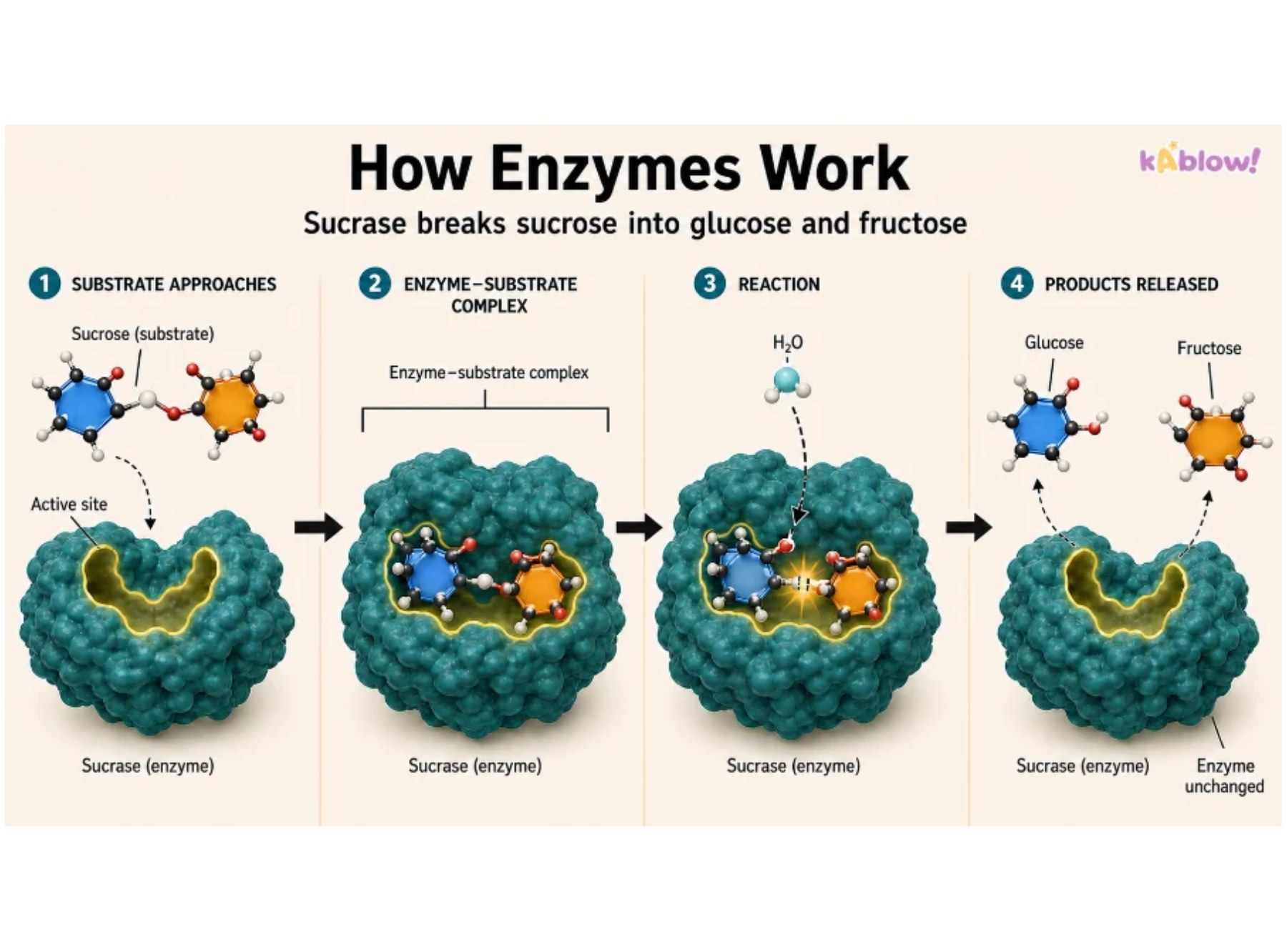
Enzyme Action in Water
- Most enzymes require water to hold their shape and maintain stability.
- Water enables enzymes to catalyse reactions in aqueous solutions.
- Hydrogen bonds often facilitate binding between the enzyme active site and its substrate.
- This binding forms an enzyme-substrate complex.
The lock and key model
Physical Properties of Water: Specific Heat Capacity
- Specific heat capacity is the energy required to raise the temperature of 1 kg of a substance by 1°C.
- Water has a high specific heat capacity (4200 J/kg/°C) compared to air (1000 J/kg/°C).
- The high value is due to the many hydrogen bonds: a lot of thermal energy is needed to break and build them.
- This means water temperature does not fluctuate greatly.
- It provides stable aquatic habitats, as water temperatures change more slowly than air temperatures.
- It helps organisms maintain a constant internal temperature and is vital for optimal enzyme activity.
- Arctic and sub-Arctic species such as the ringed seal survive year-round due to stable sea temperatures.
Physical Properties of Water: Density, Thermal Conductivity, Buoyancy and Viscosity
- Ice is less dense than liquid water, so it floats, forming a habitat for organisms such as the ringed seal.
- Thermal conductivity is the ability of a substance to conduct heat; water's thermal conductivity is almost 30 times higher than air, making air a good insulator.
- The black-throated loon traps an insulating layer of air in its feathers; the ringed seal relies on blubber for insulation.
- Ice forms an insulating layer above water because its thermal conductivity is much lower than liquid water, trapping thermal energy and increasing sea temperature below.
- Buoyancy is the ability to float; the loon has solid bones to overcome buoyancy, while the seal's blubber improves buoyancy and insulation.
- Viscosity is resistance to flow; water's viscosity is much higher than air, and body shapes of loons and seals reduce drag in water.
- The seal uses flippers to propel itself; the loon uses webbed feet and lateral foot placement to reduce drag.
Origin of Water on Earth
- When Earth formed about 4.5 billion years ago, conditions were too hot for water vapour to condense into liquid water.
- The asteroid hypothesis proposes that asteroids and their meteorites brought water to Earth, as many contain ice and organic materials.
- Carbonaceous chondrites contain hydrogen isotopes similar to those in seawater.
- Eucrite achondrites contain hydrogen isotope ratios similar to Earth's, supporting the hypothesis.
- Impacts may have released water vapour that was trapped by Earth's gravity and later condensed to liquid water.
Water and the Search for Extraterrestrial Life
- Liquid water is a requirement for life, so its presence is key in the search for extraterrestrial life.
- The Goldilocks zone is the area around a star where temperatures allow liquid water to exist.
- Exoplanets in the Goldilocks zone are studied using transit spectroscopy, which analyses light passing through their atmosphere.
- This analysis can reveal a water signature, indicating water may be present.
- To support life, an exoplanet must have a water signature, be in the Goldilocks zone, and be large enough to support an atmosphere.
Diapositivas
Sign up free to view the lesson slides
Step through every slide for this topic — plus flashcards and revision notes — with a free account.
Preguntas de práctica
Vista previa gratis — 8 de 63 preguntas. Regístrate para verlas todas.
1.Water has the ability to act as a solvent and dissolve many ionic and covalent compounds. Which of the following 3-carbon compounds will not dissolve in water?
Easy- APropanoic acid
- BPropanol
- CGlycerol
- DPropane
2.The specific heat capacity of water is the highest of all liquids. Which of the following would be a correct definition of specific heat capacity?
Easy- AThe heat required to change one mole of liquid into one mole of gas.
- BThe heat required to raise the temperature of 1 kg of liquid by 1°C.
- CThe heat required to change one mole of solid into one mole of liquid.
- DThe ability of a solid to transfer heat to a liquid.
3.Which of the following diagrams correctly shows the bonding between two water molecules?
Medium- AA hydrogen bond between the δ+ hydrogen of one water molecule and the δ− oxygen of another.
- BA covalent bond between the oxygen of one water molecule and the hydrogen of another.
- CAn ionic bond between the oxygen of one water molecule and the hydrogen of another.
- DA hydrogen bond between the δ− oxygen of one water molecule and the δ− oxygen of another.
4.Which of the following are not examples of hydrogen bonding?
Medium- ABase-pairing between two strands of DNA.
- BThe forces that hold water molecules together.
- CThe bond that joins one nucleotide to its neighbour in a strand of DNA.
- DInteractions between water and the polar R groups of certain amino acids.
5.Water (H₂O) is a polar molecule, whereas methane (CH₄) is nonpolar. Which of the properties of methane is explained by methane's lack of polarity?
Medium- ALow molecular weight.
- BLow boiling point.
- CFlammability.
- DGreenhouse gas effect.
6.Which of the following observations is not explained by water's high latent heat of vaporisation and specific heat capacity?
Medium- AIce is less dense than liquid water, so it floats on water.
- BWater exists in all three physical states (solid, liquid and gas) on Earth.
- CA small volume of water can dissipate a lot of heat from an organism.
- DA lot of heat energy is required to raise the temperature of water.
7.Which row of the table lists the four common metabolites in decreasing order of solubility in water?
Medium- Aoxygen → sodium chloride → cholesterol → hydrophobic amino acid
- Bsodium chloride → oxygen → hydrophobic amino acid → cholesterol
- Chydrophobic amino acid → oxygen → sodium chloride → cholesterol
- Dsodium chloride → hydrophobic amino acid → oxygen → cholesterol
8.Which of the following properties of water are a result of intermolecular forces? (select all that apply)
Medium- AHigh surface tension.
- BGood solvent.
- CCohesiveness.
- DHigh specific heat capacity.
- ELow viscosity.
Unlock all 63 questions & more
Crea una cuenta gratis para ver todas las preguntas, las diapositivas, las tarjetas y los apuntes de repaso de este tema.