Stability & Change
Apréndelo jugando
Responde estas preguntas para ganar energía, luego pesca y explora. Sin cuenta.
Apuntes de la lección
Features of Stable Ecosystems
- Stable ecosystems have efficient nutrient cycling, allowing the system to be self-supporting.
- They have high biodiversity, which contributes to their stability.
- They show resistance to change, meaning consumer population sizes do not change significantly, so resources are not overused.
- They have high levels of photosynthesis, which supports the food chain.
- Examples include tropical rainforests such as the Amazon and Congo, which have remained stable for tens of millions of years.
- In these rainforests, organic matter is cycled by detritivores (e.g. termites, slugs, worms) and decomposers (e.g. fungi), and water is cycled through transpiration and rainfall.
- Even stable ecosystems are not entirely static; natural selection and evolutionary change always act on species.
Requirements for Ecosystem Stability
- A supply of energy is essential; for most ecosystems this is sunlight, converted to chemical energy by photosynthesis.
- Many photosynthetic organisms (plants or algae) must be present to capture energy and pass it up food chains.
- Recycling of nutrients is essential; without it, nutrient supply will run out.
- Decomposers such as bacteria and fungi break down dead organisms, releasing carbon dioxide and minerals like nitrates and phosphates.
- Conditions must be suitable for decomposers: enough oxygen and moisture, and suitable temperatures.
- Genetic diversity (the number of different alleles in a population) allows natural selection to act on favourable alleles, enabling adaptation to environmental change.
- Climatic variables (e.g. temperature, rainfall) must remain within tolerance levels; extreme changes may force species to migrate or face extinction.
- Human activities are causing climate change so rapidly that climatic variables are changing beyond tolerance levels in some ecosystems.
Investigating Ecosystem Stability: Mesocosms
- A mesocosm is an experimental container in which a naturally occurring ecosystem is simulated.
- Mesocosms allow control of all factors except the variable being studied, making them useful for investigating ecosystem responses.
- They can be set up in many ways: water tanks on land, underwater enclosures, or large greenhouse-like buildings to replicate a rainforest.
- Mesocosm experiments may be considered unrealistic due to their enclosed nature and high level of control.
- Realism can be improved by designing large mesocosms that share more features of a real ecosystem (e.g. mixing of water layers).
- When building a mesocosm, the container should be transparent to allow sunlight to reach producers.
- Autotrophs must be included so light energy can be converted to chemical energy.
- Small primary consumers may be included if the mesocosm is large enough, but secondary consumers should not be included because there is not enough energy to sustain them and it could be unethical.
- Sealed systems are more controlled than open systems, and a control mesocosm must be set up to demonstrate that any change is due to the altered factor.
Building Terrestrial and Aquatic Mesocosms
- A terrestrial mesocosm uses a clear container with layers: drainage material (gravel), charcoal to prevent mould, sphagnum moss or filter paper for separation, and soil or compost for organic material and microorganisms.
- Slow-growing producers such as mosses and ferns are planted, and the container is sealed with a lid after watering.
- Once stabilised, plants release enough water vapour during respiration to maintain moisture levels.
- An aquatic mesocosm uses organic substrate from a lake or pond, lake or pond water (to provide microscopic organisms and avoid tap water chemicals), and healthy aquatic plants.
- Small aquatic organisms such as water fleas or water snails can be added, but only primary consumers and not more than the mesocosm can support.
- Both types should be placed in a light location with stable temperature.
- Ethical guidelines for animals in mesocosms: investigations should only involve animals if no alternatives exist, must not be cruel, and should remove potential causes of distress.
- If animals are required, only a limited number of herbivorous animals should be included, with enough food, controlled temperature, short duration, and return to natural environment at the end.
Ecosystem Stability: Deforestation in the Amazon
- Deforestation affects the self-sufficiency of the Amazon ecosystem by influencing temperature and rainfall.
- Transpiration from trees releases water vapour, cooling the air and affecting air movement and rainfall.
- Changes in tree numbers can therefore influence local temperatures and rainfall, which in turn affect photosynthesis and nutrient cycling.
- Scientists are concerned that the Amazon could reach a tipping point beyond which it is no longer stable.
- At this tipping point, so many trees are removed that temperature and rainfall patterns change significantly, and climatic factors may change beyond tolerance levels for some species.
- There is uncertainty about how much rainforest loss would trigger this tipping point, so we do not know how close the Amazon is to losing stability.
- Percentage loss of rainforest can be calculated as: (change in rainforest area / original rainforest area) × 100.
Keystone Species
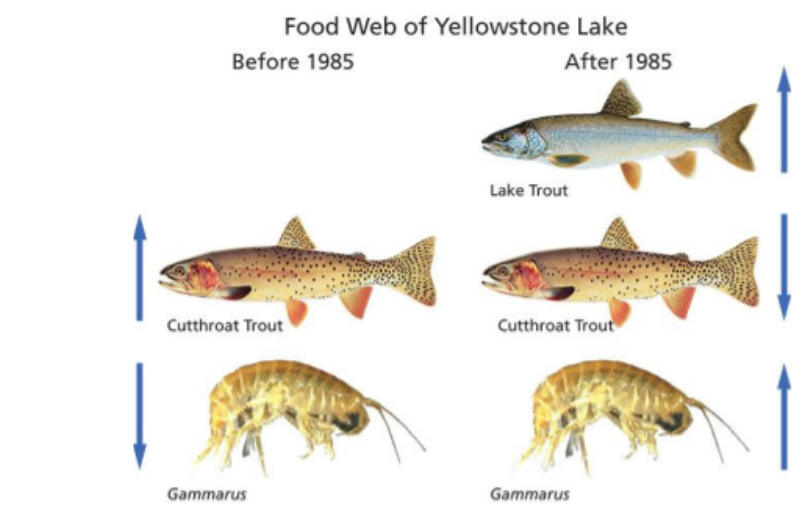
- Keystone species have a disproportionate effect on the structure and function of their ecosystem.
- Their removal can cause significant changes, including loss of other species and possible ecosystem collapse.
- Protecting keystone species helps maintain ecosystem stability, benefiting other species.
- Sea otters in kelp forests control sea urchin populations; without them, sea urchins overgraze vegetation, leaving no food or habitats for other species.
- Beavers build homes in running water, slowing flow and creating wetland habitats that support many other species.
- Elephants in African grasslands consume shrubs and small trees, maintaining grassland and food for grazers like zebras, which in turn supports large predators like lions.
A keystone species removed
Sustainability in Ecosystems and Agriculture
- A sustainably harvested resource is one that is replaced as rapidly as it is harvested, so it does not run out.
- Sustainable use requires careful regulation and monitoring to prevent over-harvesting.
- Black cherry is a slow-growing hardwood; sustainable harvesting involves selective felling, leaving enough individuals to produce seeds, and regular monitoring.
- The Alaska pollock fishery is the largest sustainably certified fishery, certified by the Marine Stewardship Council (MSC).
- Pollock are fast-growing and can reproduce from age 3–4 years; nets have minimal contact with the sea bed, bycatch is less than 1%, and monitoring is carried out by research vessels and trained individuals.
- Soil erosion occurs when land is cleared, removing roots that hold soil together; topsoil is easily washed or blown away, reducing soil available for crops.
- Leaching and nutrient run-off from synthetic fertilisers can wash into waterways; this can be reduced by applying fertilisers in small volumes, avoiding rain, and using organic fertilisers.
- Chemical fertilisers are expensive, supply may not meet demand, and production is energy-intensive; organic fertilisers can reduce these difficulties.
- Agrochemicals (pesticides, herbicides, fungicides) can enter the environment and kill non-target species; biological pest control and genetic modification can reduce their use.
- Agriculture's carbon footprint comes from fossil fuel use for transport, machinery, and fertiliser production; transitioning to renewable energy and energy-efficient practices can help.
Eutrophication
- Eutrophication occurs when water bodies receive artificially large inputs of nutrients such as nitrates and phosphates, often from fertiliser leaching.
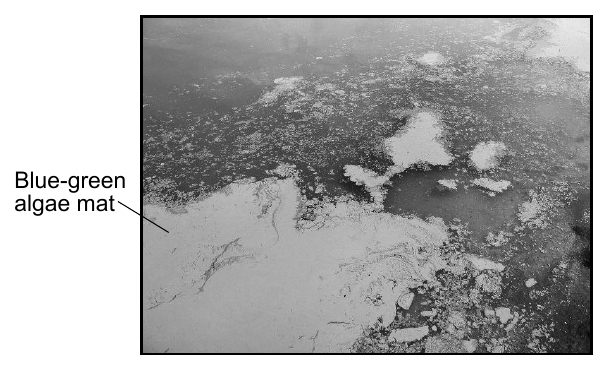
- This causes excess growth of plants and phytoplankton, known as an algal bloom.
- Algal blooms block sunlight, causing aquatic plants below the surface to die as they cannot photosynthesise.
- Algae also die when competition for nutrients becomes too intense.
- Decomposing bacteria feed on dead organic matter and increase in number, respiring aerobically and using up dissolved oxygen.
- This creates an increased biochemical oxygen demand (BOD), rapidly decreasing dissolved oxygen so fish and insects may not survive.
- Dead zones in oceans and freshwater occur when there is not enough oxygen to support aquatic life.
An algal bloom
Effects of Pollution: Biomagnification
- Biomagnification is the increase in concentration of persistent or non-biodegradable pollutants with ascending trophic level through a food chain.
- It differs from bioaccumulation, which is the build-up of pollutants within an organism or within a single trophic level.
- Pollutants become more concentrated at higher trophic levels because total biomass decreases, so top predators consume many smaller organisms and receive a larger dose.
- DDT was a widely used insecticide that leached into waterways, entered food chains via plankton, and accumulated in fish and then birds of prey.
- DDT caused thinning of eggshells and reduced reproductive success, leading to reduced bird populations; it is now banned worldwide except for essential mosquito control.
- Mercury released from coal-fired power plants and gold mining can be converted by microorganisms into highly toxic methyl mercury, which accumulates in fish and can harm humans who eat large predatory fish like tuna or swordfish.
- Plastics are non-biodegradable; macroplastics (>5 mm) and microplastics (<5 mm) cause harm.
- In marine habitats, animals may eat plastic (e.g. turtles mistaking bags for jellyfish, albatrosses feeding plastic to chicks), become caught in it, or ingest toxins that biomagnify.
- Clear communication of scientific findings can change public behaviour, e.g. reducing plastic packaging, recycling, and choosing non-plastic items.
Restoring Ecosystems
- Human activities such as deforestation and overharvesting can destabilise ecosystems.
- Ecosystem restoration (rewilding) aims to improve stability by restoring natural ecosystem processes.
- Strategies include species reintroductions, especially apex predators to control herbivores and allow vegetation recovery, and keystone species to alter ecosystem structure.
- Improving habitat connectivity through wildlife corridors (e.g. hedgerows) allows organisms to roam larger areas, access more resources, and increase population size.
- Limiting human influence may involve preventing logging, fishing, or agriculture, and using ecological management techniques like controlled grazing or burning.
- Hinewai Reserve in New Zealand was once farmland and is now privately owned for restoration; initial human intervention removed non-native species, but it is now managed with minimal intervention to allow native communities to restore by succession.
- The public can enjoy walking in the Reserve, but human activities are limited.
Diapositivas
Sign up free to view the lesson slides
Step through every slide for this topic — plus flashcards and revision notes — with a free account.
Preguntas de práctica
Vista previa gratis — 8 de 59 preguntas. Regístrate para verlas todas.
1.What is required for an ecosystem to be stable over an extended time period? I. An external supply of soil nutrients II. Genetic diversity III. An energy supply
Easy- AI and II only
- BI and III only
- CII and III only
- DI, II and III
2.Which of the following statements about keystone species is correct?
Easy- AKeystone species are always top predators.
- BKeystone species do not affect the diversity of their surrounding ecosystems.
- CThe influence of a keystone species on its ecosystem is equivalent to that of any other species.
- DRemoving a keystone species risks ecosystem collapse.
3.Which of the following considerations should be taken into account when building a mesocosm to test the impact of a particular environmental variable?
Medium- AAny type of container can be used; no secondary consumers; inclusion of autotrophs; producers should be slow-growing.
- BTransparent container; food chains of up to three organisms can be included; inclusion of autotrophs; producers should be slow-growing.
- CTransparent container; no secondary consumers; inclusion of autotrophs; a control mesocosm should be built.
- DTransparent container; no secondary consumers; inclusion of autotrophs; soil should be sterilised to prevent contamination.
4.The stability of an ecosystem can be investigated using a mesocosm. What ethical guidelines should be followed when using animals in a mesocosm? I. Animals should be used in preference to alternative organisms. II. Enough food should be available for any animals present. III. Animals must be returned to their natural environment at the end of an investigation.
Medium- AI and II only
- BII and III only
- CI and III only
- DI, II and III
5.A region of rainforest with an area of 4,100,000 km² was reduced to an area of 3,855,000 km² over a ten-year period. Which statement about deforestation in the Amazon rainforest is correct?
Medium- AOnly a small area of rainforest is needed to sustain the cycle of transpiration and rainfall that maintains the ecosystem.
- BThe percentage decrease in area was 6%.
- CScientists know the area of rainforest that needs to be maintained in order to avoid passing a tipping point in rainforest stability.
- DThe Amazon rainforest will be able to recover even if deforestation continues until the stability tipping point is reached.
6.Which of the following are features of a stable ecosystem? (Select all that apply.)
Medium- AEfficient nutrient cycling
- BHigh biodiversity
- CRapid and constant change in species composition
- DHigh levels of photosynthesis
- EDependence on external nutrient supply
7.Keystone species have a disproportionate effect on the structure and function of their ecosystem.
EasyTrue or false?
8.Match each term with its correct description.
Medium- Biomagnification
- Bioaccumulation
- Eutrophication
- Increase in concentration of persistent pollutants with ascending trophic level
- Build-up of pollutants within an organism or single trophic level
- Excess nutrient input causing algal blooms and oxygen depletion
Unlock all 59 questions & more
Crea una cuenta gratis para ver todas las preguntas, las diapositivas, las tarjetas y los apuntes de repaso de este tema.