Transfer Of Energy & Matter
Apréndelo jugando
Responde estas preguntas para ganar energía, luego pesca y explora. Sin cuenta.
Apuntes de la lección
Ecosystems as Open Systems
- An ecosystem is a group of organisms interacting with each other and with the non-living parts of their environment.
- Ecosystems contain both biotic components (living organisms) and abiotic components (e.g. salinity, pH, temperature, light intensity, mineral availability).
- Ecosystems are open systems: both energy and matter can enter and exit.
- Energy enters mainly as sunlight and flows through the ecosystem as stored chemical energy; it can also enter in the tissues of migrating organisms.
- Matter enters when organisms arrive and leaves when organisms or dead matter are removed (e.g. timber, dead plant matter washed away).
- Most organisms remain in the ecosystem throughout their lives, so matter and energy are largely recycled within the system.
- Earth is a closed system: energy can enter and leave, but matter is recycled and cannot enter or leave.
A food chain
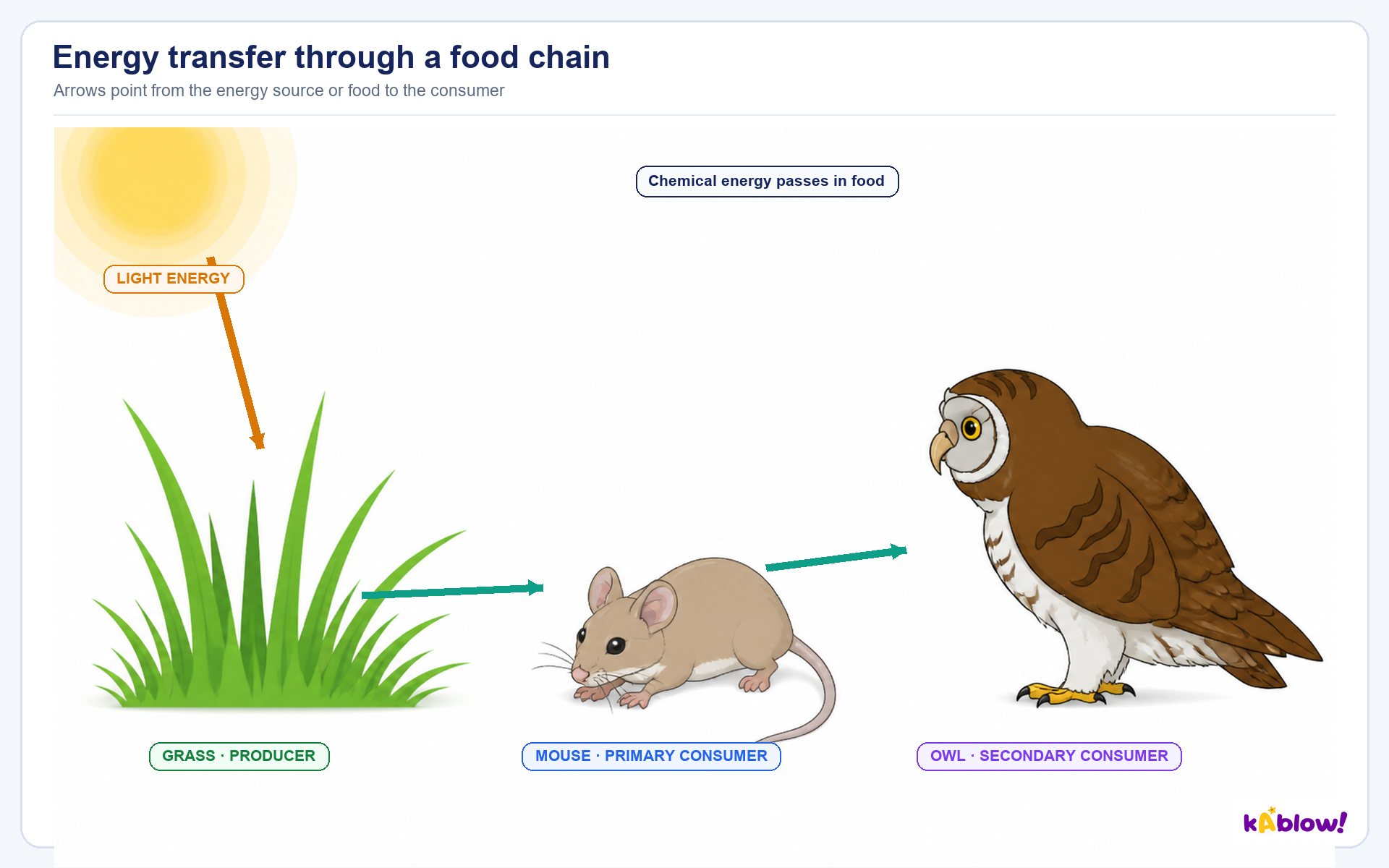
Energy Flow in Ecosystems
- Photosynthesis converts light energy into chemical energy stored in carbon compounds such as glucose, lipids and amino acids.
- When a plant is ingested, its carbon compounds and stored chemical energy pass to the primary consumer.
- The primary consumer digests and absorbs the carbon compounds, using them for respiration or to build animal tissue, transferring energy to its own tissues.
- When the primary consumer is eaten, its carbon compounds and stored energy pass to the secondary consumer, and so on up the food chain.
- When an organism dies, the chemical energy in its tissues passes to detritivores and saprotrophs.
- Food chains show feeding relationships; the arrows represent the transfer of energy (as stored chemical energy in carbon compounds) and biomass from one trophic level to the next.
- Food webs show how several food chains within an ecosystem are connected, since most species have more than one food source and more than one predator.
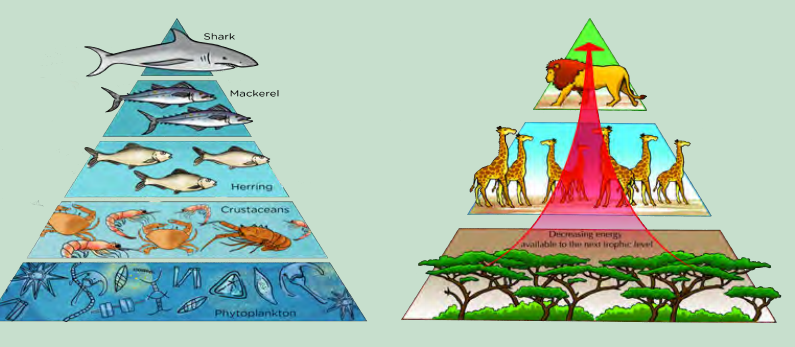
Energy pyramids for a marine ecosystem and a savanna ecosystem
Obtaining Carbon Compounds: Autotrophs and Heterotrophs
- An organism's mode of nutrition is how it gains organic molecules to fuel respiration.
- Autotrophs synthesise their own organic molecules from simple inorganic substances; because they do not rely on other organisms, they are known as producers.
- Photoautotrophs use light energy to fix carbon dioxide into organic molecules; examples include green plants, algae and cyanobacteria.
- Chemoautotrophs use energy from the oxidation of inorganic compounds (e.g. oxidising iron(II) to iron(III)) and act as producers in habitats without light, such as deep sea vents and caves.
- Heterotrophs gain carbon compounds by ingesting the tissues of other organisms, then digest and assimilate them into new carbon compounds.
- Types of heterotroph include consumers, detritivores and saprotrophs.
- Both autotrophs and heterotrophs carry out respiration, which releases energy by the oxidation of carbon compounds and also releases heat as a by-product.
Decomposers and Nutrient Cycling
- Inorganic nutrients enter the food chain and are converted into carbon compounds locked inside the tissues of living organisms.
- Because the supply of inorganic nutrients is finite, they must be released when organisms die.
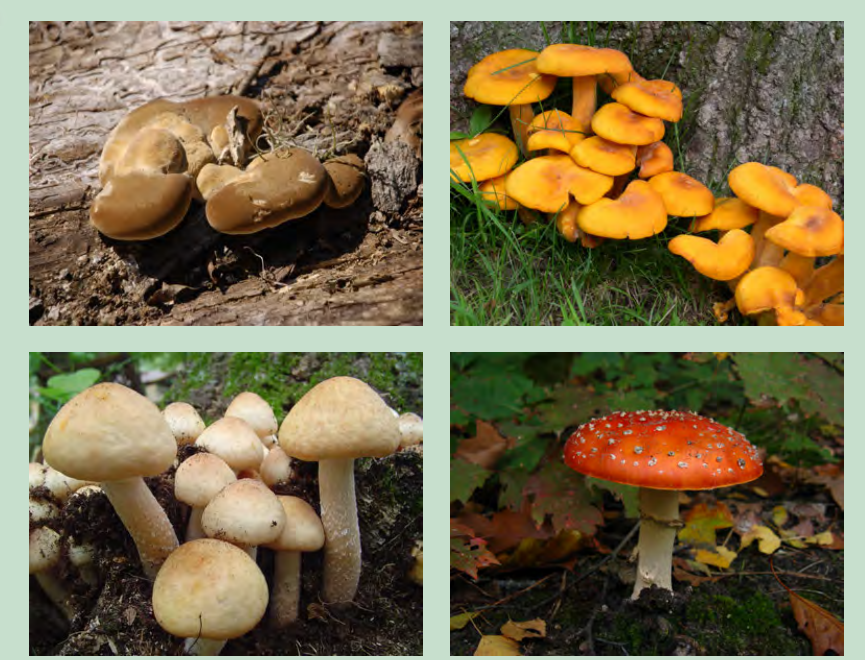
- Decomposition breaks down the bodies of dead organisms and the waste products of living organisms, enabling the cycling of nutrients.
- Detritivores often begin decomposition by breaking apart tissues.
- Saprotrophs release enzymes that break down organic molecules, releasing inorganic nutrients; they absorb some and the rest becomes available to producers.
- In a functioning ecosystem, elements needed by living organisms are constantly recycled; this applies to carbon and to mineral elements such as nitrogen, calcium, phosphorus, sulfur and potassium.
Fungi as decomposers
Trophic Levels
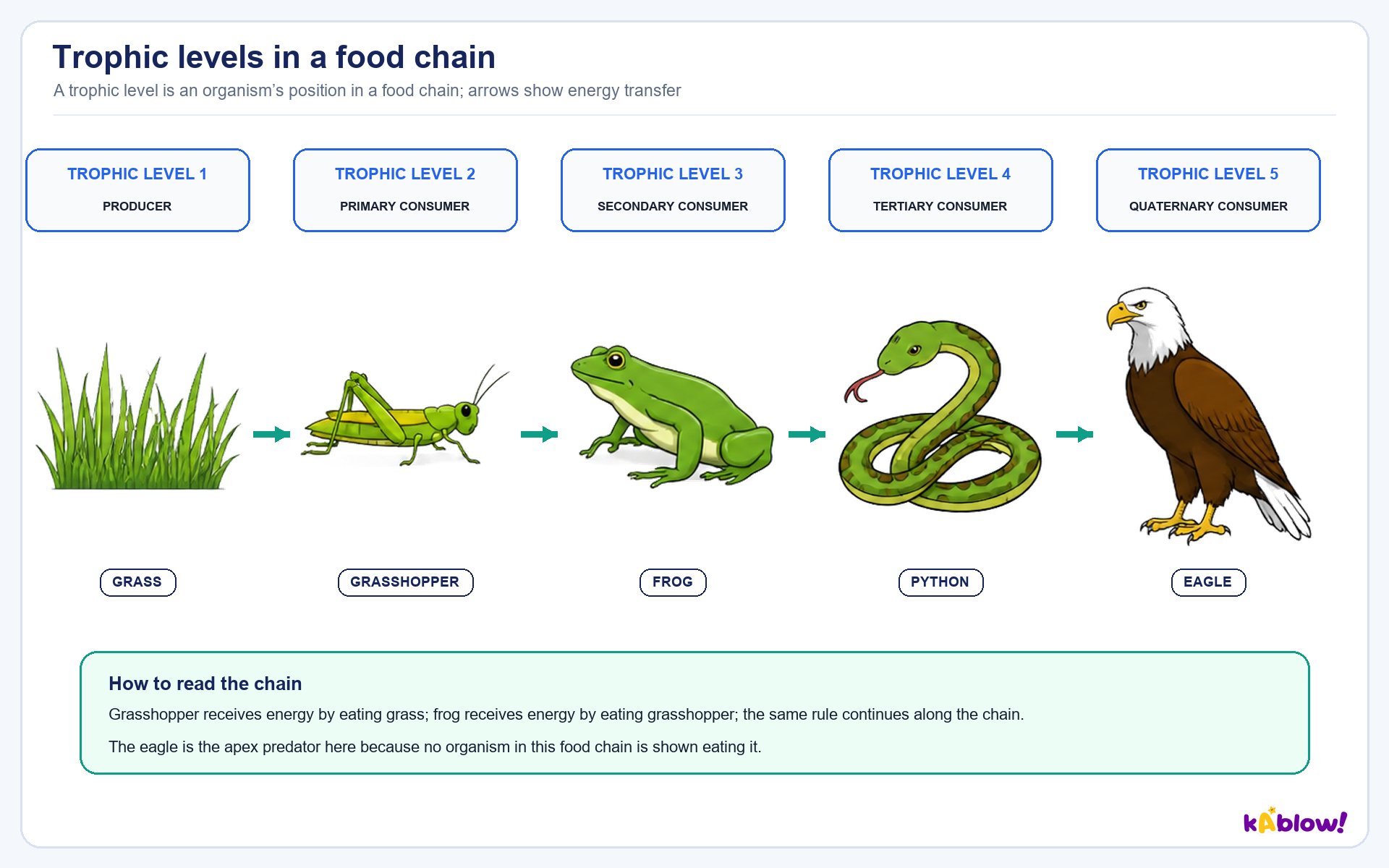
- Trophic levels describe the position of an organism in a food chain and indicate how many organisms energy has passed through.
- Level 1: producers; level 2: primary consumers (herbivores); level 3: secondary consumers; level 4: tertiary consumers; level 5: quaternary consumers.
- Energy from sunlight enters the food chain at the first trophic level, where producers convert light energy into chemical energy during photosynthesis.
- Energy is transferred from one trophic level to the next as each organism is ingested.
- Apex predators are at the top of the food chain and have no predators; their stored energy passes to decomposers when they die.
- A species may occupy different trophic levels in different food chains within a food web, e.g. sparrowhawks can be at the third, fourth or fifth trophic level.
Trophic levels
Pyramids of Energy and Energy Losses
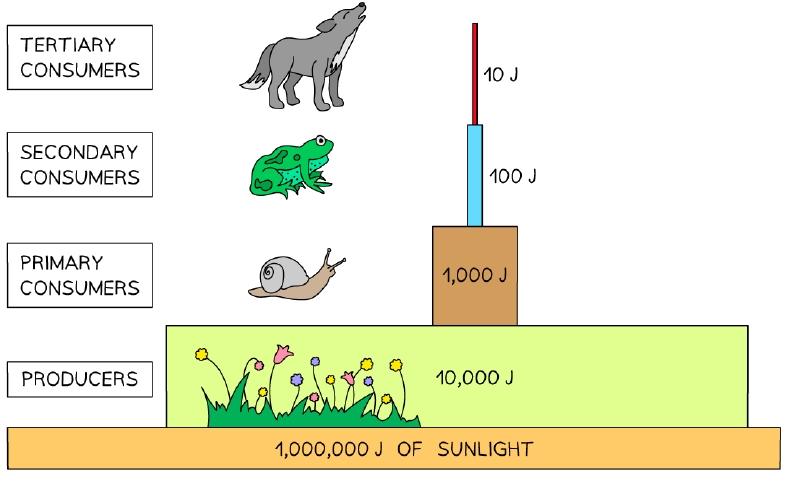
- Pyramids of energy show the energy contained in the biomass at each trophic level; the length of each bar represents the energy present.
- They should be drawn to scale, with the base widest and each level decreasing in size; units are energy per unit area per year, e.g. kJ m⁻² year⁻¹.
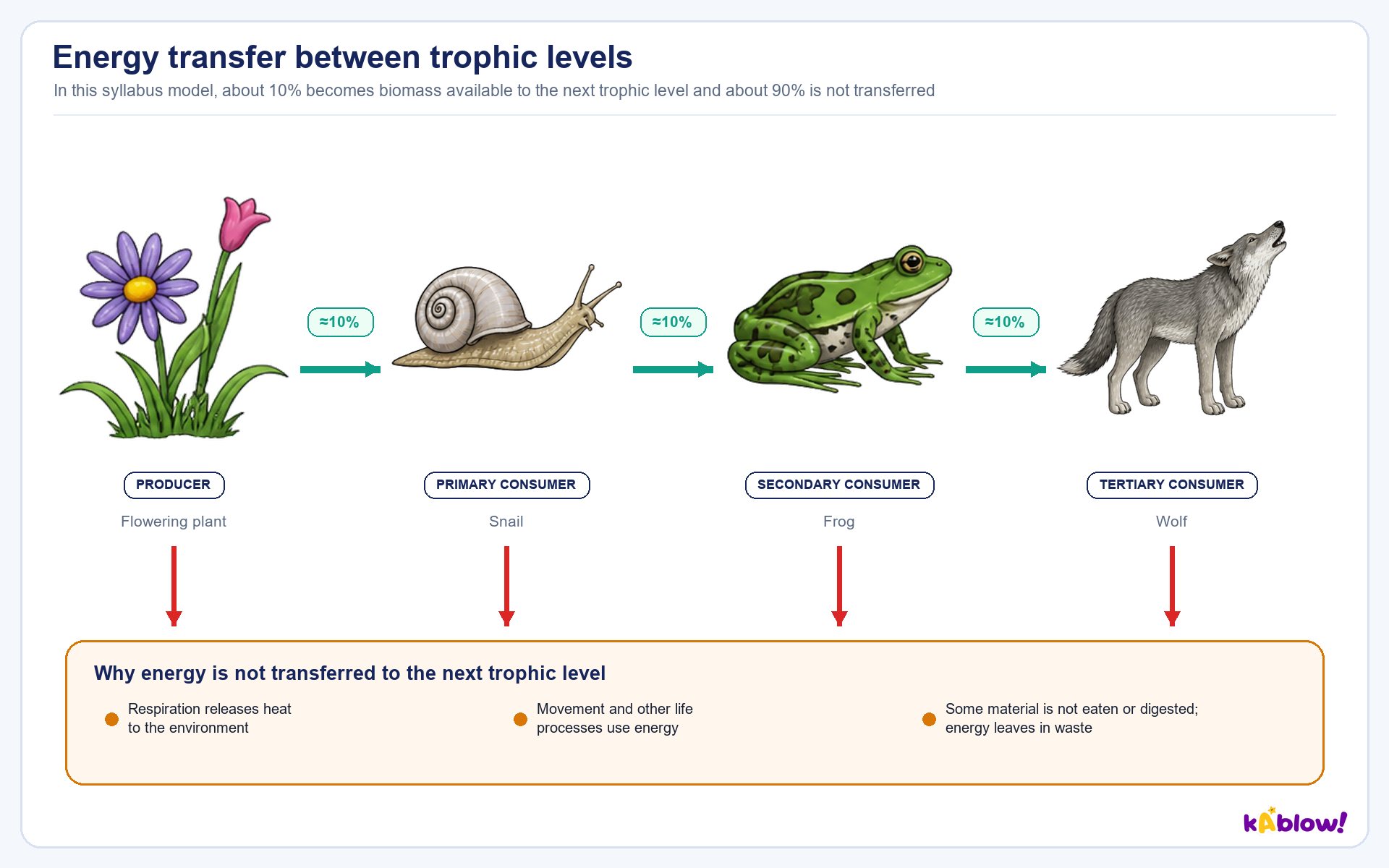
- Only about 10 % of the energy is passed on at each trophic level; around 90 % is lost to the environment.
- Energy is lost through incomplete consumption (e.g. roots, bones), incomplete digestion (egested as faeces), heat loss during respiration, and excretion of metabolic waste such as urea.
- Some organisms die without being consumed, and their bodies decompose, so their energy is lost from the food chain.
- Detritivores and saprotrophs decompose uneaten parts, undigested waste and unconsumed bodies, contributing to energy loss from food chains.
- Heat is lost to the environment at every trophic level by radiation during cellular respiration and other cellular processes.
Energy loss along a food chain
Primary and Secondary Production
- Primary production is the accumulation of carbon compounds in the biomass of autotrophs (producers).
- Primary production occurs faster in biomes with more sunlight, optimum temperatures and higher rainfall, e.g. tropical forests.
- The rate of primary production is measured in units of biomass per unit area (or volume) per unit time, e.g. g m⁻² yr⁻¹ or g m⁻³ yr⁻¹ for aquatic habitats.
- Secondary production is the accumulation of biomass in the tissues of heterotrophs after they ingest other organisms.
- Not all energy consumed by heterotrophs becomes new biomass; carbon is lost as carbon dioxide in respiration and energy is lost in excreted metabolic waste.
- The rate of secondary production is calculated by subtracting respiratory losses from the stored energy ingested.
- The rate of secondary production is always lower than the rate of primary production because of energy losses at each trophic level.
Pyramid of energy
The Carbon Cycle
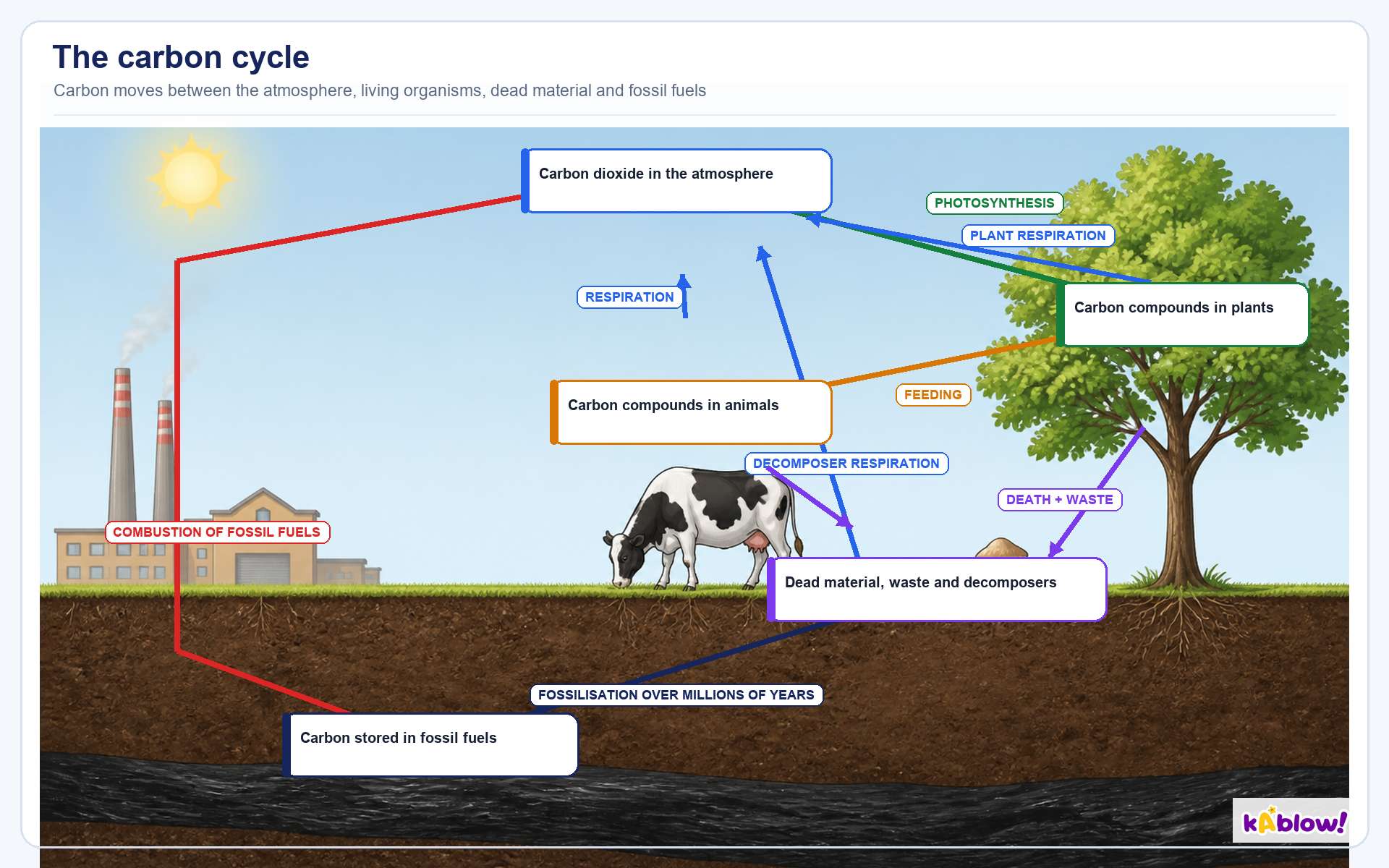
- The carbon cycle is the collection of processes by which carbon is transferred from one store to another.
- Carbon is present in organic forms (e.g. carbohydrates and proteins in biomass) and inorganic forms (e.g. carbon dioxide in the atmosphere, hydrogen carbonate ions in oceans).
- Carbon cycle diagrams show stores (pools or sinks, e.g. ocean, fossil fuels, living organisms) and fluxes (processes of transfer, e.g. dissolving, combustion, photosynthesis).
- A carbon sink takes up and stores carbon, e.g. plants photosynthesising, fossil fuels and peat, and carbon dioxide dissolving in oceans.
- A carbon source releases carbon, e.g. burning plant material, decay of dead matter, and respiration.
- If photosynthesis exceeds respiration, there is a net uptake of carbon dioxide (carbon sink); if respiration exceeds photosynthesis, there is a net release (carbon source).
- Combustion of fossil fuels (coal, oil, natural gas), peat and biomass releases carbon dioxide into the atmosphere.
- The Keeling curve shows atmospheric carbon dioxide at Mauna Loa since 1958: seasonal fluctuations due to photosynthesis, and an overall rise due to human combustion of fossil fuels.
The carbon cycle
Diapositivas
Sign up free to view the lesson slides
Step through every slide for this topic — plus flashcards and revision notes — with a free account.
Preguntas de práctica
Vista previa gratis — 8 de 61 preguntas. Regístrate para verlas todas.
1.Which term describes an organism that synthesises its own organic molecules from simple inorganic substances in its environment?
Easy- AAutotroph
- BHeterotroph
- CDetritivore
- DSaprotroph
2.Which organism is a photoautotroph?
Easy- ACyanobacteria
- BA mushroom
- CA root-feeding nematode worm
- DA soil bacterium oxidising iron
3.A chemoautotroph in a deep sea volcanic vent produces ATP by oxidising iron. Which statement correctly describes this organism?
Medium- AIt uses energy from the oxidation of inorganic compounds instead of light energy
- BIt uses light energy to split water and release electrons
- CIt gains its carbon compounds by ingesting the tissues of other organisms
- DIt releases enzymes that break down organic molecules in dead tissues
4.Which statement about ecosystems as open systems is correct?
Medium- ABoth energy and matter can enter and exit the system
- BMatter can only be recycled within the system and cannot enter or leave
- CEnergy can enter and leave but matter cannot
- DNeither energy nor matter can enter or leave the system
5.In a closed system, matter can only be recycled within the system and cannot enter or leave.
EasyTrue or false?
6.Detritivores obtain inorganic nutrients from the abiotic environment and convert them into organic molecules during photosynthesis.
EasyTrue or false?
7.Which of the following are ways in which energy is lost from a food chain between trophic levels? (select all that apply)
Medium- AHeat released to the environment during respiration
- BNot every part of the food organism is eaten
- CEgestion of undigested food as faeces
- DExcretion of metabolic waste such as urea
- EConversion of light energy into chemical energy during photosynthesis
8.Which of the following statements about pyramids of energy are correct? (select all that apply)
Medium- AThe length of each bar represents the energy present at that trophic level
- BThey are always widest at the base and decrease in size going up
- CThe units used should be energy per unit area per year, e.g. kJ m⁻² yr⁻¹
- DThey show a smooth-sided pyramid shape
- ERoughly 10 % of energy is passed on at each trophic level
Unlock all 61 questions & more
Crea una cuenta gratis para ver todas las preguntas, las diapositivas, las tarjetas y los apuntes de repaso de este tema.