Current & Circuits
Apréndelo jugando
Responde estas preguntas para ganar energía, luego pesca y explora. Sin cuenta.
Apuntes de la lección
Circuit Diagrams & Symbols
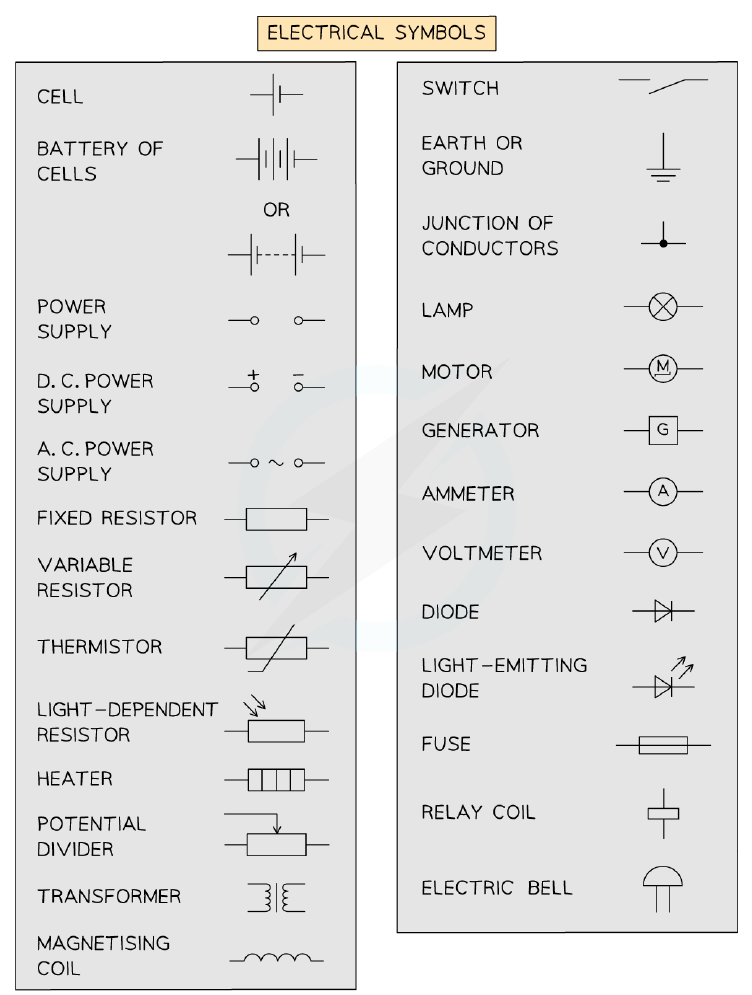
- Circuit symbols are universally recognised and used to represent components in circuit diagrams.
- A cell converts chemical energy to electrical energy; the longer line is the positive terminal, and conventional current flows from positive to negative.
- A battery is a power source made of multiple cells connected positive to negative.
- A switch turns the circuit on (closed) or off (open), allowing or preventing current flow.
- A voltmeter measures potential difference and is connected in parallel; an ammeter measures current and is connected in series.
- A fixed resistor limits current; a variable resistor has a slider to change resistance, which changes the current.
- An LDR's resistance decreases as light intensity increases; a thermistor's resistance decreases as temperature increases.
- A diode (including LED) allows current in one direction only; a potentiometer acts as an adjustable voltage divider.
Electrical symbols used in circuit diagrams
Electric Current
- Electric current is the rate of flow of charge carriers, measured in amperes (A).
- The equation for current is I = Δq / Δt, where Δq is charge in coulombs and Δt is time in seconds.
- Conventional current flows from the positive terminal to the negative terminal of a cell.
- In metals, electrons are the charge carriers and flow from negative to positive, opposite to conventional current.
- Direct current (dc) flows in one direction only and is produced by cells and batteries.
- Current is a scalar quantity; its sign indicates direction.
Potential difference in a circuit
Electric Potential Difference
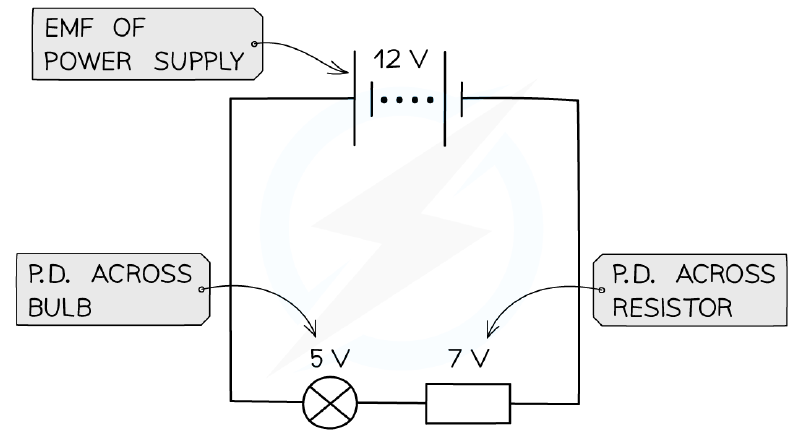
- Potential difference (p.d.) is the work done per unit charge on moving a positive charge between two points along the path of the current.
- It is calculated as V = W / q, where W is work done in joules and q is charge in coulombs.
- One volt is equal to one joule per coulomb (1 V = 1 J C⁻¹).
- Potential difference is provided by cells or batteries; electrons gain electrical potential energy as they move through the cell.
- The electronvolt (eV) is the energy needed to move an electron through a potential difference of one volt; 1 eV = 1.6 × 10⁻¹⁹ J.
Electrical Conductors & Insulators
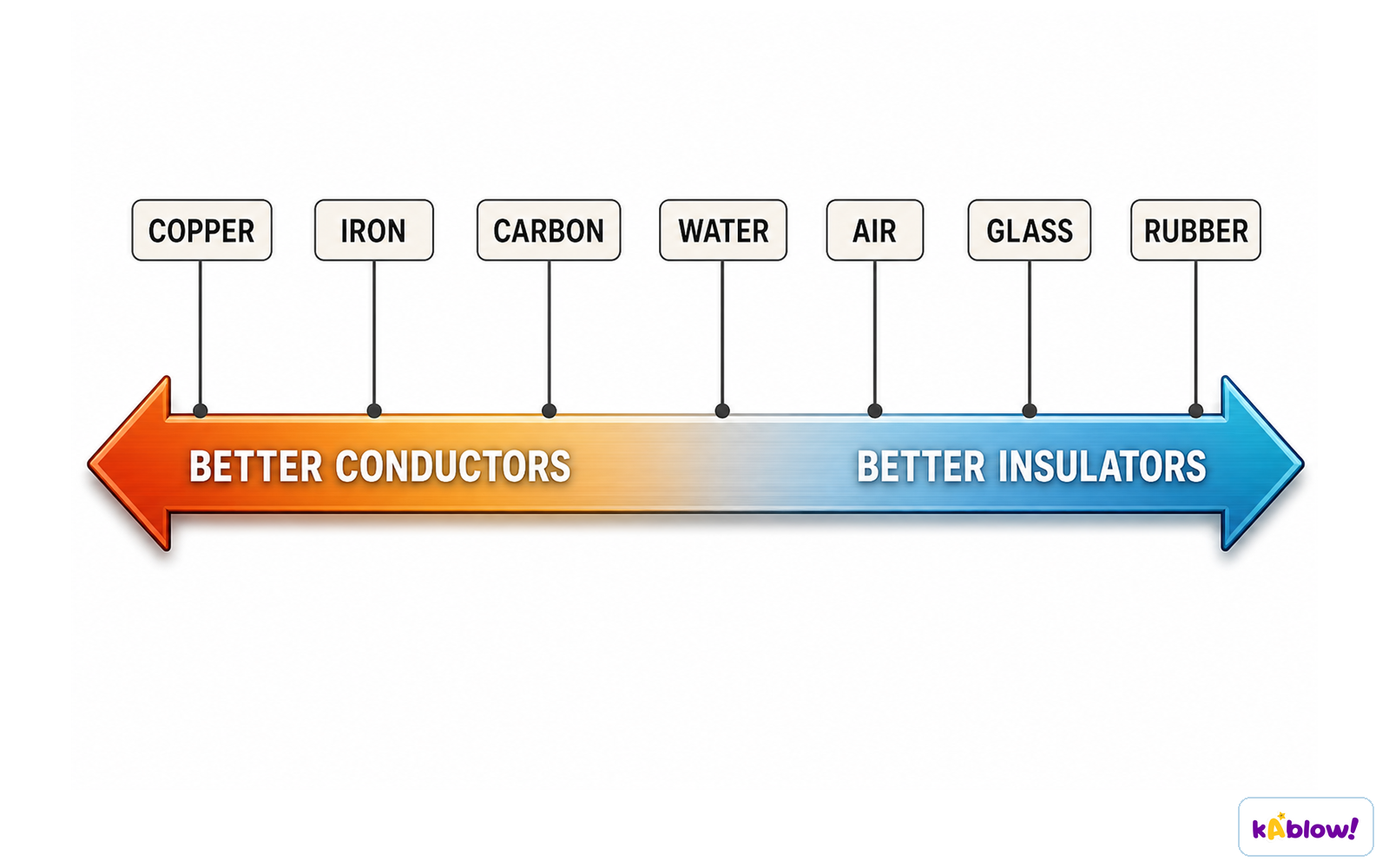
- A conductor allows charge (usually electrons) to flow easily; examples include silver, copper, aluminium, and steel.
- Metals are good conductors because they contain a large number of delocalised electrons that can flow freely.
- An insulator has very few free charges and does not allow charge to flow easily; examples include rubber, plastic, glass, and wood.
- Insulators can conduct static electricity when charge builds up on their surface and is transferred on contact with a conductor.
Conductors and insulators
Electric Resistance
- Resistance is defined as the ratio of the potential difference across a component to the current flowing through it: R = V / I.
- The unit of resistance is the ohm (Ω); 1 Ω = 1 kg m² s⁻³ A⁻².
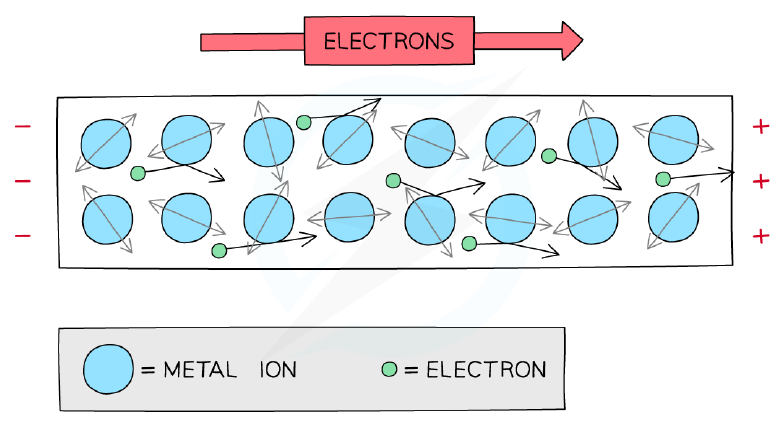
- As electrons move through a conductor, they collide with metal ions, transferring energy and causing heating, which results in resistance.
- The higher the resistance of a component, the lower the current flowing through it for a given potential difference.
- An ideal ammeter has zero resistance so it does not affect the current it measures.
- An ideal voltmeter has infinite resistance so no current passes through it.
Resistance in a conductor
Electrical Resistivity
- The resistance of a conductor is directly proportional to its length and inversely proportional to its cross-sectional area.
- Resistivity (ρ) is defined as the resistance per unit length of a material with unit cross-sectional area: ρ = RA / L.
- Resistivity is measured in ohm-metres (Ω m) and is a property of the material.
- Conductors have low resistivity, making them ideal for wires; insulators have very high resistivity.
- The cross-sectional area of a wire is modelled as a circle: A = πr² = πd²/4.
- If the diameter of a wire doubles, its cross-sectional area quadruples, so its resistance drops to a quarter.
I-V Characteristics
- Ohm's law states that for a component at constant temperature, current is proportional to potential difference: V = IR.
- An ohmic component has an I-V graph that is a straight line through the origin; examples include fixed resistors and wires at constant temperature.
- Non-ohmic components include filament lamps, diodes (LEDs), thermistors, and LDRs.
- For a fixed resistor, resistance can be found from the gradient of an I-V graph: if I is on the y-axis, R = 1/gradient; if V is on the y-axis, R = gradient.
- A filament lamp is approximately ohmic at low voltages, but as voltage increases, its temperature and resistance increase, making it non-ohmic.
- A semiconductor diode conducts when forward-biased (current in direction of arrowhead) and has zero current when reverse-biased.
Series & Parallel Circuits
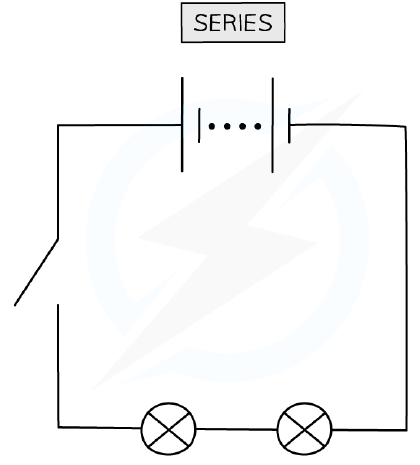
- In a series circuit, the current is the same at any point, and the potential difference is split across components depending on their resistance.
- The total resistance of resistors in series is the sum of individual resistances: Rtotal = R₁ + R₂ + R₃ + ...
- In a parallel circuit, the total current is the sum of the currents in each branch, and the potential difference is the same across each loop.
- The reciprocal of the combined resistance of resistors in parallel is the sum of the reciprocals of individual resistances: 1/Rtotal = 1/R₁ + 1/R₂ + ...
- Adding resistors in series increases the total resistance; adding resistors in parallel decreases the total resistance.
A simple series circuit
Electrical Power
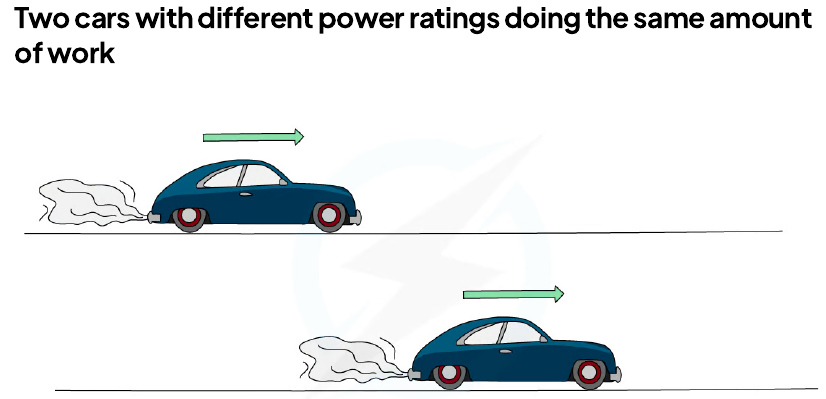
- Electrical power is the rate of energy transfer: P = E / t = W / t.
- Power can also be calculated as P = IV, where I is current and V is potential difference.
- Using Ohm's law, power can be written as P = I²R = V²/R.
- Doubling the current or voltage across a resistor increases the power by a factor of four.
- The energy transferred is given by E = VIt.
- The heat produced in a component depends on current and resistance; greater current or higher resistance produces more heat.
Power and rate of energy transfer
Sources of Electrical Energy
- Electric cells store chemical energy and convert it to electrical energy; examples include chemical cells, solar cells, mains electricity, and wind generators.
- Non-rechargeable batteries (e.g., alkaline AA) can only be used once; rechargeable cells (e.g., lithium-ion, lead-acid) can be recharged by reversing the chemical reaction.
- Solar cells (photovoltaic cells) convert electromagnetic radiation from the Sun into electrical energy.
- Advantages of rechargeable cells include high energy density, long lifetime, and low internal resistance; disadvantages include degradation over time and higher cost.
- Solar cells have an unlimited supply of energy and are clean, but their output is variable and depends on weather conditions.
- Wind generators have zero fuel costs and no chemical pollution, but have high set-up costs and inconsistent output.
- Mains electricity from fossil fuels is reliable and has high energy density, but produces greenhouse gases and is non-renewable.
Electromotive Force & Internal Resistance
- Electromotive force (e.m.f.) is the amount of chemical energy converted to electrical energy per coulomb of charge passing through a power supply.
- E.m.f. is measured in volts (V) and is the potential difference across a cell when no current flows (open circuit).
- Internal resistance (r) is the resistance within a power supply that causes a loss of voltage and heating of the cell.
- A cell can be modelled as a source of e.m.f. in series with an internal resistance.
- The e.m.f. equation is ε = I(R + r), where R is the external load resistance and r is the internal resistance.
- The terminal potential difference is the p.d. across the load resistor and is less than the e.m.f. when current flows; the difference is the 'lost volts' (Ir).
Variable Resistance
- A thermistor is a non-ohmic, temperature-dependent resistor; most are negative temperature coefficient (ntc), meaning resistance decreases as temperature increases.
- Thermistors are used as temperature sensors in ovens, fire alarms, and digital thermometers.
- A light-dependent resistor (LDR) is a non-ohmic resistor whose resistance decreases as light intensity increases.
- LDRs are used in automatic lighting systems; in the dark, resistance is very high (millions of ohms), and in bright light, it is low (tens of ohms).
- A potentiometer is a variable resistor connected as a potential divider to provide a continuously variable output voltage.
- Moving the slider on a potentiometer changes the resistance and hence the potential difference across the upper and lower parts.
Diapositivas
Sign up free to view the lesson slides
Step through every slide for this topic — plus flashcards and revision notes — with a free account.
Preguntas de práctica
Vista previa gratis — 8 de 64 preguntas. Regístrate para verlas todas.
1.Which quantity is defined as the rate of flow of charge carriers?
Easy- APotential difference
- BResistance
- CElectric current
- DElectrical power
2.Which statement correctly describes the direction of conventional current and electron flow in a metal wire?
Easy- AConventional current flows from positive to negative; electrons flow from negative to positive
- BConventional current flows from negative to positive; electrons flow from positive to negative
- CBoth conventional current and electrons flow from positive to negative
- DBoth conventional current and electrons flow from negative to positive
3.An ideal ammeter should have zero resistance.
EasyTrue or false?
4.A charge of 60 μC flows through a conductor in 140 ms. What is the current in the conductor?
Easy- A0.43 mA
- B0.23 mA
- C4.3 mA
- D0.86 mA
5.Which of the following is the correct definition of potential difference?
Easy- AThe rate of flow of charge carriers
- BThe work done per unit charge on moving a positive charge between two points
- CThe ratio of current to potential difference
- DThe amount of chemical energy converted to electrical energy per coulomb of charge
6.Two resistors of resistance 3.0 Ω and 6.0 Ω are connected in parallel. What is their combined resistance?
Medium- A2.0 Ω
- B4.5 Ω
- C9.0 Ω
- D0.5 Ω
7.Which of the following statements about series and parallel circuits are correct? (select all that apply)
Medium- AIn a series circuit, the current is the same at any point.
- BIn a parallel circuit, the potential difference is the same across each branch.
- CThe combined resistance of resistors in series is less than the smallest individual resistance.
- DThe combined resistance of resistors in parallel is greater than the largest individual resistance.
- EIn a series circuit, the potential difference is split across all components.
8.Match each electrical component with its correct function.
Medium- Ammeter
- Voltmeter
- LDR
- Thermistor
- Measures current in a circuit
- Measures potential difference across a component
- Resistance decreases as light intensity increases
- Resistance decreases as temperature increases
Unlock all 64 questions & more
Crea una cuenta gratis para ver todas las preguntas, las diapositivas, las tarjetas y los apuntes de repaso de este tema.