Preparation Of Salts
Apréndelo jugando
Responde estas preguntas para ganar energía, luego pesca y explora. Sin cuenta.
Apuntes de la lección
Naming Salts
- A salt is formed when the hydrogen atom in an acid is replaced by a metal or ammonium ion.
- The name of a salt has two parts: first from the metal/metal oxide/carbonate, second from the acid.
- Hydrochloric acid produces chlorides; sulfuric acid produces sulfates; nitric acid produces nitrates.
- Example: sodium hydroxide + hydrochloric acid → sodium chloride.
Method A1: Excess Metal
- Used for metals that react with dilute acids (e.g., Mg + H₂SO₄).
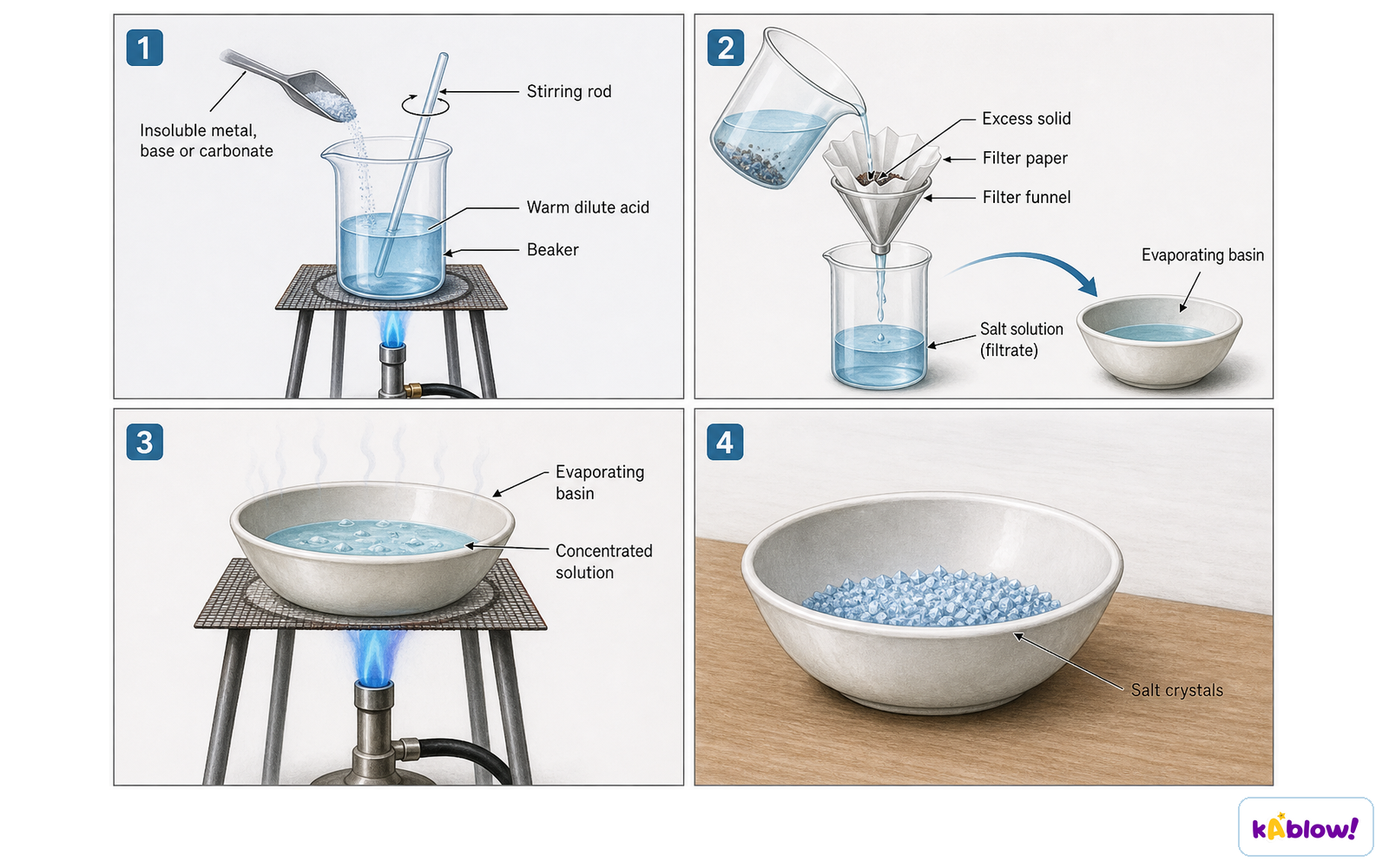
- Add dilute acid to a beaker, then add metal in small pieces until no more reacts (metal in excess).
- Filter to remove excess metal; heat the filtrate gently until concentrated.
- Leave to crystallise, decant excess liquid, dry crystals with filter paper.
- Example: Mg(s) + H₂SO₄(aq) → MgSO₄(aq) + H₂(g).
Preparing a soluble salt by the excess solid method
Method A2: Excess Insoluble Base
- Used for insoluble bases such as metal oxides (e.g., CuO).
- Warm dilute acid gently, add insoluble base slowly while stirring until no more reacts (base in excess).
- Filter to remove excess base; heat filtrate until concentrated.
- Crystallise, decant, and dry crystals.
- Example: CuO(s) + H₂SO₄(aq) → CuSO₄(aq) + H₂O(l).
Preparing a soluble salt by the excess solid method
Method A3: Excess Insoluble Carbonate
- Used for insoluble metal carbonates (e.g., CaCO₃).
- Warm dilute acid, add carbonate slowly until no more reacts (carbonate in excess).
- Filter, heat filtrate, crystallise, and dry.
- Example: CaCO₃(s) + 2HCl(aq) → CaCl₂(aq) + CO₂(g) + H₂O(l).
Preparing a soluble salt by the excess solid method
Method B: Titration (Soluble Alkali)
- Used for soluble bases like NaOH.
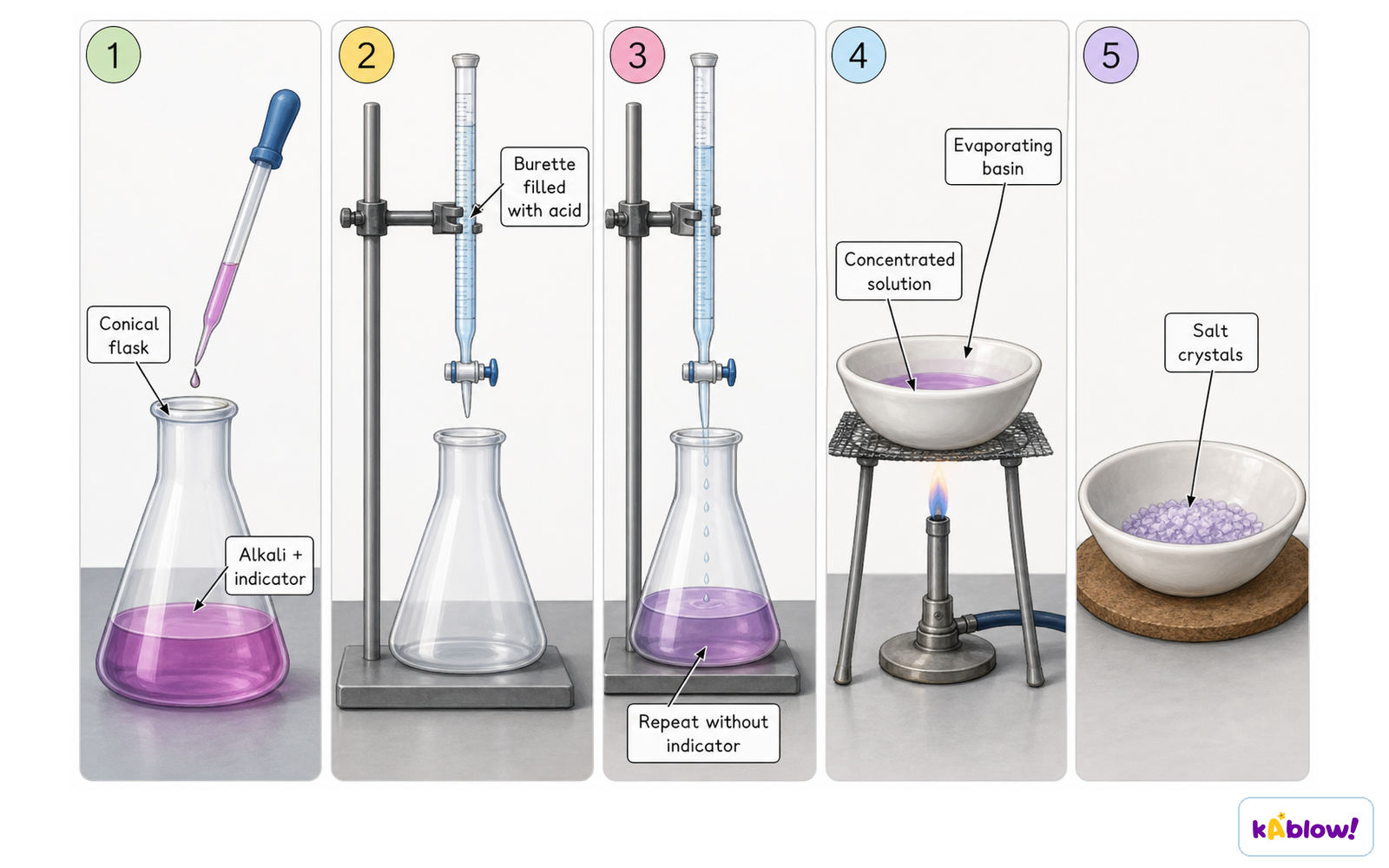
- Pipette alkali into conical flask, add indicator (e.g., phenolphthalein).
- Add acid from burette until colour change (end point); record volume.
- Repeat without indicator using same volume of acid.
- Heat neutral solution to concentrate, crystallise, and dry.
- Example: NaOH(aq) + HCl(aq) → NaCl(aq) + H₂O(l).
Preparing a soluble salt by titration
Preparing Insoluble Salts (Precipitation)
- Extended tier only: use precipitation reaction between two soluble reactants.
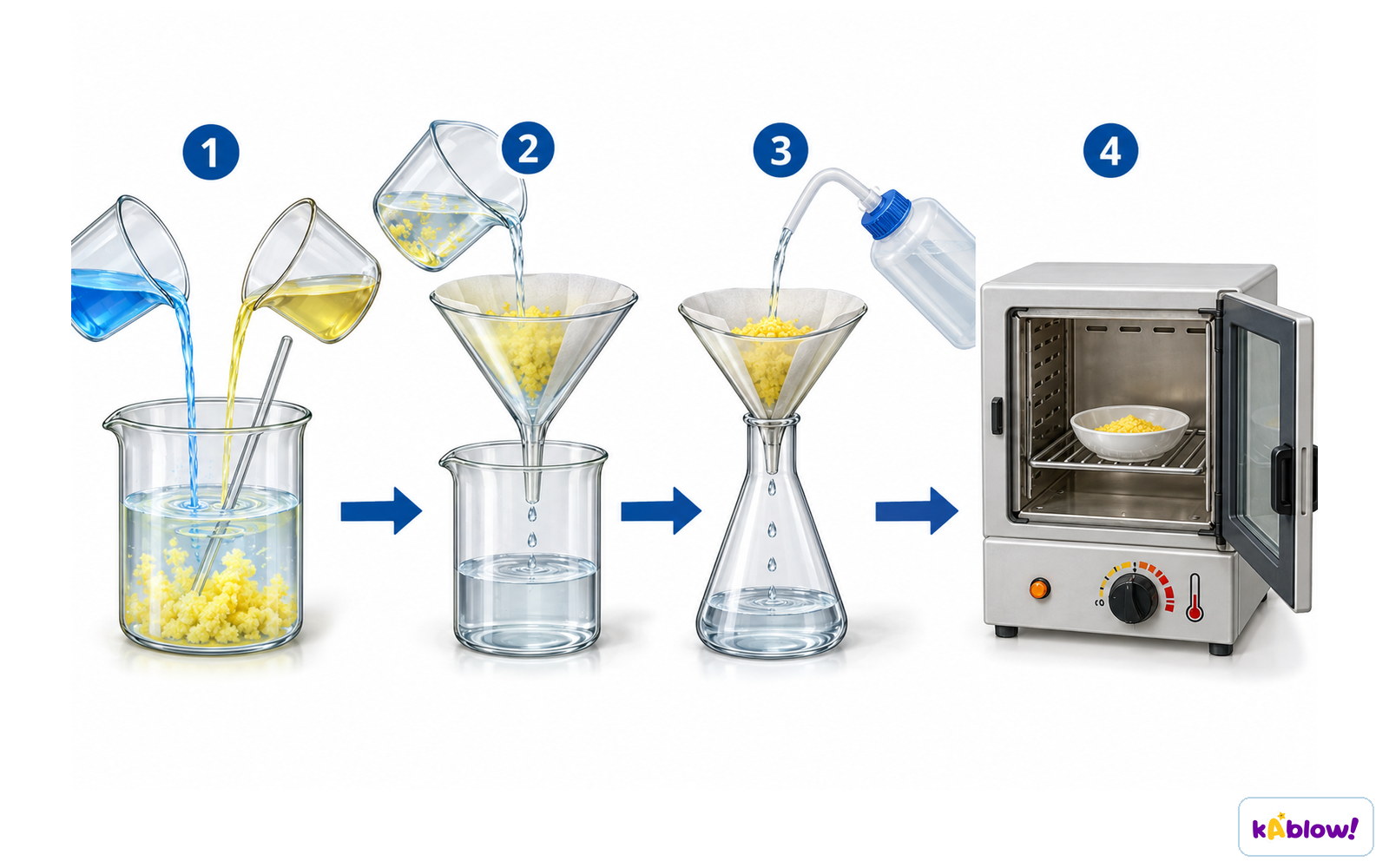
- Mix aqueous solutions of two soluble salts; insoluble salt forms as precipitate.
- Filter to collect precipitate, wash with distilled water, dry in warm oven.
- Example: Pb(NO₃)₂(aq) + K₂SO₄(aq) → PbSO₄(s) + 2KNO₃(aq).
Preparing an insoluble salt by precipitation
Hydrated & Anhydrous Salts
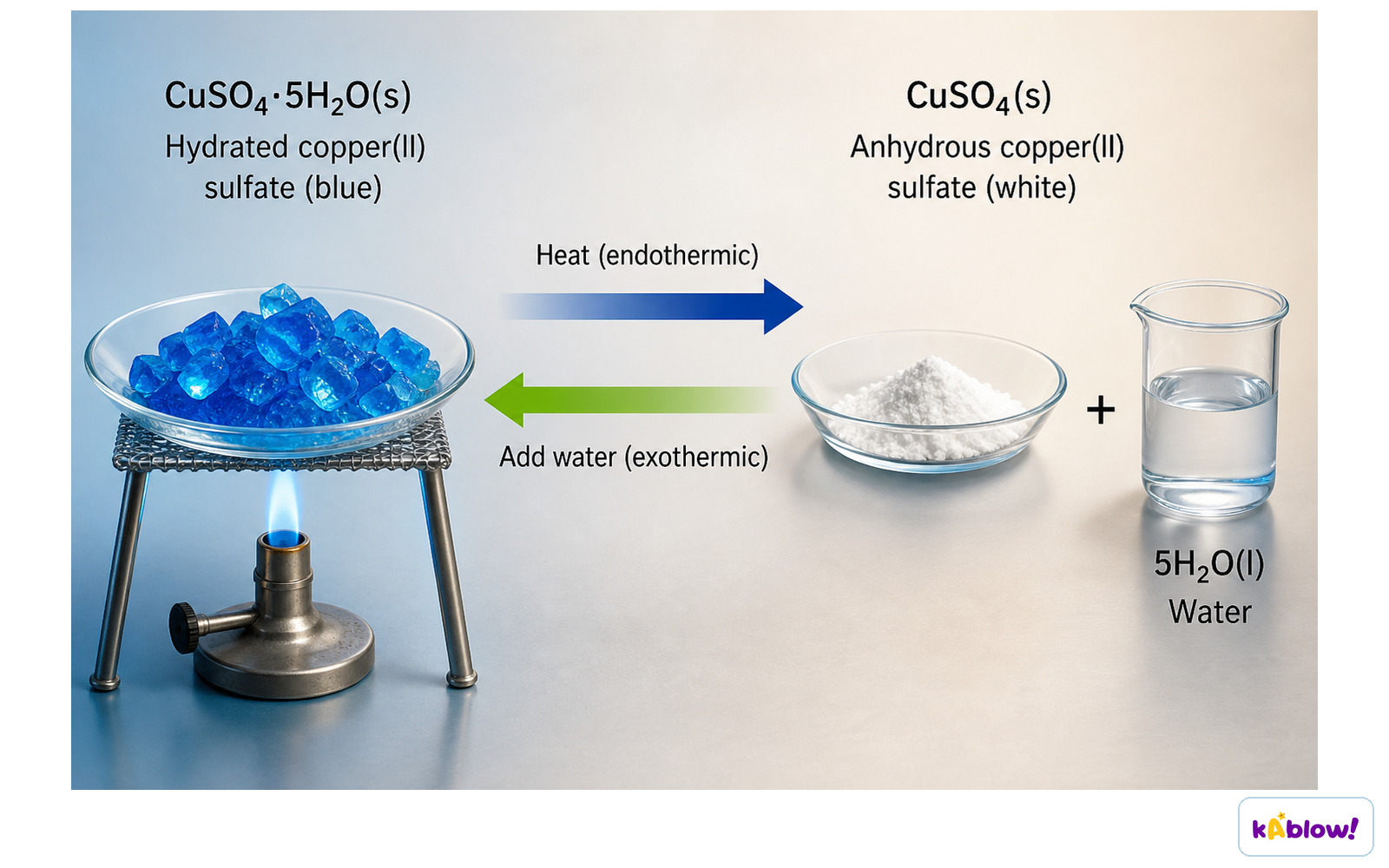
- Hydrated salts contain water within their crystal structure (e.g., blue CuSO₄·5H₂O).
- Anhydrous salts contain no water (e.g., white CuSO₄).
- Heating hydrated copper(II) sulfate removes water, turning it white (dehydration).
- Adding water to anhydrous copper(II) sulfate reverses the reaction, turning it blue.
- Equation: hydrated CuSO₄ ⇌ anhydrous CuSO₄ + water.
Dehydration of hydrated copper(II) sulfate
Diapositivas
Sign up free to view the lesson slides
Step through every slide for this topic — plus flashcards and revision notes — with a free account.
Preguntas de práctica
Vista previa gratis — 8 de 56 preguntas. Regístrate para verlas todas.
1.Which method is used to prepare a soluble salt when the base is soluble (an alkali)?
Easy- AExcess metal method
- BExcess insoluble base method
- CExcess insoluble carbonate method
- DTitration method
2.What is the name of the salt formed when zinc oxide reacts with sulfuric acid?
Easy3.Complete the sentence about naming salts.
EasyThe name of a salt has two parts: the first part comes from the ____ or metal oxide or metal carbonate, and the second part comes from the ____.
4.A salt is a compound formed when the hydrogen atom in an acid is replaced by a metal or ammonium ion.
EasyTrue or false?
5.In the preparation of magnesium sulfate crystals, if 0.24 g of magnesium reacts completely with excess sulfuric acid, calculate the maximum mass of magnesium sulfate (MgSO4) that can be obtained. (Ar: Mg=24, S=32, O=16)
Hard- A2.2
- B1.2
- C3.2
- D0.2
6.Arrange the following steps in the correct order for preparing a soluble salt using the excess insoluble base method.
Medium- Filter the mixture to remove excess base
- Heat the filtrate to concentrate the solution
- Add the insoluble base to warm dilute acid while stirring
- Leave the concentrated solution to crystallize
7.Match each acid to the salt it produces.
Easy- Hydrochloric acid
- Sulfuric acid
- Nitric acid
- Sulfate
- Chloride
- Nitrate
8.Which of the following is the correct equation for the preparation of calcium chloride using excess calcium carbonate?
Medium- ACaCO3 + 2HCl → CaCl2 + CO2 + H2O
- BCaCO3 + HCl → CaCl2 + CO2 + H2O
- CCaCO3 + 2HCl → CaCl2 + H2 + CO2
- DCaCO3 + HCl → CaCl2 + H2O + CO
Unlock all 56 questions, flashcards & more
Crea una cuenta gratis para ver todas las preguntas, las diapositivas, las tarjetas y los apuntes de repaso de este tema.