Expanding And Factorising Brackets
Apréndelo jugando
Responde estas preguntas para ganar energía, luego pesca y explora. Sin cuenta.
Para educadores: diapositivas de la lección, apuntes de repaso, diagramas listos para usar sobre Expanding And Factorising Brackets (Maths [CIE], Extended) — úsalos en tu lección, o presenta el tema como una actividad interactiva de clase que tus aprendices juegan como un juego en vivo.
Apuntes de la lección
Expanding & Simplifying Single Brackets
- To expand a bracket, multiply the term outside by each term inside.
- Example: 3x(x + 2) = 3x × x + 3x × 2 = 3x² + 6x.
- Beware of minus signs: − × − = +, − × + = −.
- When simplifying expressions with multiple brackets, expand each bracket first, then collect like terms.
- Example: 2(x + 5) + 3x(x − 8) = 2x + 10 + 3x² − 24x = 3x² − 22x + 10.
Expanding Double Brackets
- Multiply every term in the first bracket by every term in the second bracket (4 multiplications).
- Use FOIL (First, Outer, Inner, Last) to remember the order.
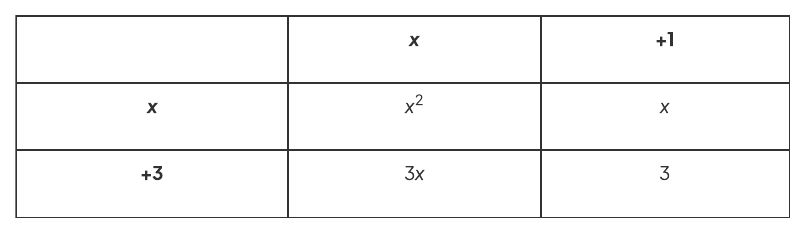
- A grid can help organise multiplication: write one bracket as row headings, the other as column headings, multiply cells, then sum.
- Example: (x + 1)(x + 3) = x² + 3x + x + 3 = x² + 4x + 3.
- For squared brackets, rewrite as a product: (x + 3)² = (x + 3)(x + 3) = x² + 6x + 9.
- When expanding with multiple variables, combine only like terms (e.g., xy terms).
Grid method for double brackets
Expanding Triple Brackets
- First expand and simplify any two brackets, then multiply the result by the third bracket.
- Use a grid to multiply the resulting quadratic by the linear bracket.
- Example: (2x − 3)(x + 4)(3x − 1) → first expand (2x − 3)(x + 4) = 2x² + 5x − 12, then multiply by (3x − 1) to get 6x³ + 13x² − 41x + 12.
Factorising Out Terms
- Factorisation is the reverse of expanding brackets: write an expression as a product of factors.
- Identify the highest common factor (HCF) of the coefficients and variables.
- Write the HCF outside brackets and the remaining terms inside.
- Example: 12x² + 18x = 6x(2x + 3).
- Always factorise fully (e.g., 2x(3x + 5) is not fully factorised; 6x(2x + 3) is).
- Check your answer by expanding the brackets.
Factorising by Grouping
- Used when an expression has four terms and can be grouped into pairs with common factors.
- Factorise each pair separately, then look for a common bracket.
- Example: xy + 3x + 5y + 15 = x(y + 3) + 5(y + 3) = (y + 3)(x + 5).
- The order of terms can be rearranged as long as grouping is possible.
Factorising Simple Quadratics (a = 1)
- For x² + bx + c, find two numbers that multiply to c and add to b.
- Write these numbers in brackets: (x + p)(x + q).
- Example: x² − 2x − 8: numbers 2 and −4 → (x + 2)(x − 4).
- Methods: inspection (quickest), splitting the middle term, or using a grid.
Factorising Harder Quadratics (a ≠ 1)
- For ax² + bx + c, find two numbers that multiply to ac and add to b.
- Use these numbers to split the middle term, then factorise by grouping.
- Example: 4x² − 25x − 21: ac = −84, b = −25 → numbers −28 and 3 → 4x² − 28x + 3x − 21 = 4x(x − 7) + 3(x − 7) = (x − 7)(4x + 3).
- A grid can also be used with the split terms.
Difference of Two Squares
- The difference of two squares is a² − b² = (a + b)(a − b).
- Both terms must be perfect squares and subtracted.
- Example: 9x² − 16 = (3x)² − 4² = (3x + 4)(3x − 4).
- Can be applied to powers: r⁸ − t⁶ = (r⁴)² − (t³)² = (r⁴ + t³)(r⁴ − t³).
- Sometimes a common factor must be taken out first: 2y² − 50 = 2(y² − 25) = 2(y + 5)(y − 5).
Deciding the Factorisation Method
- For two terms: check for common factor or difference of two squares.
- For three terms (quadratic): if a = 1, use simple factorisation; if a ≠ 1, check for a common factor first, then use grouping or grid.
- If the quadratic has a common factor, factor it out first: 3x² + 15x + 18 = 3(x² + 5x + 6) = 3(x + 2)(x + 3).
- Check if b² − 4ac is a perfect square to see if the quadratic factorises.
- Always factorise fully and check by expanding.
Diapositivas
Sign up free to view the lesson slides
Step through every slide for this topic — plus flashcards and revision notes — with a free account.
Preguntas de práctica
Vista previa gratis — 8 de 53 preguntas. Regístrate para verlas todas.
1.Expand 7(x – 8).
Easy- A7x – 56
- B7x – 8
- C7x + 56
- Dx – 56
2.Factorise 5p + pt.
Easy- Ap(5 + t)
- B5(p + t)
- Cp(5t)
- D5p(1 + t)
3.Factorise 12x + 15.
Easy- A3(4x + 5)
- B12(x + 15)
- C3(4x + 15)
- D12x(1 + 15x)
4.Factorise 5y – 6py.
Medium- Ay(5 – 6p)
- B5y(1 – 6p)
- Cy(5 – 6)
- D5(1 – 6p)
5.Factorise 2x2 – x.
Medium- Ax(2x – 1)
- B2x(x – 1)
- Cx(2x – x)
- D2x2(1 – 1/2x)
6.Factorise completely 21a2 + 28ab.
Medium- A7a(3a + 4b)
- B7(3a2 + 4ab)
- C21a(a + 4b)
- D7a(3a + 4)
7.Expand and simplify (m – 3)(m + 2).
Medium- Am2 – m – 6
- Bm2 – 5m – 6
- Cm2 – m + 6
- Dm2 + m – 6
8.Expand and simplify (x + 3)(x + 5).
Medium- Ax2 + 8x + 15
- Bx2 + 8x + 8
- Cx2 + 15x + 8
- Dx2 + 2x + 15
Unlock all 53 questions & more
Crea una cuenta gratis para ver todas las preguntas, las diapositivas, las tarjetas y los apuntes de repaso de este tema.
Exámenes anteriores
La práctica con exámenes anteriores de este tema llegará pronto.
Próximamente