Functions
Apréndelo jugando
Responde estas preguntas para ganar energía, luego pesca y explora. Sin cuenta.
Apuntes de la lección
Introduction to Functions
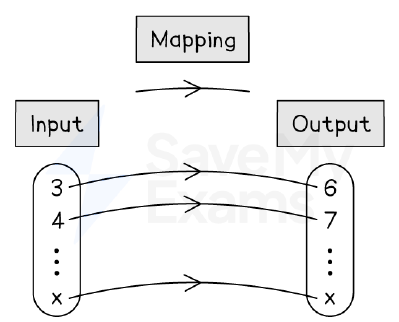
- A function is a mathematical 'machine' that takes an input and produces an output.
- Function notation: f(x) = ... means the function f with input x.
- Common letters for functions: f, g, h, j.
- To evaluate f(a), substitute a for x in the expression.
- If f(x) = output is known, solve f(x) = value to find the input x.
Mapping diagram for a function
Domain & Range
- The domain is the set of all possible inputs (x-values).
- The range is the set of all possible outputs (f(x)-values).
- Domain restrictions: avoid division by zero (e.g., x ≠ 0 for 1/x) and square roots of negatives (e.g., x ≥ 0 for √x).
- Range depends on domain; sketch the graph to help find the range.
- For a linear function f(x)=mx+c on a ≤ x ≤ b, the range is between f(a) and f(b) (order depends on gradient).
Composite Functions
- A composite function applies one function to the output of another.
- Notation: gf(x) means do f first, then g: gf(x) = g(f(x)).
- fg(x) means do g first, then f: fg(x) = f(g(x)).
- ff(x) or f²(x) means apply f twice.
- To evaluate numerically: work from the inside out.
Inverse Functions
- An inverse function reverses the original function; notation: f⁻¹(x).
- If f(a)=b, then f⁻¹(b)=a.
- To find f⁻¹(x) algebraically: write y = f(x), swap x and y, then solve for y.
- The composite of a function and its inverse cancels: ff⁻¹(x) = f⁻¹f(x) = x.
- Domain of f⁻¹ = range of f; range of f⁻¹ = domain of f.
Finding Inverse Functions
- Step 1: Write y = f(x).
- Step 2: Swap x and y to get x = f(y).
- Step 3: Rearrange to make y the subject.
- Step 4: Replace y with f⁻¹(x).
- Example: f(x)=2x+1 → f⁻¹(x) = (x-1)/2.
Domain and Range from Graphs
- The graph of y = f(x) shows domain on x-axis and range on y-axis.
- For f(x)=x², domain all real numbers, range f(x) ≥ 0.
- For f(x)=1/x, domain x≠0, range f(x)≠0.
- For f(x)=√x, domain x≥0, range f(x)≥0.
- Sketching helps visualise domain and range.
Graph of y = g(x) = 3x^2, domain x >= 0
Composite Functions Algebraically
- To find gf(x) algebraically, substitute f(x) into g.
- Example: f(x)=2x-1, g(x)=x² → gf(x) = (2x-1)².
- Simplify the resulting expression.
- Be careful with order: gf(x) ≠ fg(x) generally.
Inverse Functions and Solving Equations
- If f⁻¹(x)=c, then x = f(c) using cancellation.
- Example: f(x)=2x, solve f⁻¹(x)=5 → x = f(5)=10.
- This avoids finding f⁻¹ explicitly.
- Useful when inverse is difficult to find algebraically.
Diapositivas
Sign up free to view the lesson slides
Step through every slide for this topic — plus flashcards and revision notes — with a free account.
Preguntas de práctica
Vista previa gratis — 8 de 64 preguntas. Regístrate para verlas todas.
1.A function is defined as f(x) = 3x - 5. What is the value of f(2)?
Easy- A1
- B6
- C-1
- D11
2.The domain of a function f(x) is the set of all possible inputs. Which of the following is the correct domain for f(x) = 1/x?
Easy- AAll real numbers
- Bx ≠ 0
- Cx > 0
- Dx ≥ 0
3.For the function f(x) = 2x + 1, what is the output when the input is -3?
Easy- A-5
- B5
- C-7
- D7
4.Given f(x) = 7 - 2x, find f(-3).
Easy- A13
- B1
- C-13
- D-1
5.The function f is defined by f(x) = 3x - 5. The domain of f is {-3, 0, 2}. What is the range of f?
Medium- A{-14, -5, 1}
- B{-4, -5, 1}
- C{-14, -5, 11}
- D{ -4, -5, 11}
6.Given f(x) = 2x2 and g(x) = 4x3, find fg(1).
Medium- A8
- B32
- C16
- D4
7.If f(x) = 7x - 4 and g(x) = 2x/(x-3), x ≠ 3, find fg(4).
Medium- A52
- B24
- C60
- D38
8.The function f is defined by f(x) = 2x - 7. The domain of f is {-2, 0, 5}. What is the range of f?
Medium- A{-11, -7, 3}
- B{-11, -7, 17}
- C{-3, -7, 3}
- D{-11, 7, 3}
Unlock all 64 questions & more
Crea una cuenta gratis para ver todas las preguntas, las diapositivas, las tarjetas y los apuntes de repaso de este tema.