Kinetic Particle Model Of Matter
Apréndelo jugando
Responde estas preguntas para ganar energía, luego pesca y explora. Sin cuenta.
Apuntes de la lección
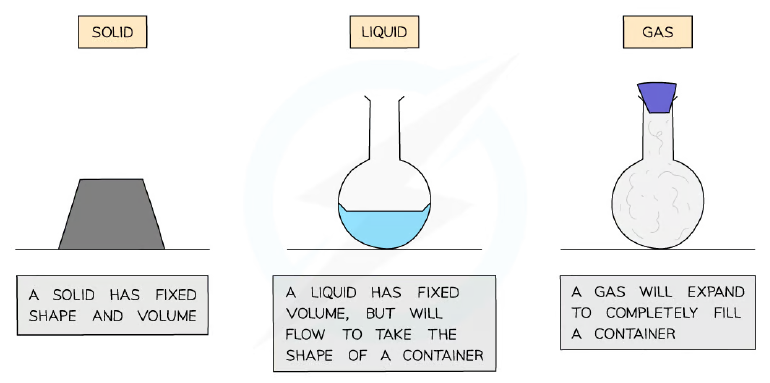
States of Matter
- Solids: definite shape and volume; cannot flow; not compressible.
- Liquids: no definite shape but definite volume; can flow; not compressible.
- Gases: no definite shape or volume; can flow; highly compressible.
- Changes of state are physical changes – mass and number of molecules remain constant; only energy changes.
- Melting: solid → liquid. Freezing: liquid → solid.
- Boiling/evaporating: liquid → gas. Condensing: gas → liquid.
The three states of matter in terms of shape and volume
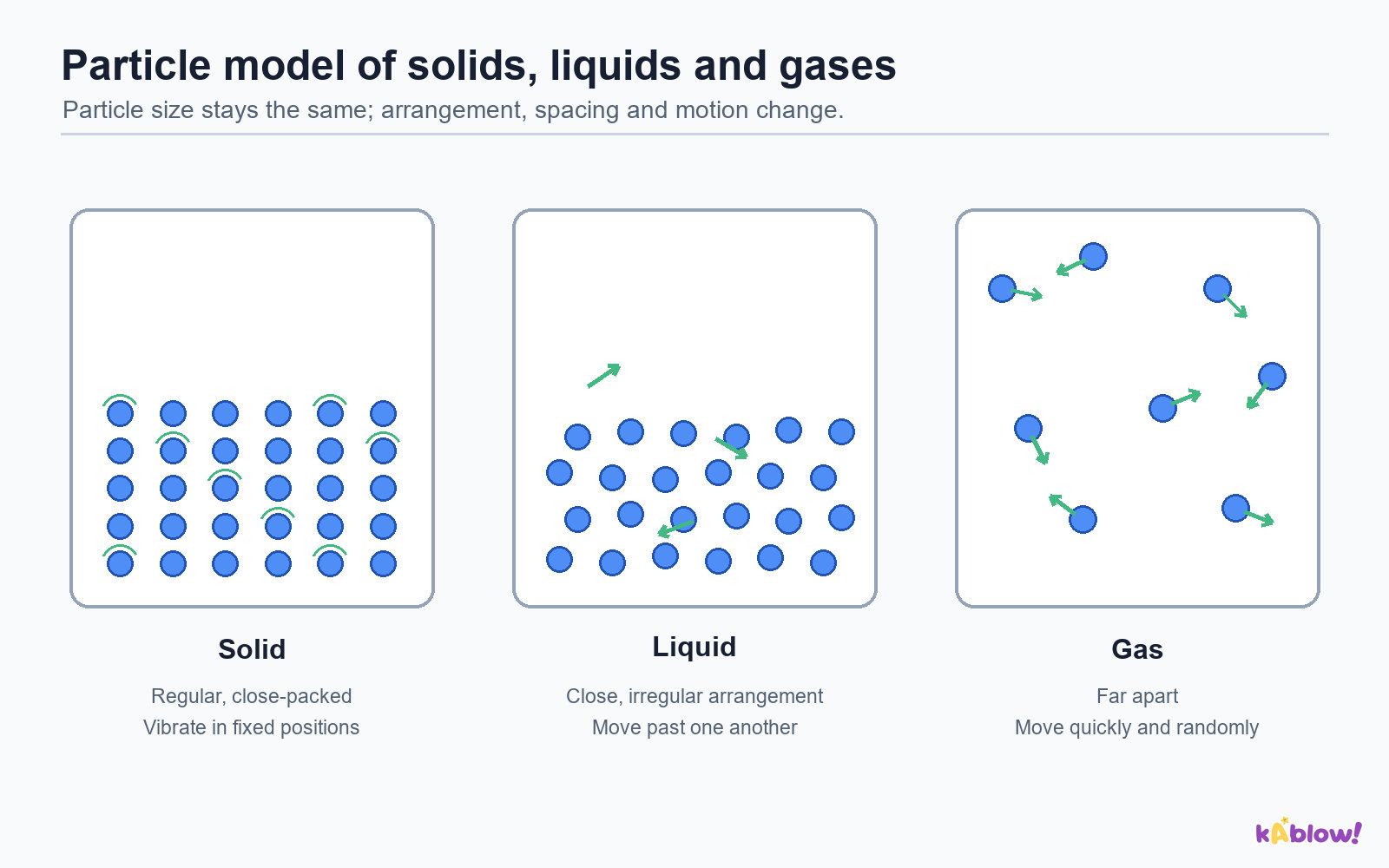
Molecular Matter – Particle Arrangement & Motion
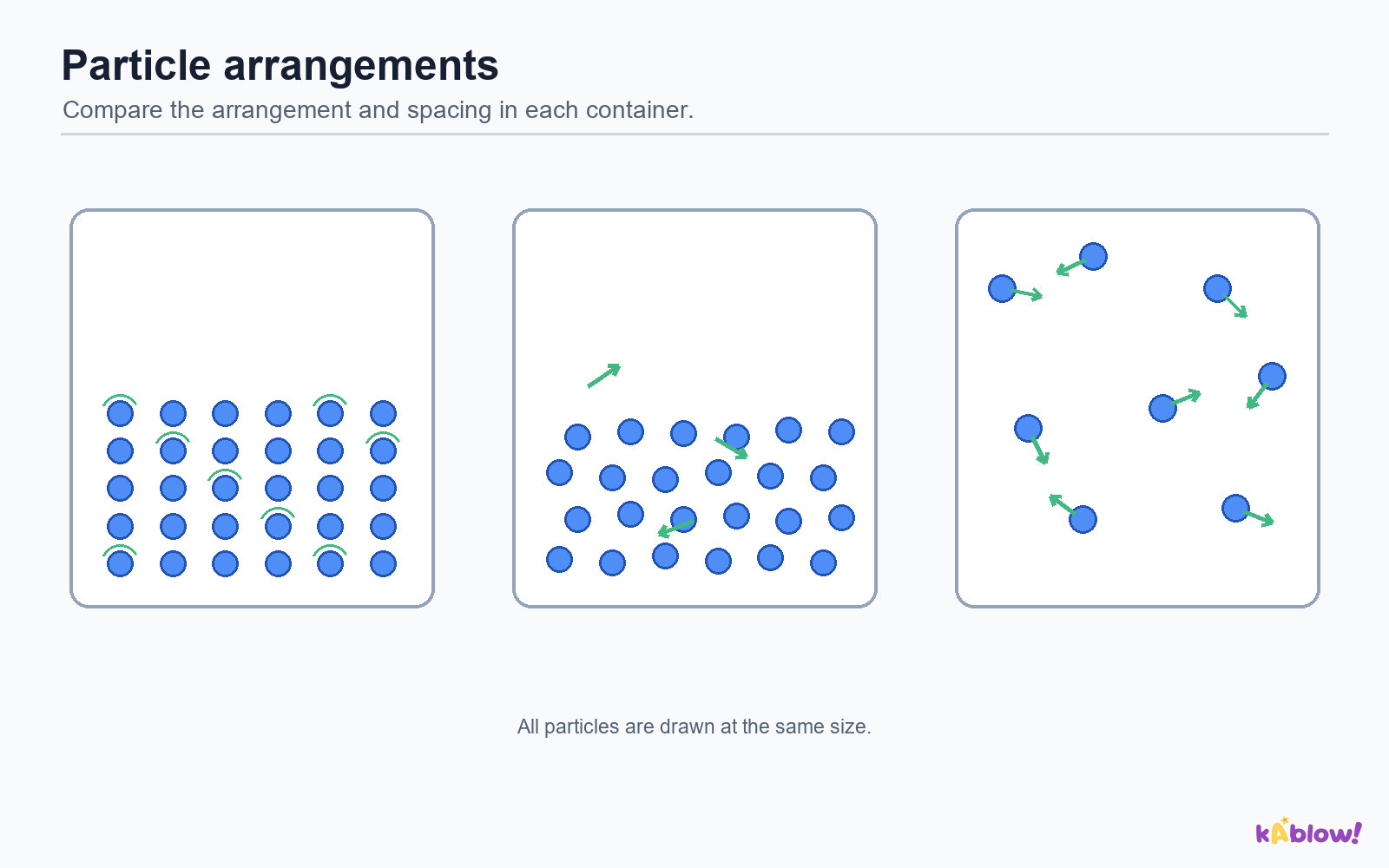
- In solids: particles are close together in a regular pattern; they vibrate about fixed positions.
- In liquids: particles are close together but randomly arranged; they slide past each other.
- In gases: particles are widely separated (~10× further apart); they move randomly at high speeds.
- Density: high in solids, medium in liquids, low in gases.
- Energy: lowest in solids, greater in liquids, highest in gases.
- Intermolecular forces (Extended): strong in solids (fixed shape), weaker in liquids (can flow), negligible in gases (free motion).
Solid, liquid and gas particle model diagrams
Particle Model of Gases
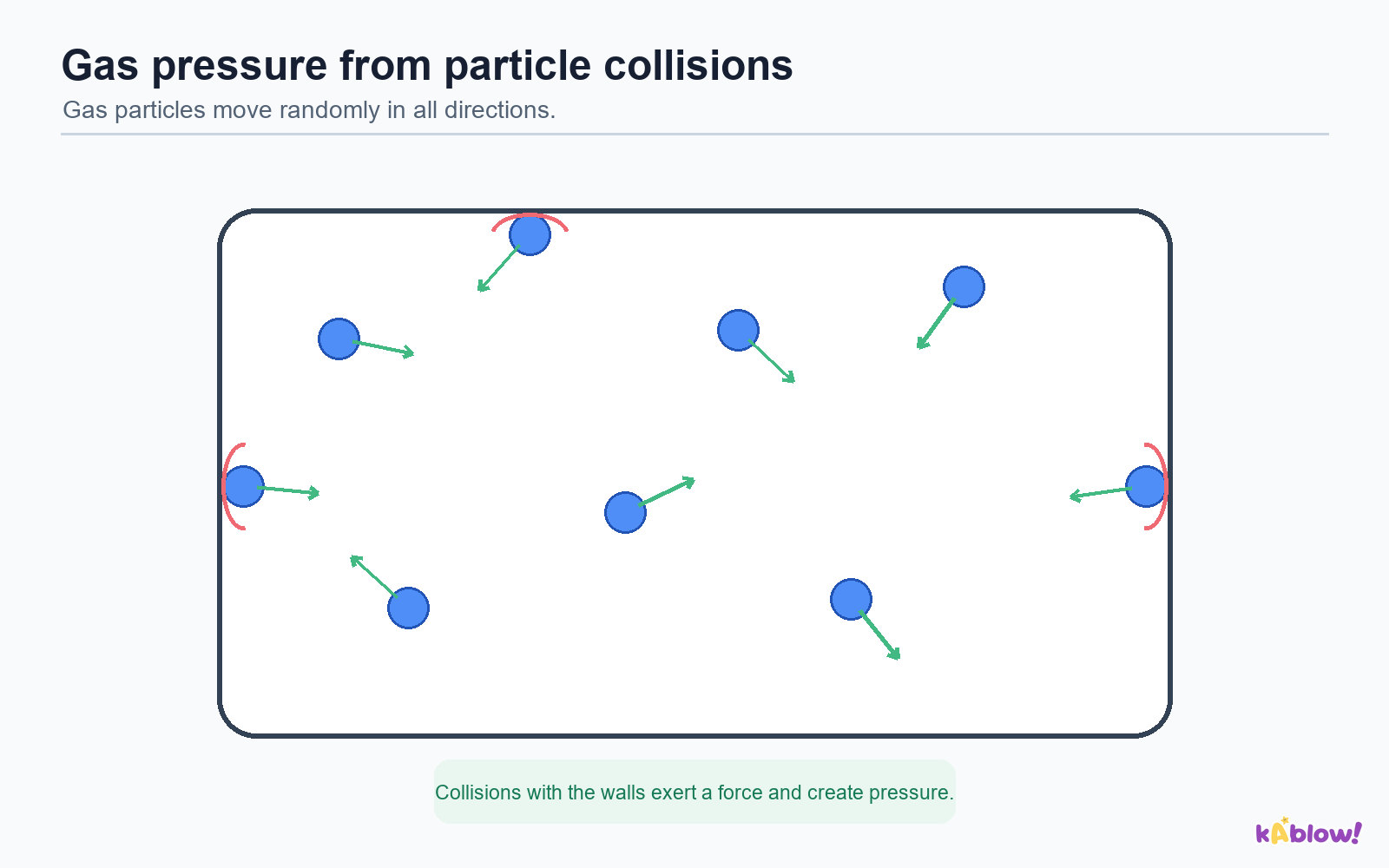
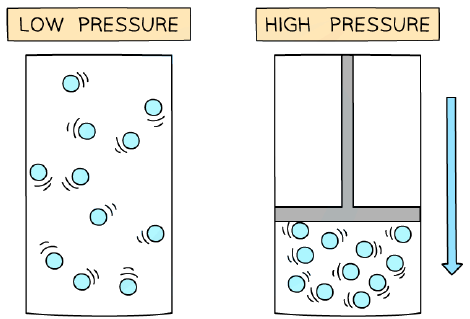
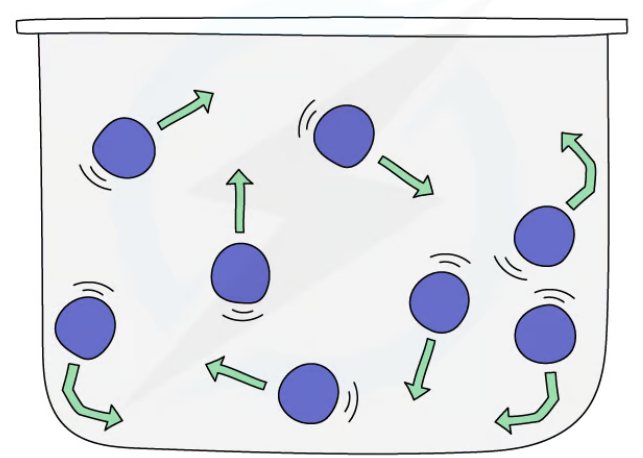
- Gas particles are in constant random motion, colliding with each other and container walls.
- Pressure is caused by collisions of particles with the walls – force per unit area: p = \frac{F}{A} .
- Higher temperature → particles move faster → more frequent/harder collisions → higher pressure.
- At constant temperature, compressing a gas (decreasing volume) increases pressure; expanding decreases pressure.
- Boyle's Law (Extended): For fixed mass at constant temperature, p \propto \frac{1}{V} or pV = \text{constant} .
Gas particles colliding with a wall, causing pressure
Brownian Motion
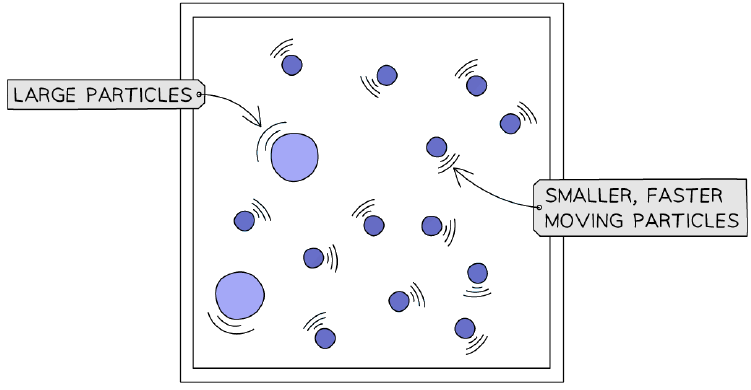
- Brownian motion: random, erratic motion of microscopic particles (e.g., pollen, smoke) suspended in a fluid.
- First observed by Robert Brown (pollen grains in water).
- Caused by collisions with smaller, fast-moving molecules (atoms/molecules of the fluid) that are too small to see.
- The visible particles change speed/direction randomly each time they are struck – evidence for the kinetic theory of matter.
Illustration of Brownian motion with large particles being collided by smaller, faster-moving particles.
Gases & Absolute Temperature
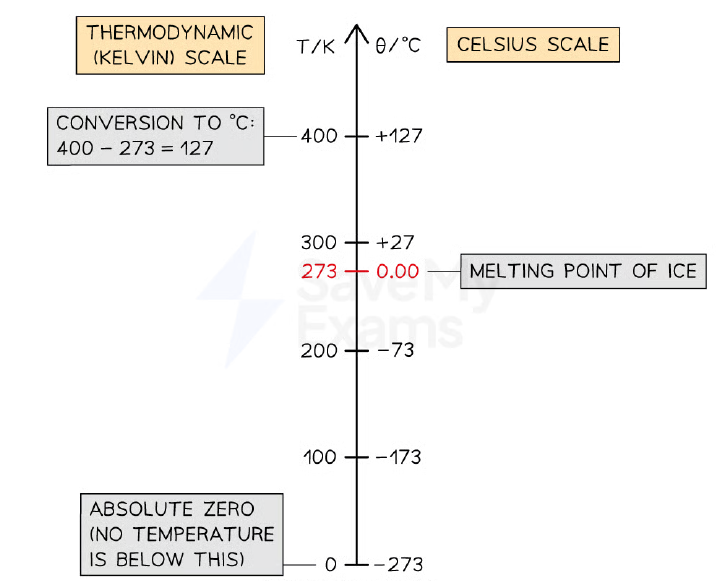
- Absolute zero = −273 °C (0 K) – lowest possible temperature; particles have minimum kinetic energy.
- Kelvin scale: T(\text{K}) = \θ(\degree\text{C}) + 273 , \θ(\degree\text{C}) = T(\text{K}) - 273 .
- An increase of 1 K equals an increase of 1 °C.
- At constant volume, pressure is directly proportional to absolute temperature (in K).
- Pressure–temperature graph is a straight line through the origin (when temperature in K).
Conversion chart relating the temperature on the Kelvin and Celsius scales
Gas Laws – Pressure & Volume (Extended)
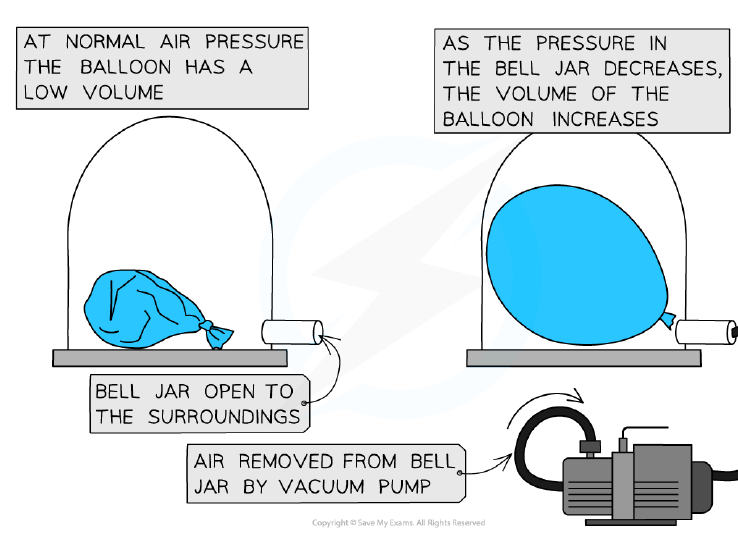
- Boyle's Law: For a fixed mass of gas at constant temperature, p1 V1 = p2 V2 .
- Pressure and volume are inversely proportional: halving volume doubles pressure.
- Graph of p vs V is a hyperbola (curve tending towards axes).
- When gas is compressed, molecules hit walls more often → greater net force → higher pressure.
An experiment demonstrating Boyle's Law, showing a balloon's volume increasing as the surrounding air pressure decreases inside a bell jar.
Diapositivas
Sign up free to view the lesson slides
Step through every slide for this topic — plus flashcards and revision notes — with a free account.
Preguntas de práctica
Vista previa gratis — 8 de 51 preguntas. Regístrate para verlas todas.
1.Which of the following best describes the arrangement and motion of particles in a solid?
Easy- AParticles are close together in a regular pattern and vibrate about fixed positions.
- BParticles are close together in a random arrangement and can slide past each other.
- CParticles are far apart and move randomly at high speeds.
- DParticles are close together in a regular pattern and move freely.
2.A liquid has no definite shape but has a definite volume. Which property of liquids explains this?
Easy- AParticles are far apart and move randomly.
- BParticles are close together but can slide past each other.
- CParticles are in fixed positions and vibrate.
- DParticles are widely separated and compressible.
3.A sealed piston is used to expand a gas at constant temperature. No gas escapes. What happens to the density and pressure of the gas?
Medium- ADensity increases, pressure increases.
- BDensity decreases, pressure decreases.
- CDensity stays the same, pressure decreases.
- DDensity decreases, pressure stays the same.
4.Which change of state involves particles moving much closer together but continuing to travel throughout the substance?
Medium- AMelting
- BFreezing
- CBoiling
- DCondensing
5.A sealed rigid container of fixed volume is filled with air and placed in a freezer. The temperature of the air decreases. Which row correctly describes the changes?
Medium- AAverage distance between particles: decreases; Average speed: decreases
- BAverage distance between particles: no change; Average speed: decreases
- CAverage distance between particles: increases; Average speed: decreases
- DAverage distance between particles: no change; Average speed: increases
6.A balloon is filled with air and tied closed. It is placed in a refrigerator. As the temperature decreases, what happens to the average speed of the air molecules and the pressure inside the balloon?
Medium- AAverage speed decreases, pressure decreases.
- BAverage speed decreases, pressure stays the same.
- CAverage speed stays the same, pressure decreases.
- DAverage speed increases, pressure decreases.
7.Brownian motion is observed when smoke particles are viewed through a microscope. What causes the smoke particles to move randomly?
Easy- AThe smoke particles are attracted to each other.
- BThe smoke particles vibrate because they are warm.
- CSmaller air particles collide with the smoke particles.
- DThe microscope vibrates slightly.
8.A gas is heated in a closed container of constant volume. What happens to the particles of the gas?
Easy- AThey expand.
- BThey get closer together.
- CThey hit the container walls with less force.
- DThey move faster.
Unlock all 51 questions & more
Crea una cuenta gratis para ver todas las preguntas, las diapositivas, las tarjetas y los apuntes de repaso de este tema.