Cell organisation
Apréndelo jugando
Responde estas preguntas para ganar energía, luego pesca y explora. Sin cuenta.
Apuntes de la lección
The Levels of Organisation
- Multicellular organisms organise their cells into a hierarchy, from simple to complex: cells → tissues → organs → organ systems → organism.
- A cell is the basic unit of life. Similar cells group together to form a tissue.
- A tissue is a group of similar cells working together to do one job.
- An organ is made of several different tissues working together.
- An organ system is a group of organs working together to carry out a major body function.
- The whole organism is made up of all its organ systems working together.
The levels of cell organisation, from a single cell to the whole organism
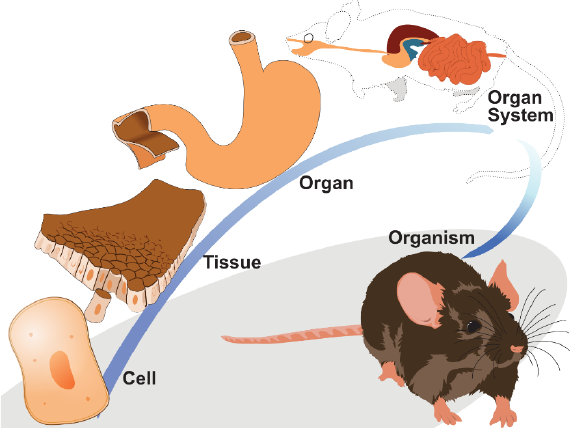
Animal Example: The Mouse Digestive System
- Epithelial cells line the stomach. They provide a protective barrier and help absorb nutrients.
- Epithelial cells group together to form epithelial tissue.
- Epithelial tissue joins with other tissues (such as muscle tissue) to form the stomach, an organ.
- The stomach combines with other organs, such as the intestines, to form the digestive system, an organ system.
- The digestive system is one of several organ systems that together make up the whole organism (the mouse).
Summary of cell organisation: the mouse digestive system

Plant Example: The Leaf
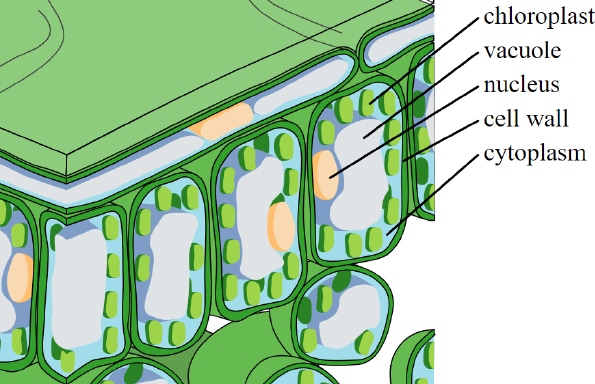
- Palisade cells are found near the surface of a leaf. They contain many chloroplasts for photosynthesis.
- Palisade cells group together to form palisade tissue.
- Palisade tissue joins with other tissues to form a leaf, an organ.
- Leaves combine with other organs, such as stems and roots, to form the shoot system, an organ system.
- The shoot system is part of the whole plant organism.
Summary of cell organisation: the leaf

Tissues vs Organs
- A tissue is a group of similar cells working together to do one job, for example epithelial tissue or palisade tissue.
- An organ is made of several different tissues working together, for example the stomach contains epithelial tissue, muscle tissue and connective tissue.
- An organ has a more complex structure than a tissue, and usually does more than one job.
Organelles in the Palisade Cell
- Chloroplast: the site of photosynthesis; contains chlorophyll to absorb light energy.
- Nucleus: contains DNA and controls the activities of the cell.
- Vacuole: stores cell sap and helps keep the cell firm (turgid).
- Cell wall: made of cellulose; supports and protects the cell.
- Cytoplasm: the jelly-like substance where most chemical reactions in the cell happen.
Palisade cells in leaf tissue, with organelles labelled
Diapositivas
Sign up free to view the lesson slides
Step through every slide for this topic — plus flashcards and revision notes — with a free account.
Preguntas de práctica
Vista previa gratis — 8 de 26 preguntas. Regístrate para verlas todas.
1.What is the correct order of cell organisation from simplest to most complex?
Easy- Acells → tissues → organs → organ systems → organisms
- Btissues → cells → organs → organ systems → organisms
- Ccells → organs → tissues → organ systems → organisms
- Dcells → tissues → organ systems → organs → organisms
2.A group of similar cells working together is called a:
Easy- Atissue
- Borgan
- Corgan system
- Dorganism
3.Which of the following correctly describes an organ?
Medium- AA structure made of different tissues working together
- BA group of similar cells performing a specific function
- CA group of organs working together
- DA single cell performing a specific function
4.Which of the following is an organ system?
Easy- AStomach
- BEpithelial tissue
- CDigestive system
- DPalisade cell
5.What type of cell lines the stomach and provides a protective barrier?
Easy- Aepithelial cell
- Bpalisade cell
- Cnerve cell
- Dred blood cell
6.In the digestive system, epithelial cells form epithelial tissue. Epithelial tissue, along with other tissues, forms the stomach. This is an example of:
Medium- Acell organisation in an animal
- Bcell organisation in a plant
- Ca unicellular organism
- Da prokaryotic cell
7.Epithelial cells line the stomach. What is the main function of these cells?
Medium- ATo produce enzymes
- BTo provide a protective barrier and aid in nutrient absorption
- CTo contract and move food
- DTo carry oxygen
8.In a leaf, which cells contain many chloroplasts for photosynthesis?
Easy- Apalisade cells
- Bepithelial cells
- Cguard cells
- Dspongy mesophyll cells
Unlock all 26 questions, flashcards & more
Crea una cuenta gratis para ver todas las preguntas, las diapositivas, las tarjetas y los apuntes de repaso de este tema.