Fertilisation and seed formation
Apréndelo jugando
Responde estas preguntas para ganar energía, luego pesca y explora. Sin cuenta.
Apuntes de la lección
Pollination and Fertilisation
- Fertilisation occurs after successful pollination.
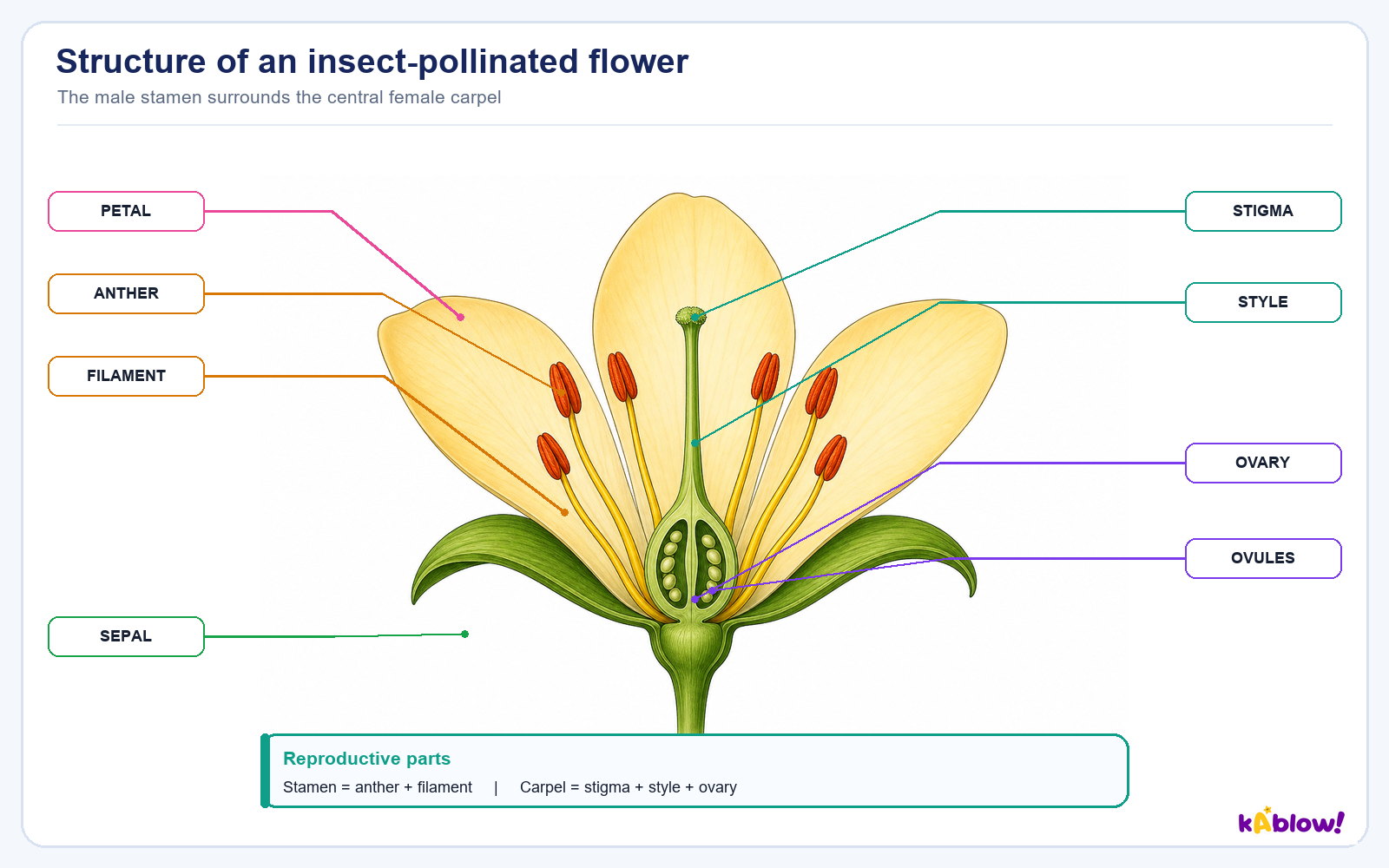
- Pollination is when pollen from the stamen (male part) reaches the carpel (female part) of a flower.
- After landing on a stigma, a pollen grain germinates and grows a pollen tube down the style to the ovary.
- The male sex cell nucleus moves through the pollen tube and joins with the ovule nucleus – this joining is fertilisation.
The parts of a flower, the reproductive organ of a plant.
Seed Formation
- The fertilised ovule becomes a seed.
- Each seed contains an embryo plant and a food store to nourish it.
- The seed is protected by a seed coat.
Fruit Formation
- As seeds develop, the ovary transforms into a fruit.
- The fruit protects the seeds and helps in their dispersal.
- Fruits include berries, nuts, and pods.
Importance of Insect Pollinators
- Many crops (fruits, vegetables, nuts) depend on insect pollination by bees, butterflies, and beetles.
- Pollinators transfer pollen between flowers, enabling seed and fruit production.
- Without insect pollination, crop yields would decrease, reducing food availability and increasing prices.
- This affects global food security – the quantity and diversity of food.
Diapositivas
Sign up free to view the lesson slides
Step through every slide for this topic — plus flashcards and revision notes — with a free account.
Preguntas de práctica
Vista previa gratis — 8 de 58 preguntas. Regístrate para verlas todas.
1.Which of the following is the male part of a flower?
Easy- AStamen
- BCarpel
- COvary
- DStigma
2.Fertilisation in plants occurs when which two nuclei join?
Easy- AMale sex cell nucleus and ovule nucleus
- BPollen nucleus and stigma nucleus
- CSperm nucleus and egg nucleus
- DMale nucleus and female nucleus
3.Which part of the flower develops into a fruit after fertilisation?
Easy- AOvary
- BOvule
- CStigma
- DStyle
4.What is the role of the pollen tube in plant fertilisation?
Easy- AIt transports the male sex cell to the ovule
- BIt produces pollen grains
- CIt receives pollen from the anther
- DIt becomes the seed coat
5.Which of the following is NOT a part of a seed?
Easy- AAnther
- BEmbryo plant
- CFood store
- DSeed coat
6.If bee populations decline significantly, what is the most likely effect on crop yields?
Medium- ACrop yields would decrease
- BCrop yields would increase
- CCrop yields would stay the same
- DCrop yields would become more variable
7.The anther and filament are parts of which flower structure?
Easy- AStamen
- BCarpel
- CPetal
- DSepal
8.What is the function of the seed coat?
Easy- ATo protect the seed
- BTo provide food for the embryo
- CTo attract pollinators
- DTo help in seed dispersal
Unlock all 58 questions, flashcards & more
Crea una cuenta gratis para ver todas las preguntas, las diapositivas, las tarjetas y los apuntes de repaso de este tema.