Food tests
Apréndelo jugando
Responde estas preguntas para ganar energía, luego pesca y explora. Sin cuenta.
Apuntes de la lección
Introduction to Food Tests
- Food tests are used to identify the presence of specific nutrients in food samples.
- Different chemical reagents produce characteristic colour changes when they react with particular nutrients.
- The four main nutrients tested are protein, sugar, starch, and lipids.
Food tests identify starch, reducing sugars, protein and lipids through characteristic colour changes or a cloudy emulsion.
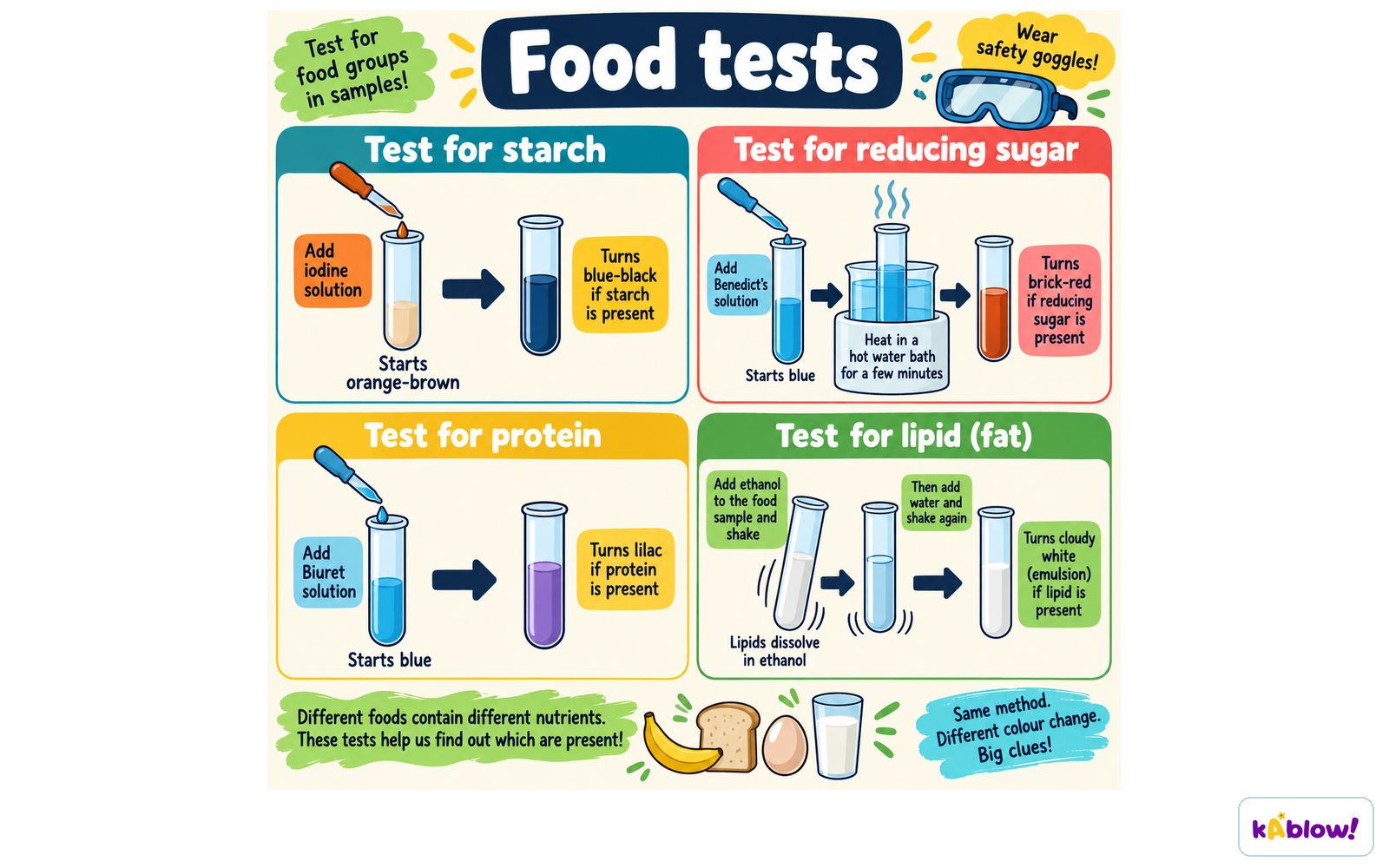
Testing for Protein (Biuret Test)
- Use Biuret solution (blue in colour).
- Add a few drops of Biuret solution to a food sample in a test tube.
- If protein is present, the solution turns purple.
- If no protein is present, the solution remains blue.
- Foods high in protein include meat, fish, eggs, cheese, milk, and nuts.
Testing for Sugar (Benedict's Test)
- Use Benedict's solution (blue).
- Add Benedict's solution to the food sample and heat in a water bath for a few minutes.
- If sugar is present, the solution changes colour: green → yellow → orange → red (depending on concentration).
- No colour change (remains blue) indicates no sugar.
- Foods high in sugar include fizzy drinks, fruit juices, sweets, and cakes.
Testing for Starch (Iodine Test)
- Use iodine solution (yellow/brown).
- Add a few drops of iodine solution to the food sample.
- If starch is present, the solution turns blue/black.
- No colour change (remains yellow/brown) indicates no starch.
- Foods high in starch include bread, pasta, potatoes, and rice.
Testing for Lipids (Ethanol Emulsion Test)
- Use ethanol (alcohol).
- Add ethanol to the food sample and shake, then pour into water.
- If lipids are present, the mixture turns cloudy/milky white.
- No cloudiness indicates no lipids.
- Foods high in lipids include oil, cheese, butter, and some meats.
Summary of Colour Changes
- Protein → Biuret: blue to purple.
- Sugar → Benedict's: blue to green/yellow/orange/red (after heating).
- Starch → Iodine: yellow/brown to blue/black.
- Lipids → Ethanol: clear to cloudy white.
Positive food tests: Biuret turns lilac, heated Benedict’s can turn brick-red, iodine turns blue-black, and the ethanol emulsion test turns cloudy white.
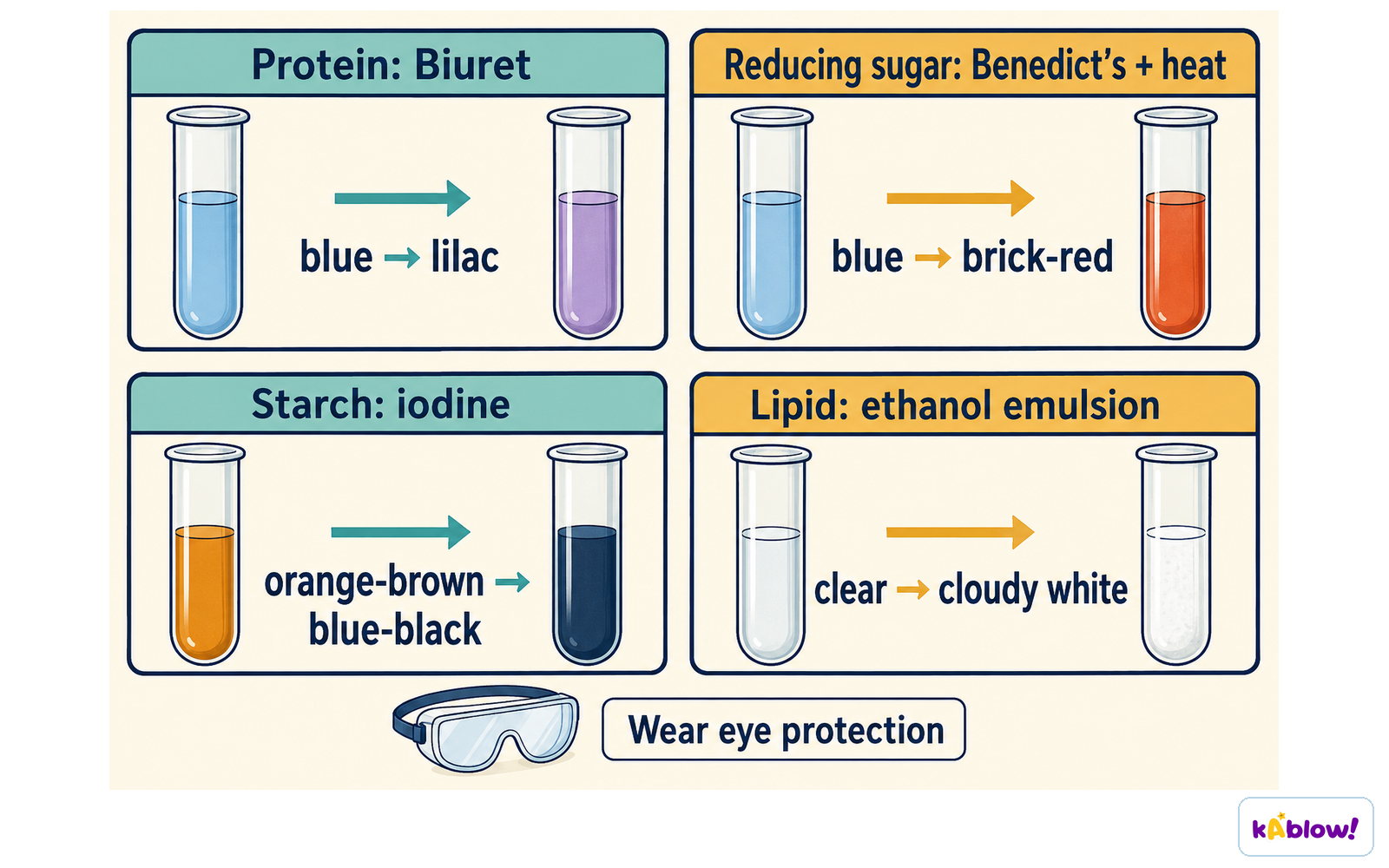
Biuret test: blue reagent gives a lilac-purple result when protein is present.
Benedict's test: heat the food sample and reagent in a water bath; orange is a positive result.
Iodine test: orange-brown iodine turns blue-black when starch is present.
Emulsion test: add ethanol, then water; a milky white emulsion shows lipids are present.
Diapositivas
Sign up free to view the lesson slides
Step through every slide for this topic — plus flashcards and revision notes — with a free account.
Preguntas de práctica
Vista previa gratis — 8 de 65 preguntas. Regístrate para verlas todas.
1.Which food contains a lot of lipids?
Easy- ABread
- BApple
- CButter
- DRice
2.Which food contains a lot of protein?
Easy- APasta
- BEggs
- COrange juice
- DPotato
3.Which food contains a lot of sugars?
Easy- ABread
- BCheese
- CFruit juice
- DButter
4.Which food contains a lot of carbohydrates?
Easy- AMeat
- BFish
- CBread
- DEggs
5.An investigation is carried out to determine if a food sample contains sugars. Which test should be used and what colour change indicates sugar is present?
Medium- ABiuret test; blue to purple
- BBenedict's test; blue to green/yellow/orange/red
- CIodine test; yellow/brown to blue/black
- DEthanol test; colourless to cloudy white
6.An investigation is carried out to determine if a food sample contains lipids. Which test should be used and what colour change indicates lipids are present?
Medium- ABiuret test; blue to purple
- BBenedict's test; blue to red
- CIodine test; yellow/brown to blue/black
- DEthanol test; colourless to cloudy white
7.An investigation is carried out to determine if a food sample contains protein. Which test should be used and what colour change indicates protein is present?
Medium- ABiuret test; blue to purple
- BBenedict's test; blue to red
- CIodine test; yellow/brown to blue/black
- DEthanol test; colourless to cloudy white
8.Iodine solution is dropped onto a slice of bread. What will be observed and why?
Medium- AThe iodine turns blue/black because bread contains starch.
- BThe iodine turns purple because bread contains protein.
- CThe iodine turns red because bread contains sugar.
- DThe iodine remains yellow/brown because bread contains lipids.
Unlock all 65 questions, flashcards & more
Crea una cuenta gratis para ver todas las preguntas, las diapositivas, las tarjetas y los apuntes de repaso de este tema.