Pregnancy
Apréndelo jugando
Responde estas preguntas para ganar energía, luego pesca y explora. Sin cuenta.
Apuntes de la lección
Fertilisation and Implantation
- Pregnancy begins when a sperm fertilises an egg, usually in the fallopian tube.
- The fertilised egg is called a zygote.
- The zygote travels down the fallopian tube to the uterus.
- The zygote implants into the thickened lining of the uterus.
First Trimester (Weeks 1–12)
- The developing baby is called an embryo in early weeks.
- The heart, brain, and other organs begin to form.
- By the end of this trimester, the baby is called a foetus and is about the size of a lemon.
Second Trimester (Weeks 13–26)
- The baby grows, developing muscles, bones, fingers, toes, and facial expressions.
- The baby can move, and the mother may feel these movements.
- The baby begins to hear sounds.
Third Trimester (Weeks 27–40)
- The baby grows rapidly and gains weight.
- The lungs mature.
- The baby moves into a head-down position, ready for birth.
- By the end, the baby is fully developed.
Supporting Structures
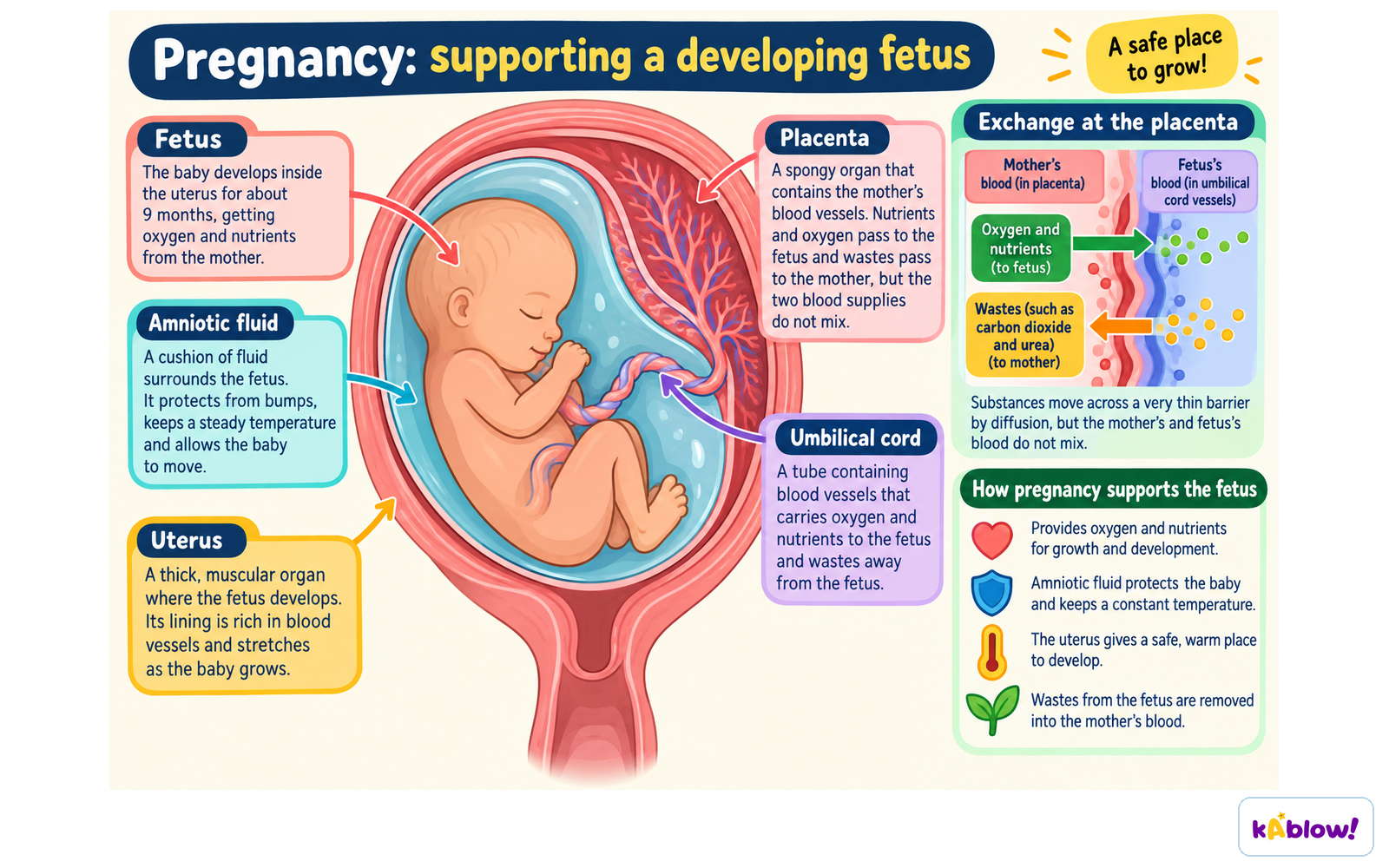
- The placenta provides nutrients and oxygen from the mother's blood and removes waste.
- The umbilical cord connects the baby to the placenta.
- The uterus stretches and grows as the baby gets bigger.
- The amniotic sac surrounds the baby, filled with amniotic fluid that cushions and protects.
- The cervix remains closed during pregnancy and opens (dilates) for birth.
- The vagina is the passage through which the baby is born.
The placenta exchanges substances between mother and fetus without mixing their blood. The umbilical cord connects the fetus to the placenta, and amniotic fluid cushions it.
Diapositivas
Sign up free to view the lesson slides
Step through every slide for this topic — plus flashcards and revision notes — with a free account.
Preguntas de práctica
Vista previa gratis — 8 de 57 preguntas. Regístrate para verlas todas.
1.What is a fertilised egg called?
Easy- AZygote
- BEmbryo
- CFoetus
- DGamete
2.Where does fertilisation usually occur?
Easy- AFallopian tube
- BUterus
- CVagina
- DCervix
3.What is the approximate length of a full-term pregnancy?
Easy- A40 weeks
- B30 weeks
- C50 weeks
- D20 weeks
4.Which of the following is the correct order of development?
Easy- AZygote → embryo → foetus
- BEmbryo → zygote → foetus
- CFoetus → embryo → zygote
- DZygote → foetus → embryo
5.What is the main function of the placenta?
Easy- ATo provide nutrients and oxygen to the baby and remove waste
- BTo produce amniotic fluid
- CTo push the baby out during birth
- DTo connect the uterus to the vagina
6.Which structure surrounds and cushions the baby with fluid?
Easy- AAmniotic sac
- BUmbilical cord
- CPlacenta
- DUterus
7.During which trimester do the baby's lungs mature?
Medium- AThird trimester
- BFirst trimester
- CSecond trimester
- DNone of the above
8.What happens to the cervix as birth approaches?
Easy- AIt gradually opens
- BIt closes tightly
- CIt contracts rhythmically
- DIt produces more amniotic fluid
Unlock all 57 questions, flashcards & more
Crea una cuenta gratis para ver todas las preguntas, las diapositivas, las tarjetas y los apuntes de repaso de este tema.