Energy transfers
Apréndelo jugando
Responde estas preguntas para ganar energía, luego pesca y explora. Sin cuenta.
Apuntes de la lección
Conservation of Energy
- Energy is never created or destroyed; it is only transferred between stores.
- The principle of conservation of energy states that total energy in a closed system remains constant.
- Energy is measured in Joules (J).
Energy is transferred usefully from the kinetic store of the bat to the kinetic store of the ball; the rest is dissipated to thermal stores
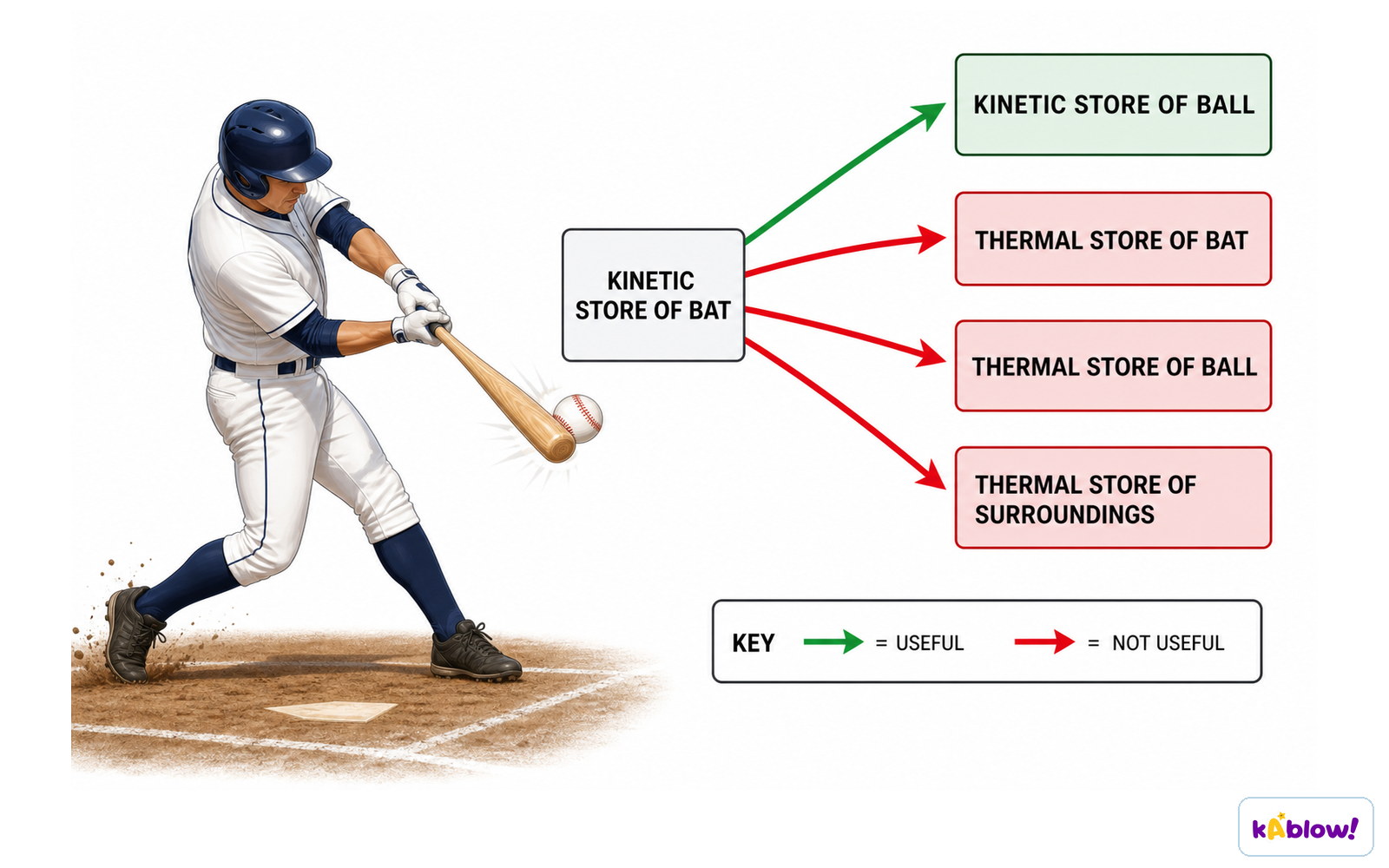
Energy Pathways
- Energy can be transferred via four pathways: mechanically, electrically, by heating, and by radiation.
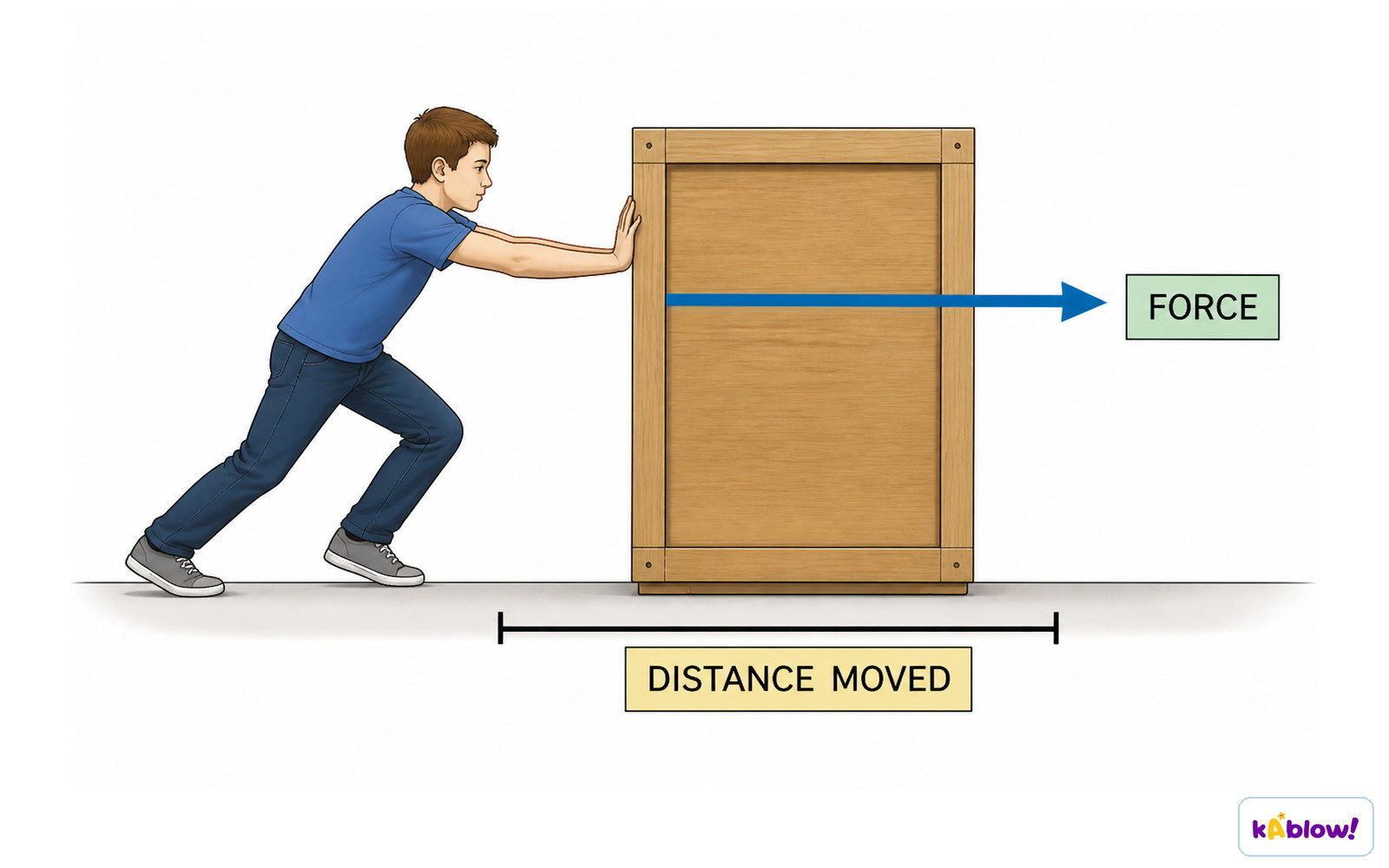
- Mechanical transfer: work done by a force moving an object over a distance.
- Electrical transfer: work done when charges move through a circuit.
- Heating: energy moves from a hotter object to a cooler object.
- Radiation: energy transferred by light, sound, or other electromagnetic waves.
Work Done
- Work done is another term for energy transferred from one store to another.
- Work is done when a force causes an object to move.
Work is done when a force moves an object over a distance: W = Fd
Energy Stores and Pendulum Example
- A pendulum has gravitational potential energy (GPE) at its highest point (e.g., 10 J).
- As it falls, mechanical work transfers GPE to kinetic energy (KE); total energy remains 10 J.
- At the lowest point, GPE is minimum and KE is maximum (10 J).
- As it rises again, KE transfers back to GPE; at the opposite highest point, GPE = 10 J, KE = 0 J.
- Energy is conserved throughout the swing.
Efficiency and Wasted Energy
- Energy transfers are not 100% efficient; some energy is wasted.
- Wasted energy often ends up in the thermal energy store of the surroundings (e.g., air, pendulum).
- Air resistance causes the pendulum to eventually stop, transferring KE to thermal energy.
Energy-transfer pathways and pendulum motion
Diapositivas
Sign up free to view the lesson slides
Step through every slide for this topic — plus flashcards and revision notes — with a free account.
Preguntas de práctica
Vista previa gratis — 8 de 63 preguntas. Regístrate para verlas todas.
1.Which of the following is the principle of conservation of energy?
Easy- AEnergy can be created but not destroyed.
- BEnergy can be destroyed but not created.
- CEnergy cannot be created or destroyed; it can only be transferred from one store to another.
- DEnergy can be created and destroyed.
2.What is the unit of energy?
Easy- AWatt (W)
- BJoule (J)
- CNewton (N)
- DPascal (Pa)
3.A pendulum at its maximum height has 10 J of gravitational potential energy. As it swings down, what happens to the total energy of the pendulum?
Medium- AIt increases to more than 10 J.
- BIt decreases to less than 10 J.
- CIt remains constant at 10 J.
- DIt becomes 0 J at the lowest point.
4.A book on a shelf has 30 J of gravitational potential energy. When it falls to the ground, what is the maximum kinetic energy it can have just before hitting the ground?
Medium- A0 J
- B15 J
- C30 J
- D60 J
5.In practice, the kinetic energy of a falling object just before it hits the ground is less than the initial gravitational potential energy. Why?
Medium- ABecause energy is destroyed during the fall.
- BBecause some energy is transferred to the thermal energy store of the surroundings due to air resistance.
- CBecause the object loses mass as it falls.
- DBecause gravitational potential energy cannot be fully converted to kinetic energy.
6.Which of the following is NOT a pathway for energy transfer?
Easy- AMechanically
- BElectrically
- CChemically
- DBy radiation
7.Energy transferred by light or sound is an example of which pathway?
Easy- AMechanically
- BElectrically
- CBy heating
- DBy radiation
8.What is meant by 'work done' in physics?
Easy- AThe total energy stored in an object
- BEnergy transferred from one store to another when a force moves an object
- CThe force applied to an object
- DThe power used by a machine
Unlock all 63 questions, flashcards & more
Crea una cuenta gratis para ver todas las preguntas, las diapositivas, las tarjetas y los apuntes de repaso de este tema.