Atoms and molecules
Apréndelo jugando
Responde estas preguntas para ganar energía, luego pesca y explora. Sin cuenta.
Apuntes de la lección
Atoms and Sub-atomic Particles
- Atoms are the basic building blocks of all matter.
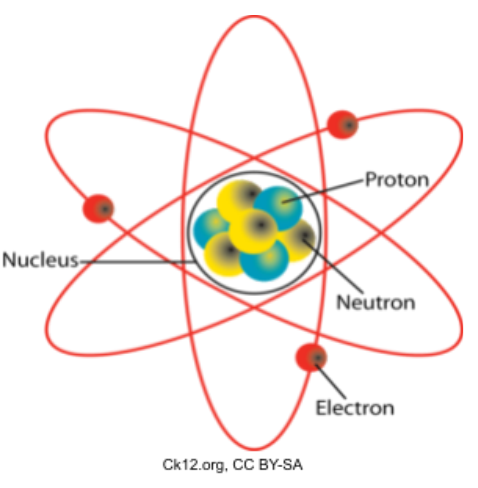
- Atoms are made of three sub-atomic particles: protons, neutrons, and electrons.
- Protons are positively charged and are found in the nucleus.
- Neutrons have no charge (neutral) and are also in the nucleus.
- Electrons are negatively charged, much smaller, and move around the nucleus in an electron cloud.
- The number of protons determines the element; in a neutral atom, protons equal electrons.
A model of an atom, showing the nucleus (protons and neutrons) at the centre and electrons orbiting around it.
Elements and the Periodic Table
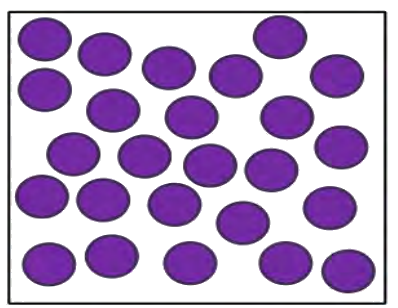
- An element is a pure substance made of only one kind of atom.
- There are more than 100 known elements, each with a unique name, symbol, and atomic number.
- Elements are arranged in the Periodic Table in order of increasing atomic number.
- Atoms of different elements have different numbers of protons and different masses.
- Metals are found on the left and non-metals on the right of the Periodic Table; semi-metals are in between.
A collection of identical atoms representing an element
Molecules
- A molecule forms when two or more atoms link together.
- Molecules can be made of the same type of atoms (e.g., O2) or different types (e.g., H2O).
- A molecule always has the same types and proportions of atoms; for example, water is always H2O.
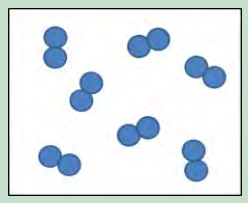
- Some elements exist as diatomic molecules (two atoms), such as H2, N2, O2, F2, Cl2, Br2, and I2.
- Molecules of compounds contain at least two different kinds of atoms.
Some elements exist as diatomic molecules.
Compounds and Chemical Formulas
- A compound is a pure substance made of two or more different elements chemically combined.
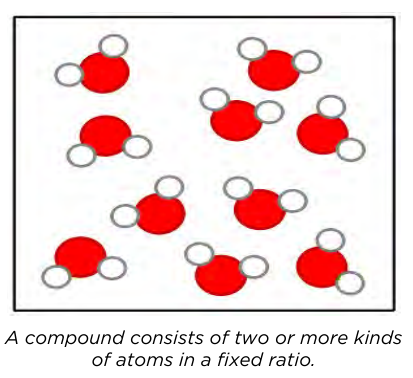
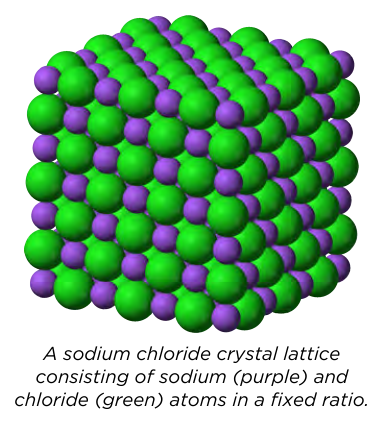
- Compounds have a fixed ratio of atoms; for example, water has 2 hydrogen atoms to 1 oxygen atom.
- Each compound has a unique chemical formula that shows the types and numbers of atoms (e.g., CO2).
- Subscripts in a formula indicate the number of atoms of each element; '1' is not written.
- Compounds form during chemical reactions when atoms rearrange and new bonds form.
A compound consists of two or more kinds of atoms combined in a fixed ratio.
Naming Compounds
- The IUPAC system provides unique names for compounds.
- For compounds of a metal and non-metal, the metal comes first, and the non-metal ends in -ide (e.g., sodium chloride).
- For compounds of only non-metals, the element further left on the Periodic Table comes first, and the second ends in -ide.
- Prefixes like mono-, di-, tri-, tetra- indicate the number of atoms when needed (e.g., carbon dioxide).
- The prefix mono- is usually omitted from the first element (e.g., CO is carbon monoxide, not monocarbon monoxide).
Mixtures vs. Compounds
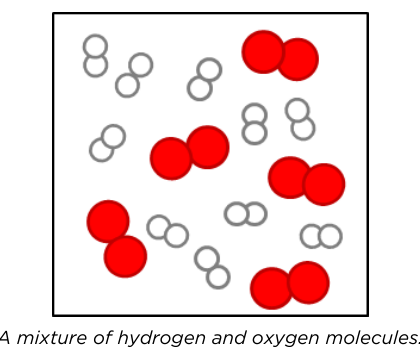
- A mixture contains two or more substances that are not chemically combined.
- Mixtures can be separated by physical means, such as filtering or evaporation.
- Compounds are chemically combined and can only be separated by chemical reactions.
- In a mixture, the substances retain their individual properties; in a compound, the properties are different from the constituent elements.
A mixture of hydrogen and oxygen molecules — the two elements are not chemically combined.
Models of the Atom
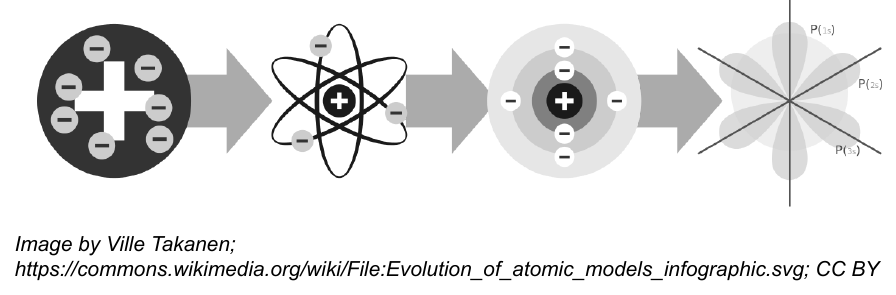
- Scientific models help us understand atoms, which are too small to see.
- The model shows protons and neutrons in the nucleus and electrons in a cloud around it.
- The nucleus is very dense and makes up almost all of the atom's mass.
- Atoms are mostly empty space; the nucleus is about 1 trillionth of the atom's size.
- The model is not to scale but effectively shows the parts and their locations.
The scientific model of the atom has changed over time, from a solid sphere to the modern electron-cloud model.
Properties of Molecules
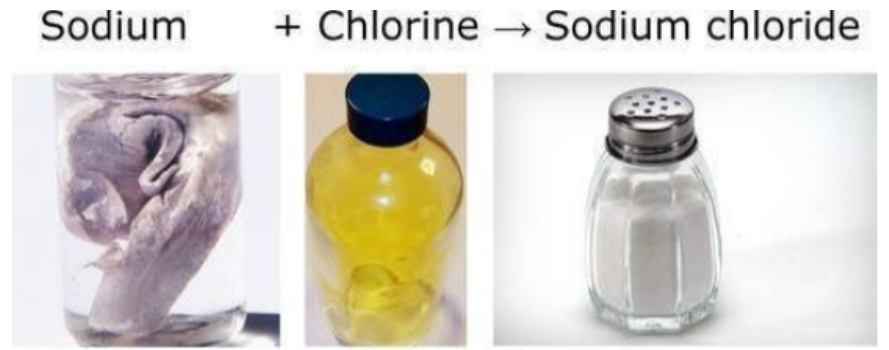
- The properties of a molecule are different from the properties of the atoms that form it.
- For example, sodium (explosive) and chlorine (poisonous) combine to form harmless table salt (NaCl).
- A pure substance has the same composition throughout; all water molecules are identical.
- Different combinations of atoms give molecules unique properties (e.g., water vs. hydrogen peroxide).
Sodium and chlorine combine to form sodium chloride — safe, unreactive table salt.
Diapositivas
Sign up free to view the lesson slides
Step through every slide for this topic — plus flashcards and revision notes — with a free account.
Preguntas de práctica
Vista previa gratis — 8 de 47 preguntas. Regístrate para verlas todas.
1.What are the three sub-atomic particles that make up an atom?
Easy- Aprotons, neutrons, electrons
- Bprotons, electrons, molecules
- Cneutrons, electrons, atoms
- Dprotons, neutrons, nuclei
2.All elements consist of molecules.
EasyTrue or false?
3.Which of the following is a diatomic molecule?
Easy- AO2
- BHe
- CH2O
- DCO2
4.What does the formula H2O tell us about a water molecule?
Easy- AIt has two hydrogen atoms and one oxygen atom.
- BIt has one hydrogen atom and two oxygen atoms.
- CIt has two hydrogen atoms and two oxygen atoms.
- DIt has one hydrogen atom and one oxygen atom.
5.Which of the following is a compound?
Medium- AWater (H2O)
- BOxygen (O2)
- CHydrogen (H2)
- DGold (Au)
6.The properties of a molecule are the same as the properties of the atoms that form it.
MediumTrue or false?
7.Match each sub-atomic particle with its charge.
Easy- Proton
- Neutron
- Electron
- Positive
- Neutral
- Negative
8.Which of the following are elements that exist as diatomic molecules? (Select all that apply)
Easy- AHydrogen (H2)
- BOxygen (O2)
- CHelium (He)
- DNitrogen (N2)
- ECarbon (C)

Unlock all 47 questions, flashcards & more
Crea una cuenta gratis para ver todas las preguntas, las diapositivas, las tarjetas y los apuntes de repaso de este tema.