Plant tissues, organs and systems
Apprends en jouant
Réponds à ces questions pour gagner de l'énergie, puis pêche et explore. Sans compte.
Notes de leçon
Plant Tissues and Their Functions
- Epidermal tissues cover the plant, protecting it from damage and water loss; the upper epidermis is thin and transparent to let light reach the palisade cells.
- Palisade mesophyll is made of column-shaped cells tightly packed with chloroplasts to absorb as much light as possible for photosynthesis.
- Spongy mesophyll has internal air spaces that increase the surface area for diffusion of gases, mainly carbon dioxide, into and out of the leaf.
- Xylem and phloem are transport tissues found in vascular bundles; xylem carries water and minerals, phloem carries dissolved sugars and amino acids.
- Meristem tissue is found at the growing tips of shoots and roots and is responsible for producing new cells for growth.
- Guard cells surround stomata and control their opening and closing, balancing gas exchange with water loss.
The Leaf as a Plant Organ
- A leaf is a plant organ adapted for photosynthesis; it has a large surface area to absorb light and carbon dioxide.
- The leaf is thin so that carbon dioxide can diffuse quickly to the palisade mesophyll cells.
- A waxy cuticle covers the leaf, reducing water loss without blocking sunlight.
- The upper epidermis is transparent, allowing light to pass through to the palisade layer beneath.
- Palisade cells are at the top of the leaf, maximising light absorption by chloroplasts.
- Stomata in the lower epidermis allow carbon dioxide to diffuse in and oxygen to diffuse out; they also allow water vapour to escape.
- A network of veins (vascular bundles) transports water to the leaf cells and carbohydrates away from the leaf.
Root Hair Cells and Water Uptake
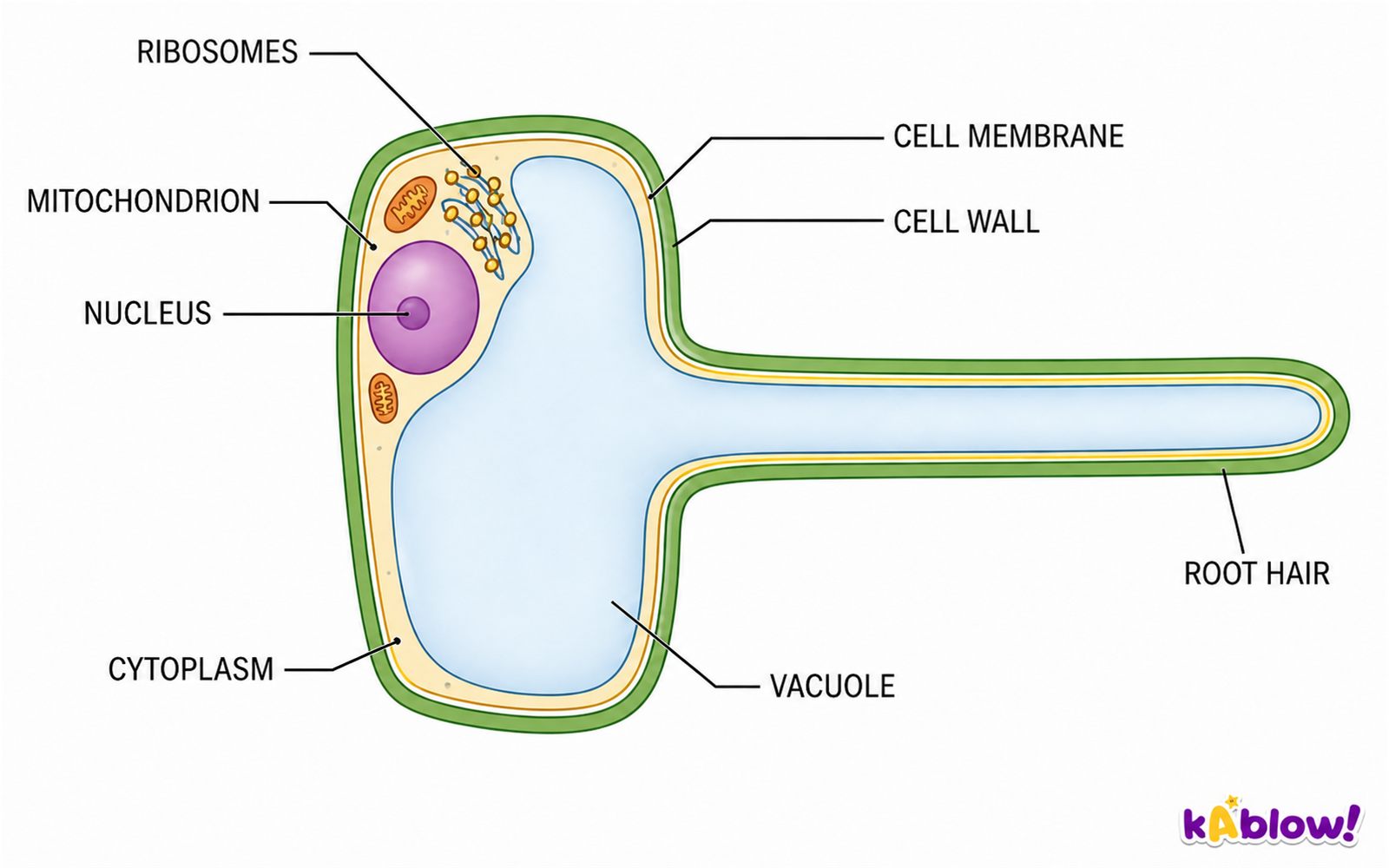
- Root hair cells are single-celled extensions of epidermis cells in the root; they grow between soil particles.
- The long hair-like projection increases the surface area to volume ratio, increasing the rate of absorption of water and mineral ions.
- Water enters root hair cells by osmosis because the soil water has a higher water potential than the cytoplasm.
- Mineral ions are taken up by active transport, which requires energy from respiration.
- Water passes through the root cortex and into the xylem vessels, then travels up to the leaves.
- The pathway of water is: root hair cell → root cortex cells → xylem → leaf mesophyll cells.
A root hair cell: its long extension increases the surface area for absorbing water.
Xylem and Phloem Structure and Function
- Xylem vessels transport water and dissolved mineral ions from the roots to the stem and leaves.
- Xylem cells are dead and hollow, with no top and bottom walls, forming continuous tubes for water movement.
- Xylem walls are strengthened with lignin, which supports the plant and helps withstand the pressure of water movement.
- Phloem vessels transport dissolved sugars (mainly sucrose) and amino acids from photosynthesising leaves to other parts of the plant.
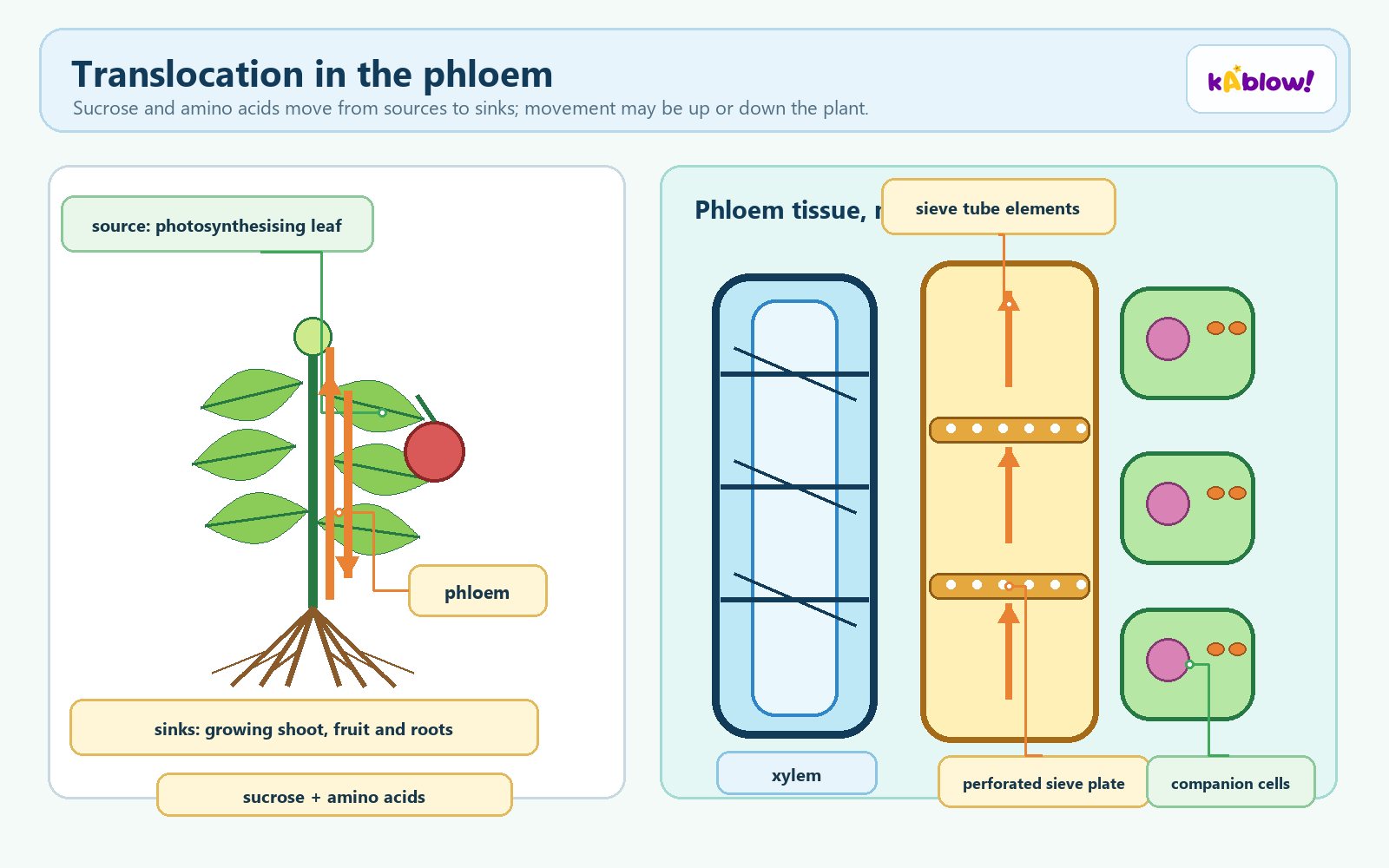
- Phloem cells are living and joined end-to-end; their end walls have pores called sieve plates that allow substances to flow through.
- Movement in xylem is only one direction (roots to leaves), while phloem transport can occur in different directions.
Transpiration and the Transpiration Stream
- Transpiration is the loss of water vapour from the parts of the plant above ground, mainly through the stomata.
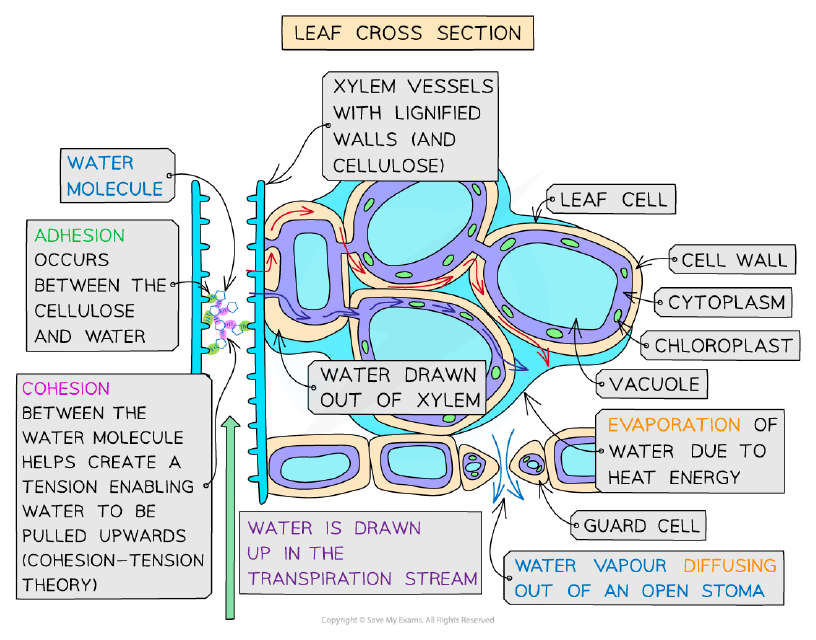
- Water evaporates from the surfaces of the spongy mesophyll cells into the air spaces, then diffuses out through the stomata.
- The transpiration stream is the continuous flow of water from the roots to the leaves through the xylem.
- Water molecules in the xylem are held together by cohesion, forming an unbroken column; transpiration pulls this column upwards.
- Transpiration helps transport mineral ions, keeps cells turgid for support, supplies water for photosynthesis, and cools the plant.
- If the rate of transpiration increases, water is pulled up the xylem faster.
The generation of the transpiration stream
Factors Affecting the Rate of Transpiration
- Temperature: higher temperature increases the rate of transpiration because evaporation is faster.
- Humidity: higher humidity decreases the rate of transpiration because there is a smaller water potential gradient between the leaf and the air.
- Air movement: increased air flow increases the rate of transpiration by removing water vapour from around the leaf, maintaining a steep diffusion gradient.
- Light intensity: higher light intensity increases the rate of transpiration because more stomata are open to allow carbon dioxide in for photosynthesis.
- If any of these factors are low, the opposite effect on transpiration rate is seen.
Stomata and Guard Cells
- Stomata are pores mainly found on the underside of the leaf; they allow gas exchange and water loss.
- Guard cells control the opening and closing of stomata by changing shape as they gain or lose water.
- When guard cells are turgid (full of water), the stomata are open, allowing carbon dioxide in and water vapour out.
- When guard cells lose water and become flaccid, the stomata close, reducing water loss.
- Stomata open during the day to allow carbon dioxide in for photosynthesis and close at night to conserve water.
- The daily rhythm of stomatal opening and closing continues even in constant light or darkness.
Translocation
- Translocation is the transport of dissolved sugars (mainly sucrose) and amino acids in the phloem, from regions of production to regions of storage or use.
- Translocation is an active process that requires energy.
- Substances are transported from source (where they are made) to sink (where they are stored or used).
- In winter, phloem may transport dissolved food from storage organs to other parts of the plant for respiration.
- In spring, storage organs are the source and growing areas are the sinks.
- In summer, leaves are the source and roots are the sinks, storing sucrose as starch.
Translocation through the phloem
Investigating Transpiration
- A potometer is used to measure the rate of transpiration by measuring water uptake.
- A bubble potometer measures the distance an air bubble moves in a set time; the further it moves, the faster the transpiration rate.
- A mass potometer measures the change in mass of a plant as water evaporates from the leaves and stem.
- When setting up a potometer, cut the shoot underwater to prevent air entering the xylem, and ensure all joints are airtight using Vaseline.
- Dry the leaves before starting because wet leaves affect the results.
- Calculate the rate of transpiration by dividing the distance the bubble travelled by the time period.
- Control variables such as temperature, humidity and wind speed to ensure a fair test.
Diapos
Sign up free to view the lesson slides
Step through every slide for this topic — plus flashcards and revision notes — with a free account.
Questions d'entraînement
Aperçu gratuit — 8 sur 62 questions. Inscris-toi pour toutes les voir.
1.Which option correctly describes the organisational structure of a leaf?
Easy- ACell
- BTissue
- COrgan
- DOrgan system
2.Which feature of palisade mesophyll cells makes them adapted for efficient photosynthesis?
Medium- AThey are transparent to allow light to pass through.
- BThey have a thick waxy coating.
- CThey contain lots of mitochondria.
- DThey contain lots of chloroplasts.
3.Which substance is transported in the phloem?
Easy- AWater
- BDissolved sugars
- CMineral ions
- DCarbon dioxide
4.Which of the statements A to D does not refer to the xylem?
Medium- ATiny pores allow water and mineral ions to enter.
- BComposed of tubes of elongated living cells.
- CStrengthened by lignin.
- DDead cells form a hollow tube.
5.What is the predominant process by which water is lost from the leaf?
Medium- ADiffusion
- BEvaporation
- CTranslocation
- DPhotosynthesis
6.What would happen to the transpiration rate of a plant during the night time?
Easy- ATranspiration increases
- BTranspiration remains constant
- CTranspiration stops
- DTranspiration decreases
7.What is the name given to the flow of water from the roots to the leaves via the xylem vessel?
Medium- ATranslocation
- BTranspiration stream
- COsmosis
- DActive transport
8.Which of the following are functions of transpiration in plants? (select all that apply)
Medium- ATransporting mineral ions
- BProviding water to keep cells turgid
- CProducing glucose for the plant
- DKeeping the leaves cool
- EAbsorbing carbon dioxide from the air
Unlock all 62 questions, flashcards & more
Crée un compte gratuit pour voir toutes les questions, les diapos, les cartes mémo et les notes de révision de ce thème.