The development of understanding of genetics and evolution
Apprends en jouant
Réponds à ces questions pour gagner de l'énergie, puis pêche et explore. Sans compte.
Notes de leçon
Darwin and Wallace: Developing the Theory of Evolution
- Charles Darwin spent five years on a voyage around the world on HMS Beagle, studying plants and animals at every location the ship visited.
- Darwin noticed variation between members of the same species and that individuals with characteristics best suited to their environment were more likely to survive and reproduce.
- From these observations, Darwin developed the theory of evolution by natural selection, published in his book×On the Origin of Species×in 1859.
- Alfred Russel Wallace independently developed a theory of evolution by natural selection after his own travels and evidence gathering.
- Darwin and Wallace published scientific papers together on the theory in 1858, which prompted Darwin to publish his book the following year.
- Wallace is best known for his work on warning colouration in animals (especially butterflies) and for his pioneering work on speciation.
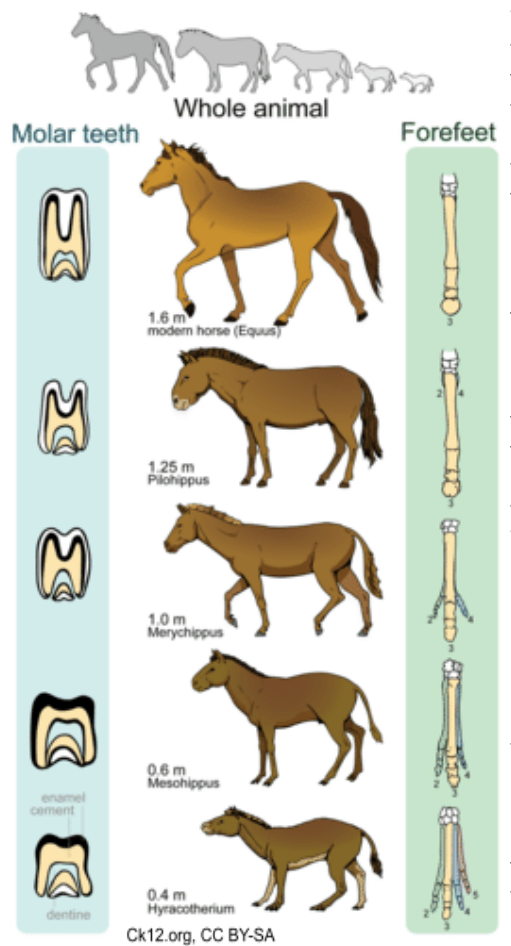
Evolution of the horse: changes in molar teeth, whole-animal size, and forefeet from Hyracotherium to the modern horse.
Evolution by Natural Selection
- Evolution is the change in the inherited characteristics of a population over many generations.
- Individuals in a species show a wide range of variation caused by differences in their genes.
- Individuals with characteristics most suited to their environment have a higher chance of survival and more opportunities to reproduce.
- The alleles that code for advantageous characteristics are passed to offspring more often than those for less suited characteristics.
- Over many generations, beneficial characteristics become more common in the population and the species changes — this is natural selection, often called 'survival of the fittest'.
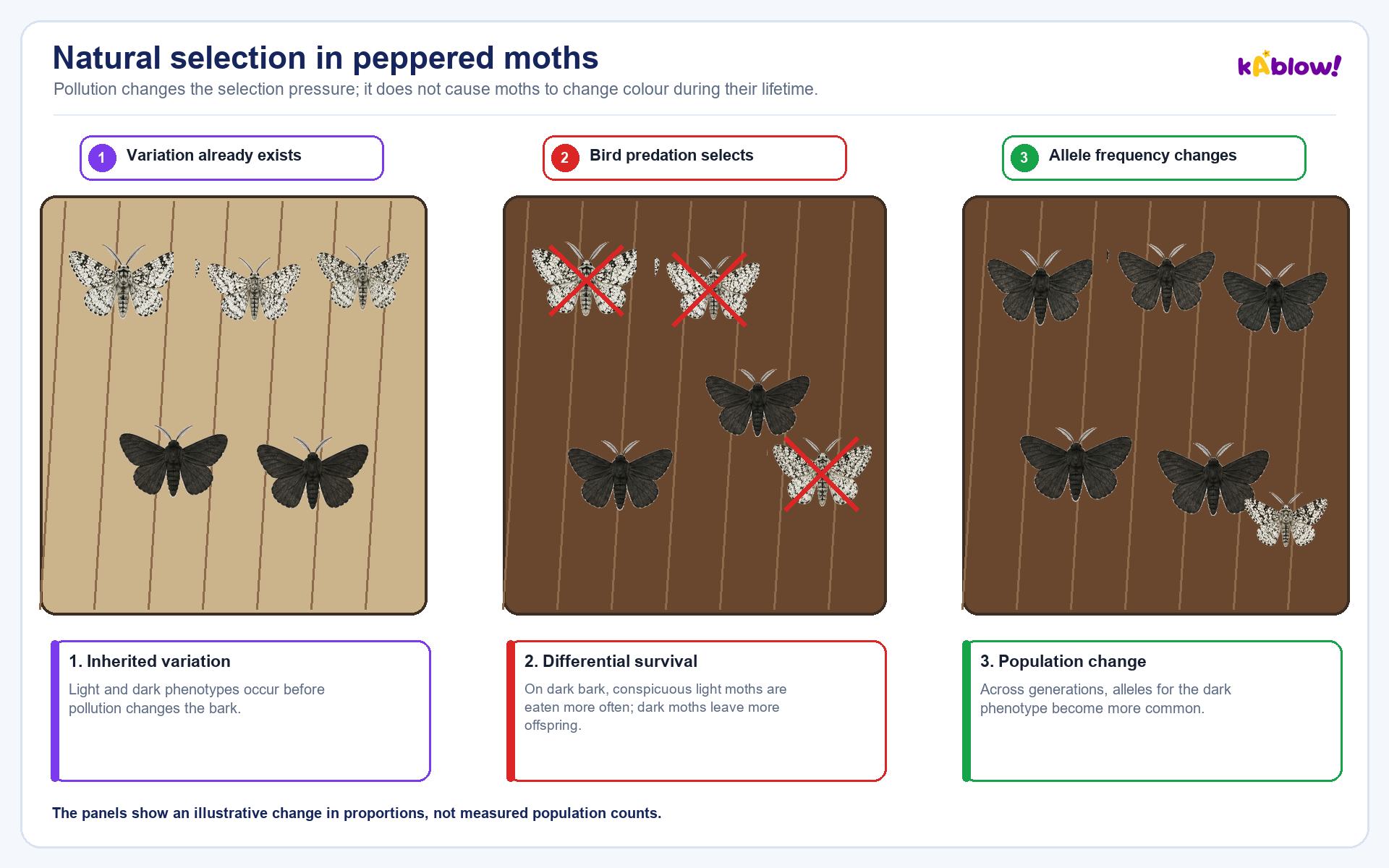
- An example is the peppered moth, where a mutation producing a different colour became advantageous as the environment changed.
Natural selection in peppered moths
Why Evolution Was Gradually Accepted
- The theory of evolution by natural selection was only gradually accepted because it was controversial and challenged the idea that God made all living things.
- At the time it was published, there was insufficient evidence to convince many scientists.
- The mechanism of inheritance and variation was not known until about 50 years after the theory was published.
- The theory developed over time from information gathered by many scientists.
- Jean-Baptiste Lamarck proposed an earlier theory that changes occurring during an organism's lifetime can be inherited — we now know this type of inheritance cannot occur in the vast majority of cases.
- Lamarck suggested giraffes stretched their necks to reach high leaves and passed on the elongated neck, but this is incorrect.
Speciation
- Speciation is the process by which new species form.
- A new species is formed when populations become so different that they can no longer interbreed to produce fertile offspring.
- Speciation occurs through a combination of isolation and natural selection.
- Geographic isolation happens when a physical barrier (such as a new river or mountain range) separates populations of the same species.
- The environments on either side of the barrier differ, creating different selection pressures.
- Natural selection causes different characteristics to become more common in each isolated population.
- Over many generations, the populations become so distinct that they can no longer interbreed — they are now separate species.
Mendel and the Understanding of Genetics
- Gregor Mendel was an Austrian monk who carried out breeding experiments on pea plants in the mid-19th century.
- Mendel discovered that inheritance of each characteristic is determined by 'units' that are passed to descendants unchanged.
- He showed that some characteristics are dominant (e.g. tall pea plants) and others recessive (e.g. short pea plants).
- Mendel's work provided the foundation for modern genetics but was not recognised until after his death.
- His studies were totally new to science and there was no knowledge of the mechanisms behind his findings (DNA, genes and chromosomes had not been discovered).
- In the late 19th and early 20th centuries, scientists observed that chromosomes behaved like Mendel's 'units', leading to the idea that the units (now called genes) were located on chromosomes.
- In 1953, the structure of DNA was determined and the mechanism of gene function was worked out, leading to the development of gene theory.
Evidence for Evolution: Fossils
- Fossils are the remains of organisms from millions of years ago, found in rocks.
- Fossils can form from parts of organisms that have not decayed because conditions needed for decay were absent.
- Fossils can also form when parts of the organism are replaced by minerals as they decay.
- Fossils can be preserved traces of organisms, such as footprints, burrows and rootlet traces.
- The fossil record is incomplete because many early life forms were soft-bodied and left few traces, and geological activity (such as tectonic plate movements) destroyed many traces.
- This is why scientists cannot be certain about how life began on Earth.
- Fossils show how much or how little different organisms have changed as life developed on Earth.
Evidence for Evolution: Resistant Bacteria
- Antibiotics are chemicals that kill or inhibit the growth and reproduction of bacteria.
- Bacteria reproduce rapidly (on average every 20 minutes), so evolution occurs in a much shorter time span.
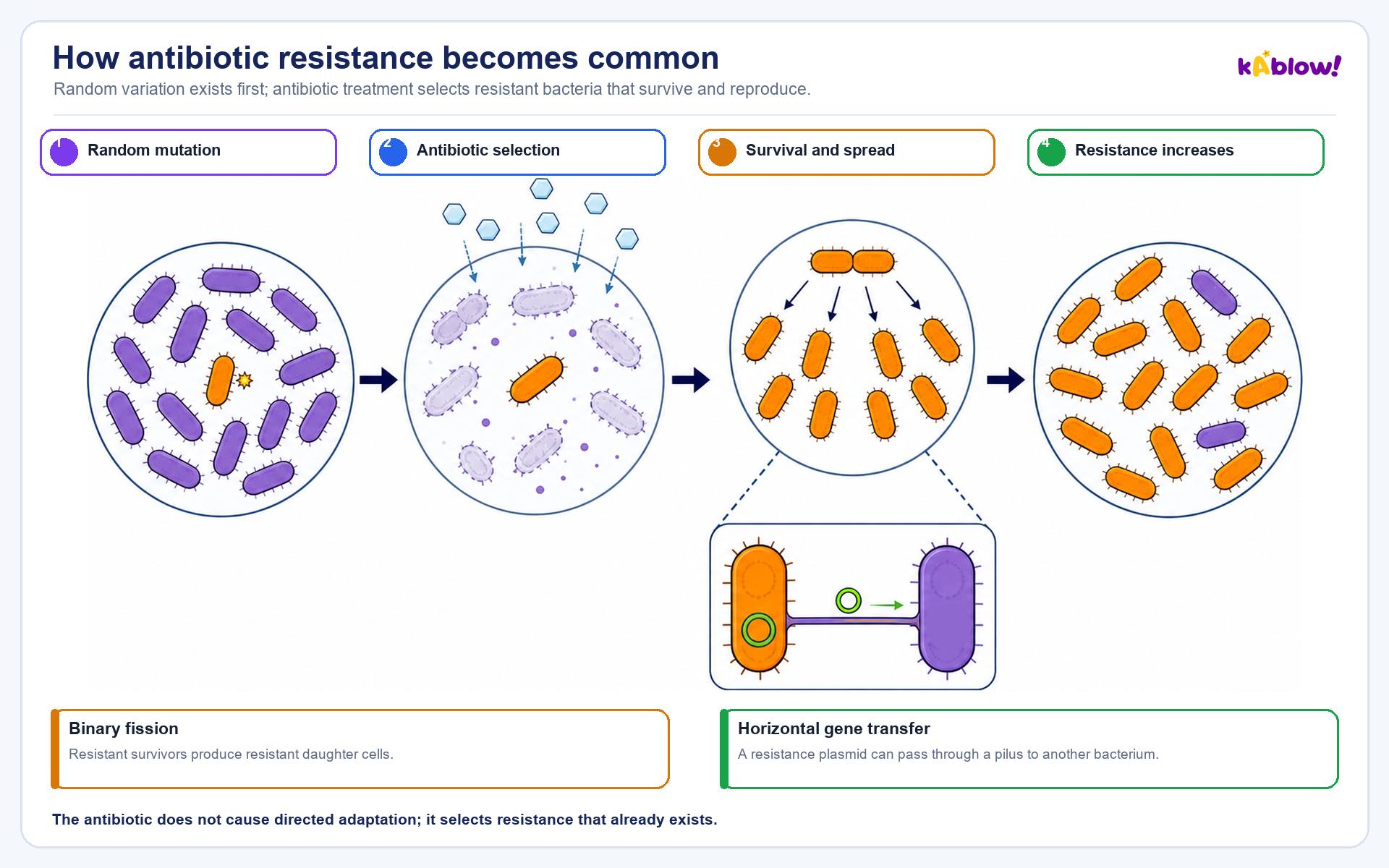
- Random mutations in bacterial DNA can cause some bacteria to become resistant to an antibiotic.
- When the population is treated with the antibiotic, resistant bacteria survive and reproduce with less competition from non-resistant bacteria.
- The genes for antibiotic resistance are passed on with much greater frequency to the next generation.
- Over time, the whole population becomes antibiotic-resistant — this is natural selection.
- MRSA is a dangerous strain of×Staphylococcus aureus×that is resistant to most antibiotics and is difficult to treat.
Reducing the Development of Antibiotic Resistance
- Doctors should avoid prescribing antibiotics inappropriately, such as for viral infections or mild infections that the immune system will clear up.
- Patients should complete their full course of antibiotics so all bacteria are killed and none survive to mutate into resistant strains.
- The agricultural use of antibiotics should be restricted to reduce the spread of resistance.
- Good hygiene practices such as handwashing and hand sanitisers reduce the spread of resistant strains like MRSA in hospitals.
- Isolation of infected patients helps prevent the spread of resistant strains, especially in surgical wards.
- Developing new antibiotics is costly and slow, making it difficult to keep up with the emergence of new resistant strains.
Development of antibiotic resistance
Extinction
- Extinction occurs when there are no remaining individuals of a species still alive.
- Species that are poorly adapted to their environment are less likely to survive and reproduce.
- If a species cannot survive and reproduce sufficiently to maintain its population numbers, it will eventually go extinct.
- Factors that may contribute to extinction include environmental changes, new predators, new diseases, and competition for resources.
- Human activities have massively increased extinction rates in recent history — humans have hunted many species to extinction (e.g. the dodo) and compete for resources such as space, food and water.
Evidence for Evolution: The Pentadactyl Limb
- A pentadactyl limb is any limb with five digits (fingers or toes).
- Pentadactyl limbs are found in many species across mammals, reptiles and amphibians.
- In different species, the pentadactyl limb has a similar bone structure but may fulfil quite different functions (e.g. human hand for handling tools, bat wing for flight).
- Although the individual bones differ in shape and size, their layout is almost exactly the same.
- This similarity provides strong evidence that these groups all evolved from a common ancestor — their limbs would have very different structures if they had evolved from different ancestors.
Diapos
Sign up free to view the lesson slides
Step through every slide for this topic — plus flashcards and revision notes — with a free account.
Questions d'entraînement
Aperçu gratuit — 8 sur 61 questions. Inscris-toi pour toutes les voir.
1.Which scientist independently developed the theory of evolution by natural selection after travelling the world and gathering evidence?
Easy- AGregor Mendel
- BAlfred Russel Wallace
- CCarl Woese
- DJean-Baptiste Lamarck
2.Which of the following best defines evolution?
Easy- AA change in an individual organism during its lifetime
- BA change in the frequency of a phenotype in a population over many generations
- CThe extinction of a species that is poorly adapted to its environment
- DThe formation of a new species from two existing species
3.The theory of evolution by natural selection was immediately and widely accepted by scientists when Darwin published it.
EasyTrue or false?
4.Which of the following statements about Darwin's theory of evolution by natural selection are correct? (select all that apply)
Medium- AIndividuals in a species show a wide range of variation caused by differences in genes.
- BIndividuals with characteristics most suited to the environment have a higher chance of survival and more chances to reproduce.
- CCharacteristics acquired during an organism's lifetime are always passed on to offspring.
- DOver many generations, beneficial characteristics become more common in the population.
- EOnly the strongest individuals survive, regardless of whether their characteristics suit the environment.
5.Which scientist proposed a theory of evolution based on the idea that changes occurring in an organism during its lifetime can be inherited?
Medium- ACharles Darwin
- BAlfred Russel Wallace
- CJean-Baptiste Lamarck
- DGregor Mendel
6.What is speciation?
Medium- AThe extinction of a species due to environmental change
- BThe process by which a new species is formed
- CThe movement of individuals from one population to another
- DThe change in an individual organism over its lifetime
7.Place the steps of speciation in the correct order.
Medium- Populations become isolated by a physical barrier
- Different selection pressures act on each population
- Natural selection causes different characteristics to become more common in each population
- Populations become unable to interbreed and produce fertile offspring
8.What causes bacteria to become resistant to antibiotics?
Easy- ABacteria learn to avoid the antibiotic after exposure
- BRandom mutations in bacterial DNA produce resistance
- CAntibiotics cause bacteria to mutate deliberately
- DBacteria inherit resistance from human cells
Unlock all 61 questions, flashcards & more
Crée un compte gratuit pour voir toutes les questions, les diapos, les cartes mémo et les notes de révision de ce thème.