A simple model of the atom, symbols, relative atomic mass, electronic charge and isotopes
Apprends en jouant
Réponds à ces questions pour gagner de l'énergie, puis pêche et explore. Sans compte.
Notes de leçon
Atoms and Elements
- All substances are made of tiny particles called atoms.
- An atom is the smallest part of an element that can exist.
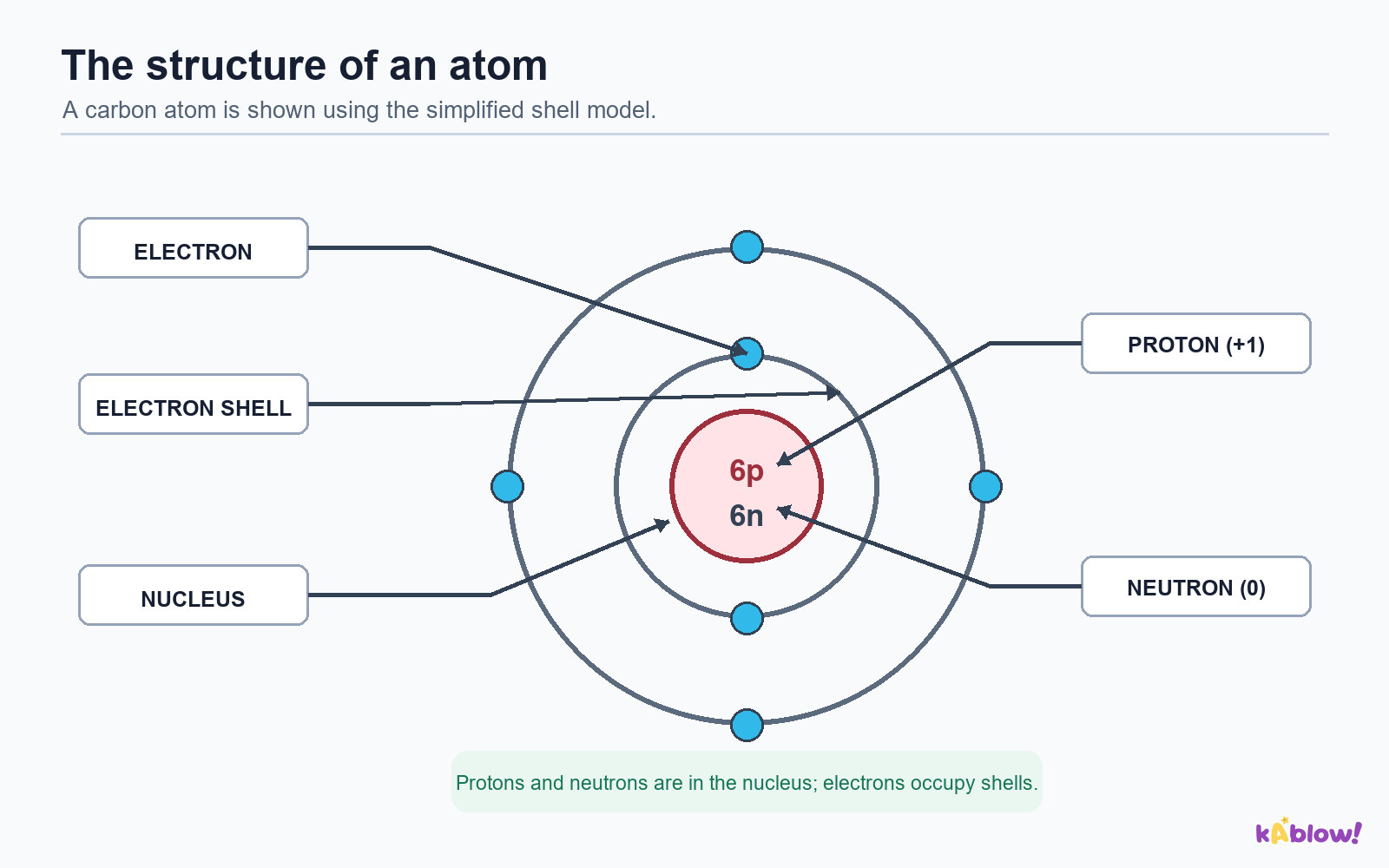
- Each atom consists of a central nucleus containing protons and neutrons, with electrons orbiting in shells.
- An element is a pure substance made of only one type of atom.
- Each element has a unique chemical symbol, e.g. O for oxygen, Na for sodium.
- There are about 100 different elements, shown in the periodic table.
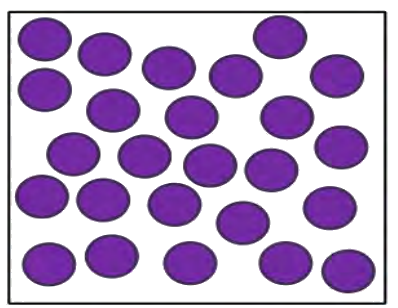
A collection of identical atoms representing an element
Atomic Structure and Symbols
- The atomic number (Z) is the number of protons in an atom's nucleus; it is unique to each element.
- The mass number (A) is the total number of protons and neutrons in the nucleus.
- In a neutral atom, the number of electrons equals the number of protons.
- Atoms have no overall charge because the positive protons and negative electrons balance.
- Chemical symbols are written with the mass number as a superscript and atomic number as a subscript, e.g. ¹²₆C for carbon-12.
- For ions, the number of electrons changes but the number of protons stays the same.
The structure of an atom
Relative Mass and Charge of Subatomic Particles
- Protons have a relative charge of +1 and a relative mass of 1.
- Neutrons have a relative charge of 0 and a relative mass of 1.
- Electrons have a relative charge of –1 and a relative mass of about 1/1836 (negligible).
- Almost all of the mass of an atom is concentrated in the nucleus.
- The nucleus is very small compared to the overall size of the atom: radius of atom ~0.1 nm, nucleus <1/10,000 of that.
Isotopes
- Isotopes are atoms of the same element with the same number of protons but different numbers of neutrons.
- Isotopes have the same atomic number but different mass numbers.
- The chemical properties of isotopes are the same because they have the same electron arrangement.
- For example, carbon-12 and carbon-13 are isotopes of carbon.
- The relative atomic mass of an element is the average mass of its isotopes, taking into account their abundances.
Calculating Relative Atomic Mass
- Relative atomic mass (Ar) is the weighted average mass of the isotopes of an element compared to 1/12 the mass of a carbon-12 atom.
- It is calculated using the formula: Ar = (mass of isotope 1 × abundance 1 + mass of isotope 2 × abundance 2 + …) / total abundance.
- Abundances are often given as percentages.
- For example, chlorine has isotopes ³⁵Cl and ³⁷Cl in abundances 75% and 25%, giving Ar = (35×75 + 37×25)/100 = 35.5.
- Relative atomic mass is not always a whole number because it is an average.
Electronic Structure
- Electrons occupy energy levels (shells) around the nucleus.
- The first shell can hold up to 2 electrons; the second and third shells can hold up to 8 electrons each.
- Electrons fill the lowest available energy levels first (innermost shells).
- The electronic structure can be written as numbers, e.g. sodium (2,8,1) or shown in a diagram.
- The number of electrons in the outer shell determines the element's chemical properties.
Development of the Atomic Model
- Early models described atoms as solid spheres that could not be divided.
- J.J. Thomson discovered the electron in 1897 and proposed the plum pudding model: a ball of positive charge with negative electrons embedded in it.
- Rutherford's α scattering experiment showed that most α particles passed straight through gold foil, but some were deflected or bounced back.
- This led to the nuclear model: a tiny, dense, positively charged nucleus at the centre, with electrons orbiting outside.
- Niels Bohr improved the nuclear model by suggesting electrons orbit in fixed shells at specific distances.
- James Chadwick later provided evidence for neutrons in the nucleus.
Size and Scale of Atoms
- Atoms have a radius of about 0.1 nm (1 × 10⁻¹⁰ m).
- The nucleus is less than 1/10,000 of the atom's radius (about 1 × 10⁻¹⁴ m).
- This means most of an atom is empty space.
- The mass of an atom is concentrated in the nucleus.
- The prefix nano means 10⁻⁹.
Diapos
Sign up free to view the lesson slides
Step through every slide for this topic — plus flashcards and revision notes — with a free account.
Questions d'entraînement
Aperçu gratuit — 8 sur 55 questions. Inscris-toi pour toutes les voir.
1.Which subatomic particles led to J.J. Thomson's plum pudding model?
Easy- Aprotons
- Bneutrons
- Celectrons
- Dnucleus
2.The diagram shows the structure of an atom using the current model of the atom. How does this diagram show that this is an atom of lithium?
Easy- Ait has three electrons
- Bit has three protons
- Cit has three protons and two neutrons
- Dit has two neutrons
3.Which of these statements is correct about atoms?
Easy- Aelectrons are positively charged
- Bthe number of protons is equal to the number of neutrons
- Cmost of the mass of an atom is concentrated in the nucleus
- Delectrons are found in the nucleus
4.Match each subatomic particle to its relative charge.
Medium- proton
- neutron
- electron
- +1
- 0
5.Atoms are made up of subatomic particles. Which statement about subatomic particles is true?
Medium- ANeutrons and electrons are found in the nucleus. Protons are found in shells.
- BProtons and neutrons are found in the nucleus. Electrons are found in shells.
- CProtons and electrons are found in the nucleus. Neutrons are found in shells.
- DNeutrons are found in the nucleus. Protons and electrons are found in shells.
6.The nucleus is very small compared to the overall size of an atom.
EasyTrue or false?
7.The nucleus is larger than the atom.
EasyTrue or false?
8.Which two statements best describe what the gold foil experiment revealed about the structure of the atom? (select all that apply)
Medium- AThe nucleus is positively charged
- BElectrons are evenly distributed throughout the atom
- CThe nucleus is small and contains most of the atom's mass
- DProtons and neutrons are evenly distributed
- EThe atom is a solid sphere that cannot be divided
Unlock all 55 questions, flashcards & more
Crée un compte gratuit pour voir toutes les questions, les diapos, les cartes mémo et les notes de révision de ce thème.