Chemical bonds, ionic, covalent and metallic
Apprends en jouant
Réponds à ces questions pour gagner de l'énergie, puis pêche et explore. Sans compte.
Notes de leçon
Chemical Bonds
- Atoms combine with other atoms by moving electrons, which can be thought of as the 'language of chemistry'.
- Atoms bond to achieve a full outer shell of electrons, which gives a more stable arrangement.
- There are three types of strong chemical bond studied at GCSE: ionic, covalent and metallic.
- Ionic bonding occurs when metals and non-metals react by transferring electrons, forming oppositely charged ions that attract via electrostatic forces.
- Covalent bonding occurs when non-metal atoms share pairs of electrons.
- Metallic bonding occurs in metals and alloys, where atoms share delocalised electrons.
- Intermolecular forces are not chemical bonds; they are much weaker (about one-tenth the strength of a chemical bond) and do not involve electron transfer or sharing.
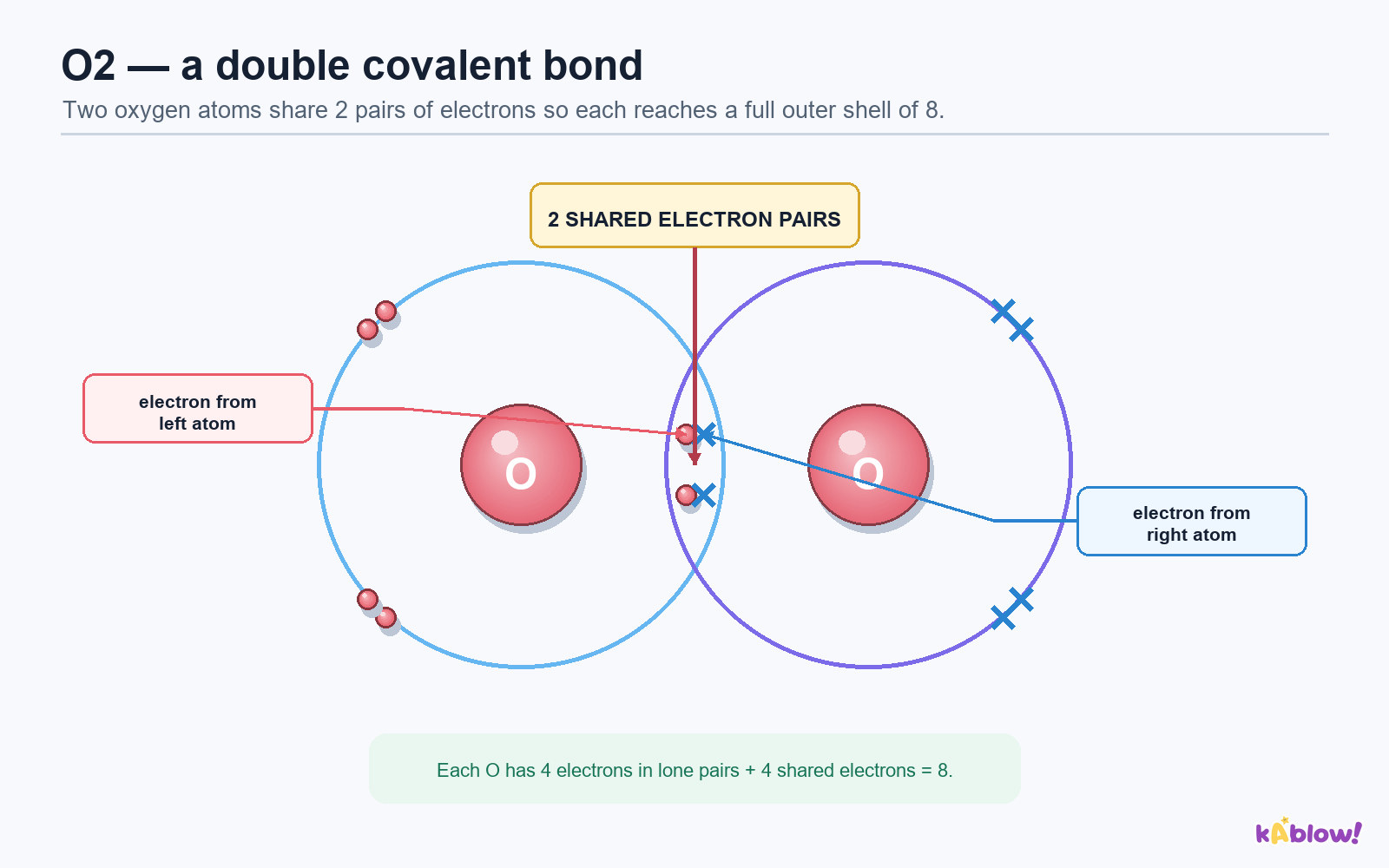
O₂ dot-and-cross diagram: a double covalent bond formed by two shared pairs of electrons.
Ionic Bonding
- Ionic bonding is the strong electrostatic force of attraction between oppositely charged ions.
- It forms when a metal atom transfers one or more electrons to a non-metal atom.
- Metal atoms lose electrons to become positive ions (cations); non-metal atoms gain electrons to become negative ions (anions).
- Ions form to obtain a full outer shell, giving them the electronic structure of a noble gas.
- The charge on an ion relates to its group number: Group 1 metals form 1+ ions, Group 2 metals form 2+ ions, Group 6 non-metals form 2− ions, and Group 7 non-metals form 1− ions.
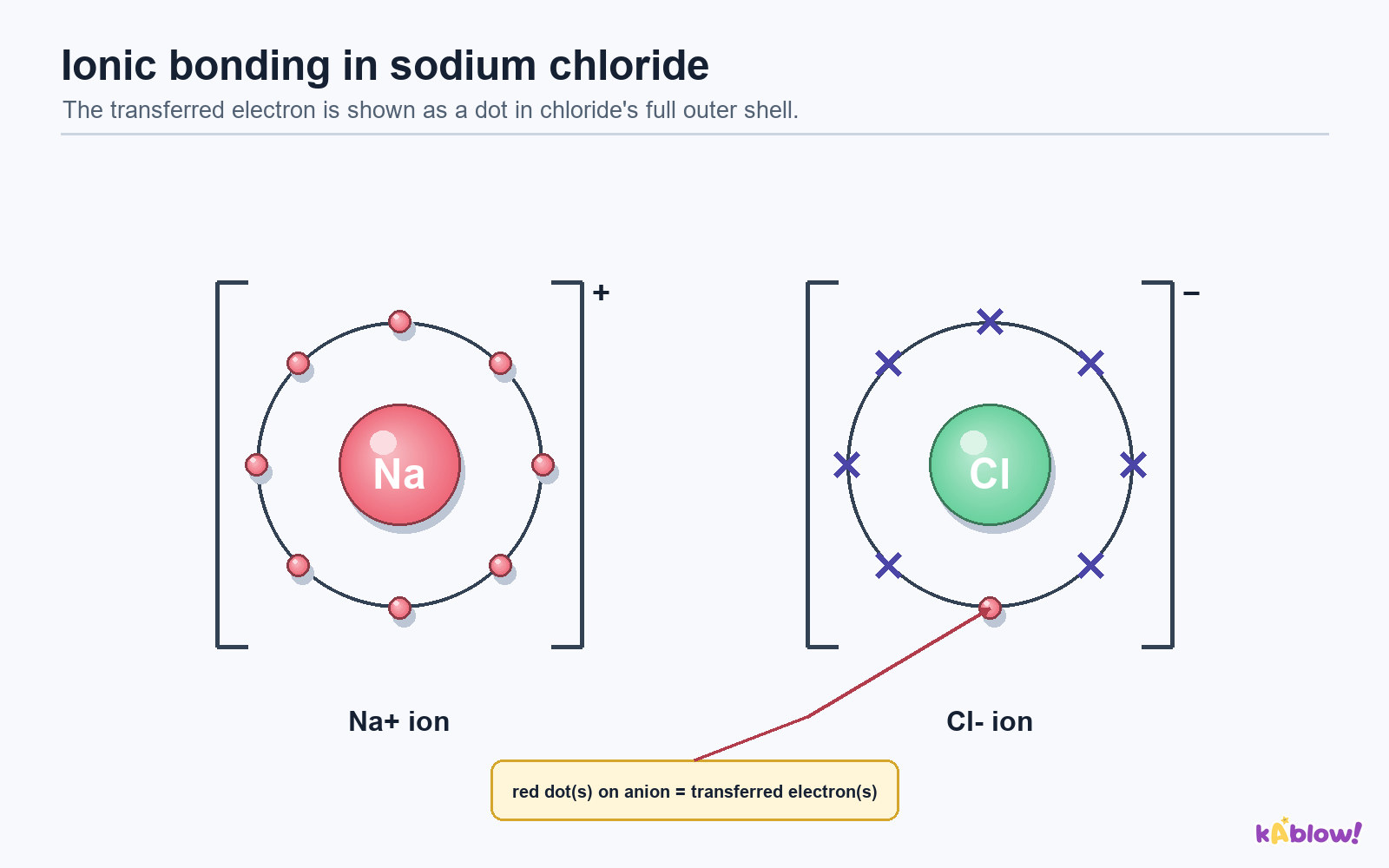
- In dot and cross diagrams for ionic compounds, each ion is enclosed in square brackets with its charge written as a superscript at the top right.
- For example, sodium (Group 1) loses one electron to form Na⁺, and chlorine (Group 7) gains one electron to form Cl⁻, giving the formula NaCl.
- Magnesium (Group 2) loses two electrons to form Mg²⁺, and oxygen (Group 6) gains two electrons to form O²⁻, giving the formula MgO.
Ionic bonding in sodium chloride.
Ionic Compounds
- Ionic compounds form giant ionic lattices – regular arrangements of alternating positive and negative ions tightly packed together.
- Strong electrostatic forces of attraction act in all directions between oppositely charged ions, holding the lattice together.
- Because many strong electrostatic forces must be overcome, ionic compounds have high melting and boiling points.
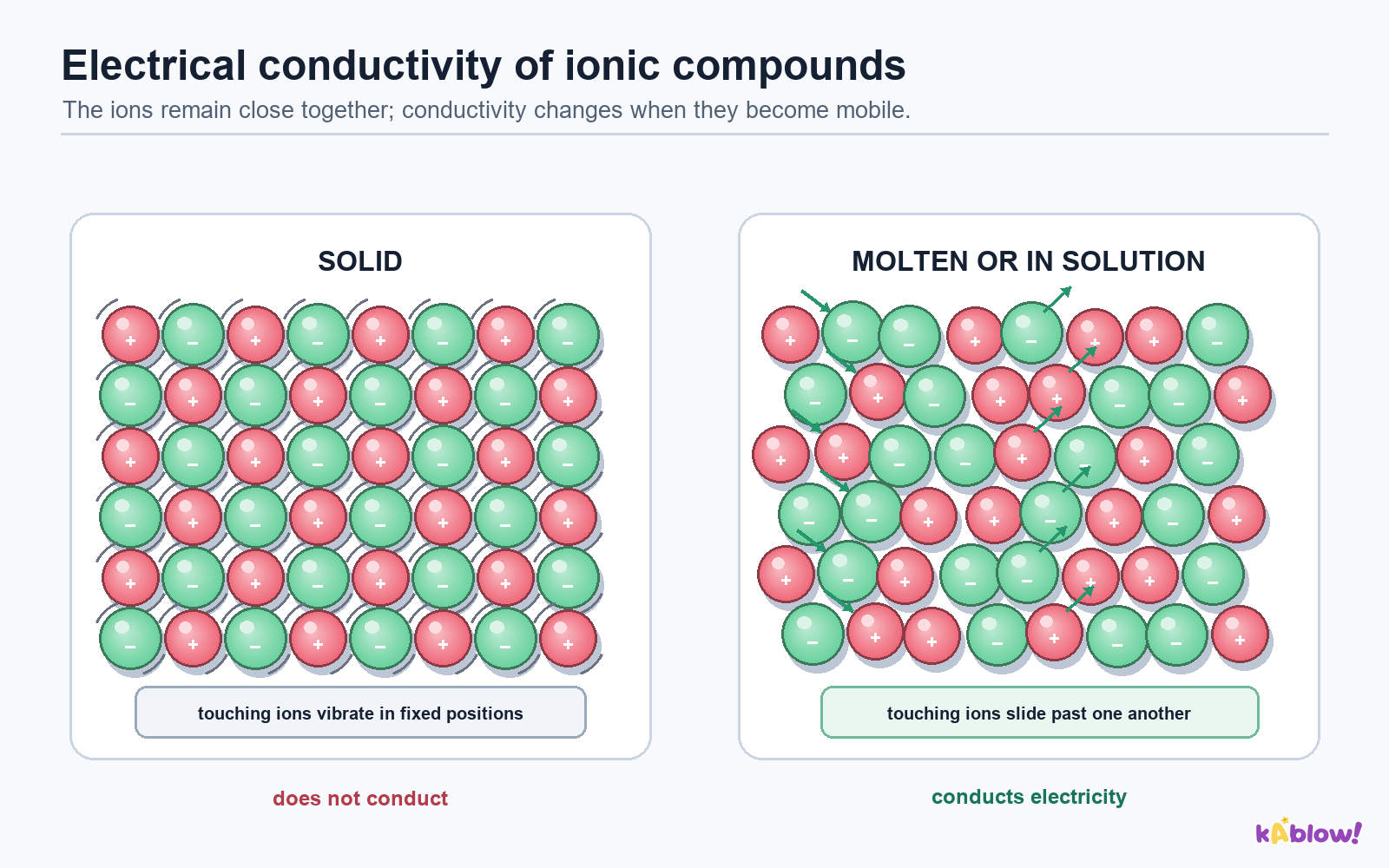
- Solid ionic compounds do not conduct electricity because the ions are fixed in position; when molten or aqueous, the ions are free to move and carry charge, so they conduct.
- 3D ball and stick models show the arrangement of ions in space but represent ionic bonds as sticks; in reality, ionic bonds are electrostatic forces acting in all directions.
- The 3D space-filling model is more accurate because it shows that there is little space between ions.
- All models have limitations: they may not correctly represent relative ion sizes or the true nature of the electrostatic forces.
Electrical conductivity of ionic compounds
Covalent Bonding
- Covalent bonding occurs when non-metal atoms share pairs of electrons to obtain a full outer shell.
- Covalent bonds are very strong and form due to the electrostatic attraction between the shared pair of electrons and the positive nuclei of both atoms.
- When two or more atoms are covalently bonded, they form a molecule.
- Shared electrons are called bonding electrons; outer-shell electrons not involved in bonding are called non-bonding electrons.
- Weak intermolecular forces exist between individual molecules; these are much weaker than covalent bonds.
- Simple covalent molecules do not conduct electricity because they do not contain free electrons.
- Covalent substances may consist of small molecules (e.g. H₂, H₂O, CO₂) or giant covalent structures (e.g. diamond, graphite, silicon dioxide).
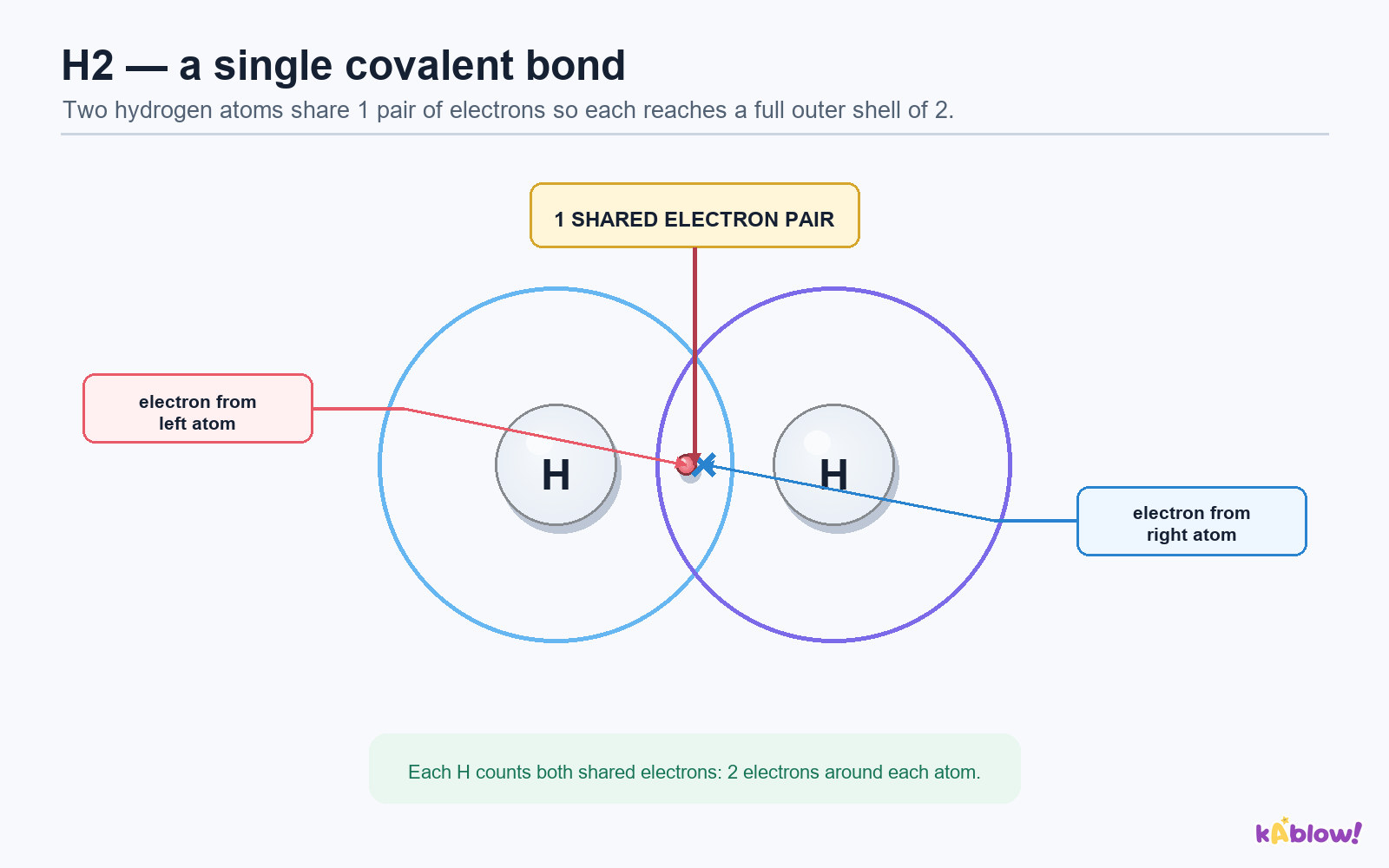
H₂ dot-and-cross diagram: single covalent bond formed by one shared pair of electrons.
Dot and Cross Diagrams for Covalent Molecules
- Dot and cross diagrams show how electrons are shared in covalent molecules.
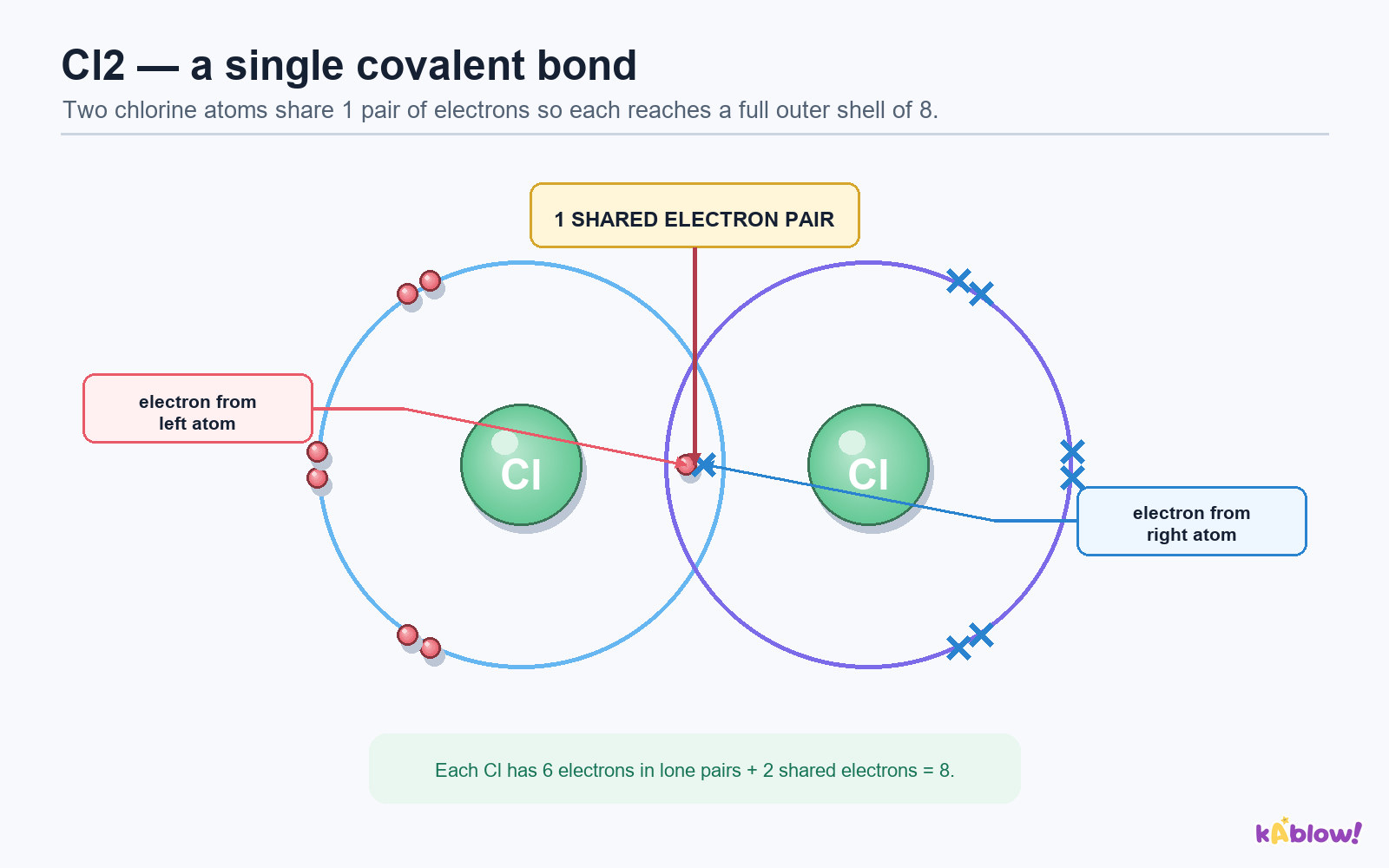
- You need to be able to draw dot and cross diagrams for: hydrogen (H₂), chlorine (Cl₂), oxygen (O₂), nitrogen (N₂), hydrogen chloride (HCl), water (H₂O), ammonia (NH₃) and methane (CH₄).
- Only outer-shell electrons are shown; for example, chlorine has 7 outer electrons, not all 17.
- The shared pair of electrons must be drawn in the overlapping region between the two atoms.
- In water (H₂O), oxygen has 6 outer electrons; it shares 2 with hydrogen atoms, leaving 4 non-bonding electrons (2 lone pairs).
- In methane (CH₄), carbon has 4 outer electrons, all of which are shared with four hydrogen atoms.
- A double bond contains two pairs of electrons (4 electrons in total).
Cl₂ dot-and-cross diagram: single covalent bond formed by one shared pair of electrons.
Metallic Bonding
- Metals consist of giant structures of atoms arranged in a regular pattern, sometimes called metallic lattices.
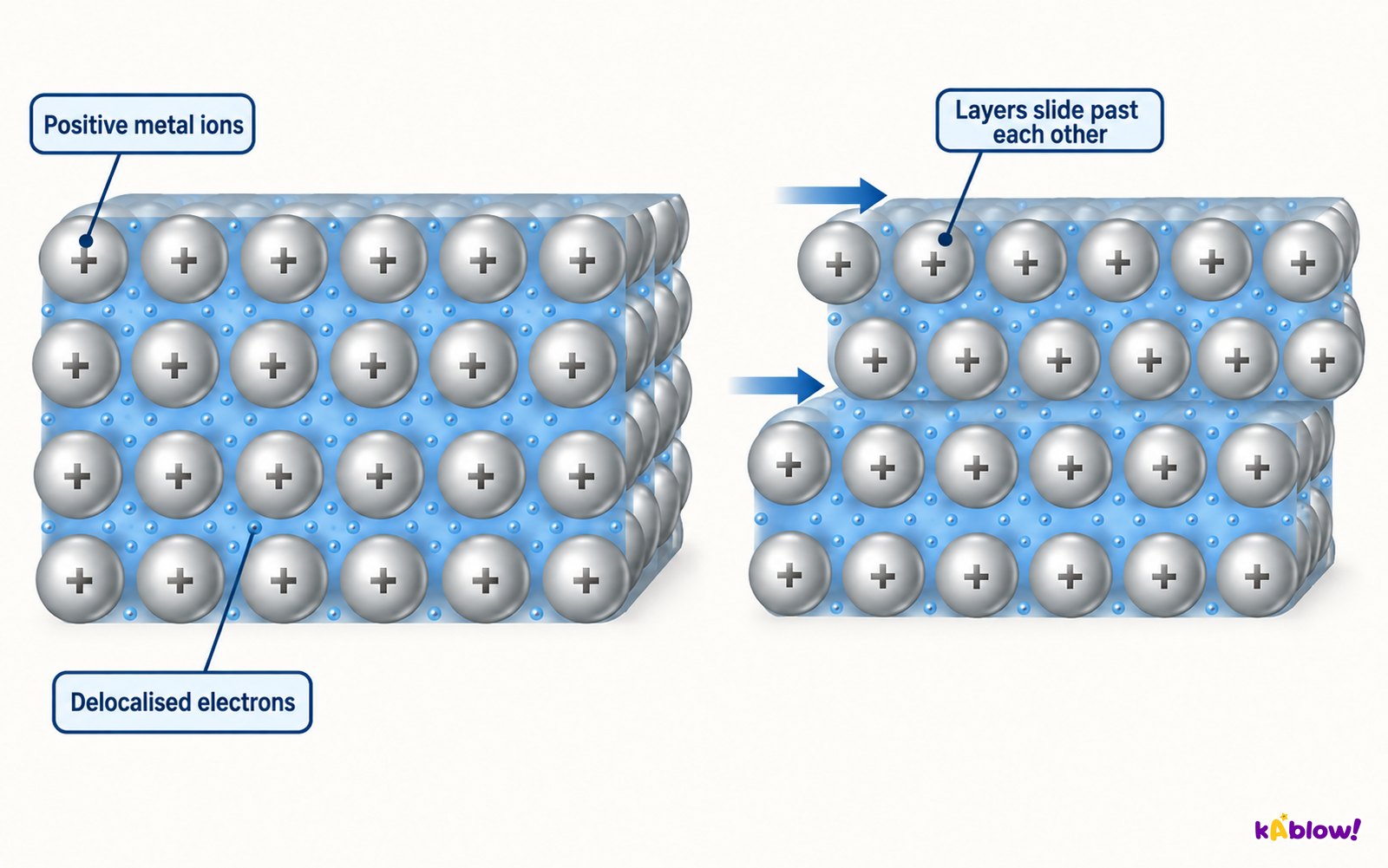
- The outer-shell electrons of metal atoms are delocalised – free to move throughout the whole structure.
- When electrons leave the outer shell, the remaining atoms become positively charged metal ions.
- The delocalised electrons form a 'sea of electrons' that moves freely between the positive metal ions.
- Metallic bonding is the strong electrostatic attraction between the positive metal ions and the sea of delocalised electrons.
- This type of bonding occurs in pure metals and in alloys (mixtures of metals).
- Delocalised electrons are not transferred as in ionic bonding; they move freely throughout the entire metallic lattice.
Metallic bonding and malleability
Representing Molecules and Structures
- Dot and cross diagrams are useful for showing the sharing or transfer of electrons and indicating which atom the electrons come from, but they do not show 3D arrangement or relative sizes.
- Ball and stick models show the arrangement of atoms in 3D space and are useful for visualising molecular shape, but they do not show electron movement and exaggerate the space between atoms.
- 2D displayed formulae are simple representations that show which atoms are present and how they are connected, but they do not show shape or relative sizes.
- Empirical formula gives the simplest whole-number ratio of atoms of each element in a compound.
- To find empirical formula from a diagram: count the atoms of each element, write the ratio, and simplify to the smallest whole numbers.
- For example, ethene (C₂H₄) has an empirical formula of CH₂; methane (CH₄) has an empirical formula of CH₄ (already simplest).
- Polymers are very large molecules made from many smaller repeating units joined by covalent bonds (e.g. polyethene, PVC).
Sizes of Atoms and Molecules
- An atom is typically about 0.1 nanometres (nm) in size, which is 0.0000000001 m or 10⁻¹⁰ m.
- Simple molecules contain only a few atoms, so their sizes are similar to those of atoms.
- The smallest molecule is hydrogen (H₂), which is about 0.074 nm long (7.4 × 10⁻¹¹ m).
- Electron microscopy can produce images of individual atoms and simple molecules.
- For example, pentacene (C₂₂H₁₄) was first imaged in 2009 using atomic force microscopy.
Key Terminology and Common Misconceptions
- Ionic bond: strong electrostatic attraction between oppositely charged ions.
- Covalent bond: strong bond formed when atoms share pairs of electrons.
- Metallic bond: strong electrostatic attraction between positive metal ions and delocalised electrons.
- Cation: positive ion formed when an atom loses electrons. Anion: negative ion formed when an atom gains electrons.
- Lattice: regular repeating arrangement of particles (ions in ionic compounds, atoms in metals).
- Avoid saying atoms 'want' or 'need' a full outer shell; instead, say they achieve a full outer shell to become more stable.
- Do not describe ionic bonding as sharing electrons – it involves transfer of electrons.
- Do not confuse intermolecular forces with covalent bonds; intermolecular forces are weak and between molecules, while covalent bonds are strong and within molecules.
Diapos
Sign up free to view the lesson slides
Step through every slide for this topic — plus flashcards and revision notes — with a free account.
Questions d'entraînement
Aperçu gratuit — 8 sur 63 questions. Inscris-toi pour toutes les voir.
1.Which type of bonding is found in methane?
Easy- AIonic
- BCovalent
- CMetallic
- DHydrogen
2.Which of the following statements about a chlorine molecule are correct? (select all that apply)
Easy- AA chlorine molecule has the formula Cl₂
- BChlorine is bonded metallically
- CAtoms are typically 0.1 nanometres in size
- DChlorine is a solid at room temperature
- EChlorine atoms share a pair of electrons
3.Hydrogen gas has the same type of bonding as chlorine. Why is hydrogen a gas at room temperature?
Easy- AThe intermolecular forces are strong
- BThe bonding in hydrogen is weak
- CThe intermolecular forces are weak
- DThe covalent bonds are broken
4.What is the correct electronic configuration of a chlorine atom?
Easy- A2.7
- B2.8.7
- C2.8.8.7
- D2.7.8
5.Which of these oxides contains covalent bonds?
Medium- AAluminium oxide
- BCarbon dioxide
- CSodium oxide
- DLead oxide
6.When water boils, the covalent bond between the atoms is broken.
MediumTrue or false?
7.What is formed when a hydrogen atom and a chlorine atom join together?
Easy- AA hydrogen chloride atom
- BA hydrogen chlorine molecule
- CA hydrogen chloride molecule
- DA hydrogen chlorine ion
8.What is the size of a typical atom?
Easy- A0.1 nm
- B0.1 μm
- C0.1 mm
- D0.1 cm
Unlock all 63 questions, flashcards & more
Crée un compte gratuit pour voir toutes les questions, les diapos, les cartes mémo et les notes de révision de ce thème.