Synthetic and naturally occurring polymers
Apprends en jouant
Réponds à ces questions pour gagner de l'énergie, puis pêche et explore. Sans compte.
Notes de leçon
What Are Polymers?
- Polymers are very large molecules with a high relative molecular mass.
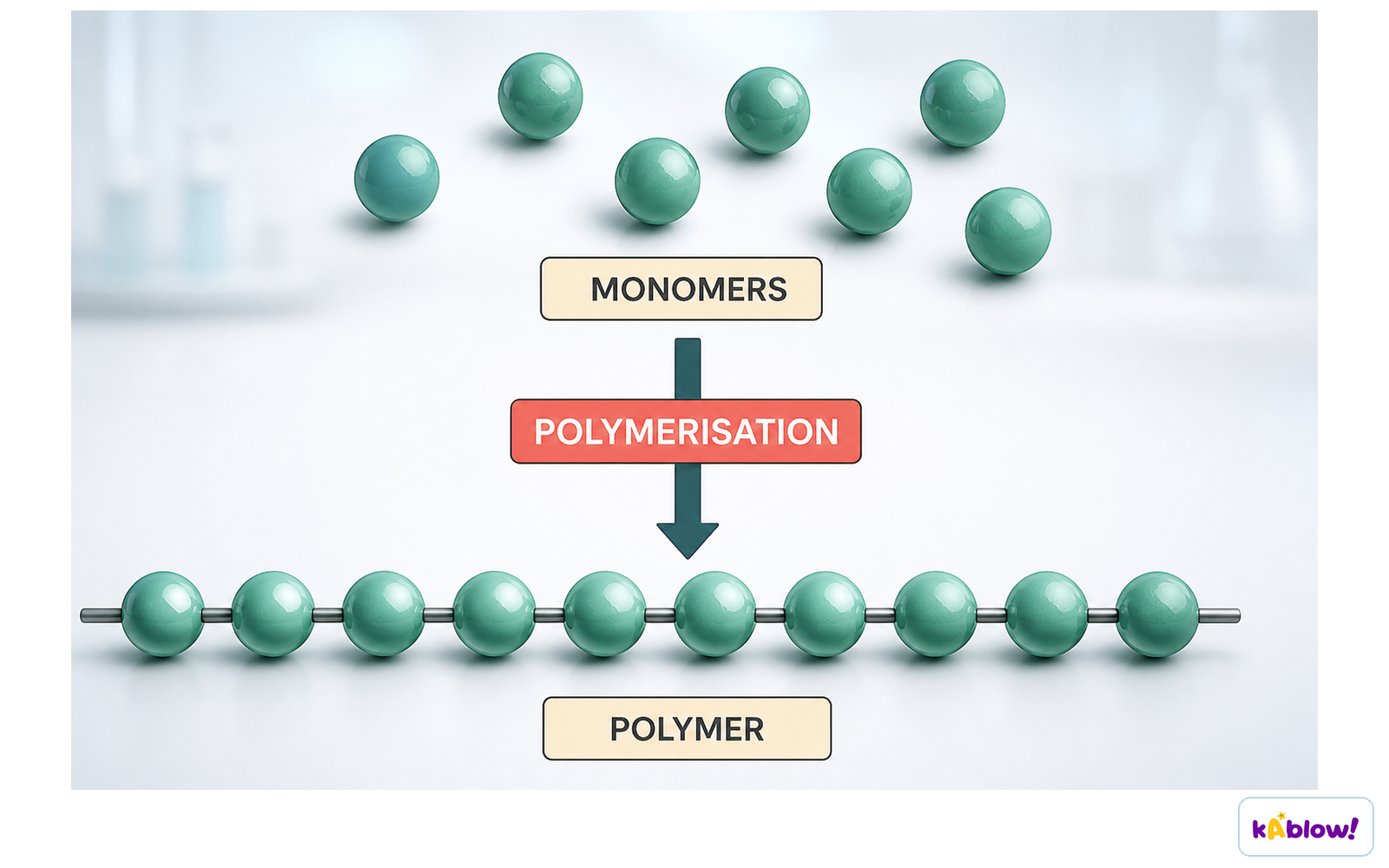
- They are made by joining together many small molecules called monomers.
- Each monomer becomes a repeat unit in the polymer chain.
- Monomers are connected to neighbouring units by strong covalent bonds.
- Polymerisation reactions usually need high pressure and a catalyst.
- Synthetic polymers are manufactured by humans, e.g. plastics, polystyrene cups and nylon.
- Natural (biological) polymers are produced by living things, e.g. DNA, proteins, starch and cellulose.
Monomers joining to form a polymer
Addition Polymerisation
- Addition polymerisation happens when many monomers join together to form one large polymer molecule only.
- It only occurs in monomers that contain a C=C double bond, such as alkenes.
- One bond in each C=C breaks, allowing the monomer to bond to the next monomer.
- The polymer formed contains single bonds only — no double bond remains in the repeat unit.
- The repeat unit has exactly the same atoms as the monomer because no other molecule is formed.
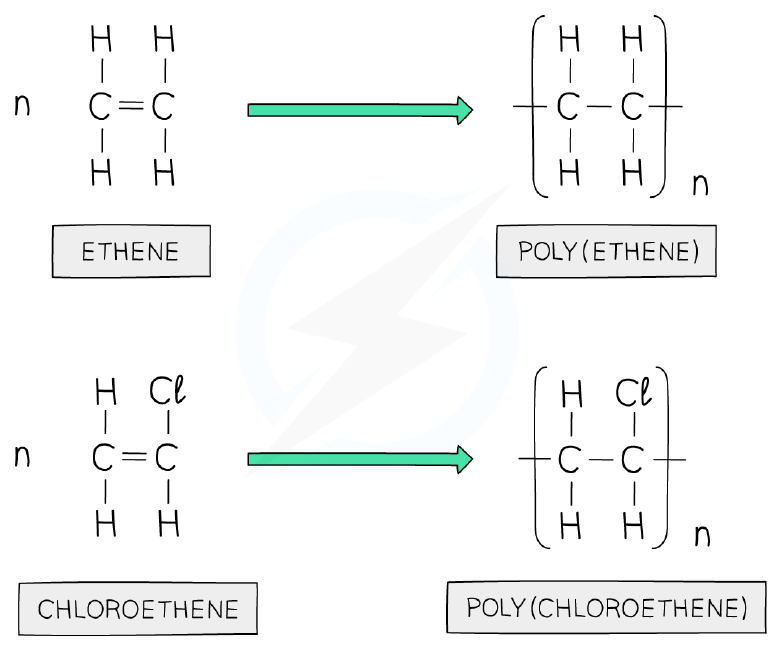
- Poly(ethene) (polythene) is made by addition polymerisation of ethene monomers.
- Other examples include poly(propene), poly(chloroethene) (PVC) and poly(tetrafluoroethene) (PTFE).
- The polymer is named by putting the monomer name in brackets and adding the prefix poly-.
Addition polymerisation of ethene and chloroethene
Drawing Addition Polymers and Their Monomers
- To draw the repeat unit from a monomer, change the C=C double bond to a single bond.
- Add a bond to each end of the repeat unit — these extension bonds must go outside the brackets.
- Write a small subscript n at the bottom right to show a large number of repeat units.
- Keep the other groups in the same order as they were around the double bond in the monomer.
- To find the monomer from a polymer, identify the repeating unit and change its single bond back to a double bond.
- Remove the extension bonds and the subscript n — the n can be placed in front of the monomer.
- A common mistake is leaving a double bond in the repeat unit of an addition polymer — don't do this.
Condensation Polymerisation
- Condensation polymerisation joins two different monomers together and removes a small molecule, usually water.
- The monomers each have two functional groups, one at each end.
- The functional groups at the ends of one monomer react with those on the other monomer.
- This creates long chains of alternating monomers.
- For every new linkage formed, one small molecule (e.g. water) is lost.
- This is the key difference from addition polymerisation, which forms the polymer molecule only.
- Polyesters are condensation polymers made from a dicarboxylic acid (two -COOH groups) and a diol (two -OH groups).
- An example is terylene, made from dicarboxylic acid and diol monomers.
Ester Linkages in Polyesters
- Each -COOH group reacts with an -OH group on another monomer.
- An ester linkage is formed, with the loss of one water molecule per link.
- The water molecule is formed from an -H and an -OH group combining.
- The structure of a polyester can be shown using boxes to represent carbon chains.
- The bonding sequence is a mirror image at either end of the link, not a simple repetition of the link.
Problems with Polymers
- Polymers contain strong covalent bonds, making them unreactive and chemically inert.
- They do not easily biodegrade, so micro-organisms cannot break them down.
- Landfill disposal takes up valuable land and sites quickly fill up.
- Incineration releases a lot of heat energy and produces carbon dioxide, a greenhouse gas.
- Burning polymers that contain chlorine, such as PVC, releases toxic hydrogen chloride gas.
- Incomplete combustion can produce toxic carbon monoxide.
- Recycling requires different polymers to be separated, which is difficult and expensive.
Recycling Polymers: Advantages and Disadvantages
- Advantage: recycling is more economically viable than making polymers from scratch.
- Advantage: it decreases the use of crude oil, keeping it for other purposes.
- Advantage: it reduces greenhouse gas and toxic gas emissions from manufacturing.
- Advantage: it reduces the amount of landfill needed and creates employment.
- Disadvantage: sorting plastics by type is tedious, labour-intensive and costly.
- Disadvantage: production may be limited by what is collected as raw material.
- Disadvantage: melting polymers produces toxic gases harmful to plants and animals.
- Disadvantage: polymers can only be recycled a limited number of times before losing their properties.
Natural Polymers: DNA
- DNA (deoxyribonucleic acid) is a large molecule essential to all life.
- It encodes genetic instructions for the development and functioning of organisms and viruses.
- DNA is made from four different monomers called nucleotides.
- The nucleotides contain bases abbreviated A, T, C and G.
- The nucleotides form two strands that intertwine to give the double helix shape.
- The bases on the two chains pair up in specific sequences, forming cross links that hold the strands together.
- Genetic information is stored in the order of the bases, which acts as a code for the organism's genes.
Natural Polymers: Proteins, Starch and Cellulose
- Proteins are condensation polymers made from amino acid monomers.
- Amino acids contain an amine (-NH₂) group and a carboxylic acid (-COOH) group.
- Amino acids join by peptide links; one water molecule is lost per peptide link.
- Long chains of amino acids are called polypeptides; proteins are one or more polypeptide chains.
- Most proteins contain at least 20 different amino acids, and their order determines structure and properties.
- Examples of proteins and their functions: haemoglobin transports oxygen, antibodies protect against viruses and bacteria, enzymes are biological catalysts.
- Starch and cellulose are carbohydrates made from sugar monomers.
- Starch stores energy; cellulose is a stiff polymer used in plant cell walls for support.
Diapos
Sign up free to view the lesson slides
Step through every slide for this topic — plus flashcards and revision notes — with a free account.
Questions d'entraînement
Aperçu gratuit — 8 sur 50 questions. Inscris-toi pour toutes les voir.
1.Which small molecules join together in large numbers to form a polymer?
Easy- AMonomers
- BRepeat units
- CNucleotides
- DAmino acids
2.In an addition polymer, the repeating unit contains a carbon–carbon double bond.
EasyTrue or false?
3.Ethene can undergo polymerisation. What type of polymer does ethene form?
Easy- ACondensation
- BAddition
- CSubstitution
- DNeutralisation
4.PVC, poly(chloroethene), is a polymer formed from chloroethene. What type of polymer is poly(chloroethene)?
Easy- AAddition
- BCondensation
- CSubstitution
- DNatural
5.What type of bond is formed between the atoms in poly(chloroethene)?
Easy- AIonic
- BMetallic
- CCovalent
- DElectrostatic
6.Which of the following statements about addition polymerisation are correct? (select all that apply)
Medium- AIt forms the polymer molecule only.
- BIt forms a small molecule such as water.
- CIt occurs in monomers that contain C=C bonds.
- DThe polymer contains only single bonds.
- EIt requires two different monomers.
7.Which of these is the correct name for the polymer formed from propene?
Easy- APoly(propane)
- BPoly(propene)
- CPropene polymer
- DPoly(ethene)
8.PTFE, poly(tetrafluoroethene), is a polymer which is resistant to high temperatures. Name the monomer that PTFE is formed from.
Easy- AEthene
- BChloroethene
- CTetrafluoroethene
- DPropene
Unlock all 50 questions, flashcards & more
Crée un compte gratuit pour voir toutes les questions, les diapos, les cartes mémo et les notes de révision de ce thème.