Forces and motion
Apprends en jouant
Réponds à ces questions pour gagner de l'énergie, puis pêche et explore. Sans compte.
Notes de leçon
Distance and Displacement
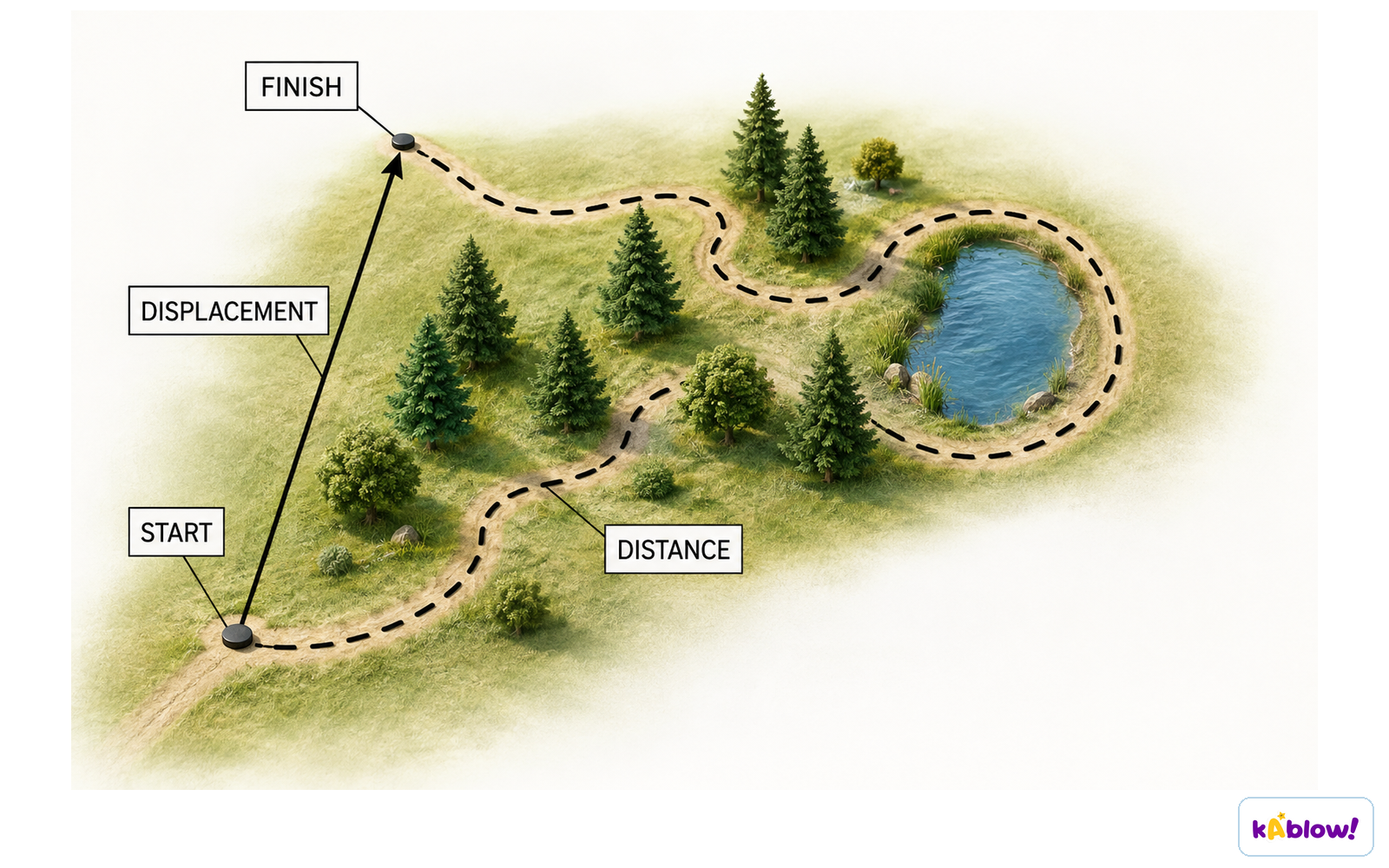
- Distance is how far an object moves, regardless of direction. It is a scalar quantity.
- Displacement is the straight-line distance from start to finish, together with the direction. It is a vector quantity.
- For example, in a 300 m race on a 400 m track, the distance run is 300 m, but the displacement might be 100 m to the right of the start.
- If a runner completes a full 400 m lap, the distance is 400 m but the displacement is zero.
- Scalars have magnitude only; vectors have both magnitude and direction.
- Common scalar–vector pairs: distance/displacement, speed/velocity, mass/weight.
Distance vs displacement
Speed and Velocity
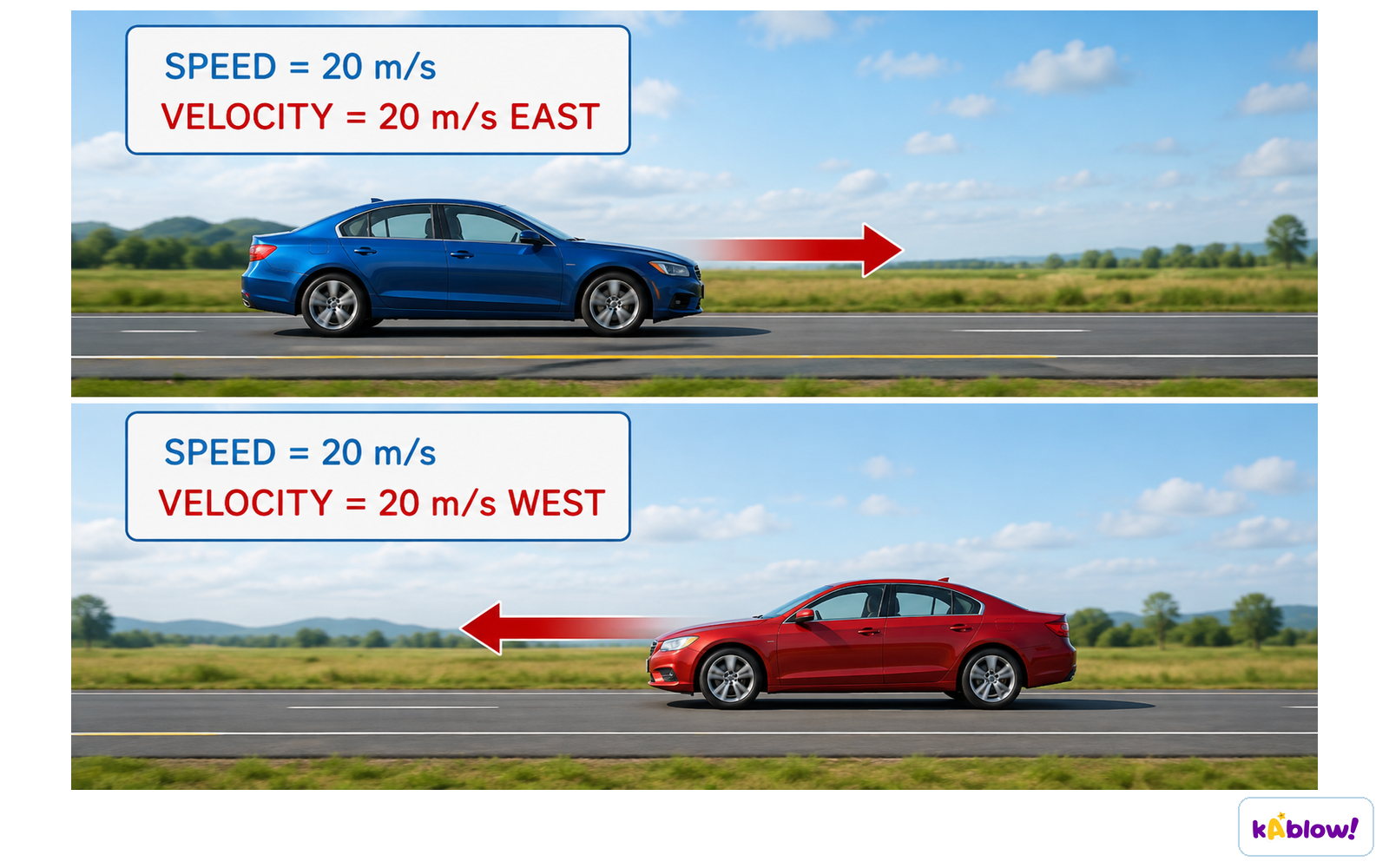
- Speed is the distance travelled per second. It is a scalar quantity (no direction).
- Velocity is speed in a given direction. It is a vector quantity.
- For constant speed: speed = distance ÷ time (v = s/t).
- For non-uniform motion, use average speed = total distance ÷ total time.
- Typical speeds: walking ~1.5 m/s, running ~3 m/s, cycling ~6 m/s.
- The speed of sound in air is typically 330 m/s; in seawater it is about 1500 m/s.
- Speed of a moving object is rarely constant; factors affecting walking/running/cycling speed include age, terrain, fitness and distance.
Comparing speed and velocity
Distance–Time Graphs
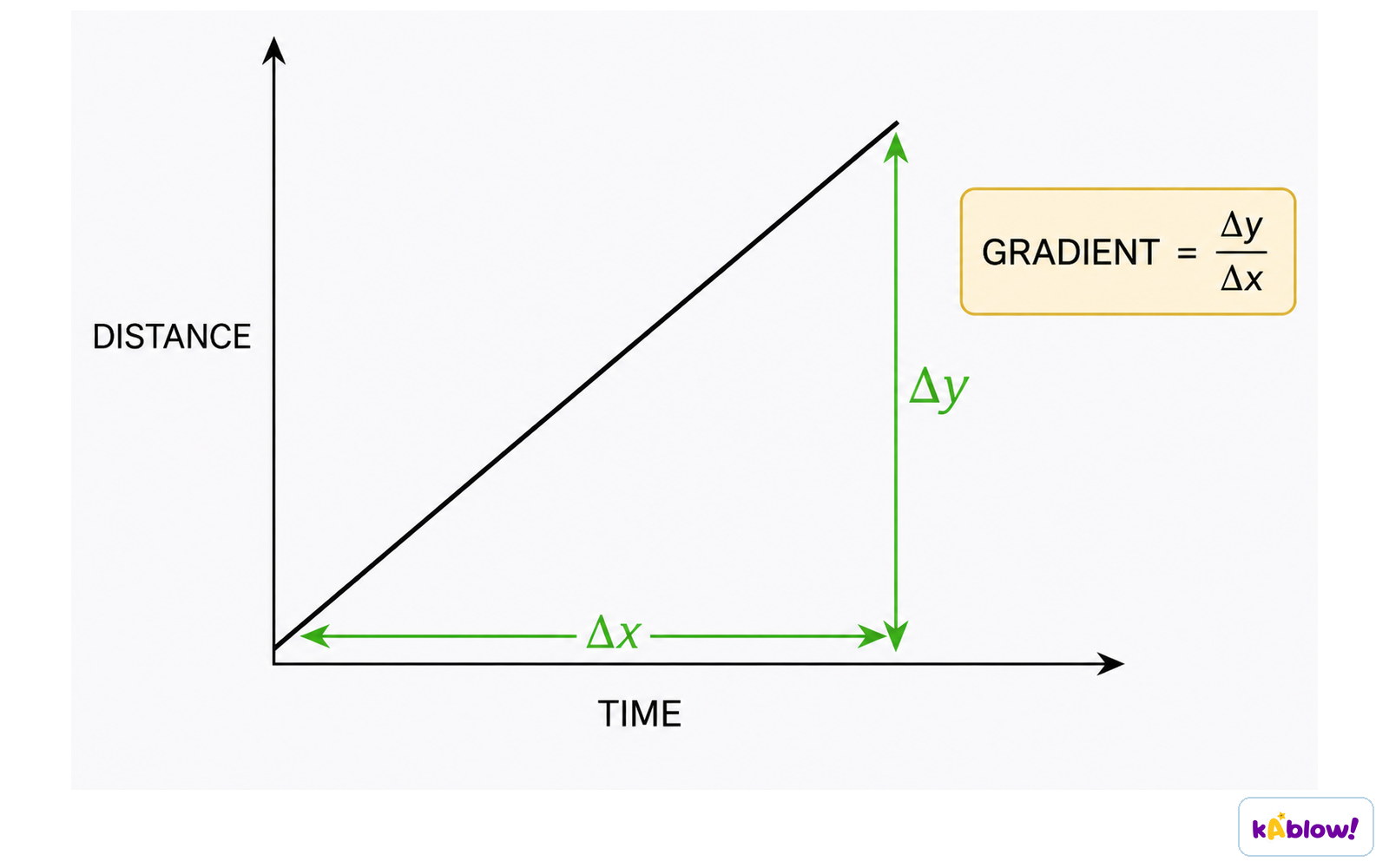
- A distance–time graph shows how distance from a starting point changes with time.
- A straight line represents constant speed; the steeper the line, the greater the speed.
- A flat horizontal line means the object is stationary.
- A curve represents changing speed: increasing gradient means acceleration, decreasing gradient means deceleration.
- The speed is equal to the gradient of the line: speed = Δy / Δx.
- To find speed at a specific time on a curve, draw a tangent and calculate its gradient.
Gradient of a distance-time graph
Acceleration
- Acceleration is the rate of change of velocity: a = Δv / t.
- Change in velocity: Δv = final velocity − initial velocity (v − u).
- Units: acceleration in m/s², velocity in m/s, time in s.
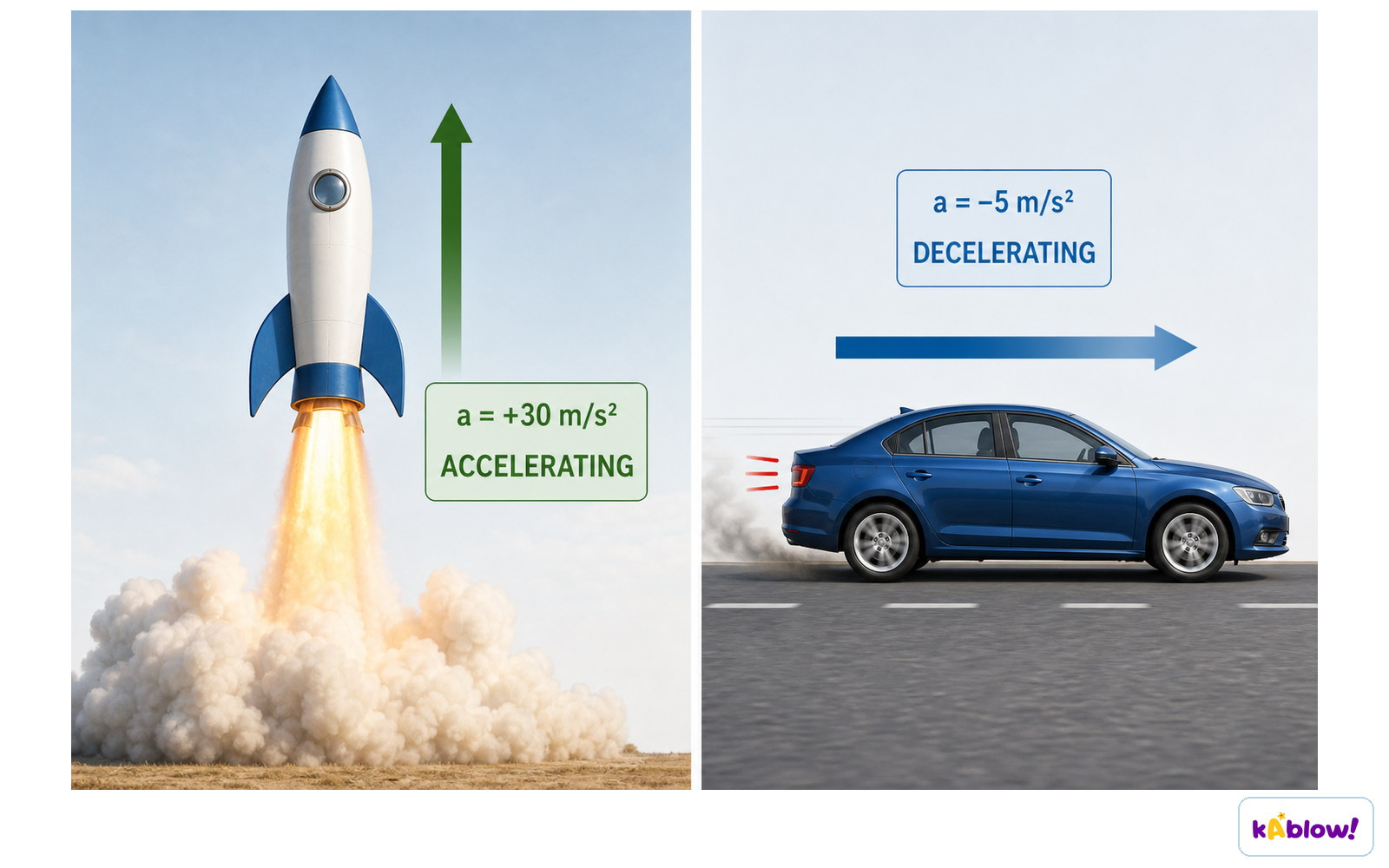
- Positive acceleration means speeding up; negative acceleration (deceleration) means slowing down.
- Typical accelerations: a family car takes about 10 s to reach 27 m/s, giving ~2.7 m/s².
- Near Earth's surface, free fall acceleration due to gravity is about 9.8 m/s² (often approximated as 10 m/s²).
Illustration of positive and negative acceleration with a rocket and a car.
Velocity–Time Graphs
- A velocity–time graph shows how velocity changes with time.
- A straight line represents constant acceleration; the steeper the line, the greater the acceleration.
- A flat horizontal line means zero acceleration (constant velocity).
- Acceleration is the gradient of a velocity–time graph: a = Δy / Δx.
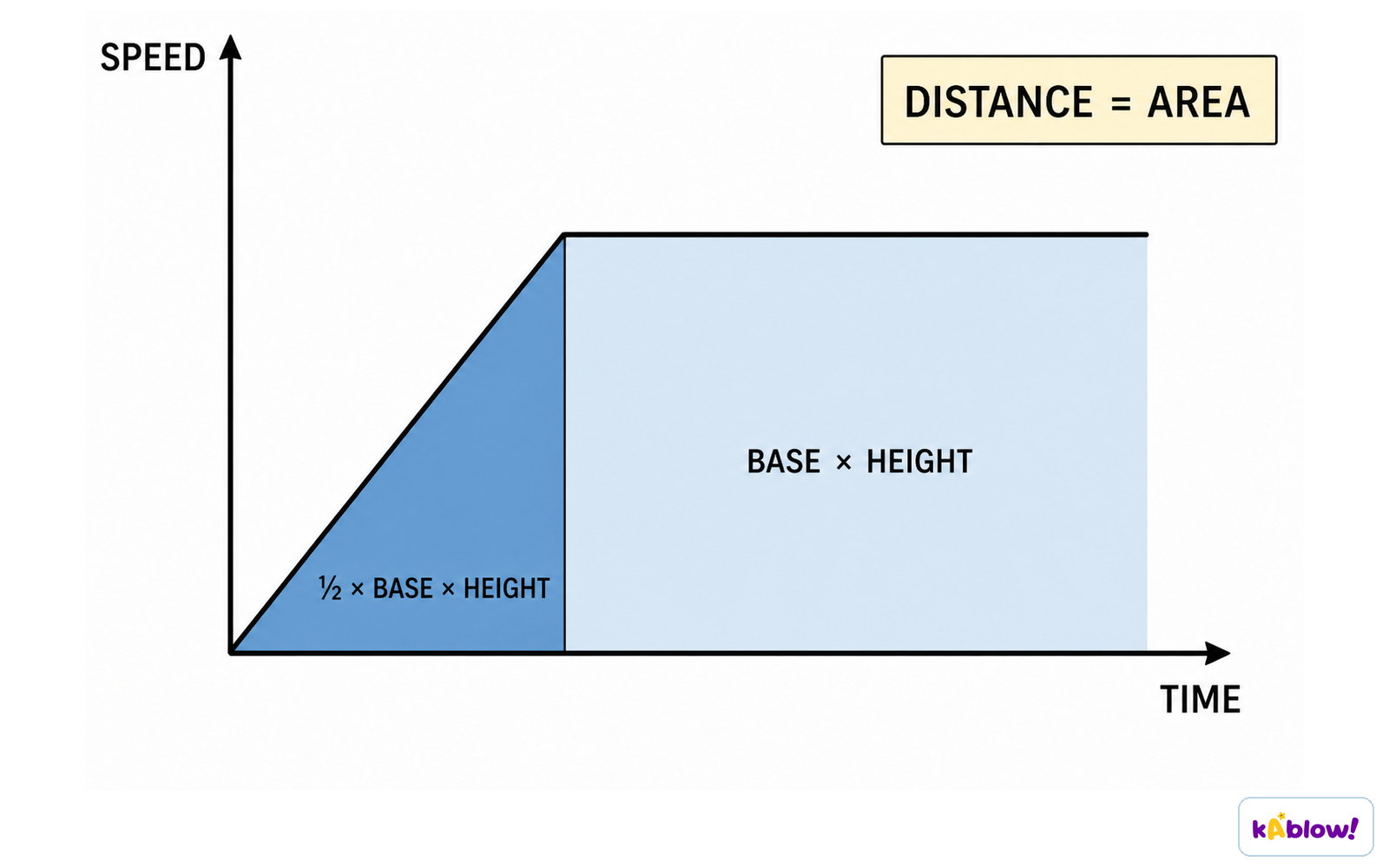
- The area under a velocity–time graph gives the distance travelled (or displacement).
- For a triangle, area = ½ × base × height; for a rectangle, area = base × height.
- If the area is complex, count squares under the graph to estimate distance.
The area under a speed-time graph, split into a triangle and a rectangle (base × height), gives the distance travelled.
Uniform Acceleration Equation
- For uniform (constant) acceleration: v² − u² = 2 × a × s.
- v = final speed (m/s), u = initial speed (m/s), a = acceleration (m/s²), s = distance (m).
- Use this equation when time is not known.
- Example: a car accelerates from rest at 2.5 m/s² to 16 m/s. Distance = (16² − 0²) / (2 × 2.5) = 51.2 m.
Newton's Laws and Forces
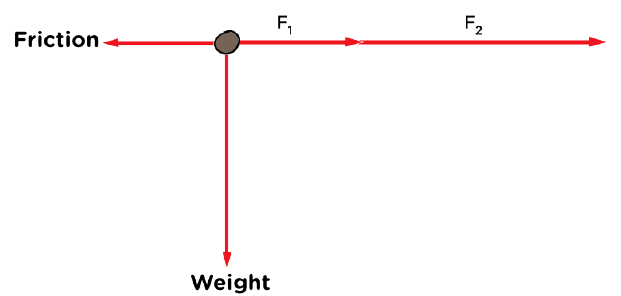
- Newton's First Law: if the resultant force on an object is zero, a stationary object stays stationary and a moving object continues at the same speed and direction (constant velocity).
- A resultant force is needed to change an object's velocity (speed and/or direction).
- When a vehicle travels at steady speed, the driving force and resistive forces are balanced.
- Inertia is the tendency of an object to continue in its state of rest or uniform motion.
- Newton's Second Law: resultant force = mass × acceleration (F = ma).
- Newton's Third Law: for every action, there is an equal and opposite reaction.
A free-body diagram: two applied forces (F1, F2), friction, and weight drawn as arrows from a central point representing the object.
Terminal Velocity
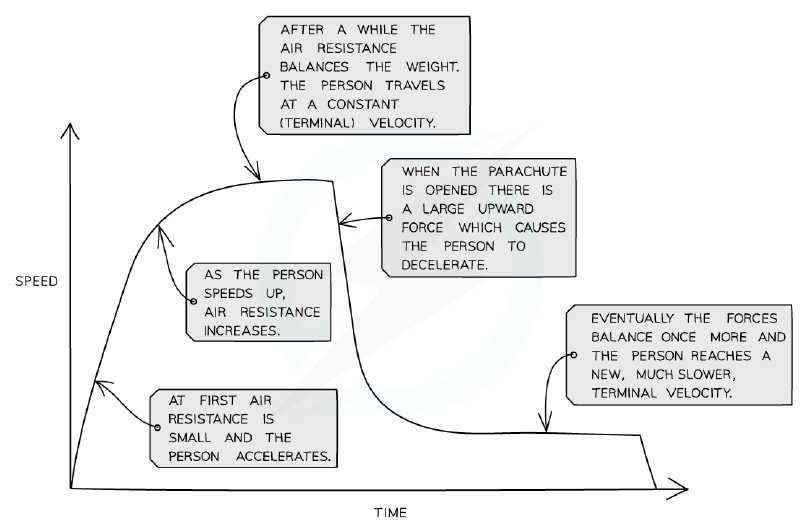
- An object falling through a fluid initially accelerates due to gravity.
- As speed increases, air resistance (drag) increases.
- Eventually, the upward drag equals the downward weight, so the resultant force is zero.
- At this point the object moves at its terminal velocity — constant speed.
- At terminal velocity, forces are balanced, but they are not zero; the object still moves.
A speed-time graph for a skydiver: air resistance builds as speed increases until it balances weight and a constant (terminal) velocity is reached.
Forces and Braking
- Stopping distance = thinking distance + braking distance.
- Thinking distance is the distance travelled during the driver's reaction time. It depends on speed and reaction time (affected by tiredness, alcohol, distractions).
- Braking distance is the distance travelled while the brakes are applied. It depends on speed, road conditions, tyre and brake condition.
- Reaction distance = speed × reaction time.
- For a given braking force, increasing speed increases braking distance because kinetic energy is proportional to speed squared.
- Work done by brakes = kinetic energy = ½ × mass × speed².
- Braking force × braking distance = work done (energy transferred).
Measuring Speed and Practical Skills
- To measure speed, time how long an object takes to travel a known distance, then use speed = distance ÷ time.
- Choose appropriate equipment: metre rule for short distances, tape measure or trundle wheel for long distances.
- Light gates give more accurate timing: a flag on the object blocks a beam, starting and stopping a timer.
- A single light gate can measure speed if the flag length (distance) and blocking time are known.
- When describing an experiment, write the equation first to identify which quantities to measure.
Diapos
Sign up free to view the lesson slides
Step through every slide for this topic — plus flashcards and revision notes — with a free account.
Questions d'entraînement
Aperçu gratuit — 8 sur 60 questions. Inscris-toi pour toutes les voir.
1.Which of the following is a scalar quantity?
Easy- AVelocity
- BDisplacement
- CSpeed
- DAcceleration
2.A student walks 300 m around a running track and finishes 100 m to the right of the start. Which statement is correct?
Easy- AThe distance travelled is 100 m and the displacement is 300 m to the right
- BThe distance travelled is 300 m and the displacement is 100 m to the right
- CBoth the distance and the displacement are 300 m
- DBoth the distance and the displacement are 100 m to the right
3.Velocity is a vector quantity because it describes both speed and direction.
EasyTrue or false?
4.Which of the following are vector quantities? (Select all that apply)
Medium- ADistance
- BDisplacement
- CSpeed
- DVelocity
- EAcceleration
5.The equation relating speed, distance and time is speed = distance ÷ time. A plane flies at an average speed of 250 m/s for 2 hours. What is the total distance travelled?
Medium- A500 m
- B30 000 m
- C1 800 000 m
- D9000 m
6.The gradient of a distance-time graph represents which quantity?
Medium- AAcceleration
- BSpeed
- CDisplacement
- DForce
7.Which statement correctly describes acceleration?
Medium- AAcceleration is the rate of change of distance
- BAcceleration is the rate of change of velocity
- CAcceleration is the total distance travelled per second
- DAcceleration is the rate of change of force
8.A Japanese bullet train decelerates at a constant rate in a straight line. Its velocity decreases from 50 m/s to 42 m/s in 30 seconds. What is the train's acceleration?
Medium- A-0.27 m/s²
- B0.27 m/s²
- C-8 m/s²
- D-1.6 m/s²
Unlock all 60 questions, flashcards & more
Crée un compte gratuit pour voir toutes les questions, les diapos, les cartes mémo et les notes de révision de ce thème.