Work done and energy transfer
Apprends en jouant
Réponds à ces questions pour gagner de l'énergie, puis pêche et explore. Sans compte.
Notes de leçon
What is Work Done?
- Work is done when a force causes an object to move over a distance.
- The force must act in the direction of the object's displacement for work to be done.
- If a force is applied but the object does not move, no work is done.
- Work is done on a ball when it is lifted to a height above the ground.
- Air resistance (drag) does work against a bird as it flies through the air.
Work is done when a force is used to move an object over a distance
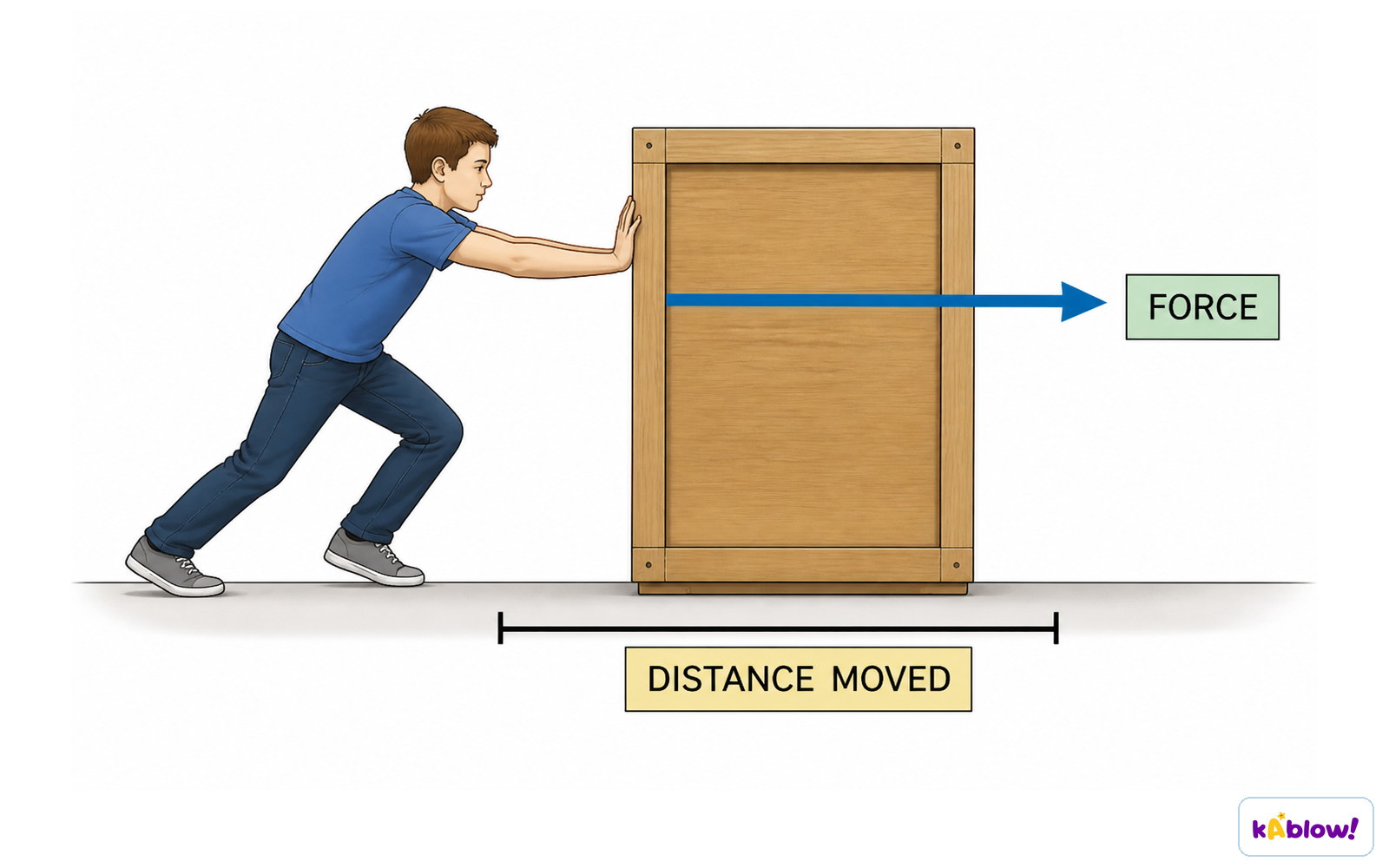
Calculating Work Done
- The equation for work done is: W = F × s
- W = work done in joules (J) or newton-metres (N m)
- F = force in newtons (N)
- s = distance moved in the direction of the force, in metres (m)
- Example: A force of 500 N moves an object 23 m, so work done = 500 × 23 = 11 500 J.
Units for Work and Energy
- Work is measured in joules (J) or newton-metres (N m).
- 1 J = 1 N m – the number of joules equals the number of newton-metres.
- One joule is the work done by a force of one newton acting through one metre.
- Conversions are straightforward: 1000 J = 1000 N m.
- Always include the correct units in your answer – you may use either J or N m.
Work Done and Energy Transfer
- Whenever work is done, energy is transferred from one store to another.
- Mechanical working (or electrical working) is an energy transfer pathway.
- The amount of energy transferred (in joules) is equal to the work done (also in joules): energy transferred = work done.
- If a force acts in the direction of motion, the object gains energy (transferred to its kinetic store).
- If a force acts opposite to the motion, the object loses energy (transferred to the thermal store of the object and surroundings).
Work Done and Gravitational Potential Energy
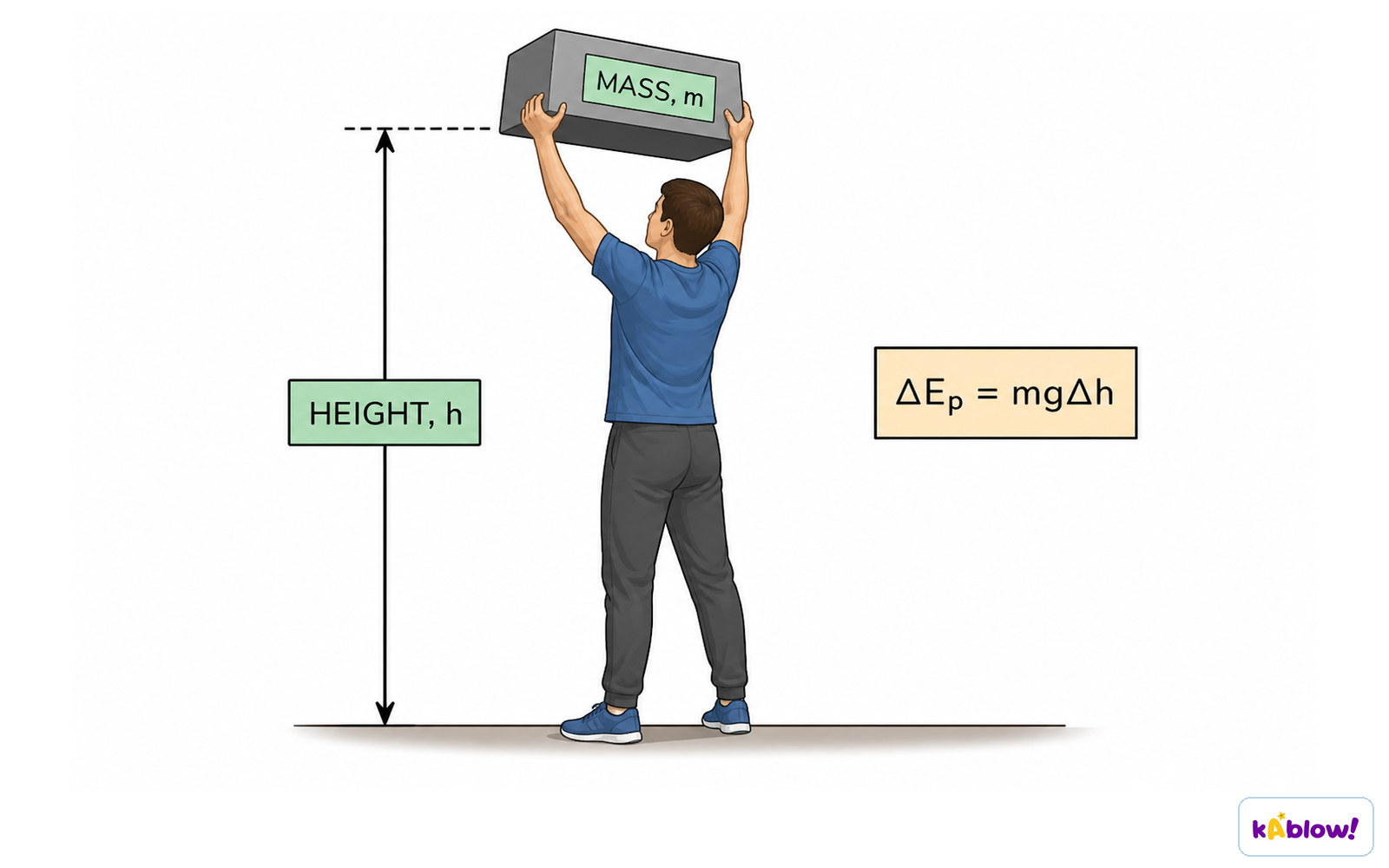
- When an object is lifted, work is done against gravity and energy is transferred to its gravitational potential store.
- The work done in lifting an object equals m × g × h (mass × gravitational field strength × height).
- This is the same as the equation for gravitational potential energy: E = m g h.
- Example: Lifting a 10 kg bucket 15 m with g = 9.8 N/kg gives work done = 10 × 9.8 × 15 = 1470 J.
- The bucket gains 1470 J of gravitational potential energy.
Gravitational potential energy of a lifted mass
Work Done and Friction
- Friction is a force that opposes the motion of an object, slowing it down.
- When friction is present, energy is transferred by heating – raising the temperature of the object and its surroundings.
- The work done against frictional forces causes this temperature rise.
- Imperfections at the interface between surfaces bump and rub against each other, transferring energy to thermal stores.
- Air resistance is a type of friction that slows objects moving through air; particles bump into the object, transferring energy by heating.
Work Done and Energy Transfer in Context
- A car braking: the brakes apply a force opposite to motion, doing work and transferring kinetic energy to thermal energy in the brakes.
- A sledge sliding down a slope: friction does work against the sledge, transferring energy to thermal stores.
- When a force moves an object, the energy transferred equals the work done – this links work, force, distance and energy.
- Changes in speed relate to kinetic energy; changes in height relate to gravitational potential energy; changes in shape relate to elastic potential energy.
Key Points to Remember
- Work done = force × distance moved in the direction of the force.
- No movement means no work done, even if a force is applied.
- Use the distance along the line of action of the force, not total distance.
- Work done and energy transferred are equal and both measured in joules.
- Work done against friction is not destroyed – it is transferred to thermal stores.
Diapos
Sign up free to view the lesson slides
Step through every slide for this topic — plus flashcards and revision notes — with a free account.
Questions d'entraînement
Aperçu gratuit — 8 sur 63 questions. Inscris-toi pour toutes les voir.
1.What are the correct units for work done?
Easy- AN
- Bm
- CN/m
- DN m
2.Which equation correctly links work done (W), force (F), and distance moved (s)?
Easy- AW = F s
- BW = F / s
- CW = F − s
- DW = s / F
3.Which of the following expressions is correct for the relationship between work done and energy?
Easy- AWork done = energy transferred
- BWork done = energy transferred × distance
- CWork done = energy transferred + distance
- DWork done = energy transferred ÷ time
4.Which of the following statements about friction are correct? (select all that apply)
Medium- AFriction always acts against motion
- BEnergy is transferred by heating
- CFriction is not a force
- DThe units for friction are watts
- EAir resistance is a type of friction
5.Work is done when a force is applied to an object but the object does not move.
EasyTrue or false?
6.Match each quantity to its correct unit.
Medium- Work done
- Force
- Distance
- Joule
- Newton
- Metre
7.Which of the following is the correct conversion between joules and newton-metres?
Easy- A1 J = 1 N m
- B1 J = 1 N/m
- C1 J = 1 N/m²
- D1 J = 1 N m²
8.Which of the following are examples of work being done? (select all that apply)
Medium- AA ball is lifted to a height above the ground.
- BA bird flies through the air, experiencing air resistance.
- CA person holds a heavy box stationary.
- DA car applies brakes and comes to a stop.
- EA force is applied to a wall but it does not move.
Unlock all 63 questions, flashcards & more
Crée un compte gratuit pour voir toutes les questions, les diapos, les cartes mémo et les notes de révision de ce thème.