Breathing and gas exchange
Apprends en jouant
Réponds à ces questions pour gagner de l'énergie, puis pêche et explore. Sans compte.
Notes de leçon
Big idea: a system that swaps gases
- Big idea (key concept): Systems. The breathing system is a set of organs that work together. The airways, the lungs, the ribs and the muscles each do one job, and together they bring oxygen in and take carbon dioxide out.
- Related concept: Function. Every part of the system has a shape that suits its job. A tube kept open by rings, a muscle that flattens, a sac with a one-cell-thick wall: in each case, structure explains function.
- Global context: Identities and relationships. Your breathing changes with who you are and what you do: asleep, running, anxious, or living with a condition such as asthma. Understanding the system helps us look after our own bodies and other people's.
- Your cells need oxygen for respiration, and respiration makes carbon dioxide as a waste product. The breathing system exchanges these two gases with the air.
- Breathing (ventilation) is moving air in and out of the lungs. Gas exchange is the swapping of oxygen and carbon dioxide between the air in the lungs and the blood. Respiration is the chemical reaction in cells that releases energy. They are three different things.
The breathing system
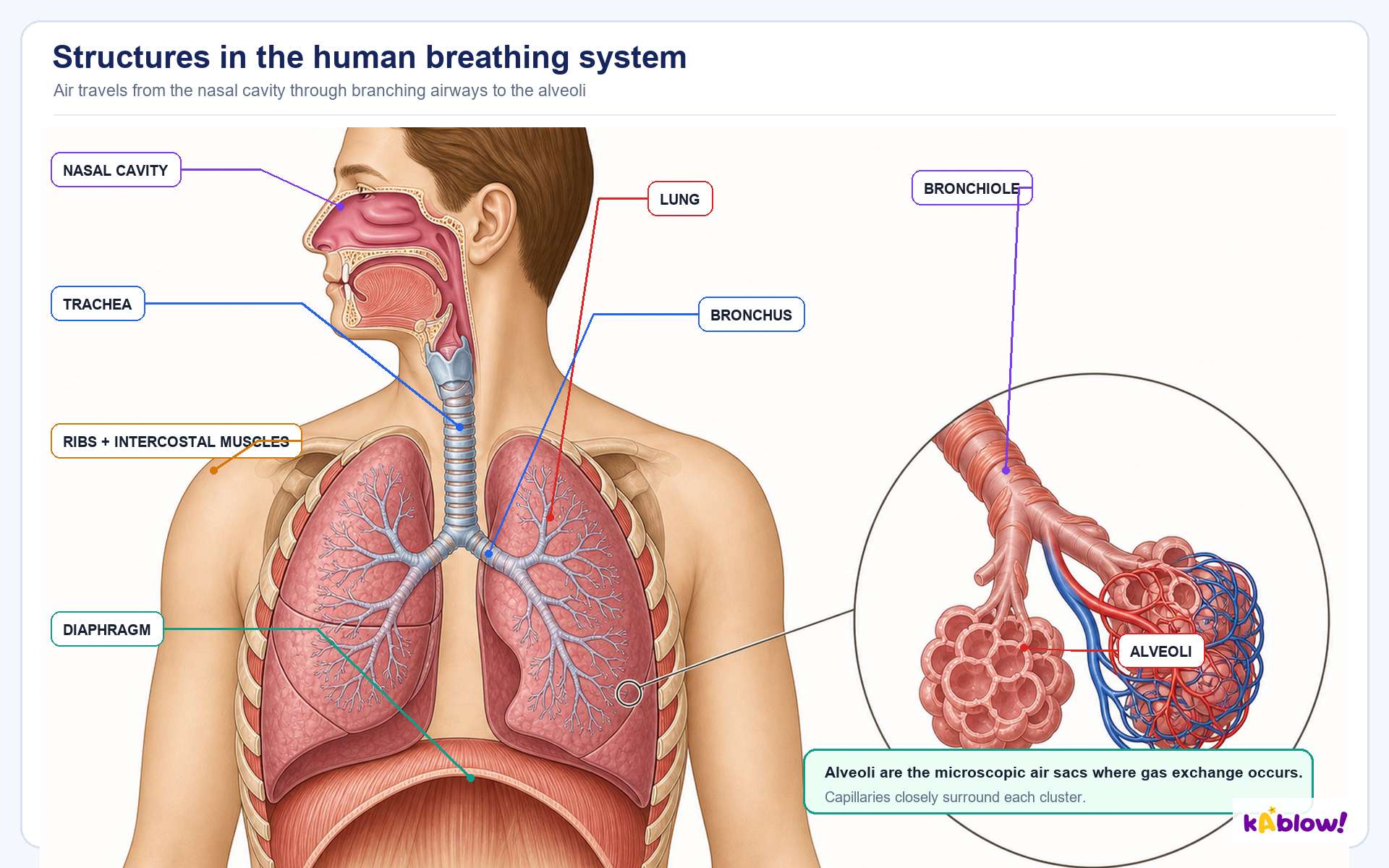
- Air enters through the nose or mouth and passes down the trachea (windpipe). The nose has hairs and mucus that trap some dust.
- The trachea is held open by C-shaped rings of cartilage. Without them it could collapse when the pressure inside it drops as you breathe in.
- The trachea splits into two bronchi (one is a bronchus), one going to each lung. Each bronchus branches again and again into smaller tubes called bronchioles.
- At the end of the smallest bronchioles are clusters of tiny air sacs called alveoli (one is an alveolus). There are hundreds of millions of them in your lungs, and this is where gas exchange happens.
- The lungs are soft and spongy. They have no muscles of their own, so they cannot pull air in by themselves.
- The lungs sit inside the thorax (chest), protected by the ribcage. The diaphragm, a sheet of muscle, forms the floor of the thorax. Intercostal muscles between the ribs move the ribcage.
- The path of air is: nose or mouth, trachea, bronchi, bronchioles, alveoli. Used air takes the same path back out.
The human breathing system, from the nose to the alveoli
Ventilation: how air gets in and out
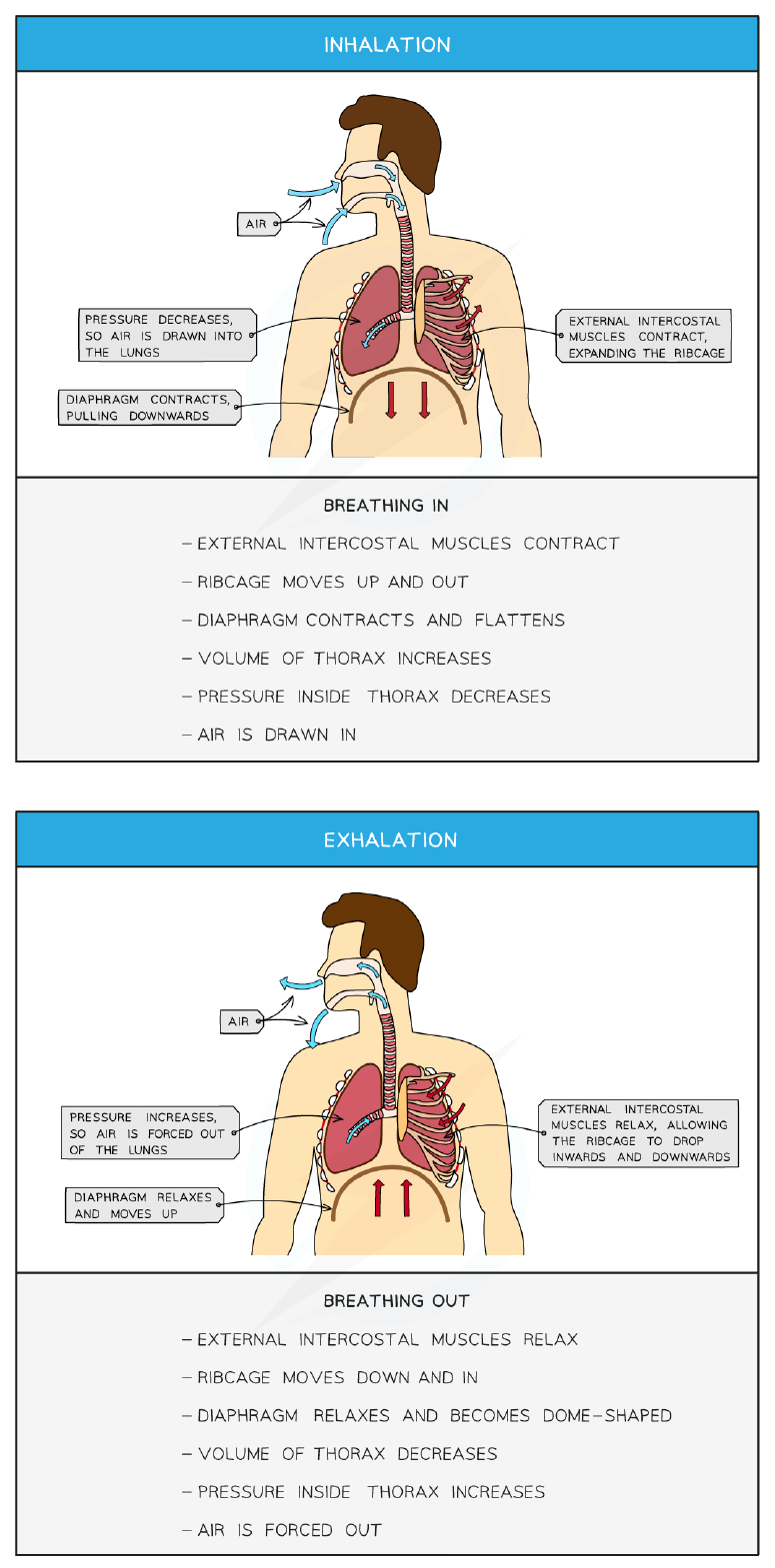
- Air always moves from a place of higher pressure to a place of lower pressure. Breathing works by changing the volume of the thorax, which changes the pressure inside it.
- Breathing in (inhaling): the intercostal muscles contract, so the ribcage moves up and out. The diaphragm contracts and flattens, moving down. The volume of the thorax increases, so the pressure inside falls below the air pressure outside. Air is pushed into the lungs by the higher pressure outside.
- Breathing out (exhaling): the intercostal muscles relax, so the ribcage moves down and in. The diaphragm relaxes and returns to a dome shape, moving up. The volume of the thorax decreases, so the pressure inside rises above the air pressure outside. Air is forced out.
- A common mistake is to say the lungs suck the air in. In fact the muscles change the size of the thorax, and the pressure difference moves the air.
- At rest an adult breathes about 12 to 20 times per minute. During exercise both the rate and the depth of breathing go up.
Breathing in and breathing out: ribs, diaphragm and pressure
Gas exchange in the alveoli
- Gas exchange happens by diffusion: particles spread from where there are lots of them (high concentration) to where there are fewer (low concentration), with no energy needed.
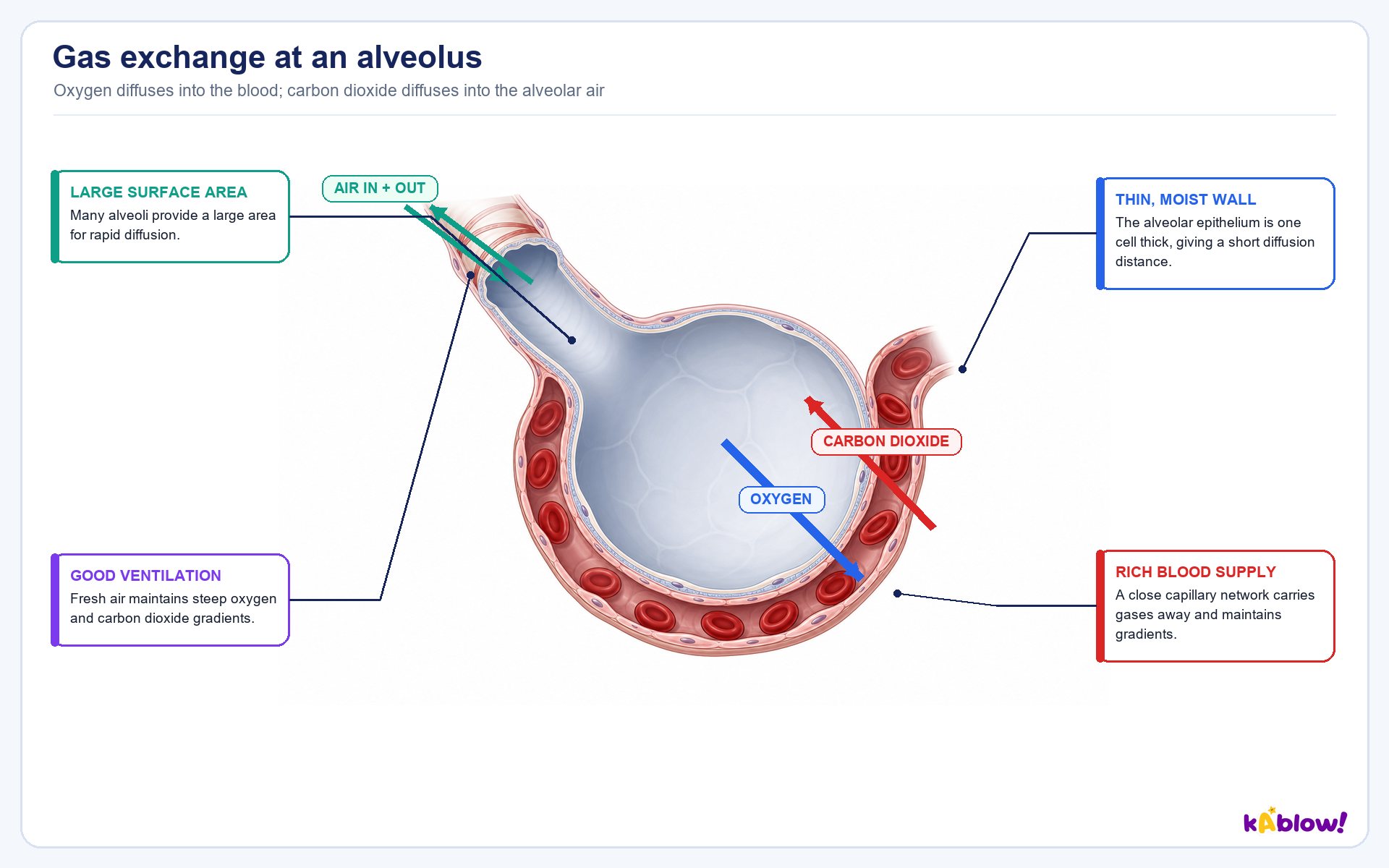
- Air in an alveolus has more oxygen and less carbon dioxide than the blood arriving in the capillary around it. So oxygen diffuses into the blood and carbon dioxide diffuses out of the blood into the alveolus.
- Inside the blood, oxygen joins with haemoglobin in red blood cells and is carried to the body. Carbon dioxide is carried back to the lungs, mostly dissolved in the plasma.
- Alveoli are adapted for fast diffusion. They have a huge surface area (millions of alveoli), a very thin wall (one cell thick, so the diffusion distance is short), a moist lining (gases dissolve before they diffuse), and a dense network of capillaries.
- Ventilation and blood flow keep the concentration gradient steep. Breathing brings fresh oxygen-rich air in and removes carbon dioxide, and the moving blood carries oxygen away and brings more carbon dioxide. If the gradient flattened, diffusion would slow down and stop.
- Compare the air you breathe in with the air you breathe out. Inhaled air is about 21% oxygen and 0.04% carbon dioxide. Exhaled air is about 16% oxygen and 4% carbon dioxide. Only a part of the oxygen is taken out. Nitrogen (about 78%) does not change, and exhaled air also contains more water vapour.
Gas exchange at an alveolus
Lung volume, smoking and asthma
- Tidal volume is the volume of air moved in or out in one normal breath, about 500 cm³ at rest. Vital capacity is the largest volume you can breathe out after breathing in as deeply as possible. Even then, some air always stays in the lungs. A spirometer is used to measure these volumes.
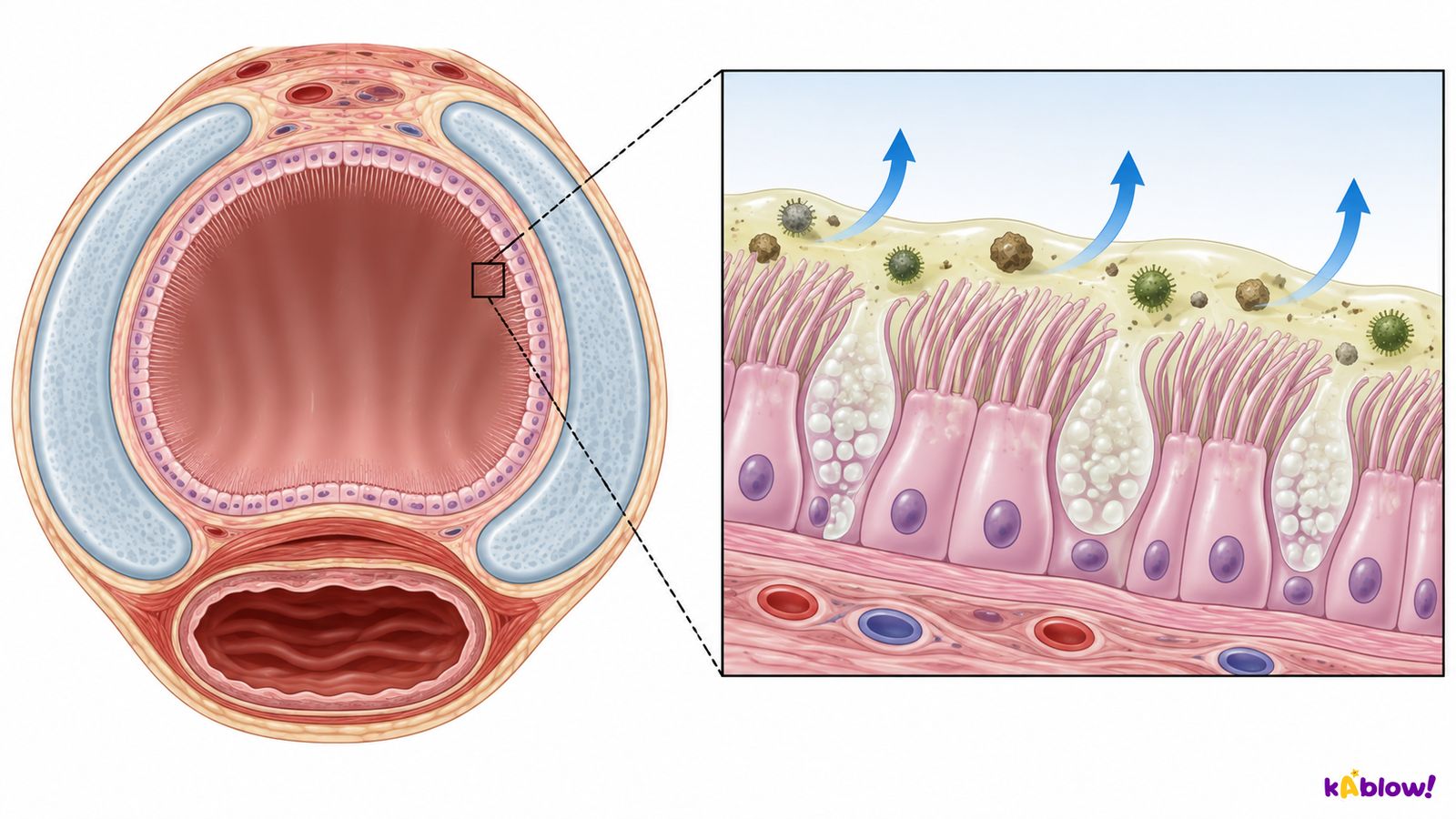
- The airways are lined with cilia (tiny hairs) and cells that make mucus. Mucus traps dust and bacteria and the cilia sweep it upwards to be swallowed or coughed out.
- Tobacco smoke contains three harmful things. Tar coats the airways, damages the cilia and contains chemicals that cause cancer. Nicotine is an addictive drug. Carbon monoxide joins to haemoglobin instead of oxygen, so the blood carries less oxygen.
- Smoking can lead to chronic bronchitis (a long-lasting cough from inflamed airways full of mucus), emphysema (the walls of the alveoli break down, so the surface area for gas exchange falls and a person becomes short of breath) and lung cancer.
- Asthma is a condition in which the airways become inflamed and narrow. The muscles in the walls of the bronchioles tighten and more mucus is made, so less air can pass and breathing out becomes hard.
- Common asthma triggers are pollen, dust mites, cold air, smoke and exercise. A reliever inhaler contains a drug that relaxes the muscles in the airway walls so they widen again.
Cilia and mucus lining the airway
Think like a scientist: does exhaled air contain more carbon dioxide?
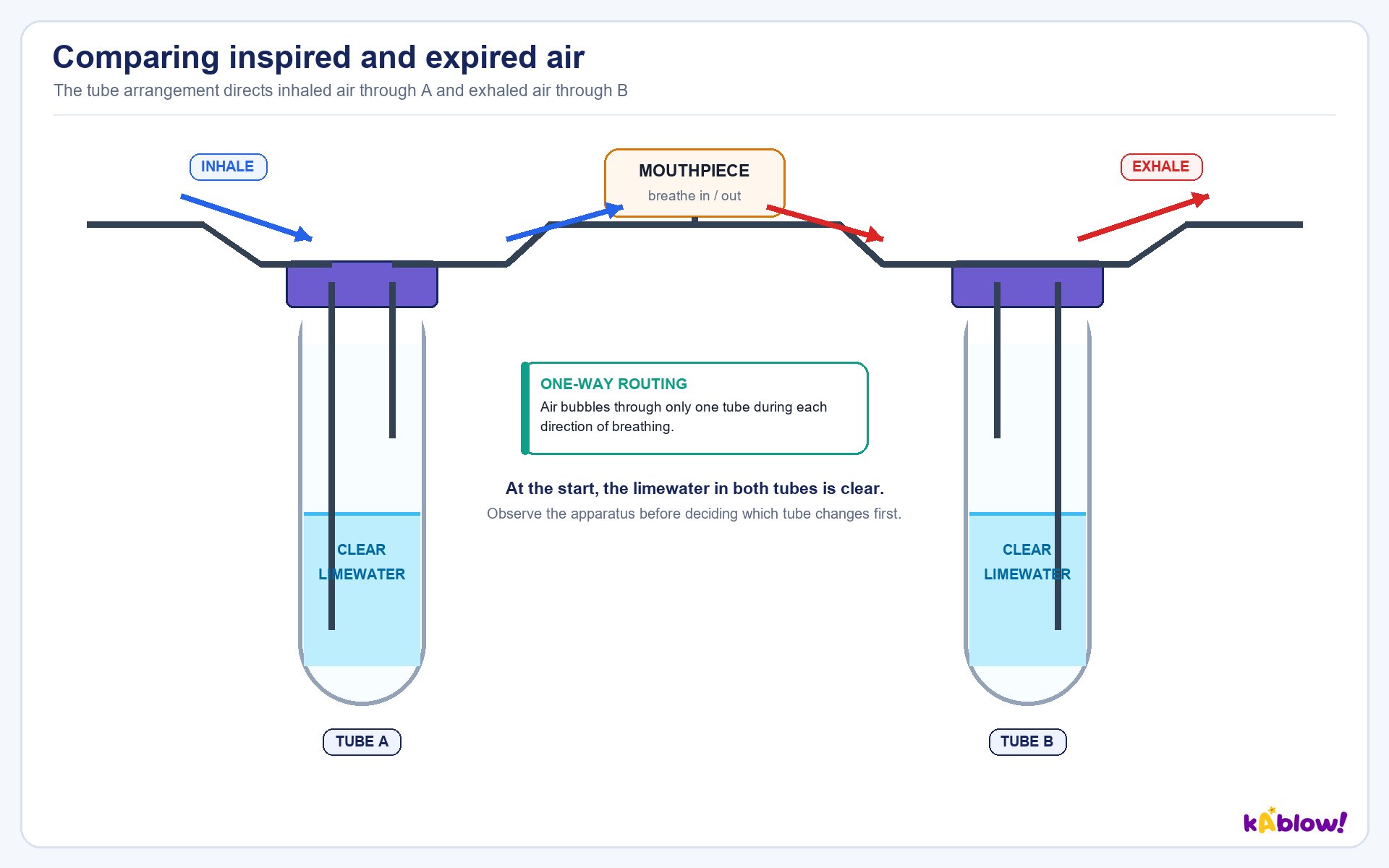
- Limewater is a clear solution that turns cloudy (milky) when carbon dioxide is bubbled through it. The faster it goes cloudy, the more carbon dioxide is in the gas.
- In the apparatus shown, the tubes are set up so that inhaled air bubbles through tube A only, and exhaled air bubbles through tube B only. You breathe in and out through one mouthpiece.
- The independent variable is the type of air (inhaled or exhaled). The dependent variable is the time taken for the limewater to go cloudy. For a fair test, keep the volume and concentration of limewater, the size of the tubes and the number of breaths the same.
- A prediction should come from the science: exhaled air should turn tube B cloudy faster because respiration in cells makes carbon dioxide, and some of it is breathed out.
- Inquiry task 1: write a method to test whether breathing rate changes with exercise. Say what you will change, what you will measure, three variables you will control and how many times you will repeat it.
- Inquiry task 2: a student tests only herself and says “exercise doubles breathing rate for everyone”. Evaluate this conclusion and suggest two improvements.
Testing inhaled and exhaled air with limewater
Diapos
Sign up free to view the lesson slides
Step through every slide for this topic — plus flashcards and revision notes — with a free account.
Questions d'entraînement
Aperçu gratuit — 8 sur 53 questions. Inscris-toi pour toutes les voir.
1.Which tube carries air from the nose and mouth down towards the lungs?
Easy- AThe diaphragm
- BA bronchiole
- CThe oesophagus
- DThe trachea
2.What are the tiny air sacs at the ends of the airways called?
Easy- ACapillaries
- BAlveoli
- CBronchioles
- DBronchi
3.Which muscle forms the floor of the thorax and helps you breathe?
Easy- AThe diaphragm
- BThe stomach wall
- CThe heart
- DThe trachea
4.Which gas do body cells need to take in from the air for respiration?
Easy- ANitrogen
- BCarbon dioxide
- CHydrogen
- DOxygen
5.Which gas moves from the blood into the alveoli so that it can be breathed out?
Easy- AOxygen
- BNitrogen
- CHydrogen
- DCarbon dioxide
6.What happens to the ribcage when you breathe in?
Easy- AIt moves up and in
- BIt moves down and in
- CIt moves up and out
- DIt stays completely still
7.Which gas makes limewater turn cloudy?
Easy- ACarbon dioxide
- BNitrogen
- COxygen
- DWater vapour
8.Which substance in cigarette smoke is addictive?
Easy- AOxygen
- BCarbon monoxide
- CNicotine
- DTar
Unlock all 53 questions, flashcards & more
Crée un compte gratuit pour voir toutes les questions, les diapos, les cartes mémo et les notes de révision de ce thème.