The nervous system and reflexes
Apprends en jouant
Réponds à ces questions pour gagner de l'énergie, puis pêche et explore. Sans compte.
Notes de leçon
Big idea: a system for fast messages
- Big idea (key concept): Systems. The nervous system is a set of organs that work together as one communication network. No single part could coordinate your body on its own.
- Related concept: Interaction. Receptors, neurones, the brain and your muscles all interact. A change in the world outside (or inside) you causes a change in your body within a fraction of a second.
- Global context: Identities and relationships. Every touch, sight and sound you experience, and every movement you make, depends on this system. It is part of what makes you who you are and how you connect with other people.
- Information travels in a chain: stimulus (a change in the environment) then receptor (detects it) then coordinator (the brain or spinal cord decides what to do) then effector (a muscle or gland) then response.
- The central nervous system (CNS) is the brain and spinal cord. The peripheral nervous system is all the nerves that connect the CNS to the rest of the body.
- Examples of receptors: light-sensitive cells in the retina, pressure and pain receptors in the skin, sound receptors in the ear. Effectors are muscles (they contract) and glands (they release a substance such as sweat).
Neurones carry the impulses
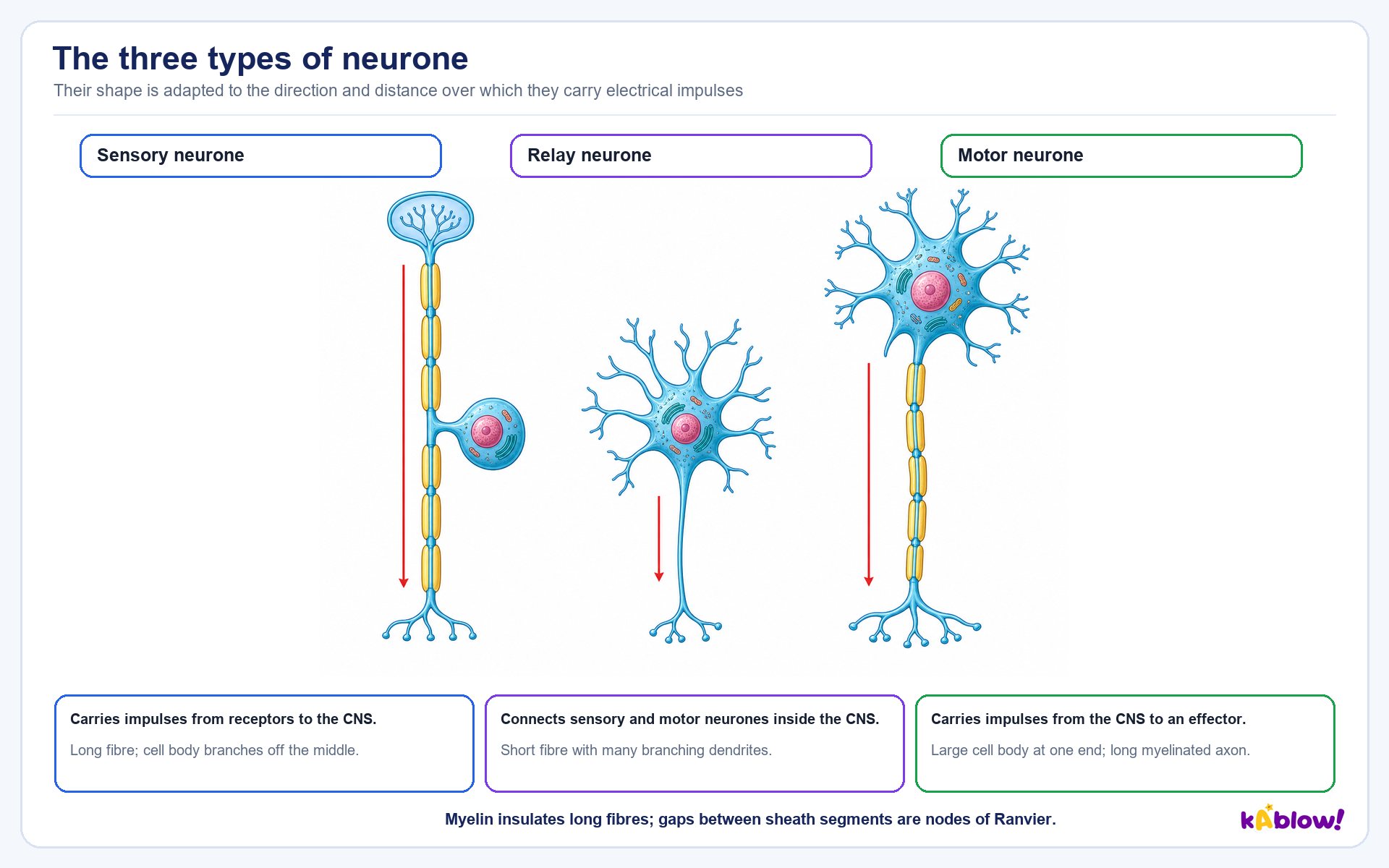
- A neurone is a nerve cell. It carries information as an electrical impulse. There are three types, each adapted to its job.
- A sensory neurone carries impulses from a receptor to the CNS. A relay neurone (in the brain or spinal cord) connects sensory neurones to motor neurones. A motor neurone carries impulses from the CNS to an effector.
- Neurones have dendrites (branched ends that receive signals), a cell body containing the nucleus, and a long axon that carries the impulse away. Long axons let one cell reach from the spinal cord to a muscle in the foot.
- Many long axons are wrapped in a fatty myelin sheath. Myelin acts as an electrical insulator and makes the impulse travel much faster. Fast myelinated neurones can carry impulses at around 100 metres per second.
- A nerve is not the same as a neurone. A nerve is a bundle of many neurones (nerve fibres) wrapped together, like a cable made of many wires.
Sensory, relay and motor neurones
The synapse: crossing the gap
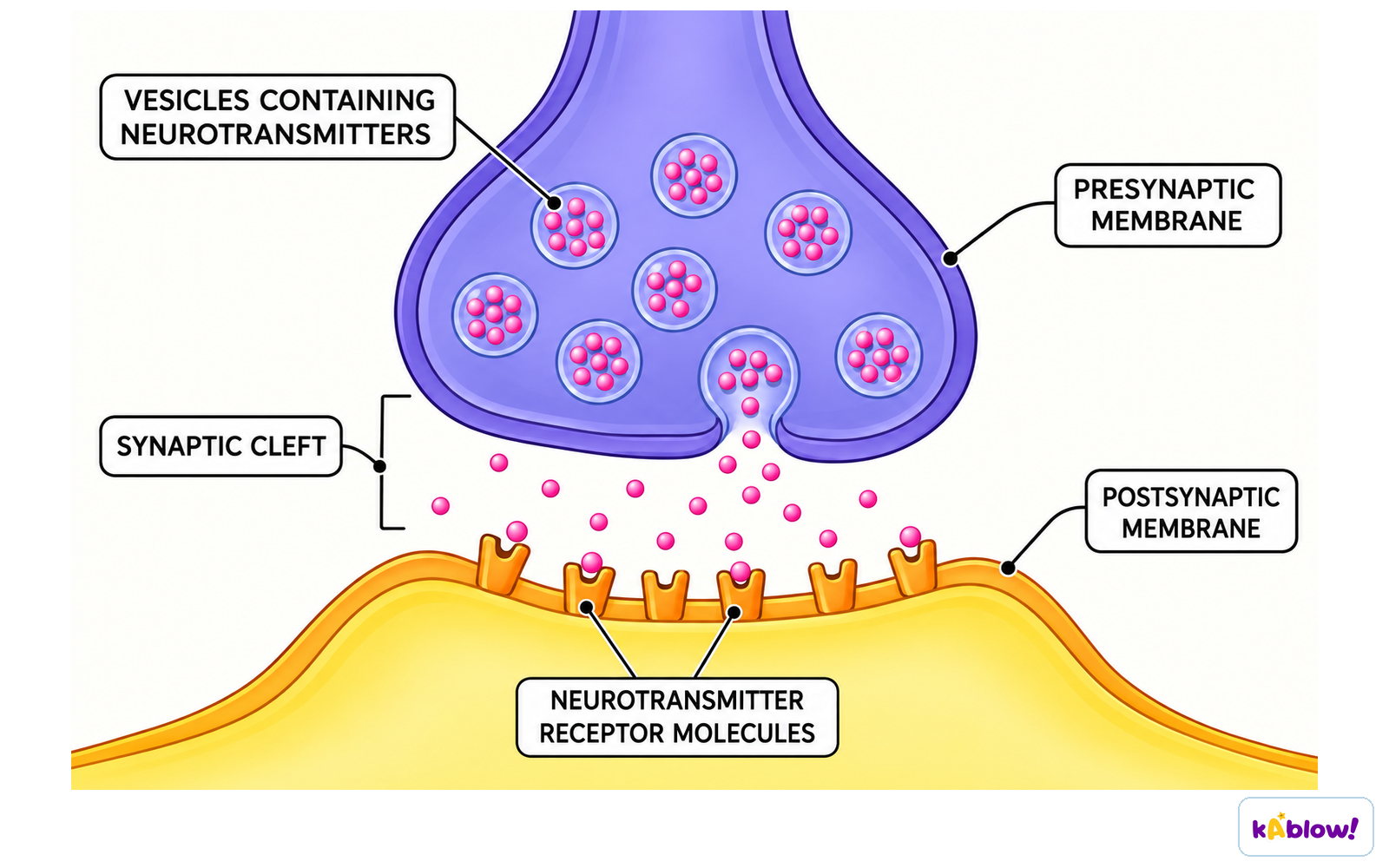
- Neurones do not touch. Between two neurones there is a tiny gap called a synapse (the synaptic cleft).
- An electrical impulse cannot jump across the gap, so the signal is passed on chemically. When an impulse reaches the end of the first neurone, vesicles release a chemical called a neurotransmitter into the gap.
- The neurotransmitter diffuses across the gap and binds to receptor molecules on the membrane of the next neurone. This sets off a new electrical impulse in the second neurone.
- Synapses make sure messages go one way only. Only the first neurone has vesicles of neurotransmitter, and only the second has the matching receptors.
- Crossing a synapse takes a little time. This is one reason why a pathway with fewer synapses is quicker, and why reflex pathways are so short.
A synapse between two neurones
Reflexes: fast and automatic
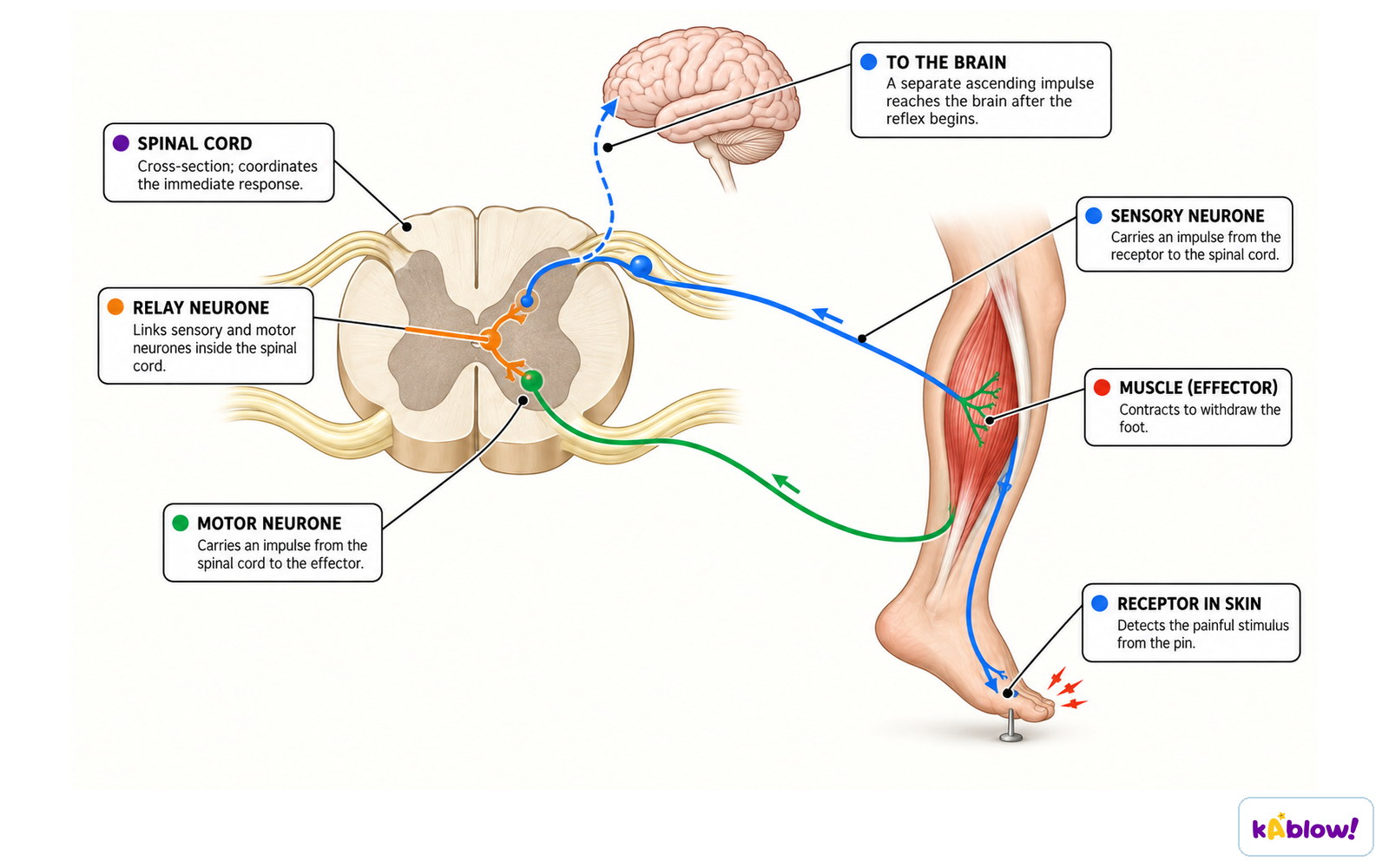
- A reflex action is a rapid, automatic response to a stimulus. You do not decide to do it and you do not think about it first. Examples: pulling your hand off something hot, the pupil getting smaller in bright light, blinking.
- A reflex follows a reflex arc: stimulus, receptor, sensory neurone, relay neurone (in the spinal cord), motor neurone, effector, response.
- A reflex is fast because the pathway is short, with only a few neurones and synapses, and the impulse does not have to be processed by the conscious part of the brain first. The brain is told about it a moment later, which is when you feel the pain.
- A voluntary action, such as choosing to pick up a pen, is different. It involves a decision in the brain and a longer pathway, so it is slower.
- Reflexes protect you from harm. Because they are automatic, they work even when you are not paying attention.
A reflex arc after a pin is stepped on
The eye: a receptor organ
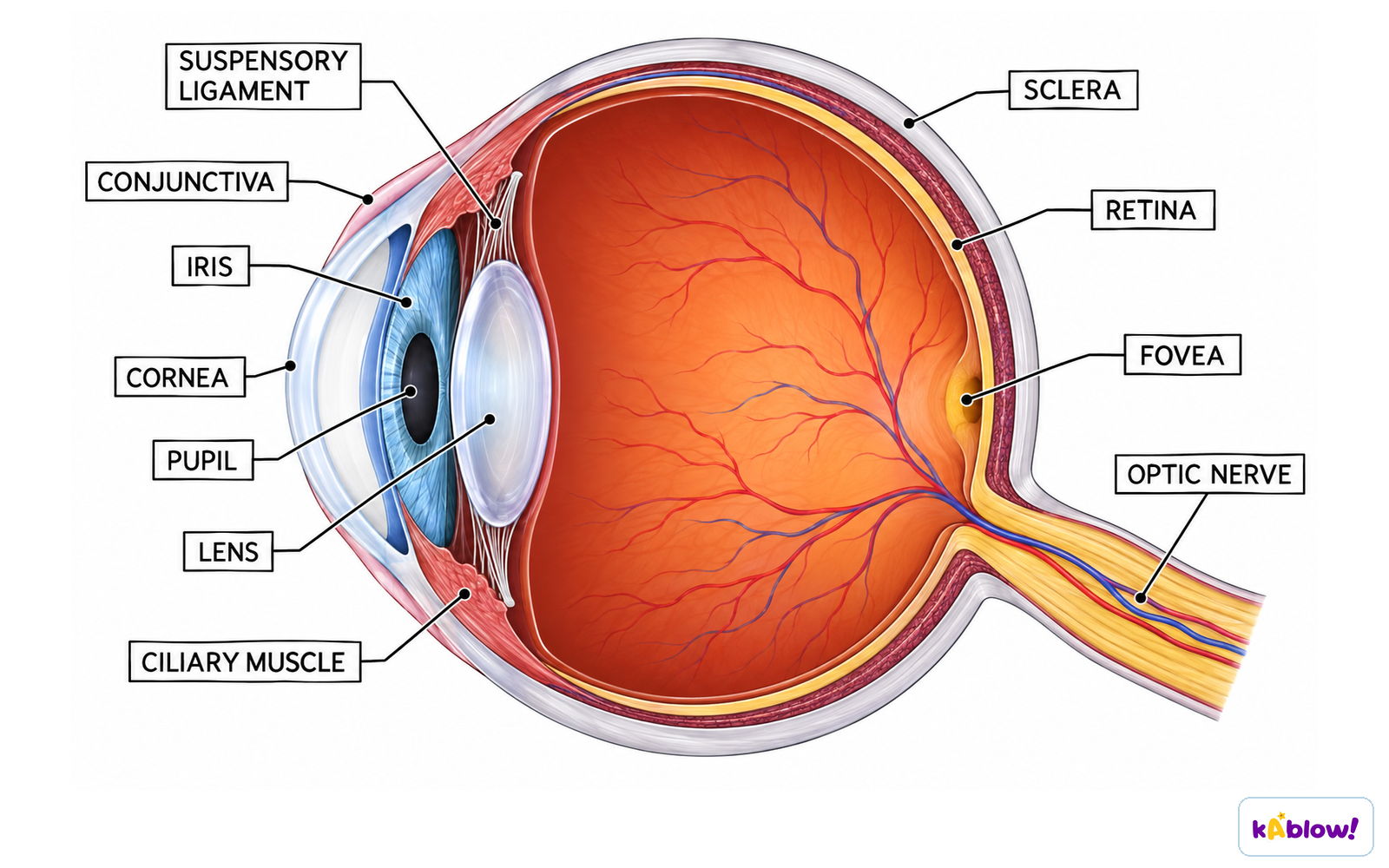
- The cornea and the lens both bend (refract) light so that it is focused onto the retina. The retina contains the light receptor cells (rods and cones), which turn light into electrical impulses. The optic nerve carries those impulses to the brain.
- The iris is a ring of muscle. It controls how much light enters through the pupil, the hole in its centre. This is a reflex. In bright light the circular muscles of the iris contract and the radial muscles relax, so the pupil gets smaller and protects the retina. In dim light the radial muscles contract and the circular muscles relax, so the pupil gets larger and lets in more light.
- To focus on a near object, the ciliary muscle contracts, the suspensory ligaments slacken and the lens becomes thicker and more curved. To focus on a distant object the ciliary muscle relaxes, the suspensory ligaments are pulled tight and the lens becomes thinner.
- Both the pupil reflex and focusing are examples of the nervous system keeping a receptor working well as conditions change.
A labelled cross-section of the eye
Think like a scientist: how fast is your reaction?
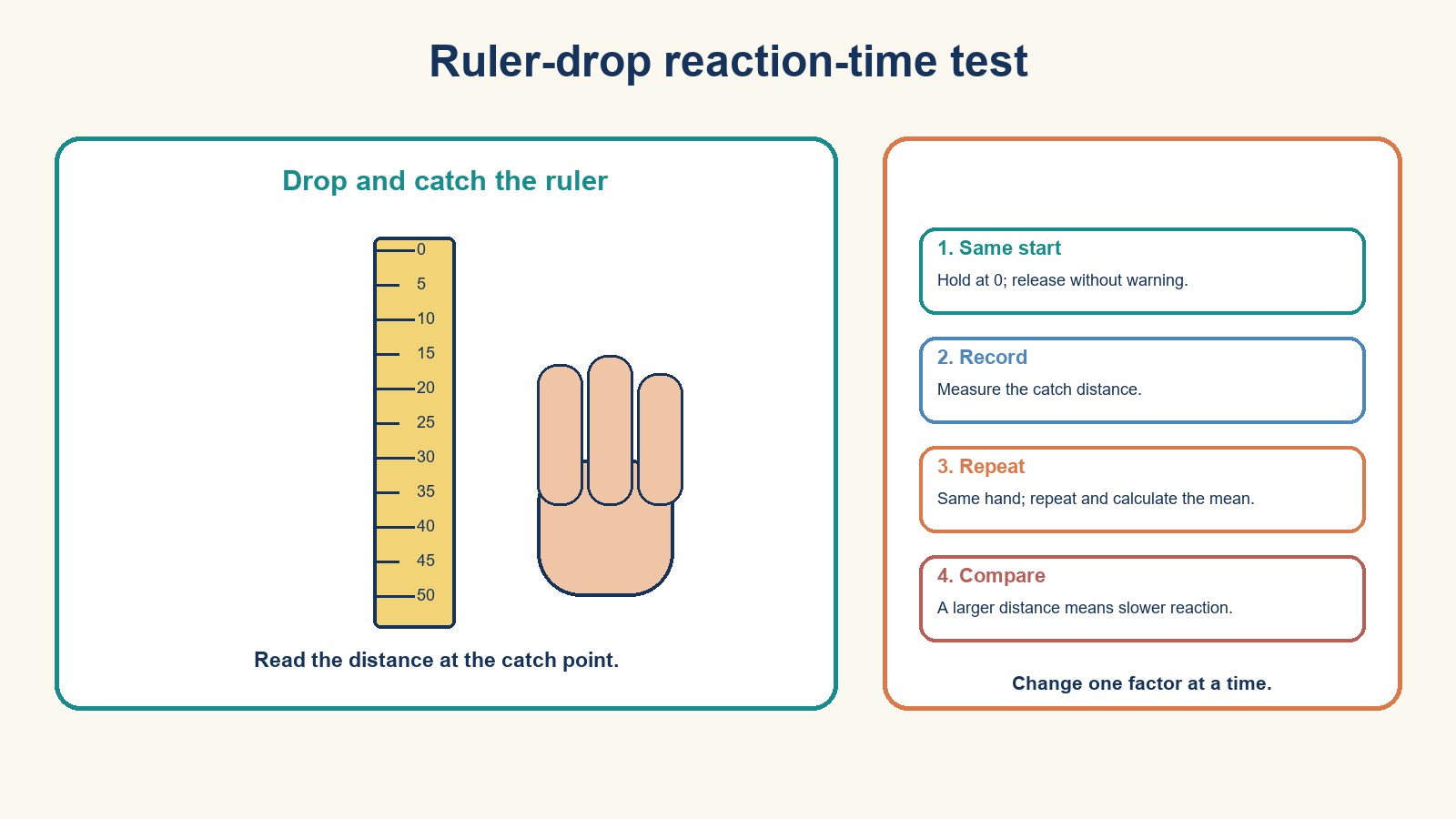
- Question: does being distracted slow down a person's reaction time? The ruler-drop test gives a simple measure. One person holds a ruler at the zero mark above the other person's open hand, drops it without warning, and the catch distance is read from the ruler. A longer catch distance means a slower reaction.
- The independent variable is whether the person is distracted (for example, answering questions or watching a screen). The dependent variable is the catch distance in cm. Control variables: the same ruler, the same hand, the same starting height, the same person doing the dropping and the same room.
- One catch could be luck, so do at least five trials for each condition and calculate a mean. If one result is far from the others (an anomaly), check what happened, repeat it, and say how you dealt with it.
- Catch distance can be turned into a time using the fact that the ruler falls with constant acceleration: time = square root of (2 x distance / 9.8), with distance in metres. For example, a catch at 20 cm means a reaction time of about 0.20 s.
- Inquiry task 1: plan an investigation into whether practice improves reaction time, and say how you would make the results reliable. Inquiry task 2: a student tests only one person, once with each condition, and concludes that distraction slows everyone down. Evaluate the method and the conclusion, and suggest two improvements.
The ruler-drop reaction-time test
Diapos
Sign up free to view the lesson slides
Step through every slide for this topic — plus flashcards and revision notes — with a free account.
Questions d'entraînement
Aperçu gratuit — 8 sur 50 questions. Inscris-toi pour toutes les voir.
1.Which two organs make up the central nervous system?
Easy- AThe eyes and the ears
- BThe brain and the spinal cord
- CThe nerves and the muscles
- DThe heart and the lungs
2.What is a receptor?
Easy- AA chemical that crosses a synapse
- BA muscle that carries out a response
- CA nerve that joins the brain to the spine
- DA cell or organ that detects a stimulus
3.An effector can be either a muscle or a gland.
EasyTrue or false?
4.Put the parts of the nervous pathway in the correct order.
Easy- Effector
- Stimulus
- Coordinator (CNS)
- Receptor
- Response
5.Which type of neurone carries impulses from a receptor to the central nervous system?
Easy- ASensory neurone
- BRelay neurone
- CEffector neurone
- DMotor neurone
6.Which type of neurone carries impulses from the CNS to an effector?
Easy- AReceptor neurone
- BRelay neurone
- CSensory neurone
- DMotor neurone
7.Match each part of the nervous system to its job.
Easy- Sensory neurone
- Relay neurone
- Motor neurone
- Receptor
- Connects sensory and motor neurones inside the CNS
- Detects a stimulus
- Carries impulses from the CNS to an effector
- Carries impulses from a receptor to the CNS
8.Complete the sentence.
EasyA nerve impulse is an ____ signal that travels along a neurone.
Unlock all 50 questions, flashcards & more
Crée un compte gratuit pour voir toutes les questions, les diapos, les cartes mémo et les notes de révision de ce thème.