Physical and chemical changes
Apprends en jouant
Réponds à ces questions pour gagner de l'énergie, puis pêche et explore. Sans compte.
Notes de leçon
Big idea: how matter changes
- Big idea (key concept): Change. Everything around us is always changing: ice melts, bread toasts, iron goes brown. Scientists sort these changes into two kinds so they can explain and predict them.
- Related concept: Transformation. In some changes one substance is transformed into a completely different one. In others the substance stays the same and only its form changes.
- Global context: Scientific and technical innovation. Chemists use reactions to make fuels, metals, medicines and materials. To do that they need to know exactly when a new substance has been made.
- A physical change changes the shape, size or state of a substance, but no new substance is made. Folding, tearing, melting and dissolving are physical changes.
- A chemical change (also called a chemical reaction) makes one or more new substances with different properties. Burning, rusting and cooking an egg are chemical changes.
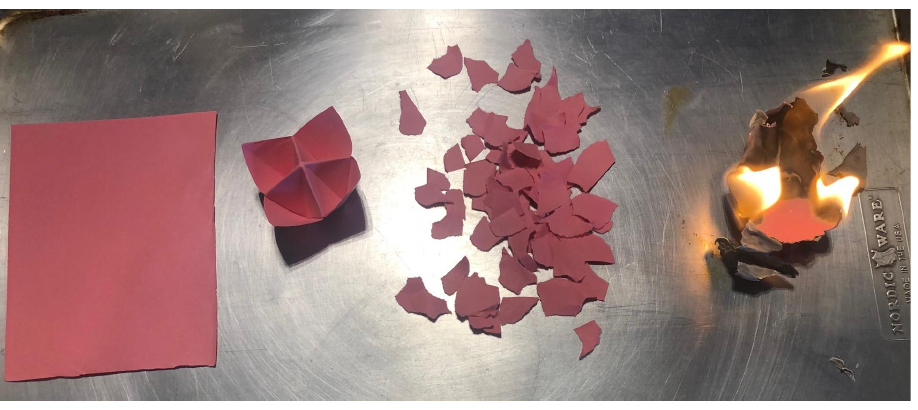
- Look at the paper: folding, tearing and crumpling only change its shape, but burning turns it into ash, smoke and gases. Those are new substances, so only burning is a chemical change.
Paper folded, torn, crumpled and burned
Physical changes
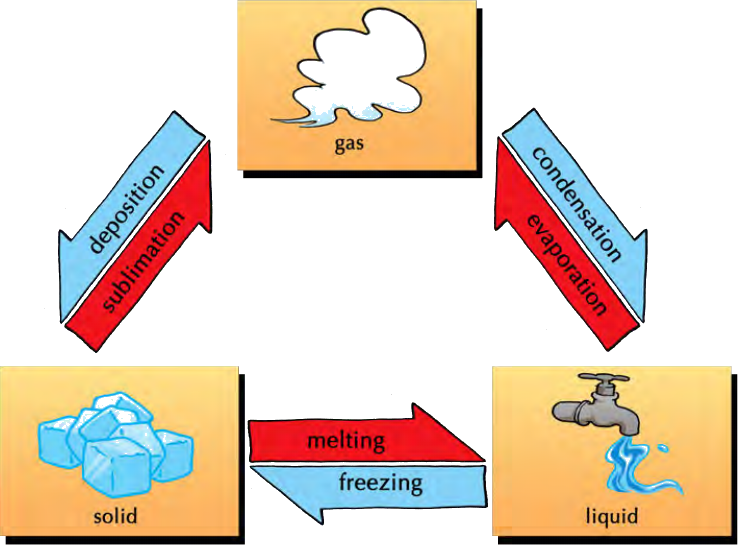
- Common physical changes are melting, freezing, boiling, evaporating, condensing, dissolving, cutting, bending and mixing.
- In a physical change the particles stay the same. Ice, liquid water and steam are all made of the same H₂O particles. Only the way the particles are arranged and how they move has changed.
- Many physical changes can be reversed. Freeze water and you get ice again. Evaporate salty water and the salt is left behind.
- Dissolving is a physical change. The sugar seems to disappear in your tea, but it is still there: the tea tastes sweet, and if you evaporate the water the sugar comes back.
- Energy is still involved. Melting takes in energy from the surroundings. Freezing gives energy out. This does not make a new substance, so it is still physical.
- The mass of the substance does not change in a physical change. Ice that melts weighs exactly the same as the water it makes.
Changes of state between solid, liquid and gas
Chemical changes and how to spot them
- In a chemical reaction the reactants (the substances you start with) are changed into products (the new substances). The atoms are joined up in a different way, so the products have different properties from the reactants.
- Chemical changes are usually hard to reverse. You cannot turn ash and smoke back into paper.
- Clues that a reaction may have happened: gas bubbles form, there is a colour change, a solid appears when two liquids are mixed (a precipitate), the temperature changes without anyone heating or cooling it, or there is light or a flame.
- A clue is not proof. Bubbles also appear when water boils, but that is just water changing into steam, which is a physical change. The strongest evidence is a new substance with different properties.
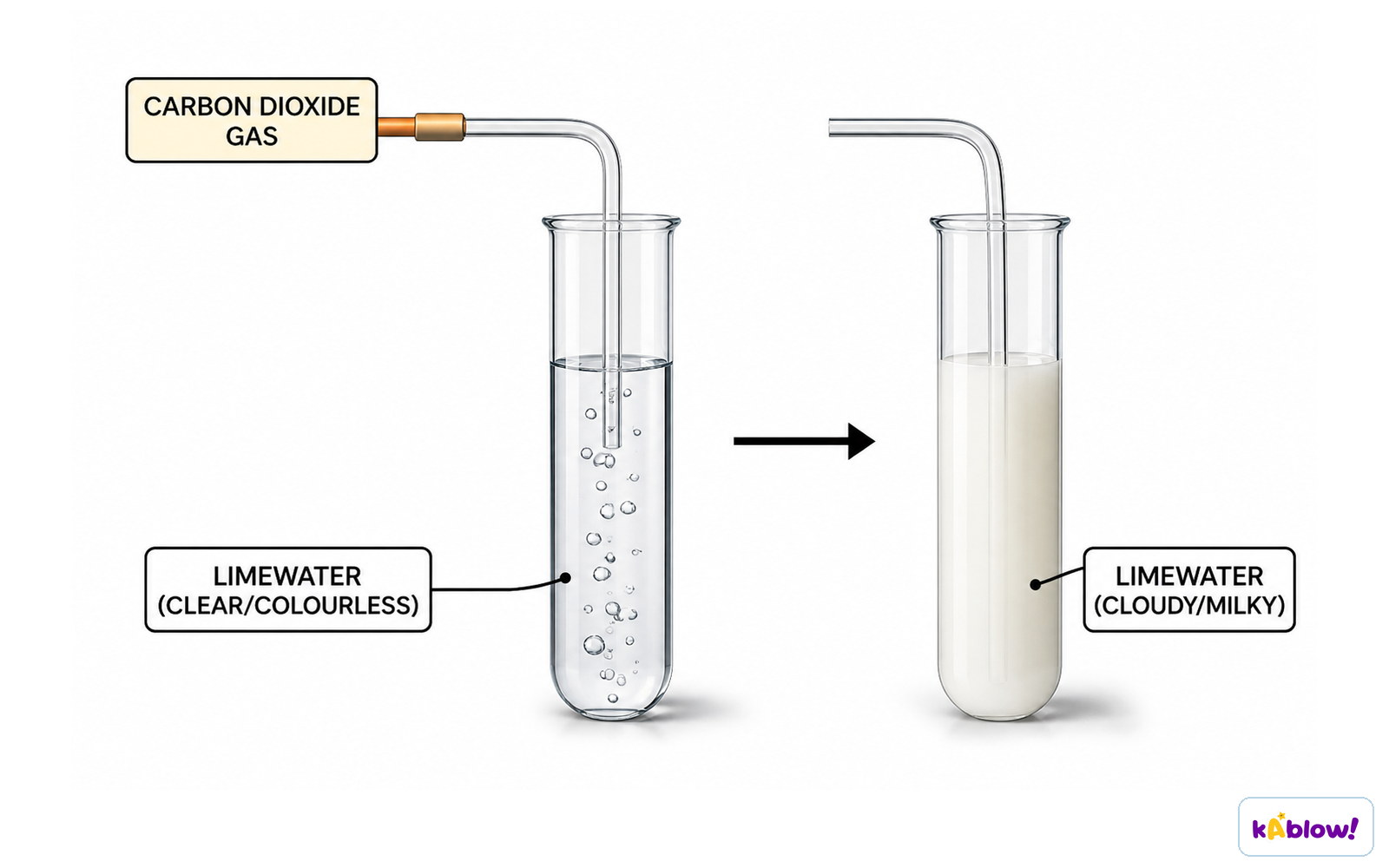
- Test for carbon dioxide: a teacher bubbles the gas through limewater, which is clear. If the gas is carbon dioxide the limewater turns milky. No other common gas does this.
- Stay safe: school reactions are teacher-run or follow school rules. Wear eye protection, never taste or sniff chemicals unless told to, and never mix cleaning products at home.
Carbon dioxide turns limewater milky
Word equations and conservation of mass
- A word equation shows a reaction in words: reactants → products. The arrow means 'react to make'. For example: carbon + oxygen → carbon dioxide.
- More examples: magnesium + oxygen → magnesium oxide. Methane + oxygen → carbon dioxide + water.
- In a reaction atoms are rearranged. They are not made and they are not destroyed. So the total mass of the products always equals the total mass of the reactants. This is conservation of mass.
- Example: 2.4 g of magnesium joins with 1.6 g of oxygen to make 4.0 g of magnesium oxide. Check: 2.4 + 1.6 = 4.0.
- Sometimes mass seems to change. If a gas escapes from an open container, the container gets lighter. If a gas from the air joins in, for example when iron wool burns, the solid gets heavier.
- In a sealed container nothing can get in or out, so the mass stays the same. That is how scientists show that the mass really is conserved.
A carbon atom and an oxygen molecule make carbon dioxide

Burning, rusting and thermal decomposition
- Combustion (burning) is a fuel reacting with oxygen and giving out energy as heat and light. Methane + oxygen → carbon dioxide + water. A fire needs three things: fuel, oxygen and heat. Take one away and it goes out.
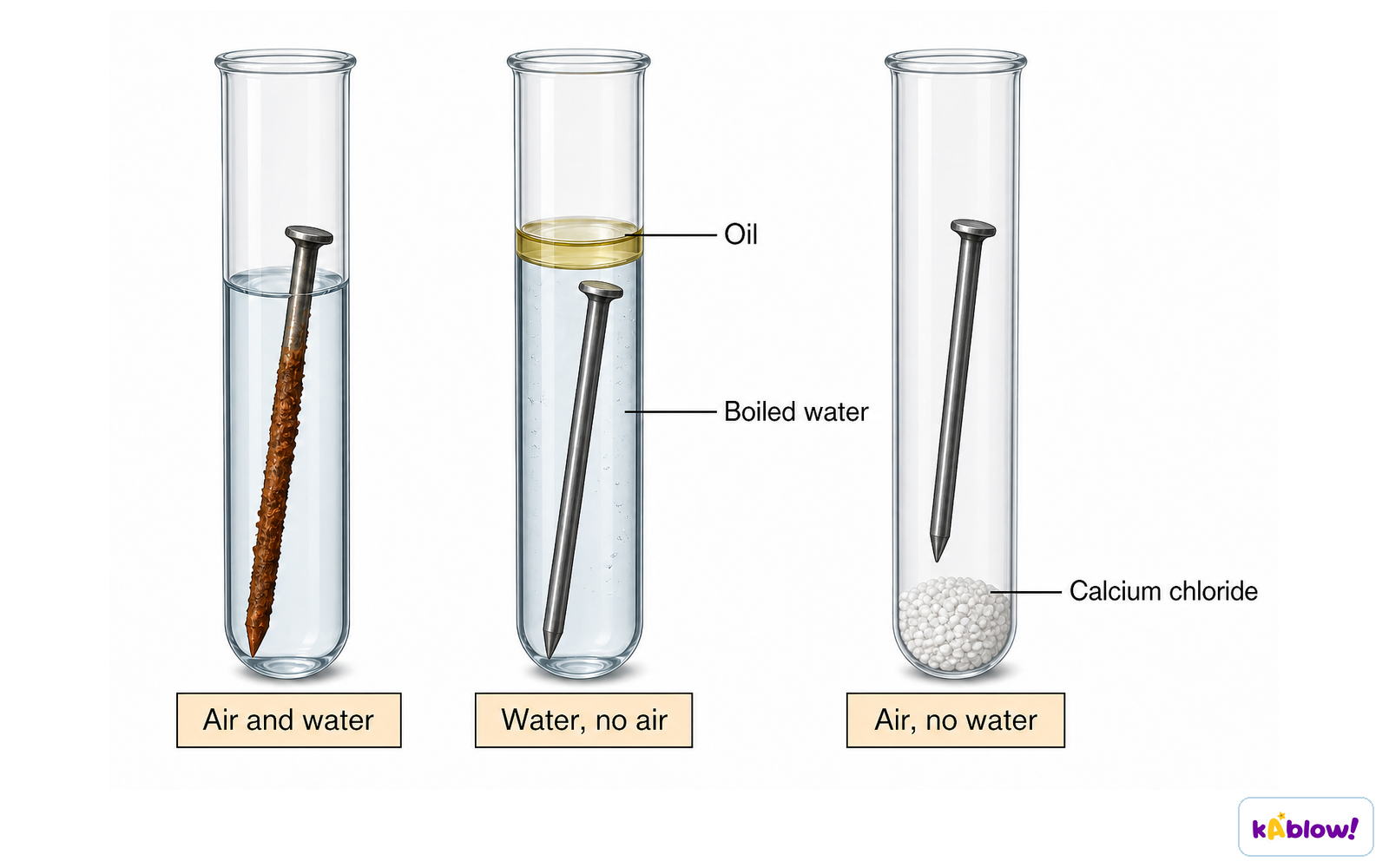
- Rusting is iron reacting slowly with oxygen and water: iron + oxygen + water → rust. It needs both. Salt in water makes it faster.
- To stop rusting, keep oxygen and water away from the iron with paint, oil, plastic or a coating of another metal such as zinc.
- Thermal decomposition is when heat breaks one compound into simpler substances. Calcium carbonate → calcium oxide + carbon dioxide. Green copper carbonate → black copper oxide + carbon dioxide. Teachers run these tests with safety equipment.
- An exothermic reaction gives energy out to the surroundings, so the surroundings get warmer. Burning and hand warmers are examples.
- An endothermic reaction takes energy in from the surroundings, so they get colder. Thermal decomposition needs a constant supply of heat, so it is endothermic.
Nails in air and water, water without air, and air without water
Think like a scientist: what makes iron rust faster?
- Question: does salt in the water make iron nails rust faster? A teacher sets up nails in tap water and in salty water and leaves them for a few days.
- The independent variable is the one you change on purpose: the type of water (tap water or salty water).
- The dependent variable is the one you measure: how much rust has formed, for example the percentage of the nail covered in rust after 5 days.
- For a fair test keep everything else the same: the size and type of nail, the volume of water, the temperature, the container and the number of days.
- Repeat with several nails in each liquid and take an average. One nail might be different from the rest.
- Inquiry task: plan an investigation to find out which of three coatings (paint, oil, nothing) protects nails best. State what you change, what you measure, three variables you will control, and how you will judge whether your results are reliable.
Diapos
Sign up free to view the lesson slides
Step through every slide for this topic — plus flashcards and revision notes — with a free account.
Questions d'entraînement
Aperçu gratuit — 8 sur 51 questions. Inscris-toi pour toutes les voir.
1.Which of these is a physical change?
Easy- AWood burning in a fire
- BIce melting into water
- CIron going rusty
- DMilk turning sour
2.What always happens in a chemical change?
Easy- AOne or more new substances are made
- BThe substance changes shape
- CThe substance gets hotter
- DThe substance becomes a liquid
3.When ice melts, what happens to the particles of water?
Easy- AThey turn into different particles
- BThey are destroyed
- CThey turn into oxygen and hydrogen gas
- DThey stay the same but move differently
4.Melting ice is a chemical change.
EasyTrue or false?
5.Burning a candle makes new substances.
EasyTrue or false?
6.Which of these is a clue that a chemical reaction may be happening?
Easy- AA solid is cut into smaller pieces
- BA liquid is poured into a different beaker
- CGas bubbles form when two liquids are mixed
- DSugar is stirred into water until it disappears
7.Which gas turns limewater milky?
Easy- AOxygen
- BCarbon dioxide
- CHydrogen
- DNitrogen
8.In the word equation magnesium + oxygen → magnesium oxide, which substance is a product?
Easy- AMagnesium oxide
- BMagnesium
- COxygen
- DBoth magnesium and oxygen
Unlock all 51 questions, flashcards & more
Crée un compte gratuit pour voir toutes les questions, les diapos, les cartes mémo et les notes de révision de ce thème.